Archive for May 2012


Austerity and stimulus in northern Europe

I want you to consider the following two northern European economies:

Country A had a deficit of 8.8% of GDP in 2011.   According to The Economist, only Egypt and Greece had larger deficits in 2011.   It has an unemployment rate of 8.2%, well above the natural rate.

Country B ran a budget surplus of 2% of GDP in 2011.  It has an unemployment rate of 7.3%, well above the natural rate.  A recent news article said the following about country B:

********** centre-right coalition government is being too tight-fisted with public finances that are likely to remain strong for years to come, a think tank charged with evaluating policy said on Monday.

The ********* Fiscal Policy Council, a state agency that evaluates government policy, said it saw little risk the country would breach spending ceiling rules in the coming years and instead urged the government to slacken spending constraints.

If you had to guess, which one would be practicing “austerity” and which one is engaged in “stimulus?”  I’m not going to tell you yet, but I’ll provide some quotations from Paul Krugman, and I want you to see if you can match them up with the respective countries:

I learn from Ezra Klein’s interview with Tom Coburn that Sweden, of all places, has become the new right-wing icon. I thought Europe’s woes were all about collapsing welfare states? But anyway, the story now is that Sweden has slashed spending and cut taxes, and is doing great; supply-side economics vindicated!

.   .   .

But Ezra didn’t challenge Coburn on the claim about spending cuts; why don’t we look at what Sweden has actually done, as opposed to the official right-wing line? Look, in particular, at actual government consumption “” purchases of stuff. Here’s Sweden versus the United States, from Eurostat:

Somebody has been practicing harsh spending-side austerity “” and it’s not Sweden.

OK, so Sweden’s not the mystery nation practicing austerity.  How about this one:

Jonathan Portes is angry, and rightly so. He points out that the Cameron government is systematically starving public investment:

There might conceivably be a justification for this policy if Britain were facing an intense cash squeeze. But it isn’t “” it’s able to borrow very cheaply, with near-zero real interest rates even on very long-term borrowing.

And given that public investment is, you know, productive, this is almost surely a case of self-defeating austerity:

Yes, tight-fisted Britain must be country B, and socialistic Sweden must be country A.  Wrong.  Britain had the massive deficit and Sweden is running a surplus.  I might add that the data Krugman presented has absolutely no bearing on the claims made by Senator Coburn.  He claimed spending cuts were made, and of course in countries like Sweden a big part of spending is transfers, not consumption.  Kind of unfair to ridicule someone, and then provide irrelevant evidence to back up your claim.

Now I’m sure a million Krugmanites will rush over here and tell me I have the data all wrong.  And they’d be right, every source I checked had different numbers.  I have no idea whether Sweden’s spending went up or down in recent years.  (Although I do know their debt to GDP ratio is falling, while those ratios are soaring much higher in the US and UK.)  But what difference does it make?  In the world of Keynesian economics spending can soar much higher, and they’d still insist that austerity is occurring.  If the Keynesians are to be believed we have savage cuts in government spending in America, despite data showing spending levels much higher than before the recession.  You can cut the numbers anyway you want, and get whatever result you want.  One of their favorite techniques is to explain away the high government spending by pointing to the depressed state of our economies, even though most private forecasters see this as the new normal, RGDP will never recover to the old trend line in either the US or UK.

But if you are not a committed ideologue on either side, just look at the data provided up top.  Does Country A really look like savage austerity?  Does country B look like a country engaged in fiscal stimulus?

In the post on Sweden Krugman also had this to say:

Ezra points out, rightly, that Sweden has actually benefited a lot from very aggressive monetary policy “” one of the original Princeton zero-lower-bound Group of Four, Lars Svensson, is now deputy governor of the Riksbank. (The others were Mike Woodford, yours truly, and a fellow by the name of Ben Bernanke).

Readers of TheMoneyIllusion were the first to find out about the Swedish monetary stimulus back in 2009.  But that begs raises another question.  Isn’t Britain also outside the euro?  If monetary stimulus makes fiscal stimulus unnecessary (and it does), then why would Britain want to do fiscal stimulus?  Why not just do monetary stimulus, and avoid the big deficits?  After all, just the other day didn’t Krugman say that there’s no argument at all for fiscal stimulus when monetary stimulus is available?  Yes he did.  And now he’s (correctly) attributing Sweden’s relative success to monetary stimulus (it sure wasn’t deficit spending!)

Some might argue that the BOE is stubborn like the Fed, they’ll refuse to raise their inflation target, or switch to NGDP targeting, and that these are the only routes to success when near the zero bound.   But wait, in Britain I thought the target was set by the government, not the BOE?  Why not instruct the BOE to set a higher inflation or NGDP target?

Just to be clear, I’m not saying there aren’t good arguments for the BOE keeping a 2% inflation target.  I don’t agree with those who support this target, but it’s an intellectually respectable argument.  But only a complete lunatic would argue that the Cameron government should refuse to boost the inflation target above 2%, but then engage in fiscal stimulus which can only work by boosting inflation! That’s like shifting your car into neutral, than flooring the accelerator. They’d have to be complete masochists; “Let’s spend lots of money, run up a huge debt, and then watch the BOE sabotage our policy.” 

PS.  Krugman acts like he just discovered the growing right-wing love affair with the Nordics.  And yet over a year ago the Heritage Foundation rated Denmark more economically free than the US.  If Krugman were smart he’d march right down to the Heritage Foundation and demand they join him in calling for Congress to scrap the US economic system and replace it with the Danish system.  I’m sure Krugman would go for that idea, but how about the Heritage Foundation?
When will China catch up to Mexico?

Here’s Alex Tabarrok:

Simply put, Chinese institutions are not as good as those in say Mexico. Thus, China will not overtake Mexico in terms of GDP per capita any time soon, hence Chinese growth rates will fall. All we are seeing today is the logic of the Solow model in action.

Let’s start with where I agree:

1.  Mexico’s per capita income is currently much higher than China’s.  Thus if ‘soon’ means “in a few years” then China is unlikely to catch up soon.

2.  China’s been growing at about 10% a year for more than 30 years.  Hence growth is likely to slow; indeed it’s probably slowing already.

3.  Good institutions are crucial in economic development.

And yet . . . I still don’t feel comfortable with Alex’s claim.

1.  Institutional reform has been the key to China’s development.  Its current institutions are vastly better than those of 15 years ago, which were vastly better than those of 30 years ago.  Because institutional reform has driven China’s growth, it’s not obvious why Alex would be pessimistic about China catching up to Mexico.  Is there some reason to suspect that institutional reform will suddenly stop?

2.  Even if China’s institutions remain inferior to those of Mexico, it’s not obvious to me that China can’t catch up economically, as other factors also matter.  Here I’ll have difficulty making an argument, because good institutions are hard to measure.  One metric that many cite is the Heritage Foundation’s Index of Economic Freedom.  Frequent commenter Statsguy pointed out that, despite its name, this index is actually more about good governance than “freedom.”  In the 2011 rankings Chile scores well above Taiwan, and yet Taiwan is more than twice as rich as Chile.  What does that prove?  Perhaps very little.  But it does suggest to me that it’s quite possible for an ethnic Chinese country to be far richer than a Latin American country, despite having inferior institutions.  (And fewer natural resources as well.)

Now of course there are lots of reasons to doubt whether China will actually catch up.  It’s institutions are far inferior to those of Taiwan.  And as the two Koreas show, ethnic similarity doesn’t always transfer over to institutional similarity.

But my hunch is that China will catch up to Mexico fairly soon, if ‘soon’ is defined as a couple decades rather than a couple years.  That’s mostly because I expect institutional change to continue in China, albeit at a slower pace.  PPP estimates are very tricky between countries as dissimilar as China and Mexico, but in purely nominal terms Mexico’s about twice as rich.  If I had to guess I’d estimate that the nominal gap will completely close at some time during the 2020s.  That will occur for three reasons; faster Chinese per capita RGDP growth, slightly higher inflation, and a nominal appreciation of the yuan against the peso.

Those that find this implausible might consider the following.  Mexico is a mature, slow growing country that seems stuck in the middle income trap.  China is a hodgepodge of some regions that got an early start, and more importantly, vast interior regions that could achieve massive growth without any further economic reform.  Thus China has the momentum to achieve quite a bit more growth merely by bringing areas like Sichuan up to the levels of development already achieved in coastal areas like Zhejiang.  In principle Mexico might do the same, but it shows no signs of doing so.  In contrast, growth rates in the interior of China are already soaring above the coastal regions, suggesting the catch-up process is fully underway.  And that’s not to mention the vast rural to urban migration that will help power Chinese growth for years to come.  There are reasons why China’s growing faster than Mexico right now (despite a slowdown this year) and those reasons aren’t going to suddenly vanish.

PS.  In 1996 I flew from Kunming, China to Chang Mai, Thailand.  It was immediately obvious that Thailand was much, much richer.  And it was.  I also recall thinking to myself that China would catch up soon.  And now it has, despite inferior institutions.   (I should clarify that it has caught up in nominal terms, it still lags slightly in PPP terms.)

Update: Marcus Nunes has a recent post showing how protectionism in Brazil contributed to their falling behind the Asian tiger economies.

Giles Harvey on Geoff Dyer on Stalker

When I was young I saw the Tarkovsky film Stalker several times.  What I remember most is a scene with rippling sand, which even today is seared into my brain—one of the most astonishing images in a lifetime to film-going.  (I’ll have more to say on this image at the end.)   Geoff Dyer has an interesting new book on the experience of watching Stalker:

The prominent place occupied in my consciousness by Stalker is almost certainly bound up with the fact that I saw it at a particular time in my life.   I suspect it is rare for anyone to see their—what they consider to be the—greatest film after the age of thirty. After forty it’s extremely unlikely. After fifty, impossible. . . . To try to disentangle their objective merits or shortcomings, to see them as a disinterested adult, is like trying to come to a definitive assessment of your own childhood:  impossible because what you are contemplating and trying to gauge is a formative part of the person attempting the assessment.  Gradually, usually in your late teens and early twenties, you start to watch the major works of the medium.  At first it is difficult to make sense of these alleged masterpieces: they are too difficult, often too boring and challenging.

.  .  .

I saw Stalker slightly later but I saw it when it came out, within a month of it’s release, when Tarkovsky was at his artistic peak.  I saw it, so to speak, live. And this means that I saw it in a slightly different way from how a twenty-four-year-old might see it for the first time now, in 2012. . . . Obviously the difference is not as acute as it would be if you saw a band today who were at their peak twenty years ago.  The thing, the product, the work of art stays the same but by staying the same it ages—and changes.  It exists now in the wake of its own reputation, not quite in the way Citizen Kane does, not only as a monument to itself, but trailing clouds in its own glory.  And it exists also in the wake of everything that has come in its wake, both the films that have been influenced by it (that’s why Citizen Kane is both ageless and incredibly old-looking; practically everything seems to have come after it) and the ones that treat it with tacit disdain and contempt (Lock, Stock, and Two—tediously—Smoking Barrels).

Here’s Giles Harvey reviewing Geoff Dyer’s book:

What we gradually come to realize is that Dyer is using Tarkovsky’s film rather as John Ashbery used Parmigianino’s Self-portrait in a Convex Mirror in his famous poem of the same name””not as an object for cool critical dissection but as the occasion for thought, as a point of departure for a series of messy digressions on life, art, time, memory, and””lest we forget””cinema. That is to say, Zona is a kind of autobiography by other means.

Amazingly, the book is not only readable, it is hard to put down. A bit like “Reader’s Block” in his Otherwise collection, Zona turns out to be an elegy for a youthful intensity of responsiveness that Dyer knows has faded and cannot come again. “The time when I might have been able to read late-period Henry James has passed,” he writes in one of his glum, self-punishing sentences,

“and because I have not read late-period Henry James I am in no position to say what harm has been done to my sensibility by not having done so. But I do know that if I had not seen Stalker in my early twenties my responsiveness to the world would have been radically diminished.”

.   .   .

Although the book forgoes the conventions of plot, it still is remarkably suspenseful; for much of the time we have literally no idea what is going to happen next. One moment Dyer is describing the grand climactic scene when the three men in Tarkovsky’s film finally make it to the Room and are about to be granted their deepest wishes; the next, he’s telling us about his own deepest wish, or as he prefers to think of it, his deepest regret, “one I share with the vast majority of middle-aged, heterosexual men: that I’ve never had a three-way, never had sex with two women at once.” And we are not denied a thorough examination of the various times in Dyer’s life when he came within a hair’s breadth of realizing his wish. It is this ironic incongruity, between Tarkovsky’s grandeur and Dyer’s carnal waywardness, that finally makes Zona, for all its formal shenanigans, such an engaging, human, and oddly traditional book. We all know what it is like to feel indebted to, and inadequate before, a towering work, but few people have ever described that feeling with the ingenuity or the candor of Dyer.

Toward the end of the book, Dyer confesses that after spending so much time with Stalker, “I might never want to set eyes on it again; after this, I might have laid it to rest for good.” What comes through in both Zona and Otherwise, even more than Dyer’s intellectual promiscuity, is the degree to which he has kept faith with a single urgent theme: namely, the half-life of our passions, the way in which the thing that thrills us one day””a novel, a piece of music, a city, a love affair””may bore us to tears the next. He understands the painful asymmetry between our desires and life’s ability to satisfy them, but this understanding doesn’t dull his appetite, it quickens it. His books and articles are a sad, funny, and instructive record of this insatiable hunger for life.

Borges once remarked:

Music, states of happiness, mythology, faces belabored by time, certain twilights and certain places try to tell us something, or have said something we should not have missed, or are about to say something; this imminence of a revelation which does not occur is, perhaps, the aesthetic phenomenon.

To feel the imminence of that revelation, one must in some sense believe it’s there, or at least suspend one’s disbelief.  That gets harder over time.  Each new experience is like another nail in the coffin.  Fortunately I’ll probably be dead long before I’ve completely exhausted my ability to believe that paradise lies in the next room, or book, or foreign country.  Later today I’ll see Ceylan’s new film.  He’s one of the few directors that still gives me hope.  Wish me luck.

PS.  About that rippling sand.  The quotation at the beginning is just a small part of a 4 page footnote to Geoff Dyer’s discussion of the rippling sand:

In any case, this slight interlude of ennui is cut short by what comes next: a shot of the muddy expanse of the Zone, dry-looking but rippling–quicksand perhaps.  Whatever it is, this quicksandy stretch of dry muddiness or muddy dryness ripples exactly as it does in the early stages of an LSD trip, when the external world takes on some of the internal rhythms of the body, its breath and pulse.  (This, apparently, was from the rejected version of Stalker, shot by Rerberg, one of the two such sequences to have made their way into the released version.)

I almost gasped on reading this, because back a few pages (in a 5 page footnote!), I had read the following:

What happened was that approximately half of the film had been shot (and two-thirds of the money spend) in Tallinn, Estonia  . . . when it became obvious  .  .  .  that there was a fault, either with the experimental Kodak film that had been used or with the way it had been stored or processed.

.   .   .

A new director of photography, Leonid Kalashnikov, took over from Rerberg. . . . Kalashnikov was replaced, in turn, by Aleksandr Knyazhinsky, who shot the final version.  It’s impossible to know of the exact extent to which this version differed from the old and damaged one (preserved by the editor Lyudmila Feiginova, in her apartment before she and the film perished  in a fire).  Tarkovsky’s assistent, Maria Chugunova, says that they were ‘almost visually identical’.  Tsymbal thought that Rerberg’s footage was ‘extraodinary’ and ‘included astonishing effects.’

I’m not sure if Stalker is enriched or diminished by the thought that somewhere in time-space exists a sort of Platonic ideal of Stalker.  In any case, from now on every time I watch Stalker I’ll visualize the Room as containing the Rerberg version of Stalker, with all its astonishing effects.

Update: Once Upon a Time in Anatolia was outstanding, probably my favorite film by Ceylan.

Shall we target inflation with fiscal policy?

Most Keynesians seem to think that fiscal policy influences AD and inflation, even when rates aren’t stuck at the zero bound.  This recent article from The Economist illustrates the conventional Keynesian view:

Even the lower estimates could easily be enough to tip the economy back into recession. Mr Greenlaw says the closest precedent was in 1968, when individual, corporate, excise and payroll taxes collectively rose by the equivalent of 3.1% of GDP, mostly to pay for the Vietnam war and to damp down inflation. The next year, the economy fell into recession.

Paul Krugman is certainly not a conventional Keynesian; he’s quite dismissive of this sort of old Keynesian reasoning:

People in my camp have repeated until we’re blue in the face that the case for fiscal expansion is very specific to circumstance “” it’s desirable when you’re in a liquidity trap, and only when you’re in a liquidity trap.

In the case of the 1968 tax increases it looks like Krugman is right and Greenlaw is wrong.  America experienced 3.1% inflation in 1967.  After taxes were raised, inflation rose to 4.2% in 1968, 5.5% in 1969, and 5.7% in 1970.  So much for “damping down inflation.”  Indeed this was one of the key stylized facts that led to the resurgence of monetarism in the 1970s, often cited by Milton Friedman.  You can’t stop inflation by balancing the budget, only monetary restraint is effective.  And we had to wait until mid-1981 for a serious effort on that front. Krugman knows this history, and understands that monetary policy drives the economy when we aren’t at the zero bound.

[The very mild recession that began at the end of 1969 might have partly reflected the worsening supply-side condition of the US economy, along with catch-up wage increases as the Phillips Curve shifted right.]

Krugman has a nuanced approach to the question of fiscal vs. monetary policy, which can occasionally go right over the heads of his readers.  I bet lots of his fans nodded their heads when reading the quotation I just provided, not realizing that “my camp” might consist of not much more than one member.  If  I’m not mistaken Joe Stiglitz is much more typical of the Keynesian camp, and he certainly thinks there’s a case for fiscal stimulus when not at the zero bound.

Here Krugman criticizes British austerity:

And given that public investment is, you know, productive, this is almost surely a case of self-defeating austerity: by shortchanging infrastructure now the Cameron government is saving only a trivial amount on interest payments while reducing long-run growth and hence revenues.

Previously I’ve argued that there isn’t much austerity in Britain—in 2011 their budget deficit was nearly the largest in the world.  But the bigger problem is monetary policy, which seems committed to targeting some combination of inflation and NGDP growth.  Either way, fiscal stimulus is ineffective in the UK, as it’s offset by the BOE doing less unconventional monetary stimulus.

There are times where Krugman seems to acknowledge that monetary stimulus is needed to boost inflation.  At least I think he does—see what you think:

At this point an argument that was once considered way out there “” that euro area adjustment won’t be possible unless the inflation target is raised “” now has widespread support, albeit not from the crucial players. Inflation significantly above 2 percent is almost surely a necessary (though not sufficient) condition for the euro to survive.

So what’s happening to euro inflation expectations? We can look at the German breakeven “” the difference in yields between German bonds, presumably viewed as safe, and yields on German bonds indexed to euro area inflation. This currently points to an expected inflation rate over the next 5 years of 1.3 percent “” way too low to make euro survival feasible.

So how has that breakeven evolved over time?

.   .   .

And what happened in April 2011? The ECB hiked rates, even though it was obvious that the rise in inflation was a temporary blip driven by commodity prices. This was a clear signal that the price stability obsession was as strong as ever. And it has meant, in the end, a loss of hope.

This is exactly right.  But what exactly is Krugman saying here?  How should Europe raise inflation?  Should they use fiscal stimulus, or monetary stimulus?  Krugman would support either approach.  But unless I’m mistaken he’s referring to the ECB in this post—they are supposed to set a higher inflation target.   Now look at what he said just a day earlier:

Simon Wren-Lewis argues that if we’re up against the zero lower bound but are uncertain about the size of the output gap “” how far the economy is operating below potential “” we should deliberately overreach on fiscal policy. Why? Because monetary policy can correct any excess stimulus, but not an inadequate stimulus.

Krugman’s fans will suggest I don’t understand, he thinks monetary stimulus is worth a try, but supports fiscal stimulus because he doubts both the willingness of the monetary authority to stimulate, and the effectiveness of monetary stimulus at the zero bound if they did.

I don’t believe fiscal stimulus can do very much, even at the zero rate bound.  But if I thought it could, and if I thought higher demand was needed, I’d recommend that the fiscal authorities raise their inflation target from 2% to 4%.  Oddly, I’ve never seen a fiscal proponent make that recommendation.  Why not?  My hunch is that deep down they know that fiscal authorities can’t really control inflation.  But in that case, how can they control aggregate demand?

BTW, Marcus Nunes has constructed an excellent graph that shows why I’m skeptical of fiscal stimulus:

It sure looks like the Fed is trying to steer the economy.

Evan Soltas provides the best argument for NGDP targeting

When Evan Soltas first asked me to add his blog to my blogroll, I politely declined.  I thought it was cute that a high school senior was attempting blogging, but come on, let’s be serious.

Big mistake.  Unfortunately, his blog is so consistently good that it can no longer be ignored.  A few days ago Evan provided six arguments in favor of NGDP targeting.  Nick Rowe pointed out that the sixth (which Evan thought up himself) was a sort of refutation of Schumpeterian economics.  Evan follows up with a post that quotes from an appalling piece in the Boston Globe:

Today, few mainstream economists share Schumpeter’s belief in the unerring regularity of business cycles. And some point out that there’s plenty of room for creative destruction when the economy is strong – witness the turmoil over the past few years in the music industry, or the airlines, or, for that matter, the newspaper industry.

Economists do agree, however, that recessions help to right economies that have lost touch with reality. Recessions not only cull unhealthy companies, they expose financial gimmickry. They punish groundless optimism and the rampant speculation it feeds – in fanciful Internet ventures in the 1990s, for example, or in housing over the past few years.

Economists do agree?!?!?!?  God I hope it’s not so.  Evan criticizes the Globe article and then cites Robert Lucas’s 1972 paper that looked at business cycles as a signal extraction problem.  Evan concludes the post with this gem:

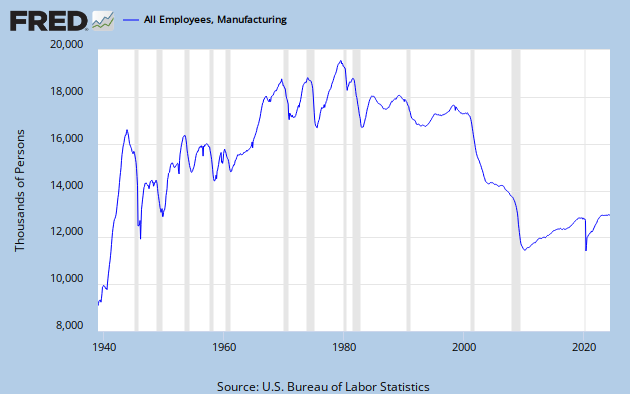
If you don’t believe the idea that firms in pool A have imperfect information, try it yourself. Here’s a simple case: the level of employment and the number of firms in the manufacturing industry have been in secular contraction in the United States for decades. However, since 2008, there has been unusual employment growth in manufacturing. To what extent does this reflect cyclical conditions, given that the 2008 recession was very deep and eliminated a large fraction of manufacturing jobs in the United States? To what extent, conversely, does it represent a secular recovery in that industry? The fact that any answer would contain a significant amount of uncertainty means that firms in the first pool face a signal extraction problem under conditions of imperfect information.

By this logic, which embraces as did Schumpeter the central importance of creative destruction, recessions do not assist the process. In fact, by corrupting the signal by which firms decide to enter or exit industries, recessions make the creative destruction process slower, less efficient, and more costly.

When I was his age . . . well I’d rather not even think about how far behind I was.  I got a C in freshman English at Wisconsin, and I can’t even imagine how badly written my blog posts would have been back then.  For some odd reason Evan reminds me of a younger Mankiw, or a younger Mishkin.  I took a class from Mishkin in the 1970s, and also briefly met Mankiw many years ago.  Both seemed like young men on the fast track to great success—possessing that mysterious intangible that I never seemed able to find.  When I was young I had some personal “issues” (I believe the clinical term is “complete loser.”)

But enough about me, I’d like to now explain the title of this post.  No, the best argument is not the 6 points listed by Evan, although they provide an excellent argument for NGDP targeting.  Instead, the best argument is that Evans Soltas is attracted to the idea.  Unlike all us older economists who come to the table with all sorts of ideological and methodological baggage, Evan is able to look out over the macro landscape like a diner examining a beautiful buffet table.  And what sort of framework seems most appealing to the best and the brightest of generation Z?  NGDP targeting!  I’d make the same claim about Matt Yglesias, another extremely bright blogger who approached this issue as an outsider (he’s got a philosophy background.)  The NGDP approach provides an intuitively appealing framework for what’s gone wrong since 2008, and what needs to be done to fix it.

Recently I had dinner with a co-author of one of the popular intro textbooks.  We discussed various ideas (he was interested in my market monetarist approach.)  When I explain my AS/AD ideas his eyes really lit up.  I argued that no intro student can possible understand the “3 reasons” why the textbook AD curve slopes downward (I forgot about Evan) and that it should be replaced with a rectangular hyperbola representing a given amount of nominal expenditure.  THIS is what we mean by aggregate demand; no other definition matches our profession’s fixation on the classical dichotomy—the idea that nominal shocks affect both prices and output in the short run, but only prices in the long run.  Call it the NE curve (nominal expenditure) and explain to students that macro’s mostly the study of how nominal changes get partitioned between prices and real output.

And this is also why people like Jan Hatzius, Brad DeLong, Christy Romer and to a lesser extent Paul Krugman are all drawn to NGDP targeting.  Once you start thinking in NGDP terms, it’s hard to go back.  It’s just so damn intuitive.

So the fact that Evan Soltas, likely winner of the 2030 John Bates Clark award, is drawn to NGDP targeting is an incredibly positive sign, and dare I say not just for the policy itself, but also for the market monetarist group that championed the policy when almost no one was paying attention to the collapse in NGDP.

Part 2.  Did base growth help during the Great Depression?

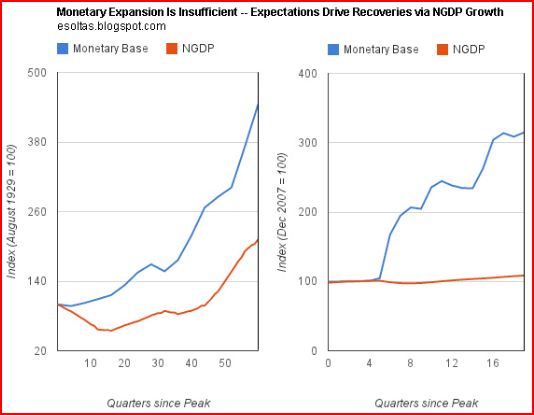
Since I’ve heaped so much praise on Evan, it’s time to mildly criticize one of his recent blog posts.  In this post Evan provided some graphs:

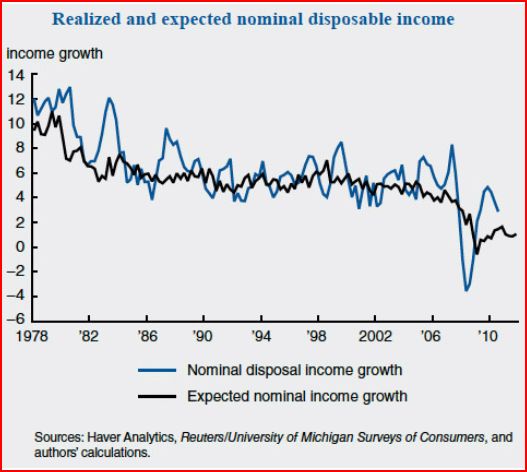
And then added these comments:

The first graph shows that even the most massive amounts of monetary expansion are ineffective medicine for NGDP expansion. What matters is expectations; growth in the medium run is conditional on expectations — not on the monetary base or price level.

The second graph shows the extent to which monetary policy seems to have forgotten this. Nominal income growth expectations have been right at zero since the recession, when before that they had been stable at the 5 percent level for decades. The findings come from this study by the Chicago FRB, which I found through this Chicago Magazine article. Paging Scott Sumner…

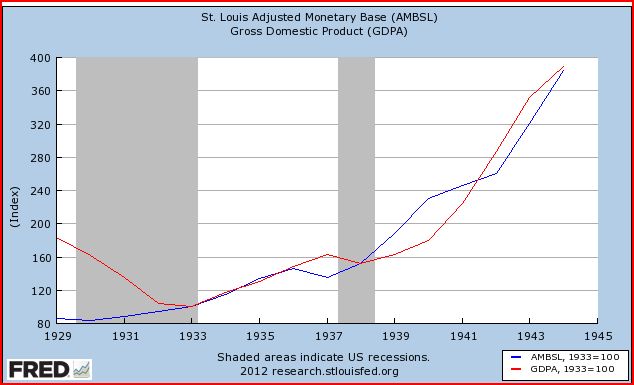
I mostly agree, and very much like the second graph, but I’d like to slightly quibble with the first graph.  I redrew it setting both the base and NGDP equal to 100 in 1933, not 1929:

Notice that the base rose in the early 1930s while NGDP fell sharply.  That’s because base demand was engorged by two factors, banking distress and ultra-low interest rates.  The ultra-low interest rates continued between 1933 and 1944, but banking distress fell sharply after dollar devaluation and the creation of FDIC.  Thus after 1933 the base and NGDP rose at roughly similar rates, both nearly quadrupling over those 11 years.  As you know, I don’t regard the base as a reliable indicator of the stance of monetary policy, because base demand can be highly volatile under certain conditions.  But the supply of base money is still very important; indeed it’s the major factor driving NGDP over the long term.

Of course things get even more complicated when you add interest on reserves, and when base injections are viewed as temporary.  So I certainly endorse Evan’s argument that it’s NGDP expectations that we should focus on, not the monetary base.  But we shouldn’t forget that those NGDP expectations are themselves driven by beliefs about expected long run path of the monetary base (and perhaps IOR.)