Random articles

1. In many ways, the UK resembles the US. This is not one of them:

Despite its reputation as a hotbed of metropolitan liberalism, London is the most devout place in the country. One in four attends a religious service in the city each month, compared with one in ten outside the capital.

2. From Al Jazeera:

When Eriko Sairyo, a 30-year-old professional who lives in Shizuoka, Japan, saw that American pop singer Gwen Stefani was being accused of “cultural appropriation” in Western media, she couldn’t understand the controversy. . . .

“I don’t have any issues when, for example, foreigners wear kimono and walk around Kyoto for sightseeing. I actually love it that people love our culture.”

In an interview with Allure magazine published last week, Stefani, 53, sparked outrage across English-language media and social media with remarks expressing the deep sense of connection she feels with Japanese culture. . . .

Media outlets including CNN, The Guardian, CBS, ABC, NBC and Buzzfeed picked up the interview and resulting social media firestorm, while notably omitting any reference to the views of Japanese people themselves.

But why would anyone care what the Japanese people think of Westerners appropriating their culture? All that matters is the views of highly educated Westerners on Twitter. Right?

3. It turns out that the KKK arrived at “progressive” views on education even before the left:

“Throughout the boom years of the early 1920s,” the historian ​Adam Laats notes in a 2012 History of Education Quarterly article, “every local Klan group made education reform a leading goal of its public activism.” Eventually, Laats writes, a push for compulsory public schooling overseen by a federal cabinet agency became the “linchpin” of the organization’s agenda.

Why the Klan’s sudden interest in education policy? First and foremost, because of the KKK’s virulent nativism and anti-Catholicism. Most private schools at the time were associated with the Catholic Church, while most public schools were openly, if unofficially, Protestant. By requiring all children to attend the latter institutions, Klan members thought they could strip Catholic parishes of an income source, reduce the Catholic hierarchy’s ability to indoctrinate the next generation, and secure their own right to inculcate values instead.

In 1979, they finally got their Department of Education. Of course once desegregation became an issue, the attitude of Southern racists toward the public schools turned on a dime.

4. How does one become the first person to lose $200 billion? Easy:

Step one: Become the world’s richest man by selling cars to Democrats.

Step two: Spend months engaging in non-stop lame twitter jokes that ridicule Democrats.

Step three: Start censoring political speech that threatens your business interests, exposing yourself as a phony.

Easy come, easy go.

5. Just how obsessed have Republicans become with conspiracy theories? In the past, Republicans would defend themselves by pointing to nutty Democratic conspiracy theories, such as the idea that 9/11 was an inside job by the Bush administration. Today, however, Republicans are more likely than Dems to believe in silly 9/11 conspiracy theories, even though these theories implicate their own party!

6. Bloomberg suggests that China’s behavior has improved in recent months, and . . . surprise, surprise . . that’s a “problem” for the US:

China Is Trying to Play Nice, and It’s a Problem for the US

I suppose if you are determined to have a cold war with a country, then it’s a “problem” if their behavior improves.

7. Ron DeSantis’s attempt to become Censor in Chief is not going well:

Florida last year passed the Stop WOKE Act, which attempts to censor how schools and even private businesses teach about race, prohibiting the inclusion of the various ideas connected to Critical Race Theory. The law is being challenged by multiple parties in court as an unconstitutional abridgment of the First Amendment. It’s not going well for Florida. An injunction has halted enforcement of the business component of the law. Another injunction has halted enforcement of the law against college professors, with one federal judge describing the law as “positively dystopian.”

8. Meanwhile, the left is destroying what’s left of NYC’s school system:

When then-Mayor Bill de Blasio and the entire New York City political and educational establishment unveiled in September 2018 a trailblazing new middle-school Diversity Plan that radically changed the admissions criteria for Brooklyn’s District 15 in the name of racial “equity,” they chose the most symbolic possible site for the announcement: M.S. 51, the William Alexander School, in progressive (and prosperous) Park Slope. . . .

After sending 122 kids to the elite schools in both 2018 and 2019, William Alexander has nose-dived down to 52. Once among the top four feeder schools in the city, M.S. 51 is now tied for 16th. And it’s not just the smart kids suffering.

Seventh-grade math proficiency scores at the school have collapsed from 81 percent in 2019 to 48 percent in 2022, with double-digit declines among each of the four racial groups that the DOE tracks. This cannot be explained away by pandemic learning loss; Manhattan’s District 2, which is consistently the second-largest feeder into the specialized high school, saw very little decline over the same period.

9. I’ve always regarded NYC’s subway system as the world’s worst. But I must grudgingly admit that this looks very impressive.

10. I’m bored with Trump, but if you insist.

11. Almost all of America’s densest urban areas are in California. (LA is denser than NYC, if you evaluate entire metro areas including suburbs.)

California, with the densest urbanization, has 70 of the 100 densest urban areas. California also has 35 of the 43 urban areas (81%) with population densities exceeding 5,000. California has the three densest urban areas with more than 500,000 population.

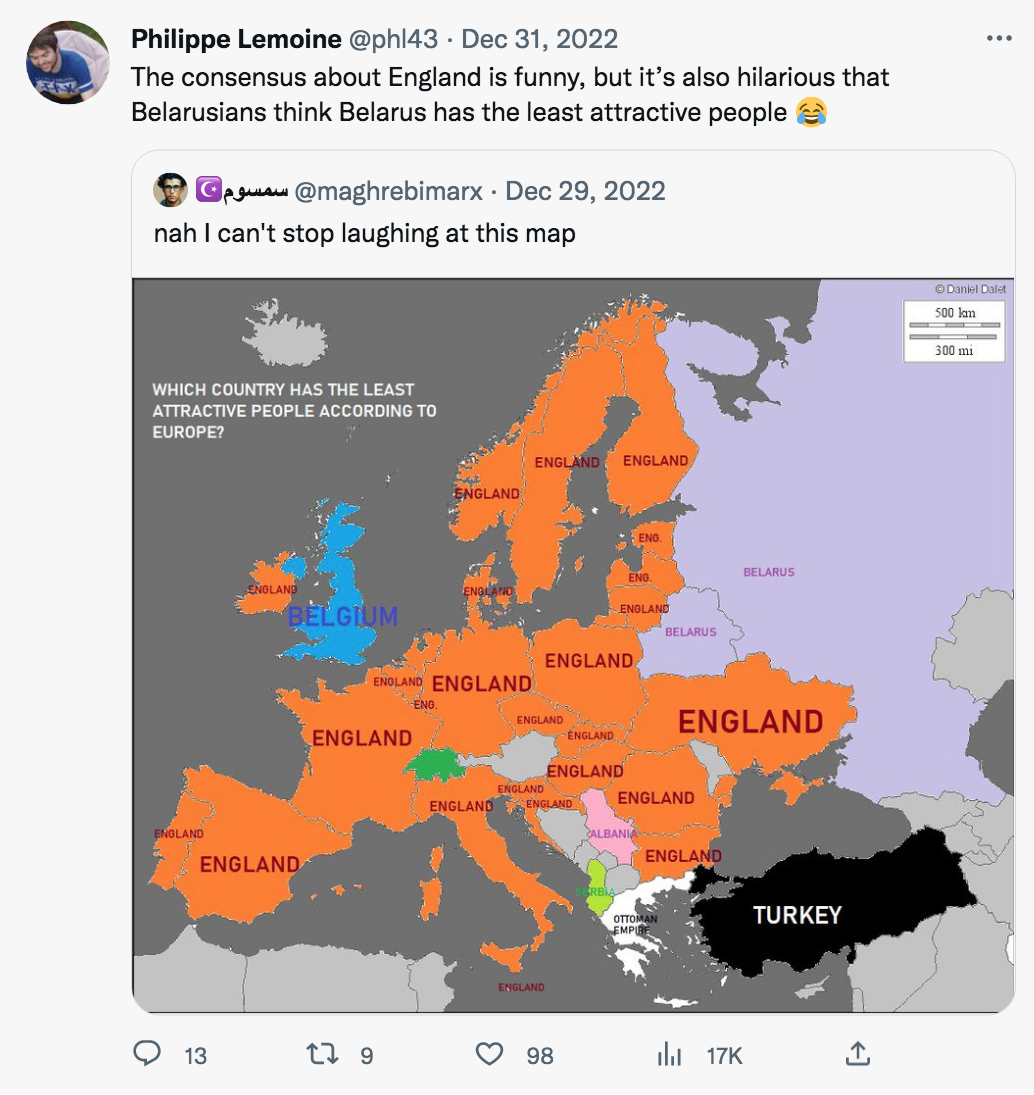
12. I am of British descent, so this caught my eye:
13. Norbert Michel says the Fed already has something akin to the trillion dollar coin:

The deferred asset is the magic asset. Though like a tax loss carry forward, the “amount of net earnings a Reserve Bank will need to realize before remittances to Treasury resume” is entirely up to the Fed. (The Fed does not follow generally accepted accounting principles (GAAP), it follows the Financial Accounting Manual for Federal Reserve Banks, a set of accounting principles the Fed created.)

The implication, of course, is that there will be earnings in the future and the Fed will remit those earnings to the Treasury. So, the Fed could just decide that it will hold back from Treasury an additional amount in the future and increase the deferred asset.

The Fed could, for instance, decide that it will hold back an additional $1 trillion in the future and increase the deferred asset now by $1 trillion. As the deferred asset goes up, capital goes up by a corresponding amount.

Just as it did in 2015, Congress could then raid the Fed’s capital account. Back then, they raided the Fed to pay for new highway spending. But there is no reason that Congress couldn’t now take the Fed’s capital surplus to pay for whatever Congress wants. (For what it’s worth, I mentioned back then Congress was setting a dangerous precedent.)

Read the whole thing.

14. Cato has a long article on trade that is difficult to excerpt. They show that America has blatantly violated international trade laws under both the Trump and Biden administrations. When I was younger, we used to complain that other countries didn’t play by the rules. Now we are the bad guys. The Europeans are so disgusted with our hypocrisy that they are considering copying our protectionist approach.

A model for Europe? / The Trump and Biden administrations’ trade phobia has contributed to making America a sort of protectionist model for Europe. The EU recently acquired new protectionist powers and is working on creating more, such as retaliation against countries whose governments limit foreign competition on domestic tender offers and restriction of exports in emergencies. The Financial Times has suggested that these measures are partly a response to Trump’s tariffs on steel and aluminum and to Biden invoking the Korean War–era Defense Production Act to threaten export restrictions on vaccine ingredients.

When people tell me, “We need to get tough with China because they don’t play by the rules”, I wonder what world they are living in.

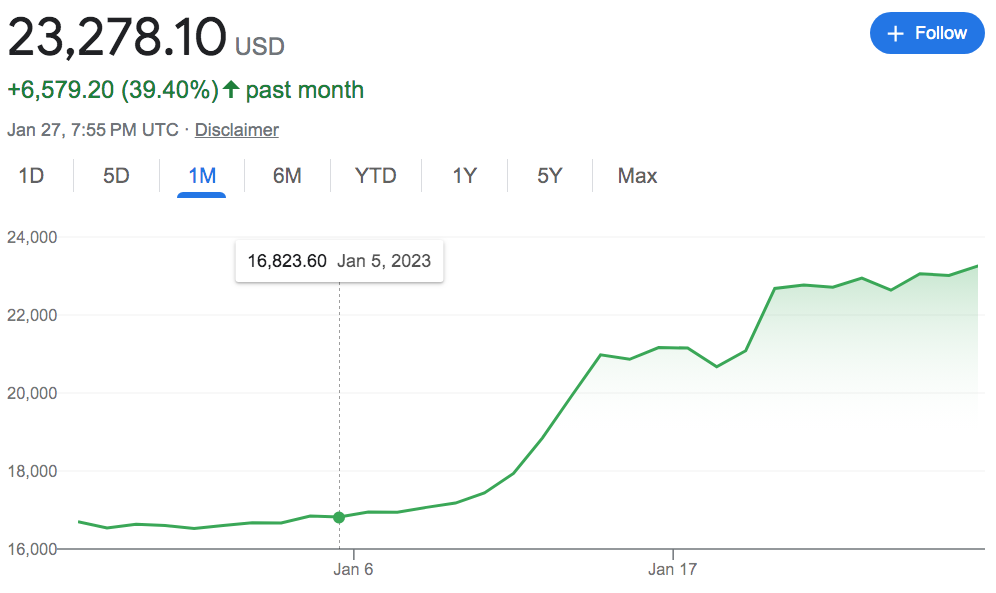
15. Update: Three weeks ago an FT reporter congratulated a colleague for calling cryptocurrencies a bubble:

My colleague Jemima Kelly, who always saw the crypto bubble for what it was, writes on what the year in crypto taught us.

Since that time, Bitcoin is up 38.4%:
There’s nothing special about zero growth

The FT has a new piece on the growth prospects for Europe:

The eurozone will avoid a recession this year according to a widely-watched survey of economists which illustrates the sharp about-turn in global economic sentiment in the past couple of weeks.

As recently as last month, analysts surveyed by Consensus Economics were predicting the bloc would plunge into recession this year. But this month’s survey found that they now expect it to log growth of 0.1 per cent over the course of 2023.

But the accompanying graph doesn’t show any sort of “sharp about-turn”:

Unfortunately, the graph is a bit hard to read. But notice that projected eurozone growth has merely edged up from about negative 0.1% to positive 0.1% over the past month or two.

AFAIK, the eurozone has no NBER to make an official recession call. (Is that right?) In addition, whereas the US has no borderline recessions, Europe does. In that case, I think it’s a mistake to focus on whether or not Europe experiences a recession this year. There’s no meaningful difference between minus 0.1% and positive 0.1%. For business cycle purposes, we should focus on the eurozone unemployment rate, not RGDP. Will there be a sharp increase in unemployment?

The US case is far more interesting. We’ve never had a mini-recession. So in 2023, we’ll either have no recession, our first ever mini-recession, or a significant recession. Any of those three outcomes would be quite interesting.

It’s better for the world if macro is boring, but it’s better for me if it’s interesting. And 2023 will be quite interesting.

PS. I define mini-recession as a rise in the unemployment rate of between 100 and 200 basis points. In the past, it either rose by more than 2% or less than 1%. Never in between 1.0% and 2.0%.

PPS. There’s a lot of talk about how inflation is coming down. But the inflation rate that matters is wage inflation, and progress there has been much more modest. A soft landing is still possible, but it won’t be easy.

The Eternal Modern

Every place seems to resemble its golden age. Last January, I visited Miami Beach, where the dominant style is art deco. Last spring, I visited Palm Springs, where the style is midcentury modern. In the fall, I visited Prague, Budapest and Vienna, which are full of art nouveau buildings. At one time, all those styles were modern. But I would argue that midcentury modern is different, a sort of eternal modern. The end of the road, or at least the end of a very important road.

It’s been said that all art is modern art. At the time, Renaissance painting was recognized as modern. Ruskin wrote about “modern artists” like Turner. Art nouveau can be roughly translated as modern art. So why do I think mid-century modern is different?

Even when I was young (in the 1960s), art nouveau architecture looked old fashioned. In contrast, buildings designed by Mies van der Rohe still look right up to date, even though we are seeing them through the same 70-year gap as I viewed art nouveau as a child. The International Style has remained the dominant architectural style. More recently, even clothing styles seem to have stopped changing. Why?

[As an aside, in this post I’m considering our macro environment. I understand that at the micro level (computer chips, biotech, etc.) rapid change continues. It might even accelerate with AI.]

In retrospect, the 1950s seem like a pivotal decade. The Boeing 707, nuclear power plants, satellites orbiting Earth, glass walled skyscrapers, etc., all seemed radically different from the world of the 1890s. In contrast, airliners of the 2020s look roughly like the 707, we seem even less able to build nuclear power plants than in the 1960s, we seem to have a harder time getting back to the moon than going the first time, and we still build boring glass walled skyscrapers.

Now think about art. Abstract expressionism seems radically different from the painting styles of the nineteenth century. But it also represented the end of a road, the end of visual experimentation. Art had been moving toward abstraction for a long time, and once it arrived there was no place to go in a visual sense. After the 1950s, the important innovations in painting were ideas, not visual styles. And since there are an infinite number of possible ideas, there is no dominant style after abstract expressionism.

[Yes, abstraction was first developed in the 1910s, but the 1950s is when it became the dominant style.]

So both engineers and artists ran out of ideas at about the same time. More specifically, engineers ran out of macro ideas, and artists ran out of ideas for visual experimentation.

In architecture, technology can drive changes in style. The steel framed, glass walled skyscraper was perhaps the most important technological innovation in the history of building, and its aesthetic possibilities were discovered almost immediately. It’s true that computer design has allowed further innovations, including the work of Frank Gehry and Zaha Hadid, but for every one of their postmodern buildings, we continue to build a hundred Mies van der Rohe buildings. (Just as the mannerist painters didn’t deflect art from the course set in the Renaissance.) At the macro level, we still live in a mid-century modern world; the world of The Jetsons never happened. Corporations still put 1950s-style abstract paintings on the walls of their 1950s-style office buildings.

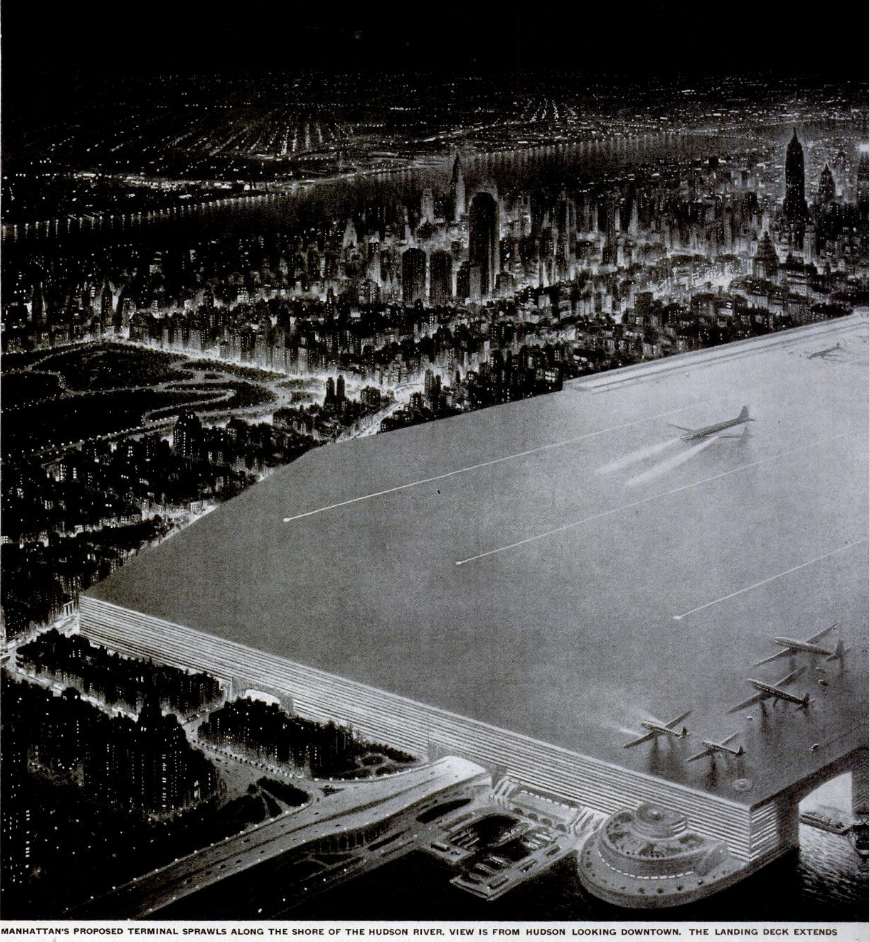
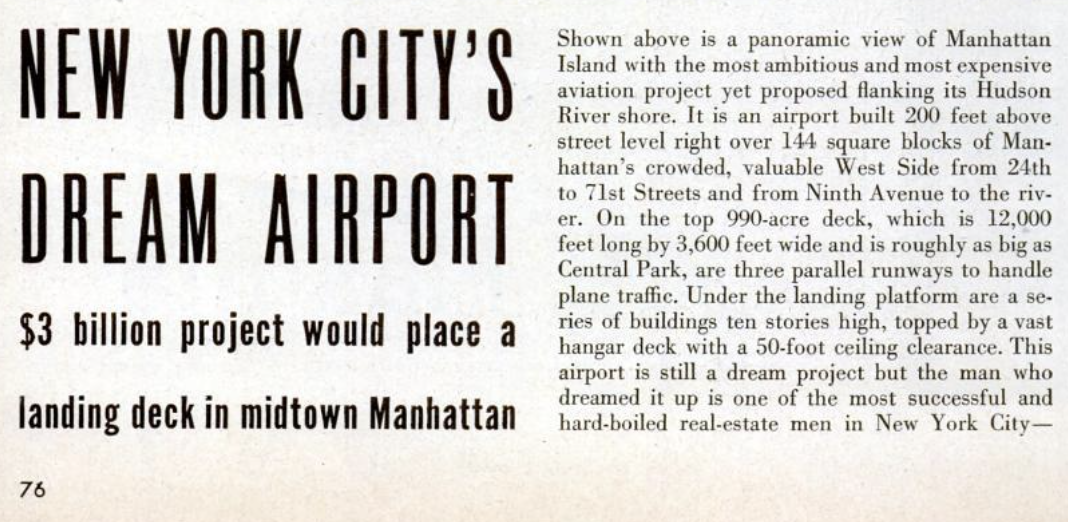
In another sense, however, we have rejected the modernism of the 1950s. The optimistic, can do attitude toward rapid change has been replaced by a decadent environmentalism. I recently came across an old Life magazine article that perfectly encapsulated the sort of midcentury modern optimism that has not endured. It described plans to build a fantastic airport on the west side of Manhattan.

Wow!!!

Love that price tag!

You probably thought I was stacking the deck by contrasting phrases like “Optimistic can do attitude” and “decadence”. But why would you assume that I view decadence as a bad thing? After all, the 1970s is my favorite decade. And even a confirmed YIMBY like Matt Yglesias would probably disapprove of this airport project.

For better or worse, during the 1970s the US and Europe decided to end their headlong rush toward growth. But in stopping growth, we also stopped (macro) change. And we need to change in order to address problems like global warming. Hence progressives have recently pivoted from hostility to enthusiasm for building lots of new stuff.

You might see all this as just boomer nostalgia for the 1960s, for the period of my youth. The golden age of pop music and the golden age of film. That’s clearly a part of this post. My visit to Palm Springs triggered an overwhelming sense of nostalgia. It made me recall a time when the future seemed bright. (Slim Aarons’s iconic photo of the Kaufmann house is perhaps the best way of grasping the mid-century modern aesthetic.)

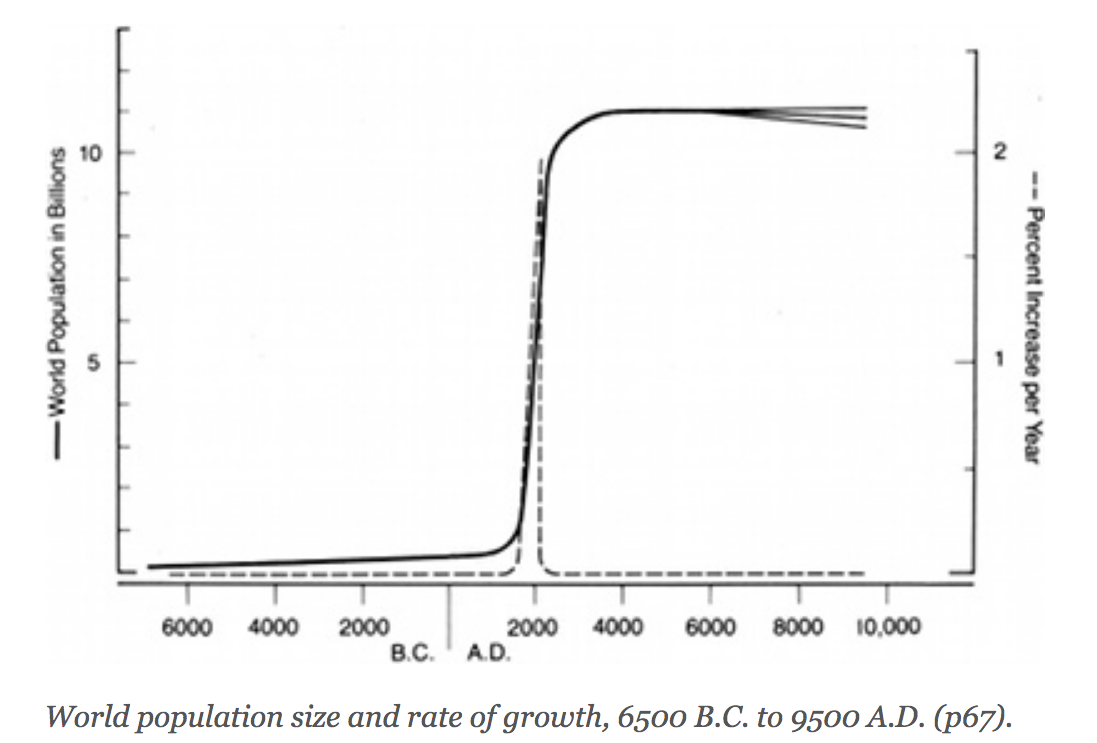
But I continue to believe that the middle of the 20th century really was special. For instance, if you look at a 10,000 year graph of world population growth rates, they are mostly just above zero, and then soar to a peak of 2.1% in the mid-1960s, before plunging much lower. (The dotted line.) I suspect that the world will never get back to 2% population growth—the 1960s was a very special period. I also suspect that we’ll never again see our macro environment change so rapidly. (I’m not ruling out rapid (micro) technological change, which depends on how AI plays out.)

When we return to the moon at some point in the future, it won’t seem as special as the 1969 moon landing. Abstract expressionism will probably end up being the final example of a recognizable style of painting, from a time when people still believed that art was progressing.

When I was young, a 94-year old chair (from the 1870s) looked like a Victorian antique. Now a 94-year old chair looks completely modern, and always will look modern.

The eternal modern:

PS. I recently saw an photo essay about Shanghai at the “turn of the century”, which the author called its “Golden Age”. For people of my generation, that phrase always meant the period around 1900. Then I saw the first picture, and it certainly looked like Shanghai from far back in history. But in this case the “turn of the century” was 2000. China’s development is so recent their “modern times” are right now.

PPS. I don’t believe old people have any special wisdom. But here’s one thing that young people might not grasp. An old person like me sees images of their youth with a sort of superposition. I see the images as I saw the world at the time, and I also see them through my 2023 eyes.

Suppose you are 25 years old. In 50 years, you’ll see an old movie from 2023 and notice some Tesla cars driving around. By then, the cars will probably look like antiques, but you’ll simultaneously recall when they looked sort of futuristic.

When I watch films from the 1950s and 1960s, I recognize the built environment as being from the distant past, but I simultaneously recall when it was modern. More importantly, I’ll recall the sort of person I was when I first saw that sort of building, when it seemed fresh and innovative.

I watch a lot of films from the 1930s. I believe it’s important to try to watch these films through the eyes of the original audience. If there’s an elegant art deco apartment in Manhattan and a hostess wearing a slinky gold lame dress, watch is as if you were a Depression-era viewer dazzled by what you were seeing.

PPPS. Hard to believe, but the Italians built this service station in 1938, in Eritrea:

Another RBC model failure

[There may be a technical outage later today as we transition to a new platform.]

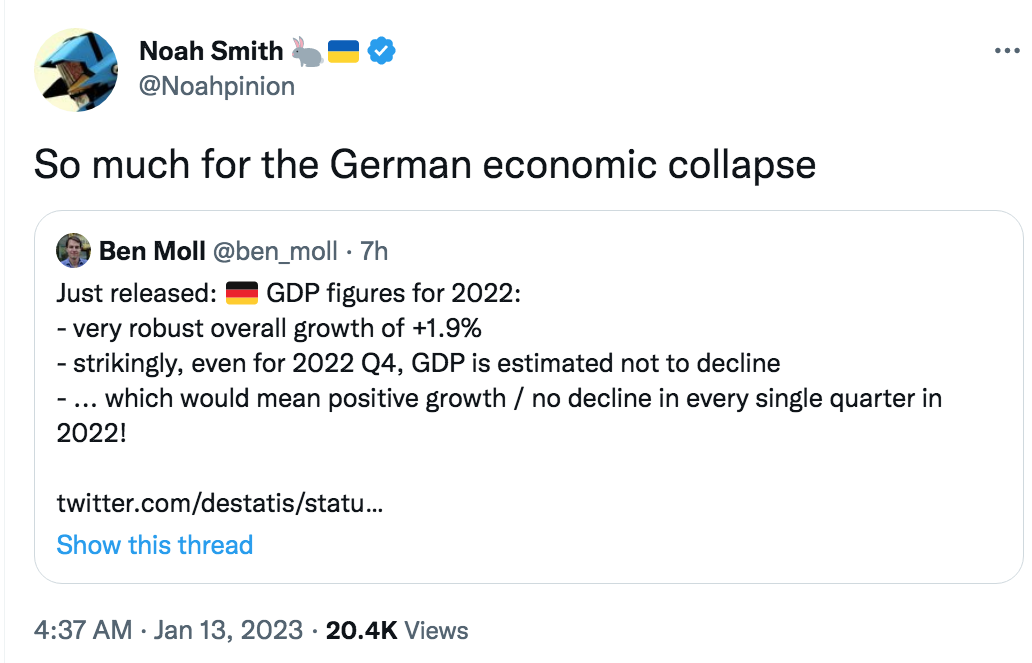
Remember early in the year when all the “experts” told us that Russia was facing economic collapse because of the draconian sanctions being imposed? Never happened. Noah Smith points out that the doomsayers were also wrong about the impact of the energy crisis on the German economy:

Germany may experience a recession in 2023 (they are very hard to predict). But if it does, it will likely not be due to “real shocks”. Rather, the cause would be declining NGDP growth triggered by the ECB’s anti-inflation program.

PS. I love to keep track of Bloomberg’s views on the economy. This is from today’s paper:

The world economy is beginning the new year on a more optimistic note, though that’s no guarantee 2023 will end that way

A variety of factors – a sooner-than-expected reopening of China’s economy, a warmer-than-normal winter in energy-strapped Europe and a sustained fall in US inflation – are combining to dissipate some of the gloom that engulfed financial markets at the end of 2022 and fanning hopes the world can dodge a recession.

And here’s what they said back in October:

I guess “100%” isn’t quite the metaphysical certitude that it used to be. (In fairness, they said “near certainty”, so perhaps they were rounding up from 99.5%.)

Me? I have “Noahpinion”.

To QE or not to QE

Over at Mercatus, Andrew Levin and Bill Nelson have an excellent essay on the fiscal cost of the Fed’s QE4 program. There isn’t much that I disagree with, but I’d frame a few of the issues slightly differently. The following reflects my own views, which largely but not entirely overlap with the views of Levin and Nelson:

1. According to Levin and Nelson, the Fed’s QE4 program is ultimately expected to cost taxpayers about $800 billion. This reflects the fact that the bonds that were purchased have sharply declined in value due to rising interest rates.

2. These losses cannot easily be avoided by holding the bonds to maturity and refusing to pay interest on bank reserves. Doing so would cause inflation to explode. The loss is real.

3. However, there is a sense in which these losses are illusionary. The Fed is part of the consolidated balance sheet of the federal government, and the Fed’s holdings of T-bonds are a liability of the Treasury. The Treasury gains when T-bond prices decline. So in one sense the gains and losses net out to zero. Even the fact that some of the bonds are MBSs doesn’t really change that fact.

4. But in a counterfactual sense, the $800 billion loss is real. If the Fed had not purchased these bonds, the Treasury would have profited handsomely from rising interest rates reducing the market value of its liabilities. The Fed took away that profit, and thus effectively cost the Treasury about $800 billion.

5. This loss is similar to the loss that would have been incurred if the Fed had not done QE, but Treasury officials had decided to issue lots of T-bills instead of long-term T-bonds right before a period of sharply rising interest rates. Ultimately, it’s a loss from choosing the wrong maturity structure for federal liabilities—too much short-term debt (or bank reserves) during a period of rising rates.

6. If markets are efficient, then the expected profit or loss from QE is rather small, ex ante. But if the central bank has inside information on its future policy, it may be able to beat the market. Surprisingly, I don’t believe the Fed does have inside information on future Fed policy.

7. The Fed profited somewhat from the first three QE programs as rates remained lower than expected, and lost much more from QE4 as rates rose more than expected.

8. The impact of QE on the fiscal position of the government should also account for changes in the macroeconomy that result from QE. This is an exceedingly complex issue.

9. Two policy reforms would allow the Fed to achieve its macroeconomic objectives with a much smaller balance sheet, and hence much less risk of large losses on its bond portfolio. One reform would be to return regulation to the pre-2008 system, where commercial banks held very small reserve balances. Much of the recent growth in reserve balances has been driven by regulatory decisions of dubious value. Second, a regime of NGDP level targeting would lead to a higher equilibrium nominal interest rate during recessions, and reduce the amount of time that the economy is stuck at the zero lower bound.

10. If policy remains dysfunctional, then QE may be the lesser of evils. It’s better to take on some financial risk and stabilize the macroeconomy, rather than avoid risk and allow deep recessions. The fiscal cost of recessions is much larger than the risk associated with plausible QE programs.

11. However, the actual QE programs have not been optimal. The first three QE programs were too small; in retrospect the policy should have been more expansionary. The final program (QE4) was associated with a monetary policy that was far too expansionary. Thus QE4 was not a “price worth paying” for sound monetary policy, it was a costly program that made monetary policy even more unsound. My own view is that the initial purchases (in 2020) were appropriate, but the program should have been unwound in 2021, before the sharp increase in interest rates. This would have resulted in much smaller losses.

12. Where QE actually is necessary to achieve macro goals, it is worth doing despite the financial risks.

13. If Congress plans to investigate these losses, it needs to consider a wide range of issues. How does Congress feel about giving the Treasury wide discretion over the maturity structure of federal debt? These decisions have huge fiscal consequences and are extremely risky. How does Congress feel about regulators pressuring banks to hold massive reserve balances, even though alternative liquid assets such as T-bills are equally effective at reducing default risk? The inquiry should not merely focus on the Fed’s decision to do QE4, there are much more important questions at stake.

14. Congress needs to also think about how it views a large Fed balance sheet. My own work suggests that in the long run the size of central bank balance sheets (as a share of GDP) is strongly (negatively) correlated with the trend rate of growth in NGDP. Countries with low trend rates of NGDP growth (Japan, Switzerland, etc.) tend to have very large central bank balance sheets. Countries with relatively high trend rates of NGDP growth (Australia) tend to have small central bank balance sheets. This reflects the fact that NGDP growth drives the equilibrium nominal interest rate, and demand for base money rises sharply at near zero rates. This is the “socialism or inflation” dilemma that most conservatives refuse to address.

15. I favor abandoning the experiment of paying interest on bank reserves, which has resulted in much larger than necessary central bank balance sheets, needlessly exposing central banks to the risk of large financial losses. Go back to the pre-2008 corridor system.