Archive for the Category Supply-side economics


Sioux Falls rises, as Sioux City falls

This follow-up post is only for tax nerds; it gets pretty deep in the weeds, or wheat fields.  I was interested in this comment in a WSJ piece on Governor Brownback, who’s struggled to enact supply-side reforms in Kansas:

During a brief presidential run in 2007, Mr. Brownback said he saw economic growth in parts of South Dakota””where there is no income tax””outpacing activity just across the border in Iowa, which has such a tax.

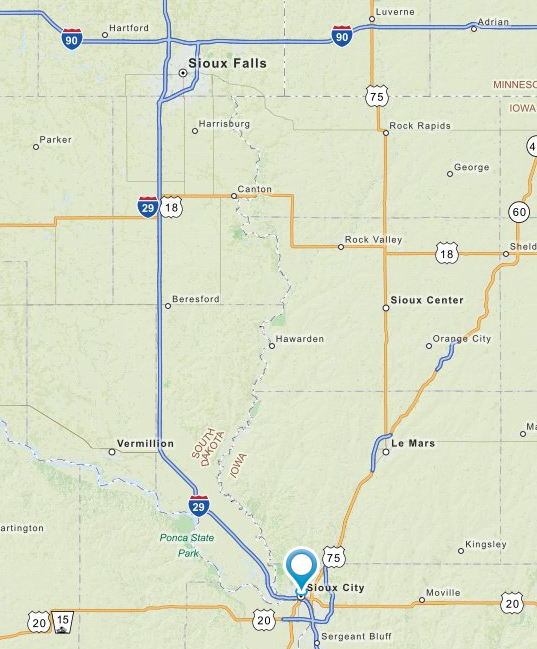
Iowa doesn’t just have a state income tax; they have a relatively high one, topping out at 8.98%.  Sioux City, Iowa and Sioux Falls, South Dakota are both quite close to the border, and so I decided to investigate these two “urban” areas.  Both towns are mostly in one county, with some suburbs that spill into another county. Sioux City, Iowa also has some suburbs that cross state lines into both South Dakota and Nebraska. I’ll consider the cross-state suburbs later.  Here’s the general area:
Screen Shot 2015-06-13 at 9.09.17 PM

From Sioux City, Interstate 29 extends northwest into a wedge of South Dakota, and highway 20 goes west into Nebraska.

Now let’s compare the population of the two South Dakota counties containing the Sioux Falls area with the two Iowa counties containing the Sioux City area:

Year     Sioux City   Sioux Falls

1990       121,664        139,236

2000       128,726       187,093

2010       127,158       228,261

2014       127,145       240,204

1990-2014: +4.5%     +72.5%

That’s quite a difference.  The spillover counties don’t have enough people to change the overall picture, but S. Sioux City, Nebraska is growing faster than Sioux City, perhaps due to the lower tax rates in Nebraska, and N. Sioux City, South Dakota is growing even faster (despite being less conveniently located):

Year     S. Sioux City   N. Sioux City

1990        16,742               10,189

2000        20,253              12,584

2010        21,006              14,399

2013/14   20,947               15,029

Growth    +25.1%             +47.5%

There’s good and bad news here for supply-siders.  The good news is that substantially lower tax rates may lead to faster growth in border areas.  The bad news is that this growth may involve merely a beggar-thy-neighbor effect, not true supply-side inducements to work, save and invest more.  Indeed it’s exactly this concern that has progressives in Europe worried about a corporate tax race to the bottom, and has them calling for minimum tax rates.  Is Brownback merely trying to steal jobs from Kansas City, Missouri, which is right on the state line?

In a recent interview, the governor pointed to a record number of Kansans employed in the private sector and a jump in new business starts, all while one of the state’s largest industries, aviation manufacturing, struggles. The governor added that employment is particularly strong along the Kansas-Missouri border, where it is easiest for businesses and people to cross state lines to respond to the tax cuts.

“It’s like going through surgery. It takes a while to heal and get growing afterwards,” Mr. Brownback said in his office, a painting of Ronald Reagan hanging behind him. “The left in the country desperately wants this to fail. They want to say, ‘You can’t cut taxes and grow your way out of things.’ “

Surgery, or stealing kidneys from one person and implanting them in another?

Here’s Brownback’s problem; Iowa’s top rate is 8.98% higher than South Dakota’s, whereas even after the tax cut Missouri’s top rate is just 1.4% above Kansas.  And Kansas is still 4.6% above Texas and South Dakota.  I believe Kansas will gradually steal some jobs from Kansas City, especially due to the elimination of taxes on small businesses.  But there won’t be any supply-side miracles.

If you look at cities using google maps, the old neighborhoods often follow a grid, and the newer suburbs have curvy streets.  If they are particularly affluent, the development will line a golf course.  That’s what happened across the river from Sioux City, in the only part of the metro area having any growth since 2000:

Screen Shot 2015-06-13 at 9.31.13 PMAnd here’s what Wikipedia has to say about the upscale community:

Dakota Dunes has five main neighborhoods including the Country Club Estates, the Meadows, the Prairie, the Willows, and Upscale Apartment Living.

Dakota Dunes is owned and developed by Berkshire Hathaway Energy of Des Moines, Iowa, which unveiled plans for the community in 1988.[4] The development is home to Dakota Dunes Country Club, a golf course designed by Arnold Palmer‘s design company.

I might have known the Sage of Omaha would be involved in this somehow.

And Wikipedia has this to say about Union county:

Union County is part of the Sioux City, IA–NE-SD Metropolitan Statistical Area. Progressive Farmer rated Union County second in the 2006 “Best Place to Live” in the U.S., because “its schools are good, its towns neat and its people friendly.”

I’m packing my bags right now.  (No one ever described Boston people as “friendly.”)  I can’t end this post without saying at least something good about Iowa.  The Wikipedia page for Sioux City has this picture of the courthouse:

Screen Shot 2015-06-13 at 9.37.00 PM

Tyler gives you pictures of ugly buildings that are actually sort of beautiful.  I make things easier for you; I give you pictures of attractive buildings that are actually kinda beautiful.

And since we are out in that area, I’ll bet not one American in ten could name America’s longest river (it’s not the Mississippi):

Screen Shot 2015-06-13 at 10.51.20 PM


Screen Shot 2015-06-13 at 10.33.15 PM

What’s wrong with Louisiana?

Tyler Cowen has a post on the problems encountered by Republican tax cutters at the state level.  The post focused on Kansas and Louisiana, which were both recently forced to raise “revenues” to cover budget shortfalls.  I decided to take a broader look at the states, and to focus on the sine qua non of supply-side economics, reducing the top income tax rate.

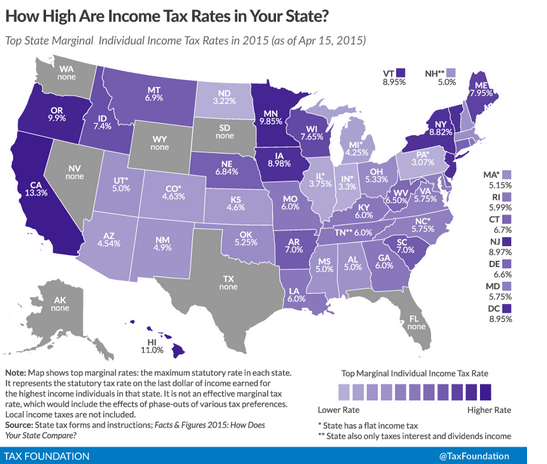
I found that between 2010 and 2015, 19 states changed their top income tax rate, with 5 increases and 14 reductions.  So it’s not just Kansas and Louisiana.  Even more surprising, Louisiana was not one of the 14, its top rate remains at 6%, a bit above average for states:

Screen Shot 2015-06-13 at 3.58.50 PMSo what happened in Louisiana, I thought Bobby Jindal was a supply-sider?  Inertia happened.  Here’s Bruce Bartlett:

In January, Gov. Jindal proposed a tax reform that conformed to the Republican ideal, which he hoped would make him a contender for the 2016 Republican presidential nomination. It would have completely eliminated the state’s corporate and individual incomes taxes, replacing the revenue with an increase in the state sales tax to 7 percent from 4 percent.

The Institute on Taxation and Economic Policy, a liberal think tank, charged that the Jindal plan would raise taxes on the bottom 80 percent of Louisiana citizens. Conservative tax guru Grover Norquist of Americans for Tax Reform cheered the Jindal plan, calling it “the gold standard for pro-growth reform.”

But the Jindal plan was not received well, even in conservative Louisiana. An April 2 poll from Southern Media & Opinion Research found a sharp drop in Jindal’s popularity to 38 percent from 51 percent in October. His tax reform was opposed by 63 percent of Louisianans and supported by just 27 percent. Even among Republicans, fewer than half supported the Jindal tax plan.

On April 8, Jindal admitted defeat and withdrew his tax reform. Bloomberg’s Josh Barro said that Jindal had overreached, noting that over the last 50 years only one state, Alaska, had abolished a major state tax, which oil revenue allowed it to do.

It’s not that a tax regime with no income tax is politically infeasible; you see that in a number of other states.  The problem is getting from here to there.  Potential losers will squawk more loudly than gainers.

So in one of the 14 states that cut the top rate (Kansas) the policy failed, while the other 13 are . . . not discussed by the New York Times.  Some of the tax cuts were small, with the largest being:

Rhode Island, down from 9.9% to 5.99% (why not 5.999%?)

North Carolina, down from 7.75% to 5.75%

Kansas, down from 6.45% to 4.6%

North Dakota, down from 4.86% to 3.22%

Oregon, down from 11.0% to 9.9%

Ohio,  down from 5.925% to 5.33%

It’s worth noting that top rates were cut in some very liberal states like New York and Massachusetts, but only by small amounts.  Among the 5 increases, the two notable cases were California and Minnesota, both of which were enacted for “progressive” reasons, and both of which seem (so far) to be fairly successful.

Let’s return to the “inertia” problem, and try to figure out the strange map above.  It makes sense that liberal states would have high taxes, but why some more than others?  Why no income tax in Washington State, and a top rate in Massachusetts that is lower than in many southern states?  And why the 14 states seeing recent cuts in top rates?  I think there are clear answers to these questions, but we need to consider several factors:

1.  Voters don’t like high income tax rates.  In both Washington (state) and Massachusetts, voters rejected referenda proposals calling for progressive income taxes, by wide margins.  Even more shocking, in 2002 about 45% of Massachusetts voters voted to entirely eliminate the state income tax.  Even the Republicans opposed that initiative.  I recall a colleague told me about a taxi ride where the driver said; “like, I don’t get it.  Why would anyone not vote to eliminate the income tax.”  If the driver came from somewhere like Somalia, then it’s not hard to understand why there might be a disconnect between taxes paid and perceived benefits received.  I was born here and even I don’t see much connection.  My town spent $200 million replacing a perfectly good high school built in the 1970s.  Why?

2.  High income tax rates are more feasible where you have a captive audience.  I hope I don’t need to explain California. (I plan to retire there rather than (low tax) Austin or Miami.)  And the New York area has cultural amenities. But what about frigid Minnesota?  Here’s what non-Midwesterners may not know.  If you are a highly educated “Millennial,” and like cities like Seattle, Portland, Austin, Boston or Raleigh, there’s really only one place in the Midwest that would work for you—Minneapolis/St. Paul.  Governor Walker keeps getting hammered because Wisconsin is not doing as well as Minnesota, but there’s not much he can do to keep well-educated UW grads (who want to stay in the Midwest) from moving to the Twin Cities.  I’m not saying their tax increase will work in the long run, but it will work in Minnesota better than in any other Midwestern state.

3.  Tax rates have lagged far behind political change.  During my lifetime, many red states have gone blue, and vice versa.  California’s recent tax increases reflect this fact, as do the many tax cuts in states that have become more red.  I predict that South Carolina will have to cut its top rate at some point, now that it has the highest taxes in the South.  It’s odd that many (blue) rust belt states have (for historical reasons) lower top rates than many conservative southern and western states.  That will gradually change.

4.  Don’t let the NYT tell you what is “popular.”  I’ve already mentioned the opposition of liberal Washington and Massachusetts voters to a progressive income tax.  I might add that although Governor Brownback is extremely unpopular among Republican legislators, it’s not clear that this applies to voters.  Before the election last fall there was a flurry of articles telling us about how unpopular Brownback was with the voters.  I expected a whole slew of follow up articles after he lost the election.  But something kind of strange happened, he won.  And those follow-up articles?  I didn’t see them. Maybe Kansas voters liked the tax cuts.

5.  On the other hand there’s no way to hide the fact that Brownback did screw up—his policies performed poorly.  He cut the top rate, eliminated taxes on small business, and did little to cut spending. The result was predictable—suddenly everyone and his brother declared “I’m a small business.” and revenues plummeted.  A deficit opened up, leading to the recent (regressive) tax increases.  But even today Kansas has a tax regime that is more progressive than the regime in Massachusetts.  And spending in Kansas is higher than in the other Great Plains states.  A much better example is North Carolina, which slashed its top rate, and also cut other programs such as unemployment insurance, to avoid running deficits. Unlike Kansas, North Carolina is doing well, although in fairness it’s been doing well for decades.  It’s hard to draw conclusions because most state level changes are small, and the effects show up very gradually.  That’s why I prefer a cross sectional approach, and on balance that approach does suggest that people prefer states with no income tax.  On average they vote that way with their feet, and in the case of Washington State, also at the ballot box.

Progressives can take heart from the fact that (in my view) the supply-side argument for lower top rates will gradually weaken over time.  In the new economy firms have tremendous pricing power, and states have more taxing power than in the old commodity-driven economy.  In the old days high taxes would make people and companies move to other states. Commodity industries are highly competitive on price. That’s Kansas and Louisiana.  But the new economy in places like Manhattan and Boston and DC and Silicon Valley has companies with lots of market power, and people so rich they care more about amenities than a few extra bucks.  So that works in favor of the progressives, but not yet in all 50 states.

Jonathan Pedde on the UK election and fiscal policy

Tyler Cowen directed me to an excellent new paper by Jonathan K. Pedde:

Standard zero-lower-bound New Keynesian models generate large fiscal multipliers and expansionary negative supply shocks. Thus, according to these models, a political party that implements fiscal contraction coupled with policies to increase aggregate supply should unambiguously cause economic contraction, compared to a party that implements the opposite policies. I test this prediction using high-frequency prediction- and financial-market data from the night of the 2015 U.K. election, which featured two such parties. By analysing financial-market movements caused by clearly exogenous changes in expectations about the election winner, I find that market participants expected higher equity prices and a stronger exchange rate under a Conservative Prime Minister than under a Labour P.M. There were little to no partisan differences in interest rates, expected inflation, or commodity prices. These results cast doubt on the empirical validity of zero-lower-bound New Keynesian models.

Some initial reactions:

1.  Wow, was that fast!  The election occurred on May 7th and a fully done research paper was at SSRN on May 12th

2.  The paper has a rather MM feel to it.  Fiscal stimulus doesn’t affect growth, no paradox of toil, use market price changes to identify the effects of policy shocks, etc. It’s a much more formal treatment of what I do informally in this blog.

[Update: Jonathan Pedde pointed out that I misinterpreted his fiscal policy claim. Here’s the more nuanced claim he actually made:

Of course, these results do not necessarily imply that the fiscal multiplier is zero. Perhaps a Conservative (rather than a Labour) P.M. leads to less expansionary fiscal policy as well as higher stock prices and exchange rates, but the higher stock prices and exchange rates happen in spite of the less expansionary fiscal policy, not because of it. But in order for this to be true, then something else about a Conservative P.M. must have been responsible for the higher stock prices and exchange rates. But, in the context of a ZLB NK model, that “something else” would probably have to be a policy relating to aggregate supply. So this argument requires that policies to increase aggregate supply actually increase GDP – which, of course, is at odds with the predictions of the ZLB NK model.

So he’s testing the overall ZLB NK model, not just fiscal policy.]

My only reservation is that one must be careful in interpreting stock market reactions. Pedde claims that the rise in stock prices reflects higher growth expectations after the Conservative victory.  I think that’s right, but it’s also possible that higher stock prices reflect lower expected future taxes on capital income in the UK.  In that sense elections are different from something like Fed announcements.

In fairness, Pedde’s growth hypothesis is confirmed by the concurrent move upward in the UK pound, which also signals faster growth ahead.  But this still shows the desperate need for more and better macro predictions markets, with higher levels of liquidity.

Interestingly, the paper relied on the Hypermind prediction market for the election probabilities.  This market also contains a set of NGDP futures markets, but with only $10,000 in prize money this year.  Think about the following.  If we boosted the prize money 50-fold to $500,000 per year, the market would be much more liquid, much more efficient.  That’s a lot of money for you and I, but for the Treasury or the Fed it’s like the coins that slip down between the cushions on your couch.  It’s nothing.  And it would open the door to a new golden age of macro research.  We could identify the stance of monetary policy in real time.  VAR studios would immediately by 100 times better.

Why hasn’t it happened yet?  Good question.  All I can say is that I’m doing my part; now I’d like to see some bigger name economists make a push for these markets.

PS.  My admittedly unscientific sense of Hypermind is that the NGDP market is now pretty accurate at identifying NGDP market forecasts, and also the gradually fall in the growth forecast over recent months.  But I don’t think it’s liquid enough at this point to do event studies.  Trading volume is too low.

On the other hand if traders knew that the most successful trader would walk away with $100,000, the second most with $75,000, the third most with $60,000, the 4th most with $50,000, etc., etc., even after having to put up none of their own money, well then I’m pretty sure that trading volume would get much, much higher.

On the plus side, even the very small Hypermind NGDP market is yielding interesting results.  I’ve argued that the current 3.4% NGDP growth forecast during a recovery year is consistent with the hypothesis that we are in a NGDP Great Stagnation, with a trend rate of 3% NGDP growth.

PPS.  Glad to see David Andolfatto and Noah Smith saying many of the same things that we (market monetarists) have been saying about Britain.

How many more populist “victories” can we survive?

Here’s Salon on the Greece government’s “victory” last February:

One week after Greece’s leftist government reached a new debt deal with its creditors, Paul Krugman argues in his New York Times column today that left-wing criticism of the deal is misguided, obscuring larger victories secured by Greek negotiators.

And here’s Paul Krugman in 2012 on Argentina’s “remarkable success.”

Matt Yglesias, who just spent time in Argentina, writes about the lessons of that country’s recovery following its exit from the one-peso-one-dollar “convertibility law”. As he says, it’s a remarkable success story, one that arguably holds lessons for the euro zone.

I’d just add something else: press coverage of Argentina is another one of those examples of how conventional wisdom can apparently make it impossible to get basic facts right. We keep getting stories about Ireland’s recovery when there is, in fact, no recovery “” but there should be, darn it, because they’ve done the “right” thing, so that’s what we’ll report.

And conversely, articles about Argentina are almost always very negative in tone “” they’re irresponsible, they’re renationalizing some industries, they talk populist, so they must be going very badly.

In fairness, they did have a very strong cyclical rebound after easing monetary policy (an issue on which I agree with Krugman.)  Where I disagree is his tendency to sort of wave away supply-side concerns—which are what matters in the long run.  It looks like the long run has arrived, as the Argentine economy has sputtered over the three years since he wrote this post, and 2015 will be downright ugly.

From the same post, Krugman has good things to say about Brazil’s slightly more moderate, but still hopelessly statist policy regime:

Just to be clear, I think Brazil is going pretty well, and has had good leadership. But why exactly is Brazil an impressive “BRIC” while Argentina is always disparaged? Actually, we know why “” but it doesn’t speak well for the state of economics reporting.

Why was Argentina disparaged?  Perhaps because some of us don’t have a “in the long run we are all dead” Keynesian obsession with the demand-side.  We saw problems down the road. BTW, the Argentine president who created the disaster died in 2010, leaving his wife to inherit the mess “in the long run.” Brazil has also done very poorly in the three years since Krugman praised its (incompetent) leadership, and the forecasts reported in the next link call the outlook for Brazil’s economy in 2015 “grim.”  Nor will boosting AD perform miracles, Brazil and Argentina already have lots of inflation.

Here’s the outlook for the key economies in Latin America next year:

Many Latin American economies will continue to face increasing growth divergence this year, which is neatly defined by the two oceans that envelop the region. The Atlantic-facing economies of Argentina, Brazil and Venezuela””the largest members of the Mercosur bloc””will contract 0.2%, 0.9%, 5.5%, respectively, according to LatinFocus Consensus Forecasts panelists. On the other side of the continent, Chile, Colombia, Mexico and Peru””which make up the Pacific Alliance””will expand 2.9%, 3.4%, 2.9% and 3.5%, respectively.

Let’s see, I’m trying to remember which side had the more statist policy regimes, the Atlantic or the Pacific bloc?  The next paragraph answers the question:

This division has little to do with the western countries’ orientation toward a more dynamic Asia and the eastern countries’ exposure to the European economies, which are still weak. In fact, the growth divergence is mainly the result of the substantial differences in each country’s economic policy during a decade-long economic boom, which was fuelled by high commodities prices and strong inflows of foreign direct investment. Throughout the boom years, Atlantic countries spent more and saved less, while the Pacific-facing countries invested more. Moreover, many governments in the Atlantic-facing countries implemented more interventionist economic policies, which put a dent in businesses’ profits and discouraged investment. Conversely, countries bordering the Pacific undertook agendas of economic reforms, which investors welcomed.

But that doesn’t make any sense. How could the Pacific countries be doing better, when they relied more on the brain dead supply-side approach of the GOP?  Of course Krugman told us that Chile’s supposed free market success is just “Fantasies of the Chicago Boys.”

But there’s another point: the economics of Chile under Pinochet are a lot more ambiguous than legend has it. The way the story is told now, the free-market guys moved in, liberalized, and then there was a boom.

Actually, as you can see from the chart above, what happened was this: Chile had a huge economic crisis in the early 70s, which was, yes, partly due to Allende and the accompanying turmoil. Then the country experienced a recovery driven in large part by massive capital inflows, which mostly consisted of making up the lost ground. Then there was a huge crisis again in the early 1980s “” part of the broader Latin debt crisis, but Chile was hit much worse than other major players. It wasn’t until the late 1980s, by which time the hard-line free-market policies had been considerably softened, that Chile finally moved definitively ahead of where it had been in the early 70s.

There’s no question the Chicago Boys screwed up in the early 1980s, by ignoring Milton Friedman’s (and Paul Krugman’s) advice to float your currency.  But what about that supposed “softening” of free market policies?  Here’s the Fraser Institute rankings of economic freedom in Chile (index number out of 10, and then global ranking), since the Chicago-style reforms began in 1975:

1975:    3.60  (71)

1980:   5.38  (48)

1990:    6.78  (27)

2000:   7.41  (33)

2010:   7.94   (7)

If there are “fantasies,” it’s the idea that Chile became less market-oriented after the late 1970s.

Perhaps Brazil could try some Paul Romer–style charter cities on its poverty-stricken northeast coast.  You know, the kind of free trade zone that was adopted by another country advised by Friedman at about the same time he advised the brutal Pinochet regime. This regime was far more brutal, and yet oddly Friedman got no criticism from the left for his advice, perhaps because the left was embarrassed by the fact that so many of their famous intellectuals had praised the regime over the previous decades, as they killed tens of millions of people.  Have you guessed which one?  Hint, it’s right after Chile in alphabetical order.  And the main street in its biggest free trade zone went from looking like this in 1981:

Screen Shot 2015-04-29 at 6.21.04 PM

To this in 2013:

Screen Shot 2015-04-29 at 6.21.24 PM

Brazil might want to contact Mr. Romer.

Amazing coincidences

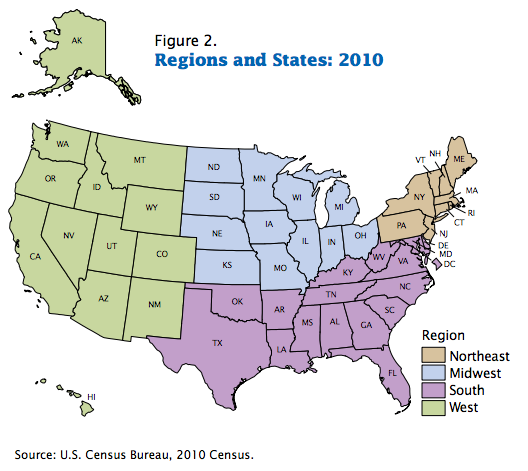
I don’t know why I have to keep shooting down this Sunbelt myth.  No, people don’t like hot weather, they like nice weather.  But they really, really like no state income tax. Here’s the US by region:

Screen Shot 2015-03-29 at 11.59.43 AMThis link has census data for the most recent decade (2000-2010).  The US population grew at 9.7% over that decade. Let’s start with the south central states, which are hot and muggy. Between Kentucky and Texas there are 8 purple states (9 if you include West Virginia). Six of the 8 (or 7 of 9) had population growth below the national average, including oil rich Louisiana and Oklahoma.  So much for the sun “belt.” Tennessee and Texas were the only two that grew faster.  And oh by the way, they are the only two with no state income tax.

On the west coast, all states grew faster than the national average. Yes, its climate is nicer that the south central region.  But look at the more detailed data and you’ll see that hot and sunny Washington state and Alaska grew the fastest of five bordering the Pacific.  And oh by the way, Washington and Alaska are the only two with no state income tax.

How about the 9 states in the northeast?  All grew slower than the national average, but tropical New Hampshire was the fastest of the tortoises.  And oh by the way, New Hampshire is the only one with no state income tax.

How about the 12 Midwestern states?  Like the northeast it was a slow growing area. But the best of a bad lot was South Dakota.  Non-American readers should know that South Dakota offers NOTHING.  Choosing to move to South Dakota over the Twin cities area of Minnesota is like choosing Belarus over Stockholm, Sweden.  Think of it as a slightly warmer “Fargo.” And oh by the way, South Dakota is the only Midwestern state with no state income tax.

In the inland southwest there are 5 fast growing states.  Nevada easily led the group. And oh by the way, Nevada is the only one with no state income tax.

Yes, there are a few outliers.  The only southeastern state with no income tax is Florida, which grew “only” by 17.6%.  Florida was narrowly edged out by Georgia (18.3%) and North Carolina (18.5%).  It’s worth noting that over multiple decades Florida has grown faster than the others, but with its population recently surpassing New York it may now be a bit congested.  In fairness, the same problem applies to California (which grew 10%).

And the ninth state with no income tax is Wyoming, which led Montana but trailed Idaho in the northern Rockies region.  Unlike Idaho, Wyoming basically has no cities. How many frustrated residents of Buffalo, NY suddenly decide, “I want to be a cattle rancher”?

For the US as a whole, only nine states lack a state income tax.  And the fastest growing state in the entire country was Nevada (at 35.1%), one of those nine.

Lots of amazing coincidences between having no state income tax and population growth relative to your neighbors.

Paul Krugman says:

So when you ask why Sunbelt states have in general grown faster than those in the Northeast, don’t credit Art Laffer; credit Willis Carrier.

I say credit both Laffer and Carrier, at the margin.  Good weather and low taxes are both important.  But people don’t like south central unless you also eliminate state income taxes.

However . . . I predict that tax differentials will play a less important role in the future. Tyler’s right that as the country gets ever wealthier, amenities will play an increasing role.  (The dramatic and underreported slowdown in New Hampshire’s growth is the canary in the coal mine for supply-siders.)

Some day I hope to move to sunny LA.