Archive for the Category Neoliberalism


The sensible centrist

I’m for Gary Johnson because I believe the War on Drug Using Americans is the greatest problem facing this country.  But he won’t win.  Of those who might I’m increasingly impressed with Mitt Romney.

1.  Romney doesn’t consider global warming to be a hoax.

2.  He refuses to join the other Republicans in criticizing fiat money and/or calling for tighter money.

3.  He understands that jobs are the big problem.

4.  He has Greg Mankiw advising him.

5.  He recently came out for UI personal accounts, a very Singaporean solution that even Singapore doesn’t have.

Yes, I’m sure you can find a few cases where he throws red meat to the populists, but mostly in areas that won’t tie his hands as President.  I’m not excited about the Mass health care reform, but at least he tried to solve a very real problem—45 million uninsured.  I don’t see many good alternative proposals coming out of the GOP.  And let’s not forget that lots of conservatives supported Romney’s bill, until Obama adopted the same idea.

Matt Yglesais mentioned the personal UI accounts idea, but then went off on a tangent that seemed, in my eyes, slightly misleading.  He cites empirical results that support Romney’s proposal, and yet I’d bet the average reader of Yglesias’s post thinks he’s criticizing it.  See what you think.  The research shows that unemployment insurance has one inefficient effect (discouraging employment due to potential loss of benefits), but perhaps an even bigger beneficial effect (encouraging optimal job search by making workers less liquidity constrained.)  Ronney’s proposal is presumably aimed at getting the best of both worlds.  No disincentive effects from a potential loss of UI benefits, but also a financial cushion to fall back on while you search.

Josh Hendrickson does a good job explaining why Romney was right in saying that corporations are composed of people.  Romney’s critics would argue that they are rich people, but that’s not at all clear.  What is clear is that corporations should not pay taxes (on capital income), rich people should pay taxes (on consumption.)

The best argument for Romney?  Look at the other GOP figures considered to be “major candidates.”

BTW, with Perry entering the race there’s a lot of debate about Texas.  Although I don’t like Perry, I do like the Texas model.  I did a post defending Texas a few weeks back; here are a few highlights:

1.  Of the 7 south central states between Georgian and Arizona, 6 are seeing population growth below the national average.  Texas has seen very fast population growth, for quite a long time.

2.  Other south central states like Louisiana, Oklahoma, New Mexico, etc, are energy rich.  Texas grew extremely rapidly when the energy industry was depressed in the 1980s and 1990s.

3.  All seven south central states have very cheap housing prices.

4.  Texas has no state income tax, the other 6 south central states have one.

5.  Lots of poor, middle class, and rich people move to Texas every year.  Revealed preference anyone?

Conclusion:  Paul Krugman is wrong and Tyler Cowen is right.

100 years of statism, 100 years of neoliberalism

I’d like to argue that to understand what’s going on in the world, one needs to understand the megatrends.  Yes, I know that ‘megatrend’ is a rather disreputable term, associated with crackpots.  But I’m going to use it anyway.  Here’s my basic hypothesis:

1.  For nearly 100 years statism was on the advance in the US, and indeed in almost every country.

2.  In the US the period of growth of government started at least as far back as 1887 (the ICC) and continued until 1977, after which deregulation, free trade agreements, and MTR cuts kicked in.  In other countries one saw MTR cuts, deregulation and privatization.

3.  During the statism megatrend, the term ‘reform’ implicitly meant bigger government.  That’s how governments reacted to crises.  During the current (neoliberalism) megatrend, the tern ‘reform’ implicitly means less government.

4.  In the US this pattern has recently been hidden by health care, which is one aspect of the welfare state that was never completed in the statist era (although it was completed in all other developed countries.)

5.  During the megatrends, there are periods of consolidation, which are falsely viewed as countertrends.  They are not countertrends.  The trend is still intact.  In the US the 1920s and 1950s were falsely viewed as countertrends.  Don’t be fooled, we are only 1/3 of the way through the neoliberalism megatrend.

The following three examples come from a single issue of The Economist.  First, how Greece spells “reform”:

WITH a target of €50 billion ($72 billion) by 2015, Greece’s privatisation plan aims to raise more cash as a share of GDP than any OECD government has managed before. If the goal for listed companies is met, the market capitalisation of the Athens stock exchange would double. The economic benefits of privatisation are widely accepted: a 2003 OECD study found “overwhelming support” for the idea that “privatisation brings about a significant increase in the profitability, real output and efficiency of privatised companies.”

Of course one could find many such examples in Europe.  Even where progress is slow, such as Spanish labor reforms, the long terms direction of change is very clear, and exactly the opposite of what FDR did in the Great Depression.

Reform is even more in evidence in developing countries, despite a drumbeat of press reports that reform has stalled in places like India and China.  Here’s a report on China:

China leads the way to freedom

For the first half-century of its emergence after the second world war, civil aviation was dominated by the huge American market, where distance favoured air travel for domestic journeys. Internationally, other countries were afraid of the dominance of the two biggest American carriers, TWA and Pan American. For their part, Americans were afraid of hostile European planes flying over their homeland, perhaps to drop bombs rather than passengers. That mutual lack of trust gave rise to the Chicago Convention on air travel in 1944 and then to restrictive bilateral air-traffic deals, exemplified by the so-called Bermuda agreement covering transatlantic flights. IATA was formed to run this regulated aviation commerce, acting as a clearing house for payments between airlines and drawing up rules for everything from the size of sandwiches to the price of headphones for in-flight films.

Those days are on the way out. Mr Bisignani, the retiring boss of IATA, reckons that China will lead the way now.  .  .  .

Asia is also proving an unlikely champion of free trade, with little enthusiasm for clinging to outdated, traffic-limiting bilateral deals. ASEAN, the Association of South-East Asian Nations, is working on establishing a single aviation market with no traffic restrictions by 2015. “China will break Bermuda and the old IATA system,” says Mr Bisignani. Thus a new economic power that joined the World Trade Organisation only in 2001, whose trade policies are frequently criticised by members of longer standing, is likely to play a leading role in tearing down the restrictions of the most regulated of global industries.

And here’s what going on in the most dynamic region of India:

SO MANY things work properly in Gujarat that it hardly feels like India. In a factory packed with kit from Germany and China, slabs of rubber and bags of carbon black are turned into tyres. After being X-rayed for imperfections, they will be distributed across India or sent for export within three days. Sandeep Bhatia, a manager for CEAT, the firm that owns the project, says it took only 24 months to complete, including the normally fraught process of buying land. There is constant electricity, gas and abundant water. The state government, he says, kept red tape to a minimum, did not ask for bribes, and does not interfere much now.

.  .  .

The state government uses the usual tricks to try to jump-start growth, including special economic zones. But more important, it has provided the bog-standard things that businesses pray for across India but often do not get””less onerous labour laws, passable roads, reliable electricity and effective bureaucracy.

Don’t just look at national governments.  The states that reform race ahead of those that don’t.  Eventually the voters of the lagging states get disgusted and throw out the bums (or communists in the case of West Bengal.)  But also don’t be too influenced by ‘left/right’ terminology.  There is little difference between the rate of liberalization in governments of the left and the right.  They both respond to the political pressures of the day.

In America, progressives are scratching their heads trying to figure out how the Bush-produced Great Recession failed to deliver FDR II:

Liberals are furious that President Obama agreed to massive spending cuts, and the promise of more, without any increase in revenues. They should be: Given how much the Bush tax cuts have contributed to the deficit (and how little they’ve spurred economic growth), it’s mind-boggling that they’ve apparently escaped this deficit-reduction deal unscathed.

But there’s a reason for that: since the economy collapsed in 2008, only one grassroots movement has emerged in response, and it’s been a movement of the right. Compare that with what happened during the Depression. In 1933, Franklin Roosevelt assumed the presidency and launched the hodgepodge of domestic programs that historians call the first New Deal. By 1935, however, he was looking warily over his left shoulder at Huey Long, whose “Share our Wealth” movement demanded that incomes be capped at $1 million and every family be guaranteed an income no less than one-third the national average.

At the same time, the Townsend plan to guarantee generous pensions to every elderly American had organizers in every state in the union. To be sure, FDR had vehement opponents on his right, but he was at least as concerned about the populist left, which helps explain why he enacted the more ambitious “second new deal,” which included Social Security, the massive public jobs program called the Works Progress Administration and the Wagner Act, which for the first time in American history put Washington on the side of labor unions.

Obama, like FDR, had a reasonably successful first two years: a stimulus package that while too small for the circumstances was still large by historical standards and a health care bill that while subpar in myriad ways still far exceeded the efforts of other recent Democratic presidents.

And then, unlike FDR, he ran into a grassroots movement of the right. Historians will long debate why the financial collapse of 2008 produced a right-wing populist movement and not a left-wing one.

Of course historians are confused.  They don’t like the idea of megatrends, especially right wing megatrends.  But we know better.

Update:  Note to equity investors.  Ultra-low real interest rates as far as the eye can see and persistent neoliberal reforms—the trend is your friend.

Update#2:  Just to be clear, I am not recommending people rush out and buy stocks.  The EMH says all this “good news” is already incorporated into stock prices.

China will fail

I often visit China, and each time I’m struck by how much freer it seems, how much more market-oriented.  But if you rely on the press, you’d think it is getting less free, less market-oriented.  They will usually say something like “after an initial burst of initiatives, the reform process has recently gone into reverse.”  The same reports are written about Indian economic reforms.  Or economic and political reforms in many other countries.  Be highly skeptical of these reports.

Obviously there are cases where economic and political reforms go into reverse.  Venezuela is a good example.  More often, however, the press falls victims to its usual bias–it’s news when a house burns down, but not when it’s built.

The powerful forces of neoliberalism and globalization are gradually making most countries freer and more market-oriented.  When I first visited China in 1994 it seemed like a communist country.  Now it seems mostly non-communist, although the communist presence is still quite significant.  It also seems much freer.  Yet virtually every year in between 1994 and 2011 I have read news articles about the market and political reforms being reversed.

The mistake people make is that reforms tend to be gradual and invisible, while setbacks are abrupt, disconcerting, and highly visible.

Martin Wolf recently wrote an article entitled “How China could yet fail like Japan.”

Define “failure.”  In 1980 China was poorer than India, poorer than sub-Saharan Africa.  Yes, if Japan is “failure,” then China will probably fail.  Indeed I guarantee China will “fail,” because the news media reports failure, not success.  Especially if you are a big and messy country.  How could China not fail?  Can you imagine a China that doesn’t have big problems; that lacks problems worthy of media attention?

PS.  I love this Ryan Avent post on China, which deflates the so-called “Chinese miracle.”

Did OSHA save lives?

Matt Yglesias recently had this to say about the decline in workplace injuries since  OSHA:

All-in-all, though, it looks like an impressive achievement to me and one the hard-working folks at the National Institute for Occupational Safety and Health deserve some credit for, along with overall economic progress and structural shifts into safer occupational categories.

Update 3/20/11:  Matt pointed out in the comments that I didn’t read his post very carefully:

The agency I actually mentioned in my post is the National Institutes of Occupational Safety and Health (part of the CDC) not OSHA.

NIOSH is an agency dedicated to collecting and disseminating information about workplace industries. They do statistics, they do some of the “information brochures being distributed to workers” stuff you recommend, and they do some kind of training.

[So whatever value the rest of my post might or might not have, it shouldn’t be viewed as a comment on Yglesias.]

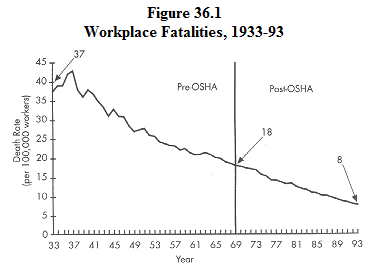
This reminded me of a graph I saw years ago in a paper by John Leeth and Tom Kniesner:

They look at a wide variety of evidence (much of which is in other papers, not this one) and conclude that OSHA should be cut back, or perhaps abolished.  Just so you don’t think they are mindless anti-government libertarians, they also argue that workplace compensation insurance is somewhat effective in reducing injuries.  They argue that compensating wage differentials (a market force) is the single most effective deterrent to injuries:

Alternatives to OSHA

In light of its ineffectiveness, giving OSHA more money, personnel, and power is not the way to cost-effective workplace safety. Most protection on the job comes from state workers’ compensation insurance programs and market-determined compensating wage differentials.

State-run workers’ compensation insurance programs are currently the most influential public attempt to promote workplace safety. Insurance premiums that take account of workplace safety encourage firms to establish safe and healthy work environments. As the frequency of claims rises, the price of workers’ compensation insurance increases, thereby penalizing firms for poor safety records. Michael Moore of Duke University and W. Kip Viscusi of Harvard University estimate that, without workers’ compensation insurance, the number of fatal accidents and diseases would be 48 percent higher in the United States.

BTW, there is no obvious “market failure” that would call for regulation.  (And please don’t drag out the tired old argument that companies know the risks, but workers don’t.  That’s not true, and if it were it would call for government information brochures being distributed to workers, not OSHA.)  I find a lot of safety regs to be very annoying.  When I was young I often worked up on ladders.  The newer Skilsaws required two hands to operate, presumably so you wouldn’t cut off some fingers.  That necessitated gripping the ladder with one’s knees.  Power mowers can no longer be operated without holding the handle–forcing contorted body positions when trying to clear debris in the mower’s path.

Matt Yglesias also has a very interesting post on the similarities between some “big government” models (such as the Nordic states) and some “small government” models, such as Singapore, Hong Kong and Chile.  He points out that Singapore’s mandatory savings plan, which has a 35.5% rate, is something like a tax, and the money is deposited in a government run investment fund. I don’t entirely agree with his post (he underestimates the difference between taxes and forced saving), but it’s hard to disagree with the general thrust of his argument .  There isn’t all that much difference between the Nordic economies and the economy cited by the Heritage Foundation as the second most economically free country in the world (and number one if one recalls that HK isn’t really a “country.”)  My initial reaction is to despair that the US is simply too big to adopt either model.  But maybe that’s giving up too easily.

Update:  Commenter Joe pointed to a Bryan Caplan post that cited a David Henderson encyclopedia entry that discussed some Kip Viscusi research on OSHA (did I miss anyone?)

Fun facts from Kip Viscusi‘s article on “Job Safety” in David Henderson’s encyclopedia:

Annual OSHA penalties for safety violations (2002): $149,000,000

Annual Workers Compensation Premiums (2001): $26,000,000,000

Estimated Annual Wage Premiums for Risky Activities (2004 dollars): $245,000,000,000

Bryan suggests that OSHA probably has little effect on injuries.

Review of The Great Stagnation

How great was Tyler Cowen’s marketing coup?  Well he forced a technophobe like me to actually learn how to use Kindle.  I wasn’t too happy about that, which makes me inclined to write a very negative review.  But that’s kind of hard to do credibly when I agree with the central proposition of the book; that technological progress (at least as traditionally measured) has slowed dramatically, and will continue to be disappointing for the foreseeable future.

In an earlier post I argued that my grandma’s generation (1890-1969) saw the biggest increase in living standards; most notably a longer lifespan (due to diet/sanitation/health care), indoor plumbing and electric lights.  Less important inventions included home appliances, cars and airplanes, and TVs.  From the horse and buggy era to the moon landing in one life.  And all I’ve seen is the home computer revolution.  Not much consolation for a technophobe like me.  I’m probably even more pessimistic than Tyler.

The parts of the book I liked best were those that discussed governance.  I had noticed that there was a correlation between cultures that are good at governance, and cultures that are good at running big corporations.    But Tyler added an interesting perspective, arguing that the technologies that facilitated the growth of big corporations also facilitated the growth of big government.  I don’t recall if he made this point, but I couldn’t help thinking that the neoliberal revolution, which led to some shrinkage in government size, was also associated with a move away from the big corporate conglomerates of the 1960s, towards smaller and more nimble businesses.

Tyler has a long list of complaints about the wasteful nature of our government/education/health care sectors, which he hinted is really just one big sector.  While reading this section I kept wondering when he was going to mention Singapore, which has constructed a fiscal regime ideally suited for the Great Stagnation.  When he finally did, on “Page” 830-37, he did so in an unexpected context, as an example of a society that reveres scientists and engineers.  He had just suggested that the most important thing we could do to overcome the stagnation was:

Raise the social status of scientists.

My initial reaction was skepticism.  First, how realistic is it to expect something like this to happen?  I suppose the counterargument is that every new idea seems unrealistic, until it actually occurs.  But even if it did, would it really speed up the rate of scientific progress?  My hunch is that if we doubled the number of people going into science, there would be very little acceleration in scientific progress.  First, because the best scientists (think Einstein) are already in science, driven by a love of the subject.  Second, with a reasonably comprehensive research regime, progress in finding a cure for cancer may require a certain set of interconnected discoveries in biochemistry that simply can’t be rushed by throwing more money and people at the problem.  Similarly, progress in info tech may play out at a pace dictated by Moore’s law.  Given Moore’s law, no amount of research could have produced a Kindle in 1983.  Could more scientists speed up Moore’s law?  Perhaps, I’m not qualified to say.  But that’s certainly not the impression I get from reading others talk about information technology.

Here’s another exhortation that caught my eye:

Be tolerant, and realize there are some pretty deep-seated reasons for all the political strife and all the hard feelings and all the polarization.

I couldn’t help thinking of Paul Krugman and Tyler Cowen, the two brightest stars of the economic blogosphere.  If only one of those two are able to have this sort of dispassionate take on policy strife, how likely are the rest of us mere mortals to be able keep a clear head and remain above the fray?  Still, it’s great advice.

There was only one place where I thought the book went slightly off the rails.  Toward the end of chapter three Tyler Cowen suggests:

Another way of putting this is, you can be an optimist when it comes to our happiness and personal growth yet still be a pessimist when it comes to generating economic revenue or paying back our financial debts.

And now we come to the book’s greatest flaw.  Tyler forget to discuss the all-important concept of . . . you guessed it . . . NGDP!  If we had more NGDP, we could pay back all those nasty debts.  Now before everyone starts madly typing out angry comments, I do understand the difference between nominal and real debts, I do realize that Tyler is looking and long term secular problems, not short term cyclical problems, and I do realize that the Fisher effect holds in the long run; you can’t inflate away debts forever.  But that got me thinking, and I started wondering whether Tyler is making an analogous error.

Tyler Cowen argues that the internet might produce all sorts of neat applications that give us endless pleasure and amusement, but without generating much revenue.  He used the term ‘revenue’ over and over again, but I always felt there was something missing.  Why should it matter if it generates much revenue?  One answer is so that we can repay our debts, but that doesn’t really answer my question.  More NGDP allows us to repay our debts.  Fiscal and regulatory reform can prevent us from becoming over-indebted again.  Sure, we might not do those reforms, but Tyler seems to be getting at something deeper, an unavoidable problem with the modern economy.  He seems to imply that even a well-regulated modern economy may not generate enough revenue.  I think that’s wrong.

Consider the following thought experiment.  All sorts of technological innovations on the internet cause our consumption (in real terms) to double, even though they don’t create any more revenue.  Because revenue is unchanged, NGDP is also unchanged.  But by assumption RGDP has doubled, meaning the price level has fallen in half.  In that case why shouldn’t we double NGDP, allowing people to repay their debts?  And even if we don’t double NGDP, people’s real incomes will have doubled, at a constant level of NGDP.  Progress will benefit society whether it generates revenue or not.  Real GDP is real, whether it generates revenue or not.

Tyler also argued that we faced a great recalculation problem, with lots of jobs opening up that need high tech skills, but way too many poorly educated workers.  Yet the facts he presents seemed to point in the opposite direction.  He mentions that the new high tech firms like Facebook can get the job done with an extremely low number of workers.  This webtopia that Tyler foresees won’t require many workers at all.  In that case, what should all our surplus workers do?  How will they find jobs?  Not in agriculture, 2 million farmers can feed the whole country.  Not in manufacturing, we are falling below 10% in that sector.  And most people don’t want three washing machines and four cars.  Where would they put them all?  Here’s what I think most people still want:

1.  A bigger and nicer house, with granite counter-tops.

2.  More restaurant meals.

3.  More fun vacations.

That means we need more construction workers, and granite miners (quarriers?)  We need more cooks and waiters.  We need more hotel receptionists and maids.  More people to work on Carnival cruise ships.  I think our workforce is skilled enough to fill those jobs.  It’s very lucky that the high tech companies that will provide all sorts of wonderful services do not need many workers.  We aren’t Singapore, and would have trouble supplying them.

I’m kind of surprised that Tyler Cowen got detoured into the “where will the jobs come from” cul de sac, as it’s usually associated with people who have very different views from Tyler.  Indeed I’m so surprised that I assume I must have misread him somewhere along the way.  Here’s how I think about jobs.  First, what do we want?  If those things can be provided with very few workers, don’t despair, ask what we want after we have gotten our first wish granted.  And so on, until all the workers are employed.

I also have a slight quibble with his views on education.  I share his intuition that the education/health care/government sector is highly wasteful, but I don’t agree with those who measure the output of education with test scores.  When I went to school I recall sitting in a class of 30, bored out of my mind as the teacher droned on, mostly staring at the clock.  My daughter is usually in a class of 20, often with 3 or 4 teachers in the room, doing all sorts of neat activities.  I hated school, she likes it.  You might argue that we live in a rich suburb, but the city of Boston spends just as much per pupil.

I’m guessing Robin Hanson must have said something to the effect “schooling isn’t about learning.”

FWIW, here are my policy suggestions for the Great Stagnation:

1.  Most important by far; end the war on drugs.  Big pharma can’t cure cancer, but they can end the pain.  But our government won’t let them.  Here’s a government “torture” problem 10,000 times bigger than waterboarding, which is tragically under-reported. (Although Matt Yglesias has a nice post.)

2.  Adopt Houston zoning laws everywhere.  There’s plenty of land around Boston, no reason for houses to be so expensive.

3.  Singapore-style HSAs, pensions and tax regime (including carbon taxes.)

4.  Education vouchers.  It won’t improve tests scores, but it will save boatloads of money.

My review hasn’t given readers a very good summary of this excellent and timely book.  It only costs $4 and one hour—read it yourself.  The best part is a very interesting and perceptive discussion of how the Great Stagnation is putting great strains on many aspects of governance, from political discourse to our ability to finance entitlements and public debts.  I probably agree with 90% of the book.  Even where he has different views from me (say on the social utility of modern finance) he probably has the stronger argument.  My review focused on the 10% where I don’t agree.