Archive for the Category Eurozone


Wise comments from the ECB

Yes, you read that correctly.  Here’s a recent news story:

FRANKFURT (Reuters) – U.S. rate hikes could have greater global repercussions than in the past and affect the euro zone more in some respects than the domestic market, European Central Bank Vice President Vitor Constancio said on Thursday.

A Federal Reserve rate rise would have a bigger impact because emerging markets, particularly China, are more integrated into the global economy than before, countries are more interlinked in production, cross-border capital flows have increased, and forward guidance has become a crucial monetary policy instrument, Constancio said.

China’s economy is now as big as the US economy, and with its currency loosely fixed to the dollar, it is directly impacted by Fed policy. And forward guidance is much more important than the current rate setting.

An additional hurdle is that central banks do not have experience in raising interest rates from an extended period at zero, so they will have to learn through practice, without a full understanding of how economies and markets may respond, Constancio told a conference in Hong Kong.

The biggest global impact of a Fed hike will be through capital markets, not international trade, and German yields already follow the change of U.S. yields in response to Fed tightening by more than one third, Constancio said.

“Overall, the evidence even suggests that spillovers from U.S. monetary policy might be larger (on the euro area) than the domestic effects in the U.S.,” Constancio said.

I think the effect is still stronger in the US, but the need for monetary stimulus is much greater in Europe, so I can see how Constancio would have that perception.  The global economy is particularly sensitive to a slowdown in Chinese investment. Less Chinese investment means reduced commodity exports from Brazil, and lower capital goods exports from Germany. The problem is not just that Chinese growth is slowing, but also that it’s shifting toward consumer goods and services, which are mostly produced within China.

On another topic, I was criticized last month for saying that the market response to the recent Fed meeting was muddled, and hard to interpret.  Some felt that it clearly showed the markets did not oppose a rate increase, or perhaps even favored one.  That’s possible, but I remain skeptical.  Hardly a day goes by without stories like this:

German Bund yields rose on Friday, with investors preferring stocks after minutes of the Federal Reserve meeting suggested that the U.S. central bank was not in a hurry to raise interest rates.

I’ve closely follow market responses to Fed policy for decades, and seen hundreds of similar stories. Any single story can be questioned, but is it likely they are all incorrect?  I’ll keep an open mind on the question, but I am reluctant to change my views based on one confusing market response.

PS.  Over at Econlog I have a reply to Kevin Drum


There’s no such thing as “out of ammo”

This really misses the point:

It’s time for central bankers to ask for help.

As the International Monetary Fund prepares to downgrade its outlook for the world economy again, monetary policy makers are running low of ammunition to fight a fresh downturn. Bank of America Merrill Lynch calculates they have reduced interest rates more than 600 times since the 2008 collapse of Lehman Brothers Holdings Inc. with theReserve Bank of India extending the run on Tuesday by cutting its benchmark more than expected.

While the European Central Bank and Bank of Japan haven’t ruled out buying even more bonds, there are doubts over how much more quantitative easing can achieve given yields are already around record lows and inflation still remains beneath the target of most policy makers. Even easier monetary policy may just end up propelling asset markets rather than economies.

That leaves economists and investors increasingly looking toward governments to lead the rescue efforts should the China-led slowdown in emerging markets infect developed nations. BofA Merrill Lynch sees a 25 percent chance of a recession-like slump this year.

“Monetary policy is basically exhausted in terms of producing real growth and even inflation,” billionaire Bill Gross of Janus Capital Management LLC told Bloomberg Television this month. “Fiscal policy is the second piece of the leg that has to take place in order to get us back to where we want to go.”

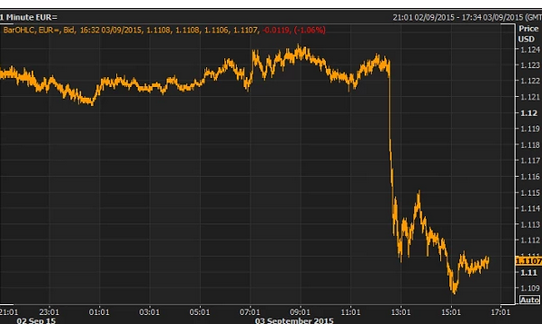
Almost every day something happens that refutes the claims made here.  First of all, there is no evidence that central bankers are not achieving their goals.  The Fed is about to raise rates.  The ECB seems satisfied with its progress in promoting a eurozone recovery.  I don’t think it should seem satisfied, but it does.  Ditto for the BOJ.  Just weeks ago Draghi said he’d do more QE if necessary.  And yet if you believe what I just quoted above, Draghi’s recent announcement should have had no impact on the markets, either because there are no more bonds to buy (out of ammo) or because QE has no effect. Instead here’s what happened to the euro:

Screen Shot 2015-09-30 at 4.58.54 PMIf Bill Gross were correct then it should be impossible to guess what time of day Draghi made his announcement.  But I’ll bet even Ray Lopez can guess.  (Hint, easier than expected money usually makes a currency depreciate in value.)

A beggar thy neighbor policy?  Let’s see how Wall Street reacted:

Wall Street has also welcomed Mario Draghi’s pledge to take more stimulus measure if needed.

The Dow Jones industrial average, and the broader S&P 500, are both up by almost 1%.

The following sounds appealing, until you think about the implications:

If the world economy enters a downdraft, Steven Englander, global head of G-10 FX strategy at Citigroup Inc., proposes a more revolutionary response, akin to the “helicopter money” once advocated by Milton Friedman.

In what he calls “cold fusion,” politicians would cut taxes and boost spending. Central banks would then cover the resulting increase in borrowing by purchasing more bonds as part of a commitment to permanently expand their balance sheets. The easier fiscal policy would be covered by QE Infinity.

“Politically it is difficult for central banks to outright endorse monetization of government debt, but faced with another slump and armed with ineffective policy tools, we expect that central banks will quickly give the wink and nod to fiscal measures,” Englander said in a report to clients last week.

The upshot would be greater purchasing power would be injected straight into the economy, increasing activity and inflation. Long-term bond yields would rise, yet short-term yields adjusted for inflation would turn negative.

Give him credit for recognizing that easier money can end up raising long term bond yields.  And “cold fusion” sounds pretty cool. But otherwise this makes no sense. What does it mean to promise the injections will be permanent?  That suggests you are targeting the monetary base, which could have catastrophic results.  You need to make just enough of the injections permanent to hit your NGDP target.  But if you do that, then the fiscal stimulus is pointless.  Even Paul Krugman claims that monetary policy ineffectiveness occurs when central banks cannot make credible promises to make monetary injections permanent.  But if you assume the promises are made and believed, then the fiscal part of the policy does nothing other than increase the national debt, worsening a problem that is already becoming increasingly worrisome as the population ages.

An important new paper on NGDP targeting

Many people have sent me an excellent new paper by Wolfgang LECHTHALER, Claire A. REICHER, and Mewael F. TESFASELASSIE, Kiel Institute for the World Economy.  The front page notes that:

This document was requested by the European Parliament’s Committee on Economic and Monetary Affairs.

However it clearly represents the authors’ views, and is not any sort of official statement by the EU.

As far as issues related to implementation are concerned, a strict inflation target can be simpler in certain ways to implement than either a flexible inflation target or a NGDP target, because revisions to the data on inflation are small, while revisions to the data on NGDP or real GDP are larger. Moreover there is considerable uncertainty about potential output growth. These are problems discussed in great detail by Orphanides and Williams (2002), Rudebusch (2002), and Goodhart et al. (2013). However, a counter-argument suggests that a NGDP target, even if in levels, would make it easier to avoid issues related to the measurement of the output gap. Additional arguments in favor of NGDP targeting involve the idea that it is easier to sell more stable nominal incomes to the public during bad times, and that a NGDP level target per se would increase the degree to which monetary policymakers are held accountable, by providing a measurable outcome.

To summarize, the theoretical evidence suggests that an explicit NGDP target, especially in levels, could possibly help the central bank to promote long-run price stability while allowing for a short-run response to output. However, this evidence is still relatively uncertain, and in the meantime, we find it useful to clarify the debate about what should and should not be expected to be achieved with a NGDP target.

I’m not qualified to discuss the data revision question, although Mark Sadowski challenged the conventional wisdom.  I would make two points:

1.  Even if measured inflation is not sharply revised, it remains a very inaccurate measure of the sort of price changes that have macroeconomic significance.  For instance, a large share of the core CPI is based on rent and rental equivalents for housing.  That data isn’t even a true “price”, and has no business influencing monetary policy.  Last time I looked housing was 39% of the core CPI.  This problem is briefly discussed later in their paper.

2.  Revisions to NGDP are not large enough to be of macroeconomic significance, with one exception—changes in methodology.  A recent example is the addition of R&D spending to investment, which caused a jump in NGDP.  But there’s pretty general agreement that monetary policymakers would allow “base drift” in those cases; they’d raise the target by the amount of the upward bump from the new definition of NGDP.  Also note that the Fed should be targeting expected NGDP 12 or 24 months out in the future, which makes near term data revisions much less important.

The theoretical case for NGDP level targeting as a forward guidance tool has been made, among others, by Woodford (2012). Similarly, in a recently published study, Coibion et al. (2012) have found strong theoretical support for price level targeting. Importantly, they take the zero lower bound into account, and they find that under inflation targeting, recessions that are deep enough so that the ZLB becomes binding are rare but costly. They Is nominal GDP targeting a suitable tool for the ECB’s monetary policy? They go on to show that price level targeting would result in less-deep recessions and stronger recoveries than would inflation targeting. Furthermore, price level targeting would imply that the ZLB would become binding less often. Therefore, switching from inflation targeting to price level targeting can lead to a substantial improvement in overall welfare, even if there is no foolproof way for such a target to always avoid hitting the zero lower bound. However, we are not yet aware of a study which compares price level targeting with NGDP level targeting, in light of the other theoretical considerations that we consider to be important. Therefore, we still consider the choice of a level target, were one to be adopted, to be an open question.

Someone should do that study!

In fact, this inability to use monetary policy to fine-tune prices or GDP motivates the debate about Taylor rules. Under a Taylor rule, the ECB would increase interest rates whenever inflation or output is above target. It turns out that something like a Taylor rule could also be used to implement NGDP targeting, at least when the zero lower bound does not bind. As Andolfatto (2013) shows, this would entail adding an additional term to represent the past deviation of the price level from its long-run path. While the specific implementation of this idea would require more thought, this idea would require relatively few changes from current operating procedures, to the extent that current policy resembles a Taylor rule but with equal weight on inflation and on output.

A more ambitious idea would be to set up a futures market in a price index or NGDP, and then for the central bank to either buy and sell these futures, or otherwise adjust monetary policy, in order to use these futures prices (rather than interest rates) as an operating instrument. To the extent that these futures prices represent accurate forecasts, then this approach should minimize fluctuations in the underlying target. Furthermore, this idea would encourage central banks to act proactively to avoid future target misses, rather than act reactively to past target misses. This idea is known as “market monetarism”, in the words of Christensen (2011) and Sumner (2011). While this approach is innovative, the likely consequences of this policy approach are not yet completely clear, and this approach would require the euro area to set up a new array of futures markets. In fact, for these futures markets to make it possible to target NGDP, financial markets would have to be efficient, in the sense of providing accurate forecasts. To the extent that financial markets are not efficient (because of bubbles, market frictions, or policy itself), then targeting futures prices would not completely solve the problems inherent in implementing a NGDP target. Nonetheless, if futures markets were to be set up, they would likely provide some information about the beliefs of market participants, and this information would be useful in implementing the target.

I’m glad they mentioned the usefulness of setting up these markets, even when they are not used as a policy instrument.

Market inefficiency is real, but very unlikely to be large enough to be of macroeconomic significance.  And if I’m wrong at least there’s the silver lining that I’ll get rich trading the futures when the market price is clearly wrong.

Another issue is related to central bank communication. For instance, Sumner (2011) posits the following scenario. During a period of low inflation, an inflation target calls for higher inflation. However, higher inflation might be difficult to communicate to the public, because the public thinks of higher inflation something bad (i.e. a higher cost of living). In contrast, a NGDP target would call for increase in nominal income, and that might sound more acceptable to the broader public. This is because the public thinks of higher income as something good. The opposite would be true when inflation is high. During a period of high inflation an inflation target calls for lower inflation (which sounds good to the public). In contrast, a NGDP target would call for lower nominal income (which sounds bad to the public). In any case, policymakers who wish to implement an inflation target or a NGDP target would have to think about how they communicate these targets to the public.

Here I add that NGDP communicates more clearly all the time, both when easing and tightening.  The public doesn’t understand the distinction between supply and demand side inflation.  But the authors are correct that the NGDP language would be more popular when the central bank is trying to stimulate.  Of course due to the zero bound problem it is precisely those times when clearer communication is most needed.  When central banks want to tighten they face no zero bound problem, and hence communication is less important.

Read the whole paper, it’s an outstanding survey of the topic, and I’m glad to see that people in Europe are paying attention to this issue.  The current ECB policy regime is clearly not effective in meeting the macroeconomic policy goals of the EU, low and stable inflation plus economic stability.


Evidence that central bankers cannot be trusted

There’s a great new Wall Street Journal article that begins as follows:

In the seven years since the world’s central banks responded to the financial crisis by slashing interest rates, more than a dozen banks in the advanced world have tried to raise them again. All have been forced to retreat.

But it’s never their fault:

Riksbank Deputy Governor Per Jansson, in a 2014 speech, responded to critics saying, “with hindsight, it is clear that monetary policy could have been somewhat more expansionary if we had known that inflation would be as low as it is now.” But, he said, “This is a natural and unavoidable consequence of the fact that monetary policy has to be based on forecasts, which are uncertain.”

Former ECB President Jean-Claude Trichet, who pushed eurozone rates up in 2011, said he needed to react to rising inflation driven by commodity prices and a threat that households and businesses might expect higher inflation rates in the future. The ECB’s mandate was for inflation near 2%, and the ECB delivered “exactly what we promised” during his term, he said in an interview. Subsequent rate reductions happened after he left and the inflation backdrop shifted, he said. Mr. Trichet said he used other measures to combat financial turmoil, including bond purchases and emergency loans to banks.

Per Jansson doesn’t tell the WSJ readers that the Riksbank’s own internal inflation forecast predicted failure, as inflation was expected to remain below target even without a rate increase.  Lars Svensson was so exasperated he resigned in protest. The Riksbank was clearly violating its legal mandate to target inflation.

Regarding Trichet, I don’t know whether to laugh or cry.  Imagine someone named Trichet racing to the edge of the Grand Canyon at 100 mph. Besides him sits Mr. Draghi.  Just before he reaches the edge of the canyon, Trichet rips off the steering wheel and hands it to Draghi.  Here, you drive.  And then he jumps out the window.

Heh, we hit the inflation target under my watch, it was my replacement who fell short.  Don’t blame me.

For years, the Paul Krugmans of the world have been telling us the Eurozone Depression is so deep that monetary policy isn’t enough, we also need fiscal stimulus. At the same time the Trichets of the world are raising rates to prevent eurozone overheating.  You can’t make this stuff up, it’s just too bizarre.

Who am I to question the wisdom of the central bankers of the world?  They are often much more distinguished than I am.  In fact, I don’t trust my own judgment; I presume that Yellen and Fischer are much better monetary economists than I am. But it seems the markets also think the Fed is wrong:

Fed officials now say they plan to move gradually. But their expectations for rates could still be too high. Officials in June estimated the Fed would raise the short-term federal-funds rate from near zero now to 1.625% by the end of 2016 and to 2.875% by the end of 2017.

Investors have a different view. Fed-funds futures markets, where traders place bets on the outlook for the central bank’s benchmark interest rate, put the Fed target at under 1% at the end of 2016 and under 1.5% at the end of 2017. In anticipation of the Fed’s next policy meeting, some officials have said they expect to reduce their projections for rates in the future. Their projections for where rates will end up in the long run have drifted down by a half percentage point in the past three years.

Yup, they’ve “drifted down” and they’ll keep drifting down, as long as central bankers think they are smarter than the markets.

As you read the following, think about how the real risk free interest rate is determined in global markets.  Then ask yourself how much success the Fed is likely to have against this backdrop:

Mario Draghi’s promise that the European Central Bank is willing to step up its stimulus if needed is resonating with economists, who see the euro-area recovery as too shallow to be sustained.

More than two-thirds of respondents in a Bloomberg survey predict the ECB’s president will expand or extend the 1.14 trillion-euro ($1.3 trillion) quantitative-easing program, and almost all of those say he’ll do so within nine months. While an increasing number of respondents see the economy improving for now, they’re also fretting that the upturn won’t last long.

The ECB’s Governing Council has already shown concern that a slowdown in global trade will erode exports, a pillar of the regional recovery, before domestic demand is strong enough to compensate. The central bank this month cut its growth and inflation forecasts and Draghi told reporters that QE is flexible in size, duration and composition. In contrast, the Federal Reserve may raise its interest rates as soon as this week.

“QE risks becoming a semi-permanent feature,” said Gianluca Sanna, a portfolio manager at Banca Monte dei Paschi di Siena SpA in Milan. “While it’s certainly true that the euro zone is indeed going through a phase of decent, maybe even above-potential, output growth, chances are that there is nothing self-sustaining in what we are seeing right now and the euro zone ends up again in a low-growth environment with inflation dangerously close to zero.”

I very much hope I’m wrong, just as I hope I’m wrong in my prediction that Chinese growth will come in well below the consensus.

HT:  Foosion

Thinking out loud

Always dangerous to speculate when the market is changing minute by minute, but a few observations:

1.  Over at Econlog I did a post earlier this morning, suggesting that the China slowdown is reducing the Wicksellian equilibrium global interest rate.  Since central banks foolishly target interest rates rather than NGDP, this makes monetary policy more contractionary.

2.  Why does this seem to affect foreign markets more than the US market?  One possibility that that economies like Germany and Japan are more exposed to a global slowdown, as manufacturing exports are a bigger part of their economies. But that suggests the yen and euro should be falling against the dollar, whereas they are actually appreciating strongly.  Indeed the appreciation is so strong that one could easily attribute much of the recent stock market decline in Europe and Japan to their strengthening currencies.  Now of course I always say “never reason from a price change,” so let me emphasize that I am implicitly assuming the stronger yen and euro reflect tighter money, not surging growth expectations in Europe and Japan.  I don’t think anyone in their right mind believes global growth prospects have been rapidly improving in the last week, especially when you look at commodity and stock prices.

3.  The falling TIPS spreads and real interest rates suggest that AD expectations are falling in the US, but not anywhere near to recession levels.  After all, did anyone expect a recession last time the S&P was at this level?  Obviously not.  The tighter money in Europe and Japan suggests those economies will be hit harder than the US.

4.  If Europe and Japan are facing tighter money than the US, why would that be? Probably because markets think it would be easier for the Fed to at least partially offset this shock, via a delay in the interest rate increase.  Areas already at the zero bound would have to be more creative, and history has shown that central banks tend to be slower to react at the zero bound, especially when there are sudden and unanticipated shocks like this.  (It’s easier to offset anticipated shocks, like 2013’s fiscal austerity.)

This is all very speculative, and I don’t have a lot of confidence on my analysis. And as always, I don’t forecast asset prices, I merely try to ascertain what the market is forecasting.  Unfortunately the Hypermind market is still not very efficient.  It opened this morning at 3.6%, which was actually up slightly in the past few days.  I don’t think that reflects actual NGDP expectations.  Last I looked it was down to 3.4%, but of course efficient markets respond immediately to shocks.  This tells me that while the market is a nice demonstration project, there is no substitute for a very deep and liquid NGDP prediction market subsidized by Uncle Sam.  If it’s not the biggest $100 bill on the sidewalk, it’s right up there.

One other point.  I’m much more concerned by falling TIPS spreads and falling 30-year bond yields, than I am by falling equity prices.  Stocks often show large price breaks, without there being any change in the business cycle.

PS.  I agree with Lars Christensen’s analysis (except the part about China not becoming the biggest economy.  We face this problem because they already are the biggest.)  I think Lars is right about the two key mistakes being the Chinese yuan/dollar peg and Yellen’s tight money policy.