Archive for the Category Eurozone


Don’t waste time looking for Ratex alternatives

Noah Smith has a new post discussing the current fad of looking for alternatives to the rational expectations model.  The motivation seems to be that we need to explain the collapse of bubble expectations and the rise in the propensity to save (although not actual saving?) during the 2008 recession.  I understand why people want to do this, but it would be a very big mistake.

I’ve always thought that it was patently obvious that the Fed caused the Great Recession with a tight money policy that allowed NGDP expectations to collapse in late 2008. But other people apparently don’t see it as being at all obvious.  They look for alternative explanations.  And yet when you ask them why, they tend to give these really lame “concrete steppes” explanations, such as, “The Fed didn’t raise interest rates on the eve of the Great Recession, so how can you claim that tight money caused the recession?”  Or they show themselves to be completely ignorant of actual Fed policy, and claim that the fed funds target was at zero when NGDP expectations collapsed in 2008.  It wasn’t.

Fortunately, neither of those apply to the ECB, which had positive target interest rates throughout 2007-2012, and which took “concrete steppes” in both 2008 and 2011, tightening money and triggering not one but two plunges in NGDP growth, which led to two recessions.  If there has ever been a more perfect example of the monetary policy/AS/AD model that we teach in our textbooks, I’d like to see it. (OK, maybe 1929-32.) And yet last time I did one of these rants almost no economists were blaming the ECB’s tight money policy for the double dip recession.

Now, I’m seeing progress.  I’m seeing more and more mainstream economists accept the MM claim that the monetary tightening of 2011 caused the second dip in Europe.  In a few more years economists will realize that the ECB tightening of 2008 (which was also “concrete”) caused the 2008 recession as well.

Then economists may begin to notice that the 2008-09 recession in the US was oddly similar to the eurozone recession, which was clearly caused by tight money. The only (minor) difference was that in the US it was “passive tightening”, if the fed funds rate is your preferred policy indicator.

A few economists don’t buy the “nominal shocks have real effects due to sticky wages and prices” model of demand side business cycles.  I don’t agree with them, but it’s fine if people like John Cochrane don’t accept my claim that the ECB didn’t caused the eurozone depression. But as for the rest, the overwhelming majority who think nominal shocks do matter, I’m mystified.  Take the AS/AD model that you see in McConnell, Mankiw, Krugman, Cowen and Tabarrok, Hubbard, or any of the other textbooks.  Why do we even teach this model if confronted with an almost perfect example of a depression caused by tight money, we simply don’t believe it?

Update: John Cochrane informed me that I mischaracterized his views.  He does believe that nominal shocks have real effects, and that wage and price stickiness do exist.  Mea culpa.

I was inspired to do this post by an excellent recent paper on the eurozone depression, by David Beckworth.

HT: Gordon
 

Germany doesn’t benefit from a weak euro

The past week it’s been open season on Germany.  Even I have occasionally bashed them for their views on monetary policy.  In a way this is odd, because in many respects Germany has been (since 1945) almost like a model country.  Other countries should try to be more like Germany.  It’s also odd because Germany’s views are completely typical of the eurozone–so why single out that one country?  Yes, France and Italy are a bit more moderate, but the other 15 are just as upset with Greece as is Germany.

Ben Bernanke recently made some comments on Germany and the eurozone:

Since the global financial crisis, economic outcomes in the euro zone have been deeply disappointing. The failure of European economic policy has two, closely related, aspects: (1) the weak performance of the euro zone as a whole; and (2) the highly asymmetric outcomes among countries within the euro zone. The poor overall performance is illustrated by Figure 1 below, which shows the euro area unemployment rate since 2007, with the U.S. unemployment rate shown for comparison. . . .

In late 2009 and early 2010 unemployment rates in Europe and the United States were roughly equal, at about 10 percent of the labor force. Today the unemployment rate in the United States is 5.3 percent, while the unemployment rate in the euro zone is more than 11 percent. . . .

The slow recovery from the crisis of the euro zone as a whole is the result, among other factors, of (1) political resistance that delayed by many years the implementation of sufficiently aggressive monetary policies by the European Central Bank; (2) excessively tight fiscal policies, especially in countries like Germany that have some amount of “fiscal space” and thus no immediate need to tighten their belts; and (3) delays in taking the necessary steps, analogous to the banking “stress tests” in the United States in the spring of 2009, to restore confidence in the banking system.

So far this is very similar to my views, except the part about fiscal policy.  But here’s where Bernanke loses me:

What about the strength of the German economy (and a few others) relative to the rest of the euro zone, as illustrated by Figure 2? As I discussed in an earlier post, Germany has benefited from having a currency, the euro, with an international value that is significantly weaker than a hypothetical German-only currency would be. Germany’s membership in the euro area has thus proved a major boost to German exports, relative to what they would be with an independent currency.

I see this argument a lot, but it makes no sense on either theoretical or empirical grounds.  Over at Econlog I have a post showing that northern European countries not in the euro have just as big current account surpluses as Germany.  And by the way, even on theoretical grounds joining the euro should not matter at all, if Europe had previously had a fixed exchange rate system.  So I’ll give Bernanke the benefit of the doubt and assume that it’s the fixed exchange rate regime that he thinks actually benefits Germany, not the euro itself.  Let’s also put aside the question of why Bernanke thinks a current account surplus “benefits” a country—that’s not standard economics.  Indeed by that logic Australia would be suffering from its large chronic CA deficits.  The CA surplus is simply domestic saving minus domestic investment; it’s not clear why we should care about it.

There is one way to test Bernanke’s claim.  A country with an undervalued currency will see its real exchange rate appreciate through inflation.  Recall that in the long run monetary policy only affects the nominal exchange rate, the real exchange rate is determined by the fundamentals driving saving and investment.

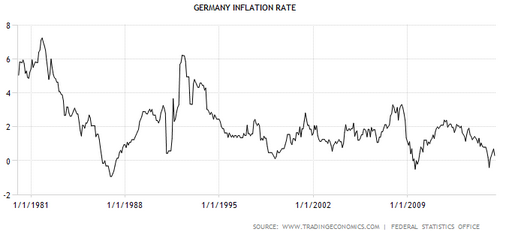
The counterargument is that prices are sticky, and hence it may take a while for the real exchange rate to reach equilibrium.  Yes, but even so, if this were occurring then you’d see high inflation in Germany during the adjustment process.  Here’s the actual inflation rate in Germany:

Screen Shot 2015-07-18 at 12.41.08 PM

It seems to me that Bernanke’s claim might apply to the early 1990s.  At that time Germany was booming, partly due to the rebuilding involved with re-unification, and the ERM tied Germany to weaker economies like Britain and Sweden.  At that time, the DM was undervalued, and instead of a rise in the nominal exchange rate (prevented by the ERM), inflation rose sharply higher, raising the real exchange rate.

Today German inflation is merely 0.3%, not what you’d expect if the euro were undervalued in Germany.  Indeed I see little evidence of an undervalued currency in Germany since 1995.  Let’s review:

1.  Bernanke’s claim is not consistent with mainstream macro theory, at least in the long run.

2.  Bernanke’s claim is not consistent with the fact that other northern European countries that still have their own currencies also have huge CA surpluses.  Why wouldn’t a Germany with the DM be like Sweden and Switzerland? (I leave out Norway, whose CA surplus may be bolstered by oil.)

3.  And Bernanke’s claim is not consistent with the very low and falling inflation rate in Germany.  If the euro were undervalued in Germany, inflation would be high and rising.

Lars Christensen on the euro disaster

Lars has a great new post on the euro disaster:

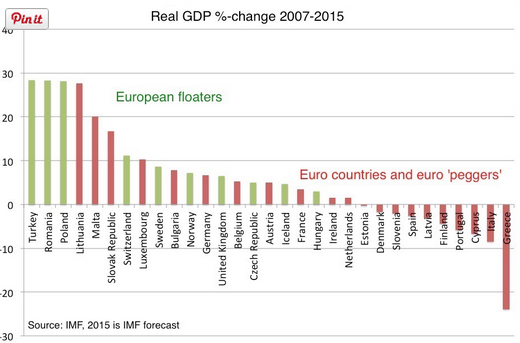
The graph below shows the growth performance for these two groups of European countries in the period from 2007 (the year prior to the crisis hit) to 2015.

Screen Shot 2015-07-15 at 11.17.43 AM

The difference is striking – among the 21 euro countries (including the two euro peggers) nearly half (10) of the countries today have lower real GDP levels than in 2007, while all of the floaters today have higher real GDP levels than in 2007.

Even Iceland, which had a major banking collapse in 2008 and the always politically dysfunctionally and highly indebted Hungary (both with floating exchange rates) have outgrown the majority of euro countries (and euro peggers).

In fact these two countries – the two slowest growing floaters – have outgrown the Netherlands, Denmark and Finland – countries which are always seen as examples of reform-oriented countries with über prudent policies and strong external balances and healthy public finances.

When some of the best managed countries in the eurozone can’t even outgrow Iceland, you know that something is very, very wrong.

Strange bedfellows in an endgame only Europe could dream up

We American are simpletons; completely unable to comprehend the dizzying series of twists and turns in this Greek drama. The latest twist is Germany treating Greece like a naughty child, suggesting that maybe they need a 5-year “timeout” from the euro.  And so we arrive at a German/Krugman alliance trying to get Greece out of the euro.  Germany to punish Greece and restore order to the euro, while Paul Krugman sees it as a way of avoiding punishing Greece, of sparking an Argentine-style recovery.

On the other side is the Sumner/Syriza alliance, taking the high road.  Agreeing with the Financial Times that:

Tsipras has capitulated. His antagonists must show magnanimity

Syriza sees Grexit as an economic disaster for Greece and a political disaster for Syriza.  I actually think Syriza would do worse politically if they stayed in the euro.  Even Greece might to worse (it’s unclear, and depends on what else they do). Instead I fear that a Greece pushed out of the euro by Germany would nudge Greece in a radical leftward direction.  A letter writer to the FT reminded readers of the dark side of the “Argentine miracle”:

“One can learn a lot about photography by studying excellent pictures and looking at bad ones. We can emulate the good and try not to duplicate the bad. Argentinian politicians raided bank accounts and absorbed pension plans in the collapse. People who saved for retirement were taken advantage of by populist politicians. Keep that in mind when your country goes down.”

And I also worry that the markets are clearly signaling that Grexit would be a deflationary shock to the other PIIGS, and indeed to the entire global economy. (Yes a modest one, but still unwelcome.)  But I am a bit conflicted, as also I see the euro itself as a huge mistake, a sort of doomsday machine.

And so we await the dramatic climax that I am certain will occur today, because the Europeans told me so.  Oh wait, I forget that we Americans are gullible simpletons like the cartoon character Charlie Brown.  Darn, fooled again.

PS.  Lars Christensen has a really nice post on how the entire euro project exemplifies Hayek’s Fatal Conceit.


The Producers

(This post is pure speculation, but let’s have some fun with it anyway.)

During the campaign for the recent Greek referendum, something inexplicable happened. The Greek leader Tsipras suddenly offered a compromise proposal that he said was very close to the proposal of the creditors.  Tsipras was campaigning for a no vote, but this move seemed to support the yes position.  Very odd.  His supporters were very upset. In email correspondence with Tyler Cowen, I mentioned my confusion.  He suggested that there might be nested games being played, perhaps Tsipras secretly prefers a yes vote.  Then on Tuesday Ambrose Evans-Pritchard reported this bombshell:

Like a tragedy from Euripides, the long struggle between Greece and Europe’s creditor powers is reaching a cataclysmic end that nobody planned, nobody seems able to escape, and that threatens to shatter the greater European order in the process.

Greek premier Alexis Tsipras never expected to win Sunday’s referendum on EMU bail-out terms, let alone to preside over a blazing national revolt against foreign control.

He called the snap vote with the expectation – and intention – of losing it. The plan was to put up a good fight, accept honourable defeat, and hand over the keys of the Maximos Mansion, leaving it to others to implement the June 25 “ultimatum” and suffer the opprobrium.

This ultimatum came as a shock to the Greek cabinet. They thought they were on the cusp of a deal, bad though it was. Mr Tsipras had already made the decision to acquiesce to austerity demands, recognizing that Syriza had failed to bring about a debtors’ cartel of southern EMU states and had seriously misjudged the mood across the eurozone.

Instead they were confronted with a text from the creditors that upped the ante, demanding a rise in VAT on tourist hotels from 7pc (de facto) to 23pc at a single stroke.

Creditors insisted on further pension cuts of 1pc of GDP by next year and a phase out of welfare assistance (EKAS) for poorer pensioners, even though pensions have already been cut by 44pc.

They insisted on fiscal tightening equal to 2pc of GDP in an economy reeling from six years of depression and devastating hysteresis. They offered no debt relief. The Europeans intervened behind the scenes to suppress a report by the International Monetary Fund validating Greece’s claim that its debt is “unsustainable”. The IMF concluded that the country not only needs a 30pc haircut to restore viability, but also €52bn of fresh money to claw its way out of crisis. . . .

Syriza has been in utter disarray for 36 hours. On Tuesday, the Greek side turned up for a make-or-break summit in Brussels with no plans at all, even though Germany and its allies warned them at the outset that this is their last chance to avert ejection.

The new finance minister, Euclid Tsakalotos, vaguely offered to come up with something by Wednesday, almost certainly a rejigged version of plans that the creditors have already rejected.

That was a very pessimistic article, but I saw a possible upside—both sides actually might want a deal.  On Wednesday I linked to the article and commented:

If so, is a deal still possible?

Then commenter Mike Sax pointed out that Varoufakis once linked to an article by Evans-Pritchard, praising it lavishly.  Interestingly, the new Evans-Pritchard piece reflects some of the views held by Varoufakis.  Could he be a source?

And then global stock markets started rallying.  Today the BBC has this report, entitled “Athens Capitulates to Creditors”:

Not for the first time over the five years of Greece’s euro crisis – or the eurozone’s Greece crisis – I am confused.

My confusion stems from the proposals for tax, benefit and economic reform submitted by the Greek government to secure, at the very last minute of the last hour, a deal from their creditors to avoid tumbling out of the euro.

Having obtained a copy of this paper, headed“Greece: Prior Actions – Policy Commitments and Actions to be taken in consultation with the EC/ECB/IMF staff”, it feels very familiar.

That familiarity stems from its great similarity to the bailout proposals put to Greece by the creditors – the eurozone governments, the European Central Bank and the IMF – last month.

Pretty much everything wanted by the creditors is there – with the odd tweak or softening, but nothing which looks as though it ought to be noxious to them.

So there is a pledge for budget surpluses rising in steps to 3.5% of GDP or national income by 2018; VAT would be raised to three rates of 23% (the standard rate), 13% (for food, energy, hotels and water) and 6% (for medicine and books) – increases that would raise revenue equivalent to 1% of GDP; and Athens is eating the dust of comprehensive reforms of pensions to make them more affordable; and so on.

So here’s why I am a bit baffled.

Only a few days ago the Greek prime minister Alexis Tsipras won an overwhelming mandate from the Greek people, in a referendum, to reject more-or-less these bailout terms.

And today, on the back of that popular vote, he is signing up to the supposedly hated bailout.

This is big politics that would make Lewis Carroll proud.

Or Mel Brooks.  It would be like selling the same play 10 times over to 10 investors. The play would have to be so bad that it would definitely fail, and then you pocket all their money.  But what if it succeeded?

It’s too soon to say any of this is true.  But each hour that goes by I am more and more convinced that this prediction will somehow turn out accurate:

Does it sound like Syriza was telling the truth?  Will the Greeks now negotiate a better deal?  Or did they not even bother presenting an offer because they knew the game is over and Grexit is approaching?  I’m not sure, but within a week we’ll probably know the truth.  My hunch is that a month from now this won’t be viewed as a “victory for democracy.”

Not my view that Grexit was likely, but rather the prediction that in the end this won’t be seen as a victory for democracy. Some very subtle games are being played here on both sides.  To think that voters could suddenly be thrust in the middle of these complex games, with no understanding of what’s really going on, and less than the legally required two weeks to analyze the situation, and make a helpful contribution to the negotiations, seems increasingly utopian.  I love referenda, but this isn’t how it’s supposed to be done.

Again, this entire post is speculation; I have no information beyond the opinions linked to above.

PS.  If a deal is reached it will be very good news for the global economy–there was danger of a deflationary shock.  But it won’t be good news for Greece, indeed in some ways the worst of all possible worlds.  The socialists will still be in power, reluctant to do neoliberal reforms, and there’s no silver lining of a boost to NGDP coming from devaluation.  Overall I’m happy if there’s a deal because I care most about global welfare—but with a tinge of sympathy for the Greeks.