
Archive for the Category Efficient markets hypothesis


Are Aussie housing regulations the dumbest rules on Earth?

Commenter Colin Docherty sent me an article on the Reserve Bank of Australia’s counterproductive attempt to hold down house prices with tight money:

The Reserve Bank of Australia’s surprise decision to defer its widely anticipated April rate cut for at least another month might have been influenced by the increasingly pricey housing market, which it regards as posing a real “dilemma”.

According to UBS, in March the ratio of Australian dwelling prices-to-disposable household incomes equalled – and is presently surpassing – the previous record of 5.3 times set back in September 2003. And they predict it will climb further.

As a result, Aussie inflation is now sliding far below the 2.5% target, and unemployment has been climbing. This is the same policy the Fed tried in 1929. This is the same policy the Riksbank tried in 2010.  Do central bankers ever learn?

Back in 2009 I ridiculed the idea of bubbles by pointing out that while all the English speaking countries had seen huge house price surges in the early 2000s, only the US and Ireland saw a crash.  Australian prices were particularly robust. But despite the bubblemongers being wrong about these countries, they continued to insist it was all a bubble.  OK, I can sort of understand how people could make that mistake in 2009. But now, six years later, Australian house prices are still up at the same lofty levels.  Is the term “bubble” now so elastic that it can fit a house price boom that’s occupied virtually the entire 21st century?  How about if prices are still high in 2020—will it still be a bubble?  How about 2030?  How about 2050? Of course the bubblemongers will refuse to answer these questions because like soothsayers they always want an “out” if their predictions fail.  They always want to be able to say; “You just wait and see.”

And how about those people who said Bitcoin was a bubble at $25?  I’m will to buy coins from you guys at twice the price you said was a bubble back then.

I still haven’t gotten to the dumbest policy on Earth.  Australia is the size of the continental US, with a population smaller than Texas.  Like Texans, Aussies should be able to afford comfortable single-family homes.  But in the right column of the article linked to above, I see links for these articles:

I can visualize microapartments in Hong Kong, but Australia? Are the zoning regulators there sadists?  What would cause an otherwise sensible country to have such insane housing rules that Sydney would end up with some of the highest land prices on Earth?

Milton Friedman said:

If you put the federal government in charge of the Sahara Desert, in 5 years there’d be a shortage of sand.

Well the Australian government was put in charge of land use in a country the size of the Sahara, and now they have microapartments.

I’m begging regulators there to make me look like a fool.  Pop that nonexistent housing bubble by changing the fundamentals.  Give landowners the freedom to build, like they have in Germany.  Please, make me look like a fool.

Update:  Lorenzo has a much better post today on housing, interest rates and monetary policy.
The New Yorker on monetary policy

I recall the New Yorker used to advertise itself as “the best magazine in the world.”  I think it’s fair to say that this was not based on its economics reporting.  Gordon sent me the following:

At the end of last year, when jobs and output both appeared to be growing strongly, members of the F.O.M.C. were predicting that G.D.P. growth in 2015 would be somewhere between 2.6 and 3.0 per cent. Now they have cut their prediction for growth this year to somewhere between 2.3 and 2.7 per cent. That’s not a drastic revision, but it reflects a number of recent economic statistics, such as retail sales and exports, having come in weaker than expected. Yellen pointed to a subdued housing market and a stronger dollar as restraining factors.

While Yellen was at pains to point out that other recent indicators, notably jobs numbers, have remained strong, the big rise in the dollar over the past year clearly has Yellen’s attention. Indeed, I suspect that the rally in the currency has prompted a serious rethink inside the Fed””and for good reason. The rise in the dollar means, effectively, that monetary policy has already been tightened. From an economy-wide perspective, an appreciation of the currency acts just like an actual rise in rates: it reduces the over-all level of demand and causes a slowdown in G.D.P. growth. Now that this has happened, it’s no surprise that the Fed would reconsider its next move.

To put it another way, the currency markets have already done a bit of the Fed’s work for it. By signalling to the market over the past few months that it was preparing to raise rates, the Fed prompted currency speculators to buy dollar-denominated assets, which bid up the price of the U.S. currency. Since this time last year, the value of the dollar against the euro has jumped by almost thirty per cent.

I can’t believe the Fed is downgrading its growth forecasts for 2015, who ever would have expected that to occur?  (Does anyone recall the last time they didn’t have to do that?)

More importantly, a rise in the dollar is most certainly not equivalent to a tightening of monetary policy.  If it was, then the dollar exchange rate would be the proper measure of the stance of monetary policy, not interest rates, real interest rates, the monetary base, M2, er, I mean NGDP growth expectations.

Perhaps the most incredible claim is that the dollar’s recent surge is due to the Fed signaling an intention to raise rates later this year, as if the market was not fully aware of that fact back when the euro traded at $1.35.  The new information in the last year has been monetary stimulus out of Europe (and probably some other things that I’m not aware of.)

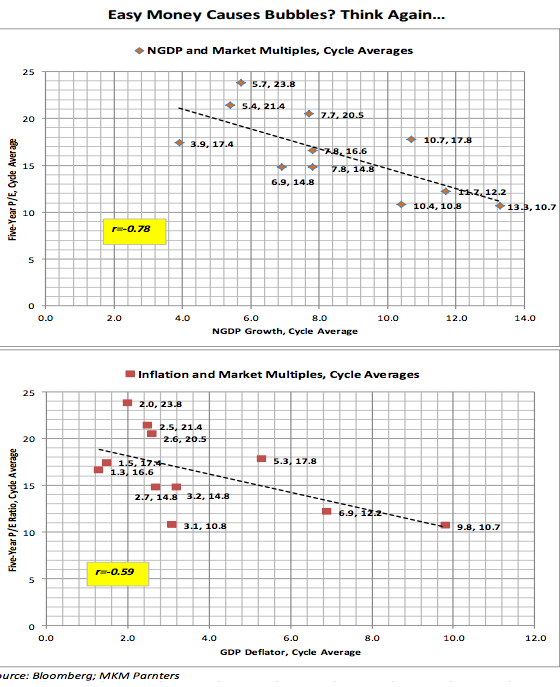
In another New Yorker article John Cassidy suggests that, “the threat of bubbles, not inflation, should guide Fed policy.”  This despite the fact that the Fed’s last effort at bubble popping (in 1929) didn’t work out so well.  Not to mention that there is essentially no evidence as to what causes bubbles, which are not generally associated with easy money policies.  Michael Darda recently sent me a graph showing that “overvalued” markets are actually more likely to occur when money is tight:

Screen Shot 2015-03-20 at 5.13.20 PM

Krugman on NRFPC

Paul Krugman has weighed in on my “never reason from a price change” argument.

[And of course NRFPC it isn’t my idea; it’s a part of EC101 that many economists never learned, or forget on occasion.  Over at Econlog I cited a great Krugman essay where he claimed that one reason he became successful is that he took the stance of a rebel, while using arguments out of standard econ textbooks.  I suggested someone else who had modest success doing exactly that.]

Here’s Krugman:

Sumner says that you can’t reason from a price change; the dollar doesn’t just move for no reason, so you have to go back to the underlying cause and ask what effect it has. Actually, asset price moves often have no clear cause “” they’re bubbles, or driven by changes in long-term expectations, so you really do want to ask about the effects of price changes you can’t explain very well.

Obviously I don’t agree about the existence of bubbles–Fama shoots that idea down in his Nobel lecture.  But even if I’m wrong about bubbles, Krugman is wrong about the relevance of never reason from a price change to bubbles.  It matters very much why prices change, even if those reasons are irrational.  For instance, stock prices may be driven to irrational heights because:

A.  People are irrationally pessimistic about NGDP growth, and this depresses bond yields to unreasonably low levels, and this discounts a given flow of earnings at a higher valuation.

B.  People are unreasonably optimistic about the economy, and expect a highly implausible rate of growth in NGDP and profits.

Surely you can’t argue that it doesn’t matter which of those two types of irrationality cause the stock price “bubble”?  And surely you can’t have confidence that something is a bubble without having some sort of view as to what market thinking is leading to the excessive price movements?

Krugman continues:

More specifically, Sumner is right that if the euro’s fall is being driven by expansionary monetary policy, this affects the U.S. through the demand channel as well as competitiveness, so it may be a wash. But I’ve already argued that the fall in the euro is much bigger than you can explain with monetary policy; it seems to reflect the perception that Europe is going to be depressed for the long term. And if that’s what drives the weak euro/strong dollar, it will hurt US growth.

I agree with the reasoning process in the last sentence.  But I don’t think it applies to the current case, as it seems very unlikely that lower growth expectations are what is depressing the euro.  Here’s what we do know:

1.  Eurozone growth expectations have been in the toilet for years.

2.  The euro was valued at about $1.35 for years, and then gradually fell to about $1.05 over the past few months.

3.  During the past few months the growth forecasts of the eurozone have been revised upward, as the euro has been falling.

You don’t need to be an EMH fanatic like me to see a problem with Krugman’s argument. Kudos to him for not reasoning from a price change, for not lazily assuming that a weaker euro meant more growth.  But I think’s he’s gone too far in the other direction, in assuming that the cause of the weaker euro was lower growth expectations.

Having said that, I’ll admit I’m a bit puzzled by the timing of the euro’s fairly steady decline.  Some of that was associated with easy money statements coming out of the ECB, but not all. So there may be some other factor depressing the euro that I don’t see. I just don’t see any evidence that slower growth in the eurozone is that mysterious X factor.  It’s not new information.  On the other hand Krugman’s right that weaker growth might be the cause, so I’m willing to revise my views as new information comes in, such as another growth pause in Europe.  There is no theoretical issue at stake here, separating our two views.

Off topic, don’t read too much into my statements on Fed policy over the next few years.  Unlike in past years, when the Fed was clearly much too tight, I don’t think they are far off course.  Some of my statements might suggest I think policy is not far off course, others might suggest I think policy is a bit too tight to hit the Fed’s dual mandate.  There is no contradiction between those statements.  It’s hard to evaluate current policy without knowing where the Fed wants to go, and they refuse to tell us where they want to be in 10 years, either in terms of the price level or NGDP.  If they would tell us, I’d recommend they go there in the straightest path possible.

Also, I see people talking like it’s perfectly obvious that Fed policy is now much tighter than ECB policy.  That’s not at all obvious.  What causes that perception?

1.  The ECB has recently loosened, and the Fed may have slightly tightened.

2.  Rates are lower in Europe, and they are doing QE.

Neither of those are good reasons.  During 2011-14 ECB was far tighter than in the US. So even though they have loosened, it doesn’t mean that ECB policy is looser in absolute terms. The deeper into a liquidity trap you fall, the more “concrete steppes” you need to achieve a given policy stance.  And the eurozone has fallen very, very deeply into their liquidity “trap.”  Of course neither interest rates nor the monetary base are good indicators of the stance of policy, unless you want to argue that the Fed’s highly deflationary policy of 1932 was actually easy money because rates were near zero and the Fed was doing QE. That claim would have been viewed as wacky 10 years ago, although I admit that many economists now seem hopelessly confused about how to define the stance of monetary policy.

As always, NGDP futures markets in the two regions would best establish the relative stances of monetary policy.  TIPS markets suggest the ECB is still effectively tighter.

HT:  Foosion, Edward

Did Keynes understand his own theory? Apparently not.

At least if we are to believe modern Keynesians like Paul Krugman, who insist that the deep 1937-38 recession was produced by a tightening of fiscal policy.

In previous posts I’ve pointed out that there are all sorts of problems with the modern Keynesian explanation for 1937.  The tightening was mostly in taxes and transfers, not government output.  In contrast, modern Keynesians suggest that stimulus involving government output is far more effective than tax cuts.

The timing is also wrong.  Investors were fully aware of fiscal tightening in early 1937, yet stocks were at very high levels.  In contrast, my explanation of the deep recession (mostly a turnaround in the world gold market which led to deflation) correlates very closely with movements in the stock market.  (I also think FDR’s high wage policy played a role in the recession.)

But who cares what I think.  I’m more interested in Keynes’s views.  Would he agree with me or Krugman?

Keynesians like to make a big deal of Keynes’s skill in investing, which is mostly (albeit not entirely) a myth.  He lost lots of money in the 1920s and had to be bailed out by his father so that he could start over again.  In the spring of 1937 he thought it was a great time to own US equities, indeed so much so that he purchased many on margin.  How’d that work out?  Here John Hussman:.

As biographer Robert Skidelski observes, “In the year of the ‘terrific decline’ which had started in the spring of 1937, he lost nearly two-thirds of his money.”

Keynes was fully aware of the fiscal tightening by this time.  And he was fully aware that a steep recession would cause a sharp sell-off on Wall Street.

So which is it?  Is the Keynesian theory wrong?  Or did Keynes not believe his own theory?

I say the Keynesian theory is wrong.  There was no reason for Keynes not to own stocks in 1937.  The events that caused the severe recession also caused the stock market crash–and those occurred in the last half of 1937.  EMH + market monetarism >>>>>> Keynesian theory.

Are corporate profits actually very high?

The OWS crowd is driven by many issues, including income inequality and the falling share of national income going to labor.  I have no reason to question the income numbers, but I also think income is meaningless (as it double counts earnings that are saved), what matters is consumption inequality.  I do wonder, however, about the profit data.  Is it accurate?  Robin Hanson pointed to this interesting post by Jialan Wang:

So according to Benford’s law, accounting statements are getting less and less representative of what’s really going on inside of companies.  The major reform that was passed after Enron and other major accounting standards barely made a dent.

.
Next, I looked at Benford’s law for three industries: finance, information technology, and manufacturing.  The finance industry showed a huge surge in the deviation from Benford’s from 1981-82, coincident with two major deregulatory acts that sparked the beginnings of that other big mortgage debacle, the Savings and Loan Crisis.  The deviation from Benford’s in the finance industry reached a peak in 1988 and then decreased starting in 1993 at the tail end of the S&L fraud wave, not matching its 1988 level until … 2008.

So the accounting profit data is not accurate.  In that case, how would we know if corporations have become highly profitable?  The obvious place to look is stock prices.  The EMH says equity markets can see though dodgy accounting.  In addition, for policy issues related to income distribution we care more about the expected future level of profits over a number of years, rather than merely a snapshot of current profits.

In this post Matt Yglesias shows that stock prices have been very volatile, but in recent years there’s no strong upward trend.  Oddly, I think the progressive Matt Yglesias is actually too pessimistic about stock prices–a longer time series would have shown an upward trend.

But are stock prices actually the right metric?  After all, stocks measure the discounted present value of future profits.  What if the discount rate changes?

We’ve seen real interests rates fall sharply in recent years, to exceptionally low levels.  Thus future profits are currently being discounted back into stock prices at a very low discount rate.  The fact that the S&P is no higher than in the late 1990s suggests that expected corporate profits have fallen very sharply.  (Or has risk aversion increased?)

I also wonder about the problem of multinational investments.  Are we interested in corporate profits earned by American firms?  Or corporate profits earned using American labor?  If it’s the latter, we should add in profits from Japanese transplant factories, and subtract out profits that US MNCs are earning in China.  Otherwise you’d end up with anomalies like labor earning less than 1% of national income in the Cayman Islands.

Finance isn’t really my area, so I imagine I’ve made many mistakes here.  I await clarification by my many excellent commenters.