
Archive for the Category Efficient markets hypothesis


Thinking out loud

Always dangerous to speculate when the market is changing minute by minute, but a few observations:

1.  Over at Econlog I did a post earlier this morning, suggesting that the China slowdown is reducing the Wicksellian equilibrium global interest rate.  Since central banks foolishly target interest rates rather than NGDP, this makes monetary policy more contractionary.

2.  Why does this seem to affect foreign markets more than the US market?  One possibility that that economies like Germany and Japan are more exposed to a global slowdown, as manufacturing exports are a bigger part of their economies. But that suggests the yen and euro should be falling against the dollar, whereas they are actually appreciating strongly.  Indeed the appreciation is so strong that one could easily attribute much of the recent stock market decline in Europe and Japan to their strengthening currencies.  Now of course I always say “never reason from a price change,” so let me emphasize that I am implicitly assuming the stronger yen and euro reflect tighter money, not surging growth expectations in Europe and Japan.  I don’t think anyone in their right mind believes global growth prospects have been rapidly improving in the last week, especially when you look at commodity and stock prices.

3.  The falling TIPS spreads and real interest rates suggest that AD expectations are falling in the US, but not anywhere near to recession levels.  After all, did anyone expect a recession last time the S&P was at this level?  Obviously not.  The tighter money in Europe and Japan suggests those economies will be hit harder than the US.

4.  If Europe and Japan are facing tighter money than the US, why would that be? Probably because markets think it would be easier for the Fed to at least partially offset this shock, via a delay in the interest rate increase.  Areas already at the zero bound would have to be more creative, and history has shown that central banks tend to be slower to react at the zero bound, especially when there are sudden and unanticipated shocks like this.  (It’s easier to offset anticipated shocks, like 2013’s fiscal austerity.)

This is all very speculative, and I don’t have a lot of confidence on my analysis. And as always, I don’t forecast asset prices, I merely try to ascertain what the market is forecasting.  Unfortunately the Hypermind market is still not very efficient.  It opened this morning at 3.6%, which was actually up slightly in the past few days.  I don’t think that reflects actual NGDP expectations.  Last I looked it was down to 3.4%, but of course efficient markets respond immediately to shocks.  This tells me that while the market is a nice demonstration project, there is no substitute for a very deep and liquid NGDP prediction market subsidized by Uncle Sam.  If it’s not the biggest $100 bill on the sidewalk, it’s right up there.

One other point.  I’m much more concerned by falling TIPS spreads and falling 30-year bond yields, than I am by falling equity prices.  Stocks often show large price breaks, without there being any change in the business cycle.

PS.  I agree with Lars Christensen’s analysis (except the part about China not becoming the biggest economy.  We face this problem because they already are the biggest.)  I think Lars is right about the two key mistakes being the Chinese yuan/dollar peg and Yellen’s tight money policy.
China: More of the same?

I recently listened to a very good interview of Tyler Cowen by Erik Torenberg. For me, it was 80 minutes of bliss. I tend to agree with the vast majority of his views (even one’s where I had no opinion until I heard his reasoning), with one notable exception—China.  Tyler seemed very pessimistic about China’s short-term prospects, and seemed to think they were headed into recession.

I’m not sure the last time China had a recession; the last time they experienced sub-5% economic growth was 1989-90, and growth was still about 4% in each of those two years.  I guess you could call that a growth recession.  But I’m fairly confident that Tyler expects something considerably worse.

My general view is that most types of recession are almost unforecastable, and that the least bad prediction is always “more of the same.”  (Here I’m thinking of ordinary demand shocks or financial crisis; a recession caused by something like the Syrian civil war can be predicted once the war begins.)  Thus people who in 2007 didn’t predict a recession for 2008 were making sensible predictions, and those who did predict it were making foolish predictions, and just got lucky.  So I’m going to predict no recession for China, this year or next.

Some might argue that there are good reasons to predict a recession, and that it’s not just a wild guess:

1.  The Chinese stock market has collapsed.

2.  The Chinese yuan has been devalued.

3.  The Chinese macro data is ugly.

I say no, those three statements are all inaccurate.  The Chinese stock market is about 20% below its recent peak, but still far higher than a year or two ago.  There is nothing in stock prices to indicate a recession.  You might respond that Chinese government intervention has made Chinese stock prices meaningless. Fine.  Then let me rephrase that; there is nothing in Chinese stock prices to indicate a recession, because they are meaningless.

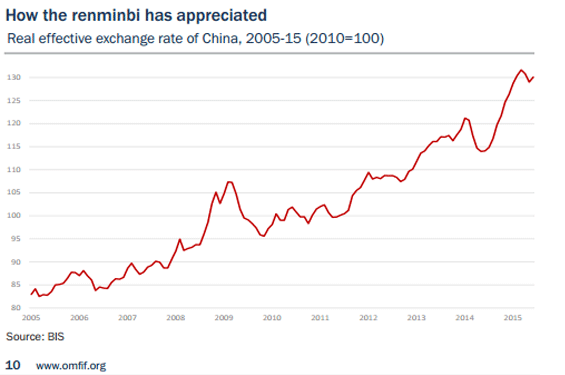
It’s also not accurate to say the Chinese yuan has recently been devalued.  The value of the yuan against a basket of currencies has been trending higher for many years.  Nothing significant has changed in that regard in recent weeks.  The yuan is still higher than a year or two ago, still very strong against almost all currencies around the world.  (Indeed too strong, and if a recession does occur it will be due to tight money.)

Screen Shot 2015-08-15 at 4.14.16 PM

And the macro data does not indicate a recession.  The Chinese economy has been growing at about 7% per year, and while I expect it to slow a little bit next year, I doubt the slowdown will be dramatic.

People often forget that with all its problems China still has enormous momentum. Let me just give you one example. China is building infrastructure at a very rapid pace, all over the country.  The construction of infrastructure is itself a part of GDP. But the whole point of building infrastructure is that it provides services.  Last year Beijing’s subways provided 3.41 billion rides, more than any other system in the world.  But their subway system is still very inadequate, and is often extremely crowded.  Many more lines are being built, and they’ll be busy too.  Now think about the flow of services from the subway.  In terms of Beijing prices it’s pretty low, as they price tickets at around 50 cents a ride.  But at New York prices it would be closer to $10 billion/year.  I can recall when Beijing’s entire GDP was about $10 billion.  (Yes there’s been inflation, but still . . . )

That flow of subway services is much bigger than the year before and next year it will be much bigger still.  And the same is true of 100 other examples I could cite. Despite what you read about “ghost cities”, there is still a enormous flow of people from rural shacks to modern urban apartments, yielding a massive and increasing flow of housing services—also part of China’s growing GDP.

China is still less that half as rich as Greece is at the bottom of Greece’s depression. Yes, China has lots of inefficiencies, such as state-owned enterprises, but they also have a labor market that’s dramatically more flexible than any labor market in Southern Europe, and which provides reasonably full employment and fast rising wage rates.  Here’s Ambrose Evans-Pritchard:

It is worth remembering that the authorities are no longer targeting headline growth. Their lode star these days is employment, a far more relevant gauge for the survival of the Communist regime.

On this score, there is no great drama. The economy generated 7.2m extra jobs in the first half half of 2015, well ahead of the 10m annual target.

Few dispute that China is in trouble. Credit has been stretched to the limit and beyond. The jump in debt from 120pc to 260pc of GDP in seven years is unprecedented in any major economy in modern times.

For sheer intensity of credit excess, it is twice the level of Japan’s Nikkei bubble in the late 1980s, and I doubt that it will end any better.

At least Japan was already rich when it let rip. China faces much the same demographic crisis before it crosses the development threshold.

It is in any case wrestling with an impossible contradiction: aspiring to hi-tech growth on the economic cutting edge, yet under top-down Communist party control and spreading repression.

That way lies the middle income trap, the curse of all authoritarian regimes that fail to reform in time.

Yet this is a story for the next fifteen years. The Communist Party has not yet run out of stimulus and is clearly deploying the state banking system to engineer yet another mini-cycle right now.

One day China will pull the lever and nothing will happen. We are not there yet.

I’m a bit more optimistic, as I think the reform process will continue.  They’ll avoid the middle-income trap.  But they haven’t yet even reached the trap—a lot more growth is ahead.  If you want to know when that day of reckoning will finally arrive in China, don’t come here looking for answers.  I will miss the collapse, blinded by the EMH, just as I missed every other dramatic economic shock in my entire lifetime.  My predictions are boring, and always the same:

More of the same ahead

My predictions are usually right, but they get no respect, and don’t deserve any.

PS.  I just talked to a Beijing resident who told me that people who cook and clean now make about $4/hour.  That sounds low to Americans.  But that figure’s been doubling every 5 or 10 years for many decades; 25 cents, 50 cents, $1, $2, and now $4.  One more doubling and it would exceed the US minimum wage.  Yes, I’d say within about 15 years something’s got to give in China.  I don’t know when it will be, or whether there’ll be a soft landing, but I can’t see this blistering growth going on much longer.

The Chinese stock market crash

I’ve been asked to discuss something that I don’t know much about, the Chinese stock market.  So here goes:

1.  Stock crashes are often predictions of bad times ahead.  Sometimes they are correct (the US in 1929, 2008) and sometimes they are incorrect (1987).  We know from 1987 that stock crashes don’t actually cause economic problems. Roosters don’t cause dawn.  Chinese stocks are still much higher than a year ago, and the Chinese people won’t decide to stop working just because stocks crash.  Indeed they may work even harder.

2.  It’s possible that the Chinese crash is not a prediction of economic distress, but rather just a sort of mass panic.  But the Australian dollar has been falling in sympathy with Chinese equities, which means that in this case it’s not just panic; it’s actual worry about a slowing economy.  (Unless Australian mass hysteria is correlated with Chinese mass hysteria, which I doubt.)

3.  Tyler Cowen often (wisely) points out that lots of things that superficially look stupid actually have good reasons if you look deeper.  Here he speculates as to why the Chinese government might have wanted to prevent a stock market crash.

4.  However even if Tyler is right, in this case the Chinese government probably is being stupid.  The techniques they are using (such as banning the sale of many types of stock) will actually create more panic, and will lead to more sales from that part of the investment community that is still free to sell.  Just as European governments that make it hard to fire workers end up causing higher unemployment, as people are afraid to hire them.

5.  There’s a lesson here for “bubbles.”  Even if you disagree with my view that bubbles are not a useful concept, there is very little evidence that governments can do anything about them.  The Chinese government tried to stop the bubble on the upside, and then more recently tried to stop the price collapse. It tried hard.  It failed miserably.  China will learn from this lesson.

6.  One reason why bubbles are not a useful concept is that it’s hard to tell what the right price should be in any “fundamental” sense.  Some people thought 1987 was a bubble.  After the huge price collapse of late 1987 they said, “I told you so.”  At that point there seemed to be a consensus among experts that prices had gone way too high, and that a correction was inevitable.  In fact, we now know that prices at the peak of the 1987 “bubble” (Dow 2700) were quite reasonable.  (The Dow was 1700 after the crash.)  If you bought at the peak and held stocks for 10 years, or 20 years, or 28 years (up to today) you did fine.  So the experts were wrong.  Thus even after an apparent bubble collapses, it’s really hard to know which price was right, the peak level or the later trough.  In 20 years we’ll have a better idea whether the Shanghai market should now be at 5000 or 3500 3400 (down 100 since I started typing).  Right now no one has a clue, just as no one in 1987 had any idea that the Dow would be at 17,000 today.

7.  I’d rather the Chinese government stay out of the stock market, but this intervention is of trivial importance compared to the bigger changes occurring in China.  I wouldn’t want the US government to spend a trillion dollars on Vanguard index funds, but if they did so it wouldn’t cause much of a problem.  The tiny Norwegian government has almost a trillion dollars in stocks, and it doesn’t seem to have hurt Norway.  There’s a lot of ruin in a nation as big as China, and China should be far more worried that the PBoC will fail to keep NGDP growing at 5% or more, and/or that Premier Li stops the economic reform process that’s been underway for 35 years, than about whether the Chinese government purchases some stocks.

8.  When I first visited China in 1994 almost no one had cars or owned stocks.  I was fascinated by the country, by the urgent moral issue of raising hundreds of millions of people out of abject poverty and misery.  Quite frankly, I find the modern problems of pollution, traffic congestion and stock market crashes to be rather boring.  Even today poverty is a much more urgent problem for China, but overall the situation is dramatically improved.

PS.  Fascinating story from Ambrose Evans-Pritchard, maybe even true.  If so, is a deal still possible?  (This link is better.)

Confirmation bias and bubbles

I’ve done a number of posts pointing out that people are hard-wired to find patterns where they don’t exist.  Studies have shown that people will see “bubbles”, even in data that is generated to follow a random walk.

Now of course just because most people would believe in bubbles even if they did not exist, does not in any way prove that they don’t exist.  Maybe they do.  But we always have to be on guard against cognitive bias.

Bob Murphy had some fun earlier today commenting on a post I did on China.  His post is entitled Chinese Stock Market Crashing”:

Details here. It’s down about 25% in the last two weeks, and 11% in the last two days.

Meanwhile, Scott Sumner is running victory laps, over those broken records who called it a “bubble” but didn’t give the precise timing.

So it sounds like I did a post mocking Chinese stock market bubble theories, and then the market crashed right after my post.  That wouldn’t really prove anything, but even I have to admit it would be pretty funny.  Chalk one up for Bob.

The only problem is it never happened.  My post was put up on June 27th, and when Bob did his post the Chinese market was actually higher than it was when I did my post.

Does this prove anything about the Chinese market?  No, for all I know it might collapse 20% tonight.  Who knows? It’s certainly been extremely volatile in recent weeks.

What it does show is that people are very receptive to data that supports their preconceived bubble theories.  And this is a part of my anti-bubble theory.  I’ve done posts on how the Economist magazine once bragged that it correctly predicted a bunch of housing bubbles, whereas the article it cited was actually totally, spectacularly WRONG about the future course of house prices in a number of countries.  Prices actually rose in markets where they predicted declines.  And yet the Economist put their “successful” prediction into an ad for the magazine. Someday China will have a big crash, and the people who have been predicting it for a long time will say, “I told you so.”  And I’ll say, “Market prices rise and fall, that’s what markets do.”

Economies have booms and recessions.  If talking about bubbles makes you feel good, go for it.  But don’t think it’s telling us anything useful about the world. When prices are high they might crash, or they might go higher.  That’s what history shows.


Please, do buy. You won’t regret it.

The anti-EMH theories are falling even faster than I expected.  Last year I did a post reminding readers of bubble theories we all heard around 2009-11, which have recently been refuted.

And now Dubai.  Five years ago we were told it was just a giant property bubble, without any sound fundamentals.  Here’s the Economist:

TRAVELLERS flying into Dubai often look down and marvel at the man-made islands with the luxury villas. These outlandish creations came to symbolise the emirate’s economic boom in the mid-2000s””and the crisis that followed in 2009, when it needed help to pay its debts, many related to property development. But once on the ground, travellers see signs of a more sustainable prosperity. The airport is bustling””more international travellers use it than any other.

Dubai has bounced back from the crisis, which saw its economy contract by around 2.5% in 2009. It is expected to grow by around 5% this year, as it did last year.  .  .  .

Dubai long ago used up most of its oil reserves, so the government has for years tried to diversify the economy. While skyscrapers and palaces grabbed headlines, this less glamorous work has slowly paid off: Dubai is now a regional hub in several areas. The airport, which already serves some 70m travellers a year, is set to expand to serve over 200m, eventually. Emirates, the local airline, is world-class. The port at Jebel Ali is by far the busiest in the Middle East, the cargo it handles growing by nearly 12% last year. It is likely to become the biggest container port in the world by 2030.

Three decades ago Jebel Ali became the Middle East’s first big “free zone” (a place where foreign firms can operate, unusually, without a local partner and with less red tape and lower taxes than in the rest of the emirate). Now it is the world’s largest, and Dubai has 22 such zones in total, most based around particular industries. Dubai’s free zone for finance even has its own judicial system, based on common law. The number of companies in it grew by 14% in 2013 and 18% last year, to reach 1,225. More growth is expected, with $1 billion worth of new development planned.  .  .  .

Planners expect Dubai’s population to reach around 3m by the time it hosts the World Expo in 2020. The Chinese are increasingly using it as a logistical hub for their African ventures. Dubai also stands to benefit if sanctions are lifted from Iran, with which it already has strong economic ties.

I guess the world’s biggest international airport, a huge container ports, 22 free trade zones, low red tape and taxes, and a common law judicial system for business don’t count as fundamentals.  Oh, and remember that house price “bubble”?  Yup, just another false claim by the bubble-mongers:

Screen Shot 2015-06-11 at 3.51.39 PM