Author Archive


Give thanks for Progress?

I’m an agnostic on the question of whether we are making progress, and I’d like to start by considering one type of progress, the war against dirt and germs. Over the course of my life, I’ve seen society put non-trivial resources into making our world cleaner and more germ-free. That sounds good! But I’m not entirely convinced, for numerous reasons:

1. When I go to another region, like East Asia, I see lots of examples that seem slightly unhinged. Lots of people wearing surgical masks in public. Waiters with plastic face guards. People forced to take off shoes every single time they enter a house. (Actually, my house is the same, as I defer to my wife.)

2. Intertemporal comparisons also seem dubious. Younger people (which is most people for a 64-year old like me) seem excessively fastidious. If I tell my daughter stories about how my dad used to take me to the “dump” when I was a kid, to search for useful stuff that people had thrown away, she’d be horrified. Ewww! Or that people didn’t pick up after their dogs in the 1960s. Indeed, I’m still a trash collector; the office chair I’m sitting in as I type this post was out at the curb of a neighbor’s house on Newton.  It looked useful so I grabbed it.

I’m self-aware enough to understand the “OK boomer” absurdity of what I’m doing here. I’m horrified when I read about how in the 1800s the streets of NYC were full of horse manure. Or the drinking water situation in London in 1840. Ewww!  It’s all relative.

If you put a gun to my head and forced me to defend the 1960s level of dirt and germs as optimal, I’d say the 1800s really did involve heath risks, but the recent improvements are mostly psychological. And I’d argue that due to the “hedonic treadmill” we are no longer getting better off, because we keep getting pickier about what we consider disgustingly dirty. Even worse, there are theories that too much cleanliness might actually make kids more susceptible to asthma.

But I’m not going to end up trying to defend the boomer generation, who I regard as just as irrational as any other. I plan to question All Progress.  So let’s take some examples:

1.  We obviously have better stuff, like iPhones.  But that’s not the issue. Just having iPhones makes us more impatient, less able to enjoy life’s simpler pleasures.  New York City has recently added a number of 100 story skyscrapers for billionaires to live in.  But that hasn’t made New York’s skyline any more impressive, as it diminishes the more beautiful art deco masterpieces from the 1920s.  It’s all relative.

2.  Suicide rates are rising.  Even worse, many deaths of despair (from drugs) are quasi-suicides.  The standard view is that this is due to hard times in Middle America.  But life expectancy only began declining after 2014, and has continued declining even as the labor market has improved dramatically (especially for low income groups.)  Hispanic life expectancy is nearly 82, far above whites and far above countries like Denmark.  And yet the economic situation of Hispanics supposedly approximates what caused all these deaths of despair—lots of low wage jobs.  If we are making so much progress, why do deaths of despair keep rising?

3.  What about progress made by formerly oppressed groups like blacks and women, and more recently gays and lesbians?  I consider this the single strongest argument for progress.  But even on the cultural front there are setbacks.  Some businesses now ban office romances.  Previous generations would be horrified by these modern killjoys.  Some of the most modern countries, such as Finland and Japan, are seeing a big drop in sex.  That’s a big deal given that we are talking about one of life’s most important pleasures.  Social media brings pleasure to some, but bullying to others.  People 18, 19, and 20 have lost the right to drink a beer.  Our legal system has removed many of life’s pleasures, as when public swimming pools are closed down due to liability issues.  People (including me) used to date people with differing political views—now we are far more intolerant of others.

4.  The Inuit of Canada were brought into the modern world, and it was a complete disaster.  They were a fairly happy group when they lived in their traditional societies, but are miserable today, despite all the “progress” that Canada gave them.

5.  Better health and longevity.  This is the strongest argument for progress, isn’t it?  But I’m one of those rare people who don’t believe in personal identity, just a flow of mental states.  Suppose we go from a society where families have 4 kids than live to 40, to one with two kids that live to 80.  The total number of “man-years” experienced by the family is the same, but recall that the first 40 years are far more enjoyable than the next 40.  So the flow of pleasure is greater in the society with shorter lives.  Once I hit 55, I got an ever increasing number of annoying ailments (fortunately all minor).  More importantly, you lose some of the youthful zest for an adventuresome life.

6.  Novelists are some of the keenest observers of life as it is actually lived.  Are people in 21st century novels experiencing a happier life than those in 20th or 19th century novels?  Most bizarrely, modern characters don’t even seem to suffer from less physical pain, even though we have all these new technologies like novocain.  In my own life, I subjectively “experience” just as much physical pain when I’m sitting around my office as when I do construction work, even though the latter job is objectively far more painful (as when I hit my thumb with a hammer.)  More hedonic treadmills.

7.  I experienced a brief rise in utility as the Milwaukee Bucks went from a 40-win team to a 60-win team.  But now that I’ve internalized their new level, I don’t enjoy games any more than before.  Today, a mere 9-point win over Atlanta is actually slightly annoying.

If you reply that you love your iPhone and would hate to live in the 1960s, then you’ve completely missed the point.  I agree that it would be annoying for a millennial living in 2019 not to have an iPhone.  That’s not the issue.  The issue is whether you would have enjoyed life in the 1960s, or the 1860s, when no one had iPhones, and no one even knew they existed.

There’s a reason why old people are annoyingly reactionary.  They recall a previous time when people were happy despite not having modern tech.  As for moral progress, they recall really nice sweet people who used to spank their children, and thus they don’t consider spanking to be a monstrous form of child abuse.  If you weren’t there you’ll never understand (just as I’ll never understand how dueling was once considered acceptable.)

Because I’m agnostic, I’ll continue working for Progress.  If there’s only a 15% chance that it’s good for us, that’s better than the 5% chance that it’s bad for us.  Pascal’s wager.

Let me conclude with a couple of anecdotes that drive home my skepticism about progress.  In April, my wife and I celebrated our 25th anniversary with a once-in-a-lifetime trip to Bora Bora, staying in two different “over water” hotels on stilts that cost three times more than any other hotel I’ve ever stayed in.  We also had the roof on our house redone this year, a major project as it’s a complicated house with Tuscan tiles and flat (leaky) aluminum sections.  There were lots of workers for three weeks, lots of pounding of nails, lots of mess.  Also the stress of cost overruns.

If you met me during the roof project, I would have told you that I couldn’t wait until it was over.  Bull****!  Deep down I never wanted it to end.  At the end of each workday I’d get up on the roof and chat with Isidro, the project manager, who was from Michoacan, Mexico.  I spent some time in Michoacan as a teenager, and we talked a lot about places we both knew.  He seemed to enjoy chatting to me; most (affluent) people he worked for probably ignored him.  He was also clearly proud of his work, and liked explaining how he solved each technical problem.  I used to do construction for my dad, so I was very interested and at least somewhat informed about his work.  We’d spend an hour or two at the end of each workday, up on the roof chatting as the sun went down over Lake Mission Viejo.  I enjoyed talking with him far more than I’d enjoy talking with an intellectual about public policy.

The Bora Bora trip?  I was sick the entire time, bundled up on the hot sunny beach in long pants and a sweatshirt, watching the young people in swimsuits enjoying life.

Have a nice Thanksgiving!

Hypermind vs. the consensus of economic forecasters

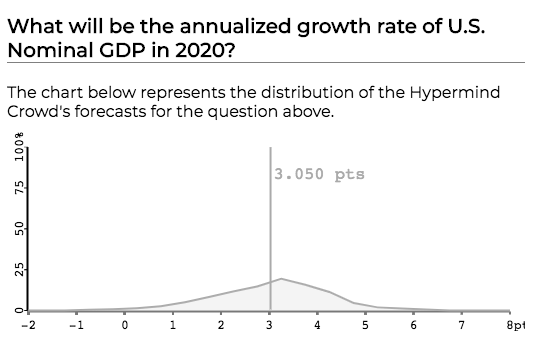
There’s a new Hypermind NGDP prediction market, which you should definitely check out. It’s still early, but right now the mean forecast for growth from 2020:Q1 to 2021:Q1 is 3.05%. That suggests that money is a bit too tight.

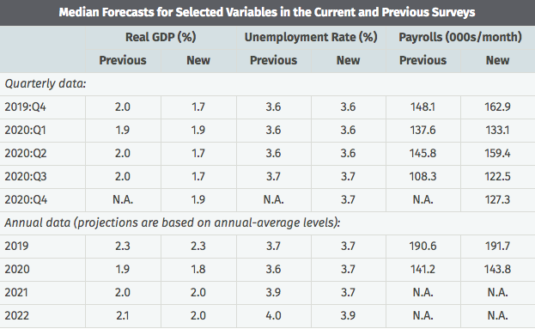
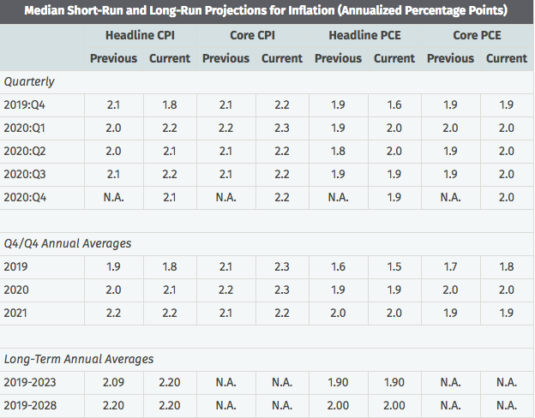
In contrast, the consensus forecast of economists, which is published by the Philadelphia Fed, shows monetary policy is right on course.  They don’t provide NGDP forecasts, but they do have RGDP growth and PCE inflation:

If you combine the 1.8% RGDP growth with the 1.95% PCE inflation, it looks like the consensus forecast for NGDP growth is about 3.75% (albeit for 2019:Q4 to 2020:Q4).  Thus Hypermind forecasters expect nominal growth to be significantly lower than the consensus forecast of economists.

Let’s revisit this post in about 18 months.

PS.  Each forecaster at Hypermind provides a distribution in their new set-up.  So those long tails are not point estimates of individual forecasters. 

Hypermind is actually much easier to use than you’d think.  I encourage people to participate.  You will help to move the economics profession out of the Stone Age and also win free money.

PPS.  The 5-year TIPS spread is 1.55%.  That’s for the CPI, and implies about 1.3% for the PCE.  If you add 1.3% to the Philly Fed’s 1.8% RGDP forecast you get 3.1%.  Interesting.  (I expect inflation to be higher than that.)

PPPS.  FWIW, I predict 3.4% NGDP growth (which includes 1.6% RGDP growth).  That’s midpoint between Hypermind and the Philly Fed.  I believe money’s a bit too tight.


Are you one of those people?

US troops are back on the warpath in Syria:

United States troops have resumed large-scale counterterrorism missions against the Islamic State in northern Syria, military officials say, nearly two months after President Trump’s abrupt order to withdraw American troops opened the way for a bloody Turkish cross-border offensive. . . .

On Friday, American soldiers and hundreds of Syrian Kurdish fighters — the same local allies the Trump administration abandoned to fend for themselves against the Turkish advance last month — reunited to conduct what the Pentagon said was a large-scale mission to kill and capture ISIS fighters in Deir al-Zour province, about 120 miles south of the Turkish border.

“Over the next days and weeks, the pace will pick back up against remnants of ISIS,” Gen. Kenneth F. McKenzie, the commander of the military’s Central Command, told reporters on the sidelines of the Manama Dialogue security conference in Bahrain on Saturday.

Are you confused by this story? Are you one of those people who believes the president has a big impact on policy? Are you one of those people who judges a president based on how the country is doing?

Two views of the Phillips Curve

The standard (Keynesian) view of the Phillips Curve is that a strong economy leads to higher inflation. If I’m not mistaken, Milton Friedman reversed the causation, arguing that higher than expected inflation led to a stronger economy:

There is always a temporary trade-off between inflation and unemployment; there is no permanent trade-off. The temporary trade-off comes not from inflation per se, but from unanticipated inflation, which generally means, from a rising rate of inflation. The widespread
belief that there is a permanent trade-off is a sophisticated version of the confusion between ‘high’ and ‘rising’ that we all recognize in simpler forms. A rising rate of inflation may reduce unemployment, a high rate will not.

That’s also my view of causality, although I think inflation is the wrong variable.  The model should use the rate of growth in NGDP, not prices.

Here’s Nick Rowe:

Andy Harless’ tweet (about the US economy) got me thinking.

There’s a frog-boiling aspect to this economy. The consistent lack of *rapid* improvement throughout the recovery is enabling us to reach levels of employment that might not otherwise have been attainable.

It reminds me of my old post “Short Run ‘Speed Limits’ on recovery“.  The basic idea is simple: actual inflation (relative to expected inflation) might depend not just on the level of employment (relative to some unknown level of “full employment”), but also on the speed at which employment increases.

I’ve added an epicycle to the Phillips Curve that I think makes it fit the facts better. But I added that epicycle 10 years before the facts that Andy’s tweet asks us to explain. And it’s based on an idea that make sense, and goes back further still:

It’s difficult and costly to increase employment quickly, and easier and cheaper to increase employment more slowly, even for the same cumulative increase in employment. So if demand for output suddenly increases by (say) 10%, individual firms will raise prices and wages relative to the prices and wages they expect at other firms, or raise them more than they would otherwise have done if demand for output had slowly increased by that same 10%. Even with no underlying trend growth in productivity. Even with the same average level of demand for output.

There’s another way of thinking about this question.  Inflation is not determined by economic slack, rather it’s determined by monetary policy.  When monetary policy is highly expansionary and prices rise much faster than expected, then output tends to rise rapidly.  That’s Friedman’s view.  Thus it’s no surprise that a subdued rate of inflation is associated with a slow recovery.  Phillips curve models that predicted otherwise, i.e., mainstream Keynesian models, are simply wrong.

I do believe that Andy and Nick are making valuable observations here, albeit not because they provide a useful tweak to Phillips curve theory.  It’s better to simply drop the Phillips curve and focus on other models, such as the relationship between unexpected NGDP growth and changes in employment.

Instead, Andy and Nick are showing that the natural rate of unemployment is a slippery concept.  If inflation is stable (or better yet if NGDP growth is stable), then the economy will gradually move toward its natural rate.  Because of costs of adjustment, however, the fact that unemployment is currently above (or below) the long run natural rate does not mean that monetary policy is off course, even if inflation (or NGDP growth) is exactly on target, and even if the Fed has a dual mandate.  Monetary policy is off course if expected future inflation/employment outcomes are not consistent with the Fed’s dual mandate, as was the case during 2008-16

During 1933, both prices and NGDP rose rapidly, and yet unemployment was roughly 25%.  Now you could certainly argue that even faster nominal growth would have been desirable.  But even with appropriate monetary policy, unemployment in 1933 would have been well above any reasonable estimate of the natural rate.

Some people argue that the current 3.6% unemployment rate shows that money was too tight a couple years ago, when unemployment was 4.1%.  That’s not the case.  Money might have been slightly too tight in 2017, but only because inflation was also running a bit below target.  The optimal unemployment rate might well have been 4.1% in October 2017 (due to costs of rapid adjustment) and 3.6% today.  But it certainly was not 10% in October 2009.

Even when monetary policy is producing appropriate nominal stability, it would not be unusual to see the unemployment rate gradually falling (or rising) toward its long run natural rate.

Don’t boycott artists

The NYT has an article discussing a London exhibition of paintings by Paul Gauguin:

Is It Time Gauguin Got Canceled?

LONDON — “Is it time to stop looking at Gauguin altogether?”

That’s the startling question visitors hear on the audio guide as they walk through the “Gauguin Portraits” exhibition at the National Gallery in London. . . .

 . . . The artist “repeatedly entered into sexual relations with young girls, ‘marrying’ two of them and fathering children,” reads the wall text. “Gauguin undoubtedly exploited his position as a privileged Westerner to make the most of the sexual freedoms available to him.”

How should we judge people who lived in an earlier era?  By our standards?  By their standards?  Indeed, should we make any judgments about their personal life?

I am a utilitarian, so I like to think about the practical value of cultural practices such as “shaming”.  How does it make society better off?  Does it discourage bad behavior?

When artists are long dead, it’s harder to make a utilitarian argument for boycotting their work.  I suppose one could argue that shaming discourages bad behavior, and that even the prospect of future shaming (after death) could encourage artists to behave better, to insure they have a good reputation in posterity.

That seems like a bit of a stretch, especially if the behavior was not seen in the same way when the artist was alive.  A French/Peruvian artist living in the 19th century might not have realized that by 2019 the NYT would regard certain types of sexual practices as being more evil when engaged in by  “privileged Westerners” than when similar practices were engaged in by native born men.  So I’m dubious that the prospect of a future boycott would have deterred Gauguin.

There are also significant costs associated with boycotting artists.  Gauguin was an extremely productive artist, producing (in aggregate) paintings worth hundreds of millions, if not billions of dollars.  There would be large costs if viewers were deprived of the pleasures associated with viewing this art.  Some viewers might find that Gauguin’s personal life in some way tainted the art, which prevented them from enjoying the paintings.  But that’s an argument for individuals to avoid viewing the art, not a societal boycott.  Where’s the “externality” argument calling for collective action?

Ironically, when I was young, Gauguin’s personal life was considered a plus by people (men?) in the artistic community—he was viewed as a sort of “hippie”, rejecting staid bourgeois values.  In the 19th century, his life was seen as scandalous for reasons entirely different from those discussed in the NYT.

There’s also the slippery slope argument against boycotts.  Should D.W. Griffith’s films be boycotted because he glorified racism?  Should Leni Riefenstahl be boycotted for glorifying Hitler?  Should Frida Kahlo be boycotted for glorifying Stalin?  Does your answer depend on whether you are on the left or the right?  When it comes to politics, even highly intelligent people often hold appallingly ill-founded opinions.  Should we cut people some slack because it’s apparently so difficult to think clearly about political issues?

And what about unproven allegations?  Many in Hollywood are boycotting Woody Allen due to allegations that were investigated by the authorities and found to be unsubstantiated.  Why not let the criminal justice system do its job?

In the end, we might end up not punishing the worst people.  Many, many, many famous artists who produced art and literature of incredible beauty and sensitivity were basically cruel jerks in their personal life.  But being a mean person doesn’t get you blacklisted, rather you get blacklisted for violating some sort of taboo.  In the 17th century, it might have been atheism, then later it might have been homosexuality, then (in the 20th century) the advocacy of fascism and communism.  Today it might be racism or sexism.  But this is self-indulgence; society is boycotting people based on our current ideological obsessions, not the eternal moral truth that cruelty is the worst thing that humans do.

“The person, I can totally abhor and loathe, but the work is the work,” said Vicente Todolí, who was Tate Modern’s director when it staged a major Gauguin exhibition in 2010, and is now the artistic director of the Pirelli HangarBicocca art foundation in Milan.

“Once an artist creates something, it doesn’t belong to the artist anymore: It belongs to the world,” he said. Otherwise, he cautioned, we would stop reading the anti-Semitic author Louis-Ferdinand Céline, or shun Cervantes and Shakespeare if we found something unsavory about them.

As I utilitarian, I have a hard time justifying that claim.  Shaming can deter bad behavior.  But so can prisons.  And what is the marginal value of shaming in a culture that already has prisons?  So perhaps Vicente Todolí is right for the wrong reason.  Some artists are deserving of being boycotted, but from a “rules utilitarian” perspective we’d be better off agreeing to a blanket rule analogous to the First Amendment to the US Constitution.  No boycotts of artists.

Gauguin may or may not have been evil, but his art is among the few things that make life worth living: