
Author Archive


Time to end the growth rate targeting experiment

In March 1968, the US began an experiment in pure growth rate targeting. The value of the dollar was no longer fixed by any “level” type variable. Prior to March 1968, the dollar had been at least loosely linked to gold (at $35/ounce during 1934-68, and $20.67/ounce during 1879-1933.) It’s time to bring this 52-year experiment in growth rate targeting to an end.

The experiment can be divided into three phases:

1. 1968 – 81
2. 1981 – 2008
3. 2009 – present

During the first period, the failure to set a price level target path resulted in excessively high inflation. This reflected a myriad of errors, including misjudging the stance of monetary policy, the politicization of monetary policy, and the misapplication of the Phillips Curve model. It was not caused by “supply shocks”, as the excessive growth of NGDP was just as appalling as the performance of inflation. RGDP growth during 1968-81 was just fine.

During the second period, monetary policy was relatively successful.

During the third period, the failure to set a price level path resulted in excessively low inflation. This reflected a myriad of errors, including misjudging the stance of monetary policy, anxiety about a large balance sheet at the Fed, and over-reliance on predicting inflation with Phillips curve models (and under-reliance on market forecasts.)

In retrospect, level targeting would have greatly improved the performance of policy during the first and third periods, and would have left the policy performance roughly the same during the middle period.

Right now, a switch to level targeting is a sort of “no-brainer” for the Fed. They’ve been discussing this idea for quite some time, so it wouldn’t be coming out of the blue. It would greatly improve policy during this crisis period, allowing a more rapid recovery from the recession. It would improve credibility, giving the markets more confidence that they would achieve their inflation target over time. It would eliminate the need for fiscal stimulus.

There’s no significant downside in committing to raise the PCE by 10.4% over the next 5 years (2% per year), and lots of downside for not setting this target.

I know that the Fed is a conservative institution that doesn’t like radical change, but that’s precisely why it’s the right time for level targeting. If they don’t do level targeting, the Fed will have to do far more of the sort of highly controversial “concrete steps” that Fed officials prefer not to do. Level targeting is a pragmatic solution, a solution that makes their job easier, not harder. It’s a failure to level target that would be risky and radical, opening the door to demands that the Fed get far more involved in bailing out the economy than is desirable.

So my message to the FOMC is, “Please, take the easy way out. Level target.”

My conspiratorial commenters will tell me that Fed officials view heavy involvement in running the economy as a feature, not a bug. I don’t believe that. I believe the FOMC wants to do the right thing.

Every expert from Michael Woodford to Ben Bernanke to Christina Romer will tell you that at the zero bound you need to level target.

So do it.  Please.

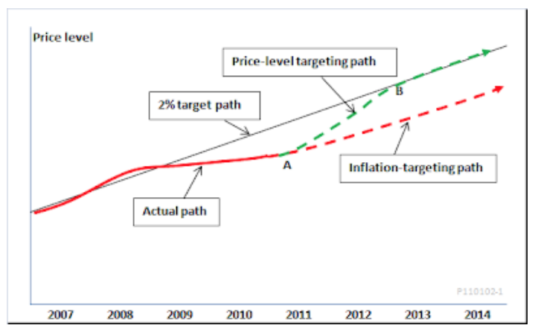
PS.  Ed Dolan has a post that explains level targeting, and provides this nice graph:
Update:  Even in this crisis period, there’s always room for some comic relief:
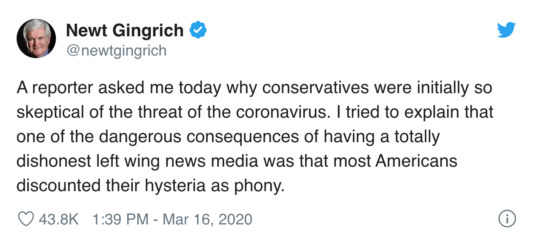
Let me add that the left wing news media is also responsible for conservatives being wrong about global warming, evolution, and a host of other issues.

Why didn’t we see this coming?

[Update:  Commenter LC wrote a comment that is much better than this post.  Read that if you only have time for one.]

Some scientists obviously did see this coming. I recall reading articles written in January, with experts claiming that 40% to 70% of the world’s population would eventually contract coronavirus. I knew that was a possibility. When I got back from New Zealand in January, I immediately stocked up on surgical masks and canned goods. But I didn’t sell my stocks, so clearly I didn’t really believe this would happen. The stock market and the general public also missed the boat. Why?

Republican voters might have been misled by the Trump administration, but that doesn’t really explain anything. Democrats and stock traders behaved no differently.

1. We’d never seen anything like this, so it’s hard to wrap your mind around a sci-fi movie coming true.

2. There had been scary warnings surrounding SARS, MERS, Ebola, etc., which fizzled out.

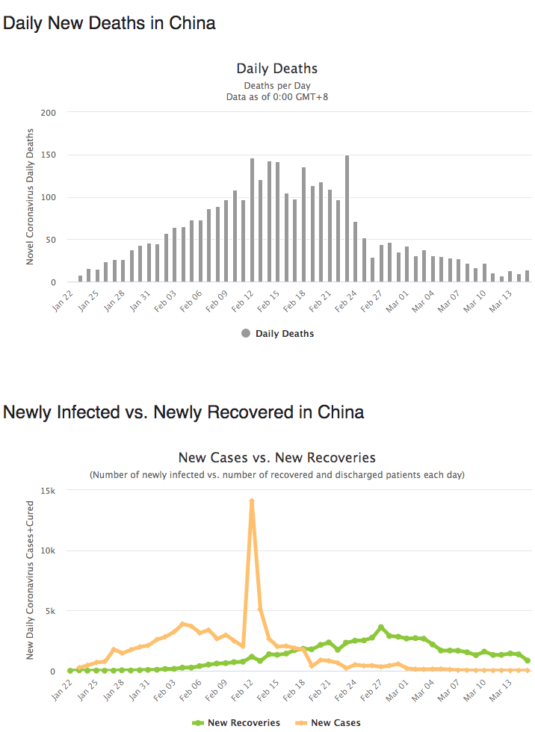
3. For me, the overwhelmingly most important factor was misinterpreting the data out of China. During the month of February, it became increasingly clear that China was getting the epidemic under control. Their data is not perfect, but at this point no one seriously questions the claim that new infections in China have dropped to a very low level and that the epidemic is under control for now (maybe not later.)

During much of February, the US and Europe had just a tiny number of reported cases (in quarantine), and the number was stable.  I knew that it would be 10 times easier for the US and Europe to control the epidemic than it would be for China, a very crowded nation where there were tens of thousands of cases spread all over the country.  And China was also a nation that initially botched the epidemic by censoring and punishing the doctors in Wuhan trying to issue warnings.  We had everything going for us.

So when I say I “misinterpreted” the data out of China, what I really mean is that I misinterpreted the implications of the Chinese data for the West.  I assumed the positive Chinese data meant that we’d also be able to control the epidemic.  Obviously, I was wrong.  I suspect the stock market made a similar mistake.

PS.  People may want to hammer me for buying facemasks when there is much greater need for such masks in hospitals.  Before doing so, keep in mind the following:

1. Back in January, there wasn’t as much chatter in the press about how buying masks is anti-social.

2.  I assumed that the US had given at least a tiny bit of thought to the possibility of a pandemic, and had stockpiled enough surgical masks (an inexpensive item.)

3.  I assumed that if the US had not instituted plans to deal with a pandemic, and had not stockpiled masks, then at the very least they would have instituted a crash program to build masks and ventilators when the Chinese crisis became apparent in January.

4.  I did not know that the US government would spend all of January and February twiddling its thumbs, doing nothing, and not leap into action until the NBA season was cancelled.

I know, how stupid can a blogger be?  Imagine someone who assumed that the US government had an ounce of competence.  Silly me.

Just relax

Well what did you expect?

1/22  “. . . we have it totally under control. It’s one person coming in from China, and we have it under control. It’s going to be just fine.”

1/24  “It will all work out well.”

1/28  “Johnson & Johnson to create coronavirus vaccine.”

1/30  “We have it very well under control. We have very little problem in this country at this moment — five. And those people are all recuperating successfully.”

2/10  “Looks like by April, you know, in theory, when it gets a little warmer, it miraculously goes away,”

2/19  “I think the numbers are going to get progressively better as we go along.”

2/26  “the Democrat policy of open borders” had brought the virus into the country.

2/27  “It’s going to disappear. One day — it’s like a miracle — it will disappear.”

2/29  vaccine would be available “very quickly” and “very rapidly”

3/2  “It’s very mild”

3/6  “Anybody that wants a test can get a test.”

3/6   “People are surprised that I understand it. Every one of these doctors said, ‘How do you know so much about this?’ Maybe I have a natural ability.”

3/7  “I’m not concerned at all.”

3/10 “It will go away. Just stay calm. It will go away.”

Today:  Just relax

Update:  I predict that by the end of March there will be more people with coronavirus in Switzerland than in China (active cases.)  If I’d made that prediction a month ago I would have been put in an insane asylum.

Concrete steps are not enough, we need regime change

Central banks are conservative; they don’t like change. I worry the Fed will respond to this crisis with concrete steps like liquidity injections during periods of market turmoil, and interest rate cuts. Those steps may be beneficial in isolation, but they won’t do much.

We need a regime change; at a minimum an immediate switch to level targeting. Perhaps they could start the PCE clock at December 2019, and promise to target the 5-year forward PCE price index along a 2%/year trend line.  (A total increase of 10.4%.)  Then promise to do whatever it takes.

Time for the expectations fairy:

“Think of the grandparents”

Doesn’t the 21st century feel depressing? I don’t think that’s because it is worse that the 20th century, which had far worse disasters. Rather it reflects the aging global population.

In 2000, we entered the century with Japan at the zero bound, partly due to its low birth rate (reducing real interest rates) combined with a zero percent inflation target. This low birth rate contributed to its aging population. The low global real interest rates (and Asian CA surpluses) were blamed for the housing bubble in the US. Today, millennials can’t buy homes because selfish older boomers refuse to have new construction in their towns. And now the epicenter of the coronavirus epidemic has rapidly moved from China to the oldest country in Europe.

In 1919, few people would have cared about coronavirus. It’s not very dangerous to the young, or even to the middle aged, and there were relatively few old people in 1919. Dying at age 67 or 73 or 76 was completely normal in 1919, indeed expected. We are likely to have a fear recession, a recession that would not have occurred in 1919 when we were less fearful of death at an old age.

BTW, I frequently have to remind commenters that this is my “bad blog”. The good blog is at Econlog, where I have a good new post today. This blog contains my “drunk in a bar” observations. I throw them out there to get your response, and learn more about the issues. So don’t tell me to avoid subjects on which I’m not well informed. If I do so, how will I ever learn?

Here are today’s observations:

Switzerland has been hit hard; it’s just 2 or 3 days behind Italy. But that’s probably an artifact of more testing in Switzerland.

Denmark continues to show progress.

Worrying signs of exponential growth in South America (but not Africa). Another concern is that Australia and Canada have very similar outcomes. Is summer actually going to help?

East Asia has avoided exponential growth, but its linear growth has shifted up a notch. But this was entirely predictable (in retrospect; I never predict anything in advance.) 🙂

Today, the problem in East Asia is imported cases. Taiwan, Singapore, Hong Kong and China will gradually import more cases as the global caseload soars much higher. As long as they avoid community transmission they can avoid exponential growth. But can they avoid community transmission long enough to get to a vaccine? That’s the 6.4 trillion dollar question.

By “East Asia” I mean roughly “Confucian Asia”, say ethnic Chinese, Japanese, Koreans and Vietnamese. South and Southeast Asia better hope that warm humid weather helps.

In the developed world, East Asia is the place you are least likely to contract Covid-19.

PS. Some in my comment section are in denial about the UK’s abandonment of the “herd immunity” approach. This article confirms what I predicted yesterday over at Econlog.

Update: This caught my eye:

“I don’t think we’re going there [down the path of Italy, which has the largest number of cases outside China] if we do the kinds of things that we are publicly saying we need to do, we need to be very serious about,” said Mr Fauci, speaking on CBS News.

True, but very misleading. What matters is active cases. Italy has twice as many active cases as China, and within a week will have ten times as many active cases. China has 20 times more people, which means Italy will soon have 200 times more active cases per capita. What a disaster for its hospitals.

Even the US has more active cases than China, on a per capita basis.