Archive for June 2015


What’s wrong with Louisiana?

Tyler Cowen has a post on the problems encountered by Republican tax cutters at the state level.  The post focused on Kansas and Louisiana, which were both recently forced to raise “revenues” to cover budget shortfalls.  I decided to take a broader look at the states, and to focus on the sine qua non of supply-side economics, reducing the top income tax rate.

I found that between 2010 and 2015, 19 states changed their top income tax rate, with 5 increases and 14 reductions.  So it’s not just Kansas and Louisiana.  Even more surprising, Louisiana was not one of the 14, its top rate remains at 6%, a bit above average for states:
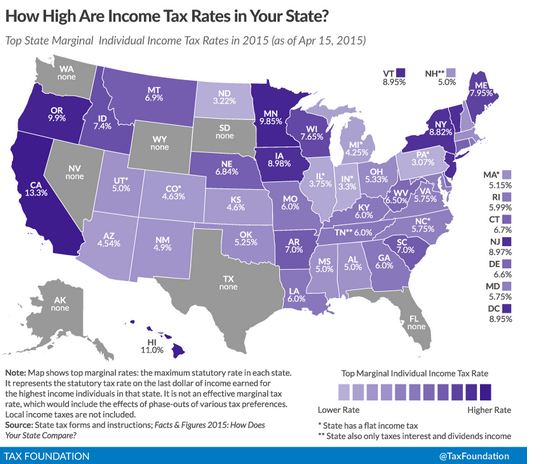
Screen Shot 2015-06-13 at 3.58.50 PMSo what happened in Louisiana, I thought Bobby Jindal was a supply-sider?  Inertia happened.  Here’s Bruce Bartlett:

In January, Gov. Jindal proposed a tax reform that conformed to the Republican ideal, which he hoped would make him a contender for the 2016 Republican presidential nomination. It would have completely eliminated the state’s corporate and individual incomes taxes, replacing the revenue with an increase in the state sales tax to 7 percent from 4 percent.

The Institute on Taxation and Economic Policy, a liberal think tank, charged that the Jindal plan would raise taxes on the bottom 80 percent of Louisiana citizens. Conservative tax guru Grover Norquist of Americans for Tax Reform cheered the Jindal plan, calling it “the gold standard for pro-growth reform.”

But the Jindal plan was not received well, even in conservative Louisiana. An April 2 poll from Southern Media & Opinion Research found a sharp drop in Jindal’s popularity to 38 percent from 51 percent in October. His tax reform was opposed by 63 percent of Louisianans and supported by just 27 percent. Even among Republicans, fewer than half supported the Jindal tax plan.

On April 8, Jindal admitted defeat and withdrew his tax reform. Bloomberg’s Josh Barro said that Jindal had overreached, noting that over the last 50 years only one state, Alaska, had abolished a major state tax, which oil revenue allowed it to do.

It’s not that a tax regime with no income tax is politically infeasible; you see that in a number of other states.  The problem is getting from here to there.  Potential losers will squawk more loudly than gainers.

So in one of the 14 states that cut the top rate (Kansas) the policy failed, while the other 13 are . . . not discussed by the New York Times.  Some of the tax cuts were small, with the largest being:

Rhode Island, down from 9.9% to 5.99% (why not 5.999%?)

North Carolina, down from 7.75% to 5.75%

Kansas, down from 6.45% to 4.6%

North Dakota, down from 4.86% to 3.22%

Oregon, down from 11.0% to 9.9%

Ohio,  down from 5.925% to 5.33%

It’s worth noting that top rates were cut in some very liberal states like New York and Massachusetts, but only by small amounts.  Among the 5 increases, the two notable cases were California and Minnesota, both of which were enacted for “progressive” reasons, and both of which seem (so far) to be fairly successful.

Let’s return to the “inertia” problem, and try to figure out the strange map above.  It makes sense that liberal states would have high taxes, but why some more than others?  Why no income tax in Washington State, and a top rate in Massachusetts that is lower than in many southern states?  And why the 14 states seeing recent cuts in top rates?  I think there are clear answers to these questions, but we need to consider several factors:

1.  Voters don’t like high income tax rates.  In both Washington (state) and Massachusetts, voters rejected referenda proposals calling for progressive income taxes, by wide margins.  Even more shocking, in 2002 about 45% of Massachusetts voters voted to entirely eliminate the state income tax.  Even the Republicans opposed that initiative.  I recall a colleague told me about a taxi ride where the driver said; “like, I don’t get it.  Why would anyone not vote to eliminate the income tax.”  If the driver came from somewhere like Somalia, then it’s not hard to understand why there might be a disconnect between taxes paid and perceived benefits received.  I was born here and even I don’t see much connection.  My town spent $200 million replacing a perfectly good high school built in the 1970s.  Why?

2.  High income tax rates are more feasible where you have a captive audience.  I hope I don’t need to explain California. (I plan to retire there rather than (low tax) Austin or Miami.)  And the New York area has cultural amenities. But what about frigid Minnesota?  Here’s what non-Midwesterners may not know.  If you are a highly educated “Millennial,” and like cities like Seattle, Portland, Austin, Boston or Raleigh, there’s really only one place in the Midwest that would work for you—Minneapolis/St. Paul.  Governor Walker keeps getting hammered because Wisconsin is not doing as well as Minnesota, but there’s not much he can do to keep well-educated UW grads (who want to stay in the Midwest) from moving to the Twin Cities.  I’m not saying their tax increase will work in the long run, but it will work in Minnesota better than in any other Midwestern state.

3.  Tax rates have lagged far behind political change.  During my lifetime, many red states have gone blue, and vice versa.  California’s recent tax increases reflect this fact, as do the many tax cuts in states that have become more red.  I predict that South Carolina will have to cut its top rate at some point, now that it has the highest taxes in the South.  It’s odd that many (blue) rust belt states have (for historical reasons) lower top rates than many conservative southern and western states.  That will gradually change.

4.  Don’t let the NYT tell you what is “popular.”  I’ve already mentioned the opposition of liberal Washington and Massachusetts voters to a progressive income tax.  I might add that although Governor Brownback is extremely unpopular among Republican legislators, it’s not clear that this applies to voters.  Before the election last fall there was a flurry of articles telling us about how unpopular Brownback was with the voters.  I expected a whole slew of follow up articles after he lost the election.  But something kind of strange happened, he won.  And those follow-up articles?  I didn’t see them. Maybe Kansas voters liked the tax cuts.

5.  On the other hand there’s no way to hide the fact that Brownback did screw up—his policies performed poorly.  He cut the top rate, eliminated taxes on small business, and did little to cut spending. The result was predictable—suddenly everyone and his brother declared “I’m a small business.” and revenues plummeted.  A deficit opened up, leading to the recent (regressive) tax increases.  But even today Kansas has a tax regime that is more progressive than the regime in Massachusetts.  And spending in Kansas is higher than in the other Great Plains states.  A much better example is North Carolina, which slashed its top rate, and also cut other programs such as unemployment insurance, to avoid running deficits. Unlike Kansas, North Carolina is doing well, although in fairness it’s been doing well for decades.  It’s hard to draw conclusions because most state level changes are small, and the effects show up very gradually.  That’s why I prefer a cross sectional approach, and on balance that approach does suggest that people prefer states with no income tax.  On average they vote that way with their feet, and in the case of Washington State, also at the ballot box.

Progressives can take heart from the fact that (in my view) the supply-side argument for lower top rates will gradually weaken over time.  In the new economy firms have tremendous pricing power, and states have more taxing power than in the old commodity-driven economy.  In the old days high taxes would make people and companies move to other states. Commodity industries are highly competitive on price. That’s Kansas and Louisiana.  But the new economy in places like Manhattan and Boston and DC and Silicon Valley has companies with lots of market power, and people so rich they care more about amenities than a few extra bucks.  So that works in favor of the progressives, but not yet in all 50 states.

Iceland’s austerity; second to one

Matt Yglesias recently did a post on Iceland’s surprisingly strong recovery.  In a post at Econlog I agreed with much of what he had to say, but was doubtful about Matt’s claim that Iceland rejected austerity.  Paul Krugman did a post criticizing austerity, and cited Yglesias’s post as supporting evidence for the heterodox policy approach. Now Mark Sadowski has a post over at Marcus Nunes’s blog, which provides much more comprehensive information on Iceland’s fiscal policy:

Scott is looking at the “net operating balance” which excludes the “net acquisition of nonfinancial assets”. Including this item results in “net lending”, which is what Europeans call “the deficit”. The net lending of Iceland’s general government fell from 9.7% of GDP in calendar year 2009 to 1.7% of GDP in calendar year 2013, a change of 8.0% of GDP.

Moreover, Iceland’s general government budget ran a surplus equal to 1.8% of GDP in 2014, or a change in fiscal stance since 2009 equal to 11.5% of GDP. This can be found on Table A1 of the April 2015 IMF fiscal Monitor.

And, according to IMF estimates, Iceland’s output gap was actually somewhat larger in 2014 than in 2009.  .  .  .  Table A3 shows that Iceland’s general government cyclically adjusted balance rose from a deficit of 10.0% of potential GDP in 2009 to a surplus of 2.7% of potential GDP in 2014, or a change of 12.7% of potential GDP.

But even this tends to understate the amount of fiscal austerity that Iceland has engaged in. This is because it includes the increase in spending attributable to rising interest payments on the national debt. To get a proper idea of the amount of fiscal austerity that Iceland has engaged in (i.e. cuts in direct spending and increases in taxes) one has to look at the general government cyclically adjusted primary balance which can be found in Table A4.  Iceland’s general government cyclically adjusted primary balance rose from a deficit of 6.9% of potential GDP in 2009 to a surplus of 6.2% of potential GDP in 2014, or a change of 13.1% of potential GDP.

Mark also constructed this graph, showing Iceland’s austerity relative to other countries:

Screen Shot 2015-06-12 at 9.28.37 PM


Mark continues:

By this standard Iceland has done about 30% more austerity than Ireland, over double that of the UK, roughly two three and a half times as much as the US, and approximately five and a half times as much as Latvia. The only country that has done more fiscal austerity is Greece.

None of this should come as a surprise. When nearly all the other OECD members were busy implementing fiscal stimuli in early 2009, Iceland (joined only by Ireland) was engaged in a massive fiscal consolidation (see Figure 3.2 and Table 3.1).

In 2012 the Icelandic Finance Ministry, in front of an audience of fellow OECD senior budget officials, patted itself on the back for a job well done.

The scope and scale of Iceland’s fiscal consolidation was truly mind boggling. Real primary expenditures were estimated to fall by 12.7% between 2009 and 2012 (Slide 16). This was accomplished by slashing current expenditures, transfers, and maintenance and investment, and by freezing public sector wages and benefits for a period of four years (Slide 13), during a time when inflation soared due to the 50% depreciation of the króna.

On the revenue side the VAT was raised to 25.5%, which at that time was the highest in the world (Slide 14). The top personal income tax rate was increased from 35.7% to 46.2% (Table 2):

The capital income tax rate was doubled from 10% to 20%, the corporate income tax was increased from 15% to 20%, the social security contribution (SSC) was increased from 5.34% to 8.65% and fishing levies (important in Iceland) were increased. In addition a whole slew of new taxes were imposed (e.g. a net wealth tax, an inheritance tax, a financial activities tax (FAT) etc. etc.)

The bottom line is that Krugman’s implied poster child for anti-fiscal austerity is in reality the advanced world’s second leading practitioner of it. If Iceland’s economy is doing as well as Krugman claims (I have my doubts), then the only real reason it is doing so well (we have yet to see what happens after capital controls are lifted) is relatively steady NGDP growth as demonstrated in Scott’s post.

Thus it seems to me that Krugman’s recent posts extolling the relative economic performance of Iceland are inadvertently strengthening the argument for the ability of monetary policy to wholly offset fiscal policy.

Note that Iceland’s various income tax rates were surprisingly low before the crisis, especially for a Nordic country.


Worth 1000 words

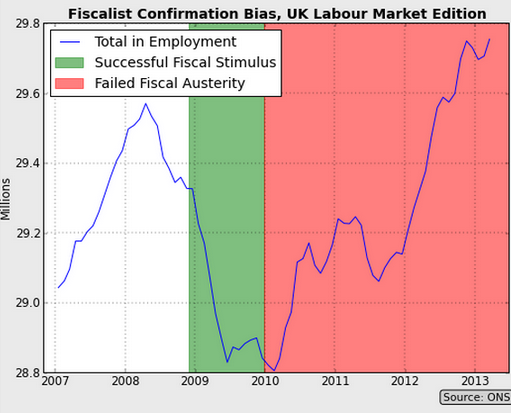
From Britmouse:

Screen Shot 2015-06-12 at 11.52.27 AM(I’m getting senile—this link turns out to be 2 years old.  But still worth revisiting.)

But here’s a new paper by Andrew Johnston and Alexandre Mas, sent to me by John Thacker. Here’s the abstract:

In this paper we examine how an unanticipated cut in potential unemployment insurance (UI) duration, which reduced maximum duration in Missouri by 16 weeks, affected the search behavior of UI recipients and the aggregate labor market. Using a regression discontinuity design (RDD), we estimate that a one-month reduction in maximum duration is associated with 15 fewer days of UI receipt and 8.6 fewer days of nonemployment. We use the RDD estimates to simulate the change in the time path of the unemployment rate assuming there are no market-level externalities. The simulated response closely approximates the estimated change in the unemployment rate following the benefit cut, suggesting that even in a period of high unemployment, the labor market was able to absorb this influx of workers without crowding out other jobseekers.

Shorter version:  Krugman’s wrong again.

Please, do buy. You won’t regret it.

The anti-EMH theories are falling even faster than I expected.  Last year I did a post reminding readers of bubble theories we all heard around 2009-11, which have recently been refuted.

And now Dubai.  Five years ago we were told it was just a giant property bubble, without any sound fundamentals.  Here’s the Economist:

TRAVELLERS flying into Dubai often look down and marvel at the man-made islands with the luxury villas. These outlandish creations came to symbolise the emirate’s economic boom in the mid-2000s””and the crisis that followed in 2009, when it needed help to pay its debts, many related to property development. But once on the ground, travellers see signs of a more sustainable prosperity. The airport is bustling””more international travellers use it than any other.

Dubai has bounced back from the crisis, which saw its economy contract by around 2.5% in 2009. It is expected to grow by around 5% this year, as it did last year.  .  .  .

Dubai long ago used up most of its oil reserves, so the government has for years tried to diversify the economy. While skyscrapers and palaces grabbed headlines, this less glamorous work has slowly paid off: Dubai is now a regional hub in several areas. The airport, which already serves some 70m travellers a year, is set to expand to serve over 200m, eventually. Emirates, the local airline, is world-class. The port at Jebel Ali is by far the busiest in the Middle East, the cargo it handles growing by nearly 12% last year. It is likely to become the biggest container port in the world by 2030.

Three decades ago Jebel Ali became the Middle East’s first big “free zone” (a place where foreign firms can operate, unusually, without a local partner and with less red tape and lower taxes than in the rest of the emirate). Now it is the world’s largest, and Dubai has 22 such zones in total, most based around particular industries. Dubai’s free zone for finance even has its own judicial system, based on common law. The number of companies in it grew by 14% in 2013 and 18% last year, to reach 1,225. More growth is expected, with $1 billion worth of new development planned.  .  .  .

Planners expect Dubai’s population to reach around 3m by the time it hosts the World Expo in 2020. The Chinese are increasingly using it as a logistical hub for their African ventures. Dubai also stands to benefit if sanctions are lifted from Iran, with which it already has strong economic ties.

I guess the world’s biggest international airport, a huge container ports, 22 free trade zones, low red tape and taxes, and a common law judicial system for business don’t count as fundamentals.  Oh, and remember that house price “bubble”?  Yup, just another false claim by the bubble-mongers:

Screen Shot 2015-06-11 at 3.51.39 PM


I beg of you, listen to Reason

Here’s Virginia Postrel:

Wielding subpoenas demanding information on anonymous commenters, the government is harassing a respected journalism site that dissents from its policies. The U.S. Attorney’s Office for the Southern District of New York claims these comments could constitute violent threats, even though they’re clearly hyperbolic political rhetoric.

This is happening in America — weirdly, to a site I founded, and one whose commenters often earned my public contempt.

Los Angeles legal blogger Ken White has obtained a grand jury subpoena issued to Reason.com, the online home of the libertarian magazine I edited throughout the 1990s. The subpoena seeks information about commenters who posted in response to an articleby the site’s editor Nick Gillespie about the letter that Silk Road founder Ross Ulbricht wrote to Judge Katherine B. Forrest before she sentenced him to life in prison without parole. Ulbricht was convictedof seven felony charges, included conspiracies to traffic in narcotics and launder money, and faced a minimum sentence of 20 years in prison. The letter was an appeal for leniency.

Gillespie, who declined to comment on the subpoena, aptly described the letter as “haunting.” In it, Ulbricht expressed the libertarian ideals he said animated his creation of Silk Road — the same ideals that Reason upholds. The portion Gillespie reproduced reads:

I created Silk Road because I thought the idea for the website itself had value, and that bringing Silk Road into being was the right thing to do. I believed at the time that people should have the right to buy and sell whatever they wanted so long as they weren’t hurting anyone else. However, I’ve learned since then that taking immediate actions on one’s beliefs, without taking the necessary time to really think them through, can have disastrous consequences. Silk Road turned out to be a very naive and costly idea that I deeply regret.

Silk Road was supposed to be about giving people the freedom to make their own choices, to pursue their own happiness, however they individually saw fit. What it turned into was, in part, a convenient way for people to satisfy their drug addictions. I do not and never have advocated the abuse of drugs. I learned from Silk Road that when you give people freedom, you don’t know what they’ll do with it. While I still don’t think people should be denied the right to make this decision for themselves, I never sought to create a site that would provide another avenue for people to feed their addictions. Had I been more mature, or more patient, or even more worldly then, I would have done things differently.

The letter depicts Silk Road as an attempt to bring libertarian ideals into the real world — a virtual version of the seasteading schemes for new countries, hopelessly naive, perhaps, but certainly not evil in its intentions.

Judge Forrest handed down a sentence even more draconian thanprosecutors had sought and made a point of condemning Ulbricht’s political views. “In the world you created over time, democracy didn’t exist,” she said. “Silk Road’s birth and presence asserted that its…creator was better than the laws of this country. This is deeply troubling, terribly misguided, and very dangerous.”

Whatever you think of Ulbricht or Silk Road, you can see why libertarians might be upset. A federal judge has just made the belief that it’s good for people to have “the freedom to make their own choices, to pursue their own happiness, however they individually saw fit” part of her justification for the most punitive sentence short of the death penalty. Her rationale offends libertarians on two grounds: It punishes political views and it punishes their particular political views.

In the future, selling pot will be legal in all 50 states.  Historians will look back in disbelief that 400,000 people were in prison for using and selling drugs.  They’ll read about Republican politicians who only began worrying about dirty needles when it affected their voters.  They’ll read about Democratic politicians who were more interested in inequality, gay marriage and a few hundred terrorists in Guantanamo than in 400,000 people (disproportionately African American) in prison for engaging in capitalism between consenting adults.  People like Ulbricht (and Ed Snowden) will be viewed as martyrs. Both parties (and much of the media) are so corrupt, so authoritarian, that the voters are finally rising up in one state after another.  It’s a pretty sad state of affairs when the masses have more enlightened views on criminal justice than the elites.

Update:  Some commenters thought I was implying that gay rights are not important.  On the contrary, I think they are very important.  But I think that right now the war on drugs is a far more important problem.  In 1950 I would have argued (I would hope) that gay rights were a far more pressing issue than the war on drugs.

PS.  Five more states will vote on pot legalization in 2016, including California.

PPS.  Legislators don’t want to legalize drugs because of the political clout of the prison industrial complex.  Something similar is at work in taxes. Everyone from Jeb Bush to Barack Obama has endorsed the Estonian approach to taxes, which is so simple that people don’t need to hire expensive (and incompetent) tax preparers.  But it has no chance of passing because of corrupt legislators:

Sounds wonderful — maybe it’s something the United States could benefit from?

Well, as it turns out, President Barack Obama proposed something much like this during his 2008 campaign. Obama said he would direct the IRS to “give taxpayers the option of a pre-filled tax form to verify, sign and return to the IRS or online. This will eliminate the need for Americans to hire expensive tax preparers and to gather information that the federal government already has on file.”

But a funny thing happened on the way to enactment: Crickets. PolitiFact rated it a Promise Broken.

Why? According to the Sunlight Foundation, “companies that prepare taxes are throwing millions at Congress to oppose making tax filing easier.” The foundation writes that the companies “warn that IRS-prepared returns will cost millions to develop and will result in more filing errors and missed refunds for taxpayers. Grover Norquist, president of Americans for Tax Reform … calls the system ‘a money-grab by the government‘ and points out the conflict of interest that arises from a tax collector like the IRS preparing taxpayers’ returns.”

If you win the presidency, Gov. Bush, you’ll get your chance to make it happen.

Our ruling

Bush said “you can fill out your tax return in Estonia online in five minutes.” If anything, Estonian tax filers tell us, it takes even less than that. We rate Bush’s claim True.

There is almost no chance of this sort of tax reform in the near future.  The only way it could get enacted is if we had a democratic political system like Switzerland, and voters could pass a referendum simplifying taxes.

PPPS. Why do I say that tax preparers are incompetent?  I know a couple 90 year olds who had “professionals” do their taxes.  The total tax bill was $12,000, and they sent the money to the IRS.  I suggested they hire someone else, and file an amended return.  Their actual tax bill was zero.  The problem?  The first tax preparer assumed that the entire sale price of a standard diversified mutual stock fund bought in 2005 and sold in 2010 was profit.  100%.  That’s our system in a nutshell.

End of rant.