
Archive for January 2013


Students need to be taught monetarism first, then Keynesianism

Greg Ip seems to have a pretty low regard for monetarists:

But in the real world, the Fed sets a fixed interest rate and lets the money supply adjust. Back in 2000 David Romer proposed modifying the IS-LM model to reflect this reality. In his IS-MP model, the upward sloping LM curve is replaced by a horizontal MP curve.

.  .  .

The Fed influences the level of output by changing its interest rate, i.e. shifting the MP curve up or down.  At any given interest rate the money supply is infinitely elastic, which simply means it is determined by demand, rather than the other way around, as monetarists think.  I wish undergraduate courses used Mr Romer’s IS-MP model instead of the IS-LM model; students would have a much easier time applying their class work to the real world.

God help us if there are any monetarists out there who don’t understand that the money stock becomes endogenous when the Fed pegs interest rates.

Greg Ip continues:

This essentially explains why no major central bank targets the money supply. The money supply does matter, but for narrow, technical reasons.

Ip is right that central banks choose not to target the money supply, but it’s not for the reasons he suggests.  The real problem is that the demand for money (or velocity, if you prefer) is not stable.  Thus targeting the money supply might leave prices and/or NGDP quite unstable.  And the money supply matters for broad macroeconomic reasons, not narrow technical reasons.

Because the demand for money is unstable, and because there are lags between changes in monetary policy and observed changes in NGDP data, most central banks rely on intermediate targets like interest rates or exchange rates.  But these are still targets, monetary policy consists of control of the money supply.  Here’s how it works:

1.  The central bank determines a policy goal–say 2% inflation.

2.  The central bank doesn’t know how much money is required to generate 2% inflation, so they set targets for interest rates and exchange rates, and then adjust those targets as needed to stabilize inflation.

3.  Suppose a central bank sees inflation rising too fast.  They might decide to raise interest rates.  But higher interest rates don’t lower inflation, they raise inflation.  That’s because as interest rates rise, velocity rises.  Higher velocity raises inflation, it doesn’t lower it.  So why do central banks talk about “raising interest rates” to control inflation?

4.  Here’s what’s really going on.  Suppose the central bank sees inflation rising too rapidly.  They realize that the need to reduce money growth.  But they don’t want to target money growth, as that makes other variables too volatile.  So they they raise the target short term interest rate enough so that the money supply (now or later) will have to be reduced in order to hit the interest rate target.  They hope the reduction in the money supply reduces inflation.

Let me repeat, higher interest rates are inflationary.  They increase velocity.  If you don’t believe me, check out interest rates and velocity during any extremely high inflation episode.  When rates rise, inflation usually rises.  Higher interest rates are inflationary.  Repeat 100 times.  But the thing the Fed uses to generate higher short term interest rates—a reduction in the money growth rate—is deflationary.  To reduce inflation you must reduce money growth.  Interest rate targeting (or exchange rate targeting) is simply a tool.  It is changes in the money growth rate that actually drive macro nominal aggregates up and down.

It is precisely because students were taught IS-LM and IS-MP that we are in this mess.  Both models teach students that easy money reduces interest rates.  So 99.999% of people in 2008-09 inferred that the Fed was easing monetary policy, even as they adopted the tightest policy since 1938.

Woodford and Bernanke are right; the stance of monetary policy depends on outcomes like NGDP growth and inflation, not interest rates and the money supply.  But that is NOT what students are being taught.

PS.  I said money is endogenous when the central bank pegs interest rates.  It’s not endogenous in any long run sense when they target interest rates.  That’s because targets are adjusted to change the money supply.
Give war a chance

Let’s hope Barry Eichengreen doesn’t see this Yahoo article:

Japan has set the stage for a potential global currency war, announcing plans to create money and buy bonds as the government of Prime Minister Shinzo Abe looks to stimulate the moribund growth pace.

Economists in turn are expecting others to follow that lead, setting off a battle that would benefit those that get out of the gate quickest but likely hamper the nascent global recovery and the relatively robust stock market.

Update:  Ryan Avent and Matt Yglesias have excellent posts criticizing ECB policy.  Matt links to another great article from Ambrose Evans-Pritchard:

Japan’s premier Shinzo Abe has more or less ordered his central bank to both reflate and target jobs creation. The US Federal Reserve stands ready to inject stimulus until America’s jobless rate falls to 6.5pc. Yet the ECB professes itself helpless in the face of 11.8pc unemployment, a post-EMU record and rising each month.

The ECB’s Mario Draghi said there is “not much” that monetary policy can do to fight structural unemployment. If it really was “structural”, his plea might convince. It is not.

Ireland has one of the world’s most flexible labour markets yet its jobless rate has risen from 4.6pc to 14.6pc, and that includes the safety valve of massive job flight to the UK, US, and Australia.

.  .  .

Former ECB governor Athanasios Orphanides — a world expert on deflation –has broken loose, rebuking his ex-colleagues for standing “idly by” as Europe’s socio-economic disaster unfolds.

“We are in the middle of a policy-induced recession and monetary policy can do more to contain it, without compromising price stability,” he said.

Jacques Cailloux from Nomura says money is still ferociously tight for a string of countries. Their sovereign bond yields have fallen far, but not far enough to keep pace with GDP contraction.

Nor have the gains fed through to the economy. Italian and Spanish companies still pay twice as much to borrow as German rivals. The North-South gap is becoming hard-wired into the system.

.  .  .

I might add that ECB bond purchases amount to fiscal union by stealth, outside democratic control.

Chancellor Angela Merkel has mutualized EMU debt without telling German taxpayers. This may be necessary if the goal is to save the euro — not a goal of any moral content — but it is hardly a healthy state of affairs. The Bundesbank’s Jens Weidman is right to warn that it will come back to haunt.

That is a story for another day. The horror before our eyes right now is social ruin. Europe’s crisis strategy is to the break the back of labour resistance to pay cuts by driving unemployment through the roof. That is what `internal devaluations’ are. It stinks. And the ECB is adding to the cruelty by keeping money too tight.

Mr Draghi deserves his accolades, but his job is not yet done. He has saved the rich. Now he must save the poor. Coraggio.

Reserves are old-fashioned; currency is right up to date.

Pretend this post was written in July 2008; later I’ll discuss the most recent 4 1/2 years.

I notice that some commenters think there is something slightly old-fashioned about my emphasis on the lowly currency stock.  On the contrary, it is bank reserves that were a big part of grandpa’s monetary regime.

During the first 35 years of the Fed’s existence, bank reserves mostly fluctuated between 40% and 60% of the monetary base.  That’s a pretty important share. It’s no surprise that the early post-WWII monetarists focused on the banking system.

Today (in 2008) bank reserves are only about 5% of the monetary base.  The rest is currency held by the public.  And most of the “reserves” are also currency, aka “vault cash.”  So the monetary base is actually about 99% currency and 1% bank deposits at the Fed.  Monetary policy is (implicitly) conducted by adjusting the total stock of currency.

The other mistake is to make too much of the supposed “endogeneity” of currency.  Nick Rowe has done some excellent posts on this, but I’ll try to briefly summarize:

Let’s suppose that back in 1964 Milton Friedman’s evil twin Myron Friedman tried to convince the Fed to inflate, as a way of lowering unemployment–so that LBJ could get re-elected in 1968.  He told the Fed to print money like crazy.  But Fed officials scratched their heads:

How do we do that?  The base is mostly endogenous. If we try to conduct monetary policy via control of the base then rates will go haywire.

Myron Friedman responded as follows:

Under interest rate targeting the base is endogenous in the ultra-short run, but exogenous in the medium and long run—which matters for inflation.  Thus you need to adjust interest rates to a level where holding them at that level will require the Fed to increase the base at a faster and faster rate.  For the moment, that might involve a slight rate cut.  But over time the Wicksellian equilibrium rate will rise and you’ll actually be able to raise rates HIGHER than they would be under a tight money policy.  The key is to keep watching that monetary base.  Make sure your fed funds target is always set at a level where the Fed is forced to inject more and more base money into the economy.  That level of base money will equilibrate the feds fund market in the very short run, but will disequilibrate the broader macroeconomy.  It will be more currency than the public wants to hold at the current price level, and thus prices will have to rise.

And here’s the beauty of my plan.  NO ONE WILL BLAME YOU! Remember, it’s December 1964, and “we’re all Keynesians now” (except Milton and I).  So after a tiny drop in interest rates, my plan will call for steadily higher interest rates over the next 17 years.  It will look like tight money. Those stupid Keynesians will never figure out what hit them. They’ll raise incomes taxes in the vain hope that this will stop inflation. But it won’t. Then they’ll try price controls—and just create shortages. Eventually they’ll get around to much higher nominal interest rates, but even that won’t be enough, as they’ll have forgotten about the Fisher effect.

I suppose it won’t work forever, eventually Milton will convince the profession, and a monetarist will be put in charge of the Fed and start reducing the money supply growth rate.  But by then it will be too late.  LBJ will have been re-elected in 1968.

Of course LBJ lost, but not because of the economy (which was in pretty good shape in 1968), but rather because of Vietnam and crime and race riots.

Unfortunately it is no longer July 2008.  We have gone back to the Stone Age. We are back to the Fed policy of the late 1930s, where most of the base is reserves, and nominal rates are near zero because monetary policy has been way too tight since July 2008.  I wish the Fed would go back to a “modern” monetary regime, one where the base was 99% currency.

PS.  I stole the evil twin idea from Steve Waldman.

PPS.  I never called the Keynesians “stupid.”  Myron did.

Currency matters, even with IOR

Today I’m going to be defending Paul Krugman, who claims that the quantity of money does matter when interest rates are positive.  Steve Waldman recently criticized Krugman in this post:

If Ip and I are right, Paul Krugman is wrong to say

“It’s true that printing money isn’t at all inflationary under current conditions “” that is, with the economy depressed and interest rates up against the zero lower bound. But eventually these conditions will end.”

Printing money will always be exactly as inflationary as issuing short-term debt, because short-term government debt and reserves at the Fed will always be near-perfect substitutes. In the relevant sense, we will always be at the zero lower bound. Yes, there will remain an opportunity cost to holding literally printed money “” bank notes, platinum coins, whatever “” but holders of currency have the right to convert into Fed reserves at will (albeit with the unnecessary intermediation of the quasiprivate banking system), and will only bear that cost when the transactional convenience of dirty paper offsets it. In this brave new world, there is no Fed-created “hot potato”, no commodity the quantity of which is determined by the Fed that private holders seek to shed in order to escape an opportunity cost. It is incoherent to speak, as the market monetarists often do, of “demand for base money” as distinct from “demand for short-term government debt”. What used to be “monetary policy” is necessarily a joint venture of the central bank and the treasury. Both agencies, now and for the indefinite future, emit interchangeable obligations that are in every relevant sense money.

There are several mistakes here, but the most important is to assume that the quantity of base money doesn’t matter in a world of zero rates, or a world of IOR. Let’s suppose the Fed keeps paying IOR permanently.  And during normal times the level of bank reserves is much higher than under the pre-2008 regime (when it was less than 5% of the base.)  More specifically, let’s assume that in the year 2020 the base is $1 trillion, and that represents $800 billion in currency and $200 billion in reserves.  Waldman is appointed to the Fed, and told to use IOR to double the price level.  Or IOR plus fiscal policy.  He can’t use OMOs, because we know that the quantity of base money doesn’t matter, he must use the IOR.  What happens?

One answer is that he cannot double the price level.  Monetary policy is impotent for “Fiscal Theories of the Price Level” reasons. But this is hard to reconcile with the fact that many central banks have been using IOR for quite some time, and seem to have no problem doing regular monetary policy.  The only real question is whether they can do monetary policy without adjusting the quantity of base money, as Waldman asserts.

So let’s say Waldman tries to adjust the IOR until the price level doubles.  What will he have to do to the IOR?  Presumably he cuts the IOR, which reduces the demand for bank reserves, and this reduces the value of bank reserves.  So far so good.  Bank reserves are a medium of account, so if their value falls then the price level rises.  And what is the demand for currency in the new long run equilibrium, once prices have doubled?  Obviously $1600 billion.  So the new equilibrium level of the monetary base is $1600 billion plus the new level of reserves (which will be lower as a share of the base, but might be higher or lower in absolute terms.)

So the base rises by at least 60% in the new equilibrium.  But we assumed no rise in the base, as Waldman said the quantity of base money no longer matters.  So the quantity of base money must matter.  QED.

Astute readers will notice the similarity between this example and the gold standard.  Under the gold standard a $1 bill and 1/20.67 ounces of gold were both MOAs.  Gold could be freely converted into currency, and vice versa, just as Waldman assumes reserves and T-bills and currency are freely convertible. Nonetheless, the quantity of gold mattered, and it mattered a lot, because there was a zero lower bound on central bank gold stocks.  Likewise there is a zero lower bound on bank reserves, and thus currency still matters a lot.

But even if Waldman were right that the quantity of base money didn’t matter, even if IOR was the only tool of monetary policy, he’d still be wrong about the hot potato effect. And that is because T-bills are not “in every relevant sense money.” Indeed they are not money in the only relevant sense.  They are not a medium of account. When the value of T-bills change the nominal price of T-bills change. When the value of money changes the nominal price of money doesn’t change. Instead, all other prices in the economy adjust. That’s why I monomaniacally focus on the base.

Now let’s suppose we have a cashless economy, just interest-bearing reserves. The base is one trillion dollars and NGDP is $20 trillion.  People prefer to hold base money equal to 5% of NGDP.  Now the Fed wants to double NGDP, to $40 trillion.  How do they do this?  They could adjust the quantity of base money.  But let’s rule that out.  We’ll have them adjust the demand for base money by changing the IOR.  So let’s say they cut IOR until the public prefers to hold reserves equal to 2.5% of NGDP.  If the stock of reserves is unchanged, there will be an excess supply of reserves at the new IOR.  The hot potato effect will take over, and raise prices and output until NGDP has doubled.  Then we will be in equilibrium again.  So the hot potato effect refers to changes in both the supply and the demand for base money.  There is nothing particularly “monetarist” about the hot potato effect.

Contrary to Waldman’s claim, market monetarists have grappled with a world of IOR.  Indeed my very first blog post (after the intro) advocated negative IOR as a way of boosting NGDP.

PS.  Peter Ireland did a paper that made some very similar points using a formal model.  He showed that money continues to be neutral in the long run, even with positive IOR.

PPS.  This thought experiment also demonstrates why Fama was right to focus on currency, not the base.  Currency is the part of the base that really matters.

HT:  Tim Duy

Update:  After I wrote this I noticed that Krugman did a similar post.

Update:  David Beckworth has an excellent explanation of IOER.

The Great Inflation was caused by the Fed increasing the currency stock

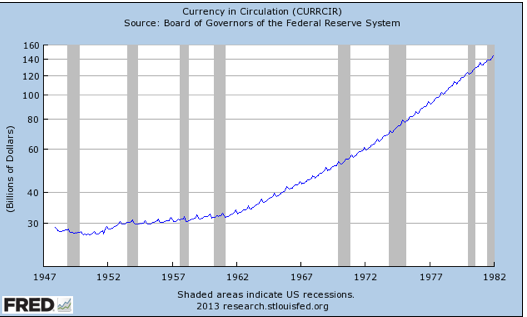
Some commenters argue that the Fed can’t control the monetary base.  And they say that open market operations won’t affect the price level, as the Fed is simply swapping one asset for another asset of equal value. This is not true, as currency is not generally a close substitute for other assets.  So when you increase the stock of currency via OMOs, the value of currency will usually fall.  Between December 1947 and December 1964 the Fed increased the currency stock from $28.9 billion to $39.7 billion, and prices rose modestly.  Then they started printed money like crazy, and prices soared between December 1964 and December 1981.  By the end of 1981 the currency stock had hit $144.4 billion:

Some old style Keynesians will point to fiscal stimulus, but deficits weren’t particularly large during the Great Inflation (and indeed were very small in real terms.)  Deficits actually got much bigger after the Great Inflation ended.  The currency printing policy was instituted to bring down unemployment. It succeeded, but only up through 1969.

Some will ague that the currency stock is endogenous; the Fed controls the monetary base.  Technically that’s true, but until 1914 the entire base was currency, and indeed when the IOR is zero it really doesn’t matter whether bank reserves are held as deposits at the Fed or vault cash.  In any case, reserves are only a small share of the base.  The Great Inflation was basically caused by printing lots of currency.  That’s what central banks do.  Fama was right.

Fiscal theories of the price level can’t explain the Great Inflation, nor can they explain the Volcker disinflation.

However the quantity theory of money also has trouble explaining the Volcker disinflation.  The growth rate of the currency stock did slow after 1981, but only very slightly.  Meanwhile the inflation rate fell sharply.  Why doesn’t the QTM explain the Volcker disinflation?  Because when inflation slows the demand for base money rises.  Recall that inflation/interest rates are the opportunity cost of holding currency.  So you actually need to model both the supply of currency (under Fed control) and the demand for currency (related to the opportunity cost of holding currency.)  When you do both, you have a pretty good model of the price level.

Here’s another problem with the Fiscal Theory of the Price Level.  When the Fed decided to target inflation at around 2%, they pretty much succeeded.  Raise your hand if you think Congress should be congratulated for bringing inflation down sharply in 1981-82 with the massive Reagan deficits, and then after 1990 holding inflation near 2% for decades.  Congress adeptly nudges deficits up and down to keep that darn inflation rate pegged right around 2%.  I don’t see any hands in the air.

Printing money is what the Fed does.  (Speaking loosely—another agency actually runs the printing presses.)  That policy affects all sorts of other variables, such as the fed funds rate.  The Fed’s Great Inflation policy caused the fed funds rate to soar into double digits by 1981, so don’t assume that printing money causes lower interest rates, at least over any extended period of time.