Archive for January 2013


Money demand slopes downward. Higher interest rates raise velocity. Period. End of story.

I suppose I should not have been shocked.  Economics is full of obvious truths that sound odd when expressed in an unfamiliar way.  Everyone knows that the real demand for money slopes downward, as a function of the nominal interest rates.  It’s in all the textbooks.  If you raise the opportunity cost of holding base money (the interest rate) people will hold less base money.  It’s basic supply and demand.

But people seem shocked by the implications.  Higher interest rates raise velocity.  In a moment I’ll show you some evidence.  And there is a mountain of academic studies that show this to be true (Cagan, etc.)  But what it implies is that holding the money supply constant, higher interest rates will raise not just V, but also NGDP and inflation.  And that’s what shocks people.

They are not always shocked by this relationship.  They understand that fiscal stimulus can raise interest rates and raise inflation, holding M constant.  Ditto for greater animal spirits leading to more investment.  It’s the tight money that throws people off.  How can tight money raise inflation?  It doesn’t, but the higher short term interest rates caused by tight money do raise inflation.  We don’t notice it because the overall effect is for lower inflation.  The reduction in M reduces NGDP and inflation by more than the higher interest rates from tight money raises V and inflation.  There is nothing at all controversial in what I am saying here.  Indeed this is an argument that Keynesians frequently make to criticize monetarism.  The gains from more M will be offset by less V.

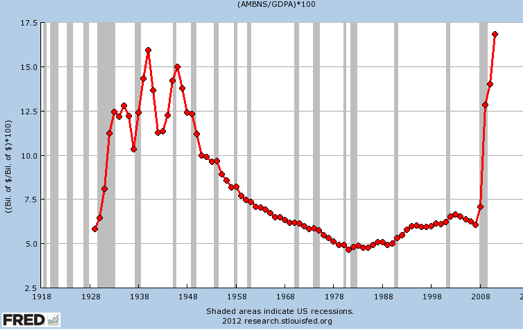
I could not find a time series of base velocity, but I did find it’s inverse, the base/GDP ratio.  And I found short term interest rates since 1934.  Note that between 1929 and 1934 (not shown on graph) the short term rate plunged from about 6% to little more than zero.  That explains the huge surge in the base/GDP ratio during 1929-34, and the resulting plunge in base velocity.  There is a drop in the base/GDP ratio in 1937 as rates rose slightly above zero in a premature exit from the zero rate trap (coming soon to theatres near you.)  Then rates go right back to zero, and the base/GDP ratio shoots up again peaking in 1940, when T-bill yields hit bottom.  After the war, interest rates trended upward all the way to 1981, and the base/GDP ratio falls, bottoming out in 1981 (i.e. velocity peaks).  Then interest rates fall gradually, and velocity falls as well, as the base/GDP ratio rises.  Recent years are a repeat of the 1930s.  I would add that after 2008 you don’t want to look at the nominal interest rate alone, rather the velocity of bank reserves depends on the short term interest rate minus IOR, which is actually negative.  The last 4 years are the least costly time in all of world history to hold reserves.

Krugman, Kaminska, and Waldman

There is an interesting debate taking place over the issue of whether we are in a new world, where monetary injections will no longer create inflation via a sort of “hot potato effect.”  Instead, base money and short term debt would become almost perfect substitutes.  Here’s Izabella Kaminska:

In this way, we agree with Waldman that the moment IOER created a preference for excess reserves over short-term debt assets or cash, was the moment excess reserves became a new type of safe asset security in their own right.

Excess reserves became the equivalent of state debt. But, very importantly, a state debt taken with the intention of never being spent, but rather for the purpose of creating safe assets instead.

Fed exit

And herein lies the differentiation point. If and when the Fed decides to exit unconventional policy, it will be obliged to re-associate opportunity costs with excess reserves. As rates go up, the spread between between the Fed Fund rate and the rate on excess reserves will only widen.

At this point the huge amount of excess liquidity sitting on reserve would either end up chasing any positive-yielding safe security in town or flood directly into the real economy. And both scenarios carry risks. In the former scenario, the crowding out of safe assets could once again lead to repo rates falling well below the Fed Funds rate, rendering central bank rate-hiking policy useless. In the latter scenario, the economy could face the real risk of run-away inflation.

To counteract these effects, the central bank would need to drain excess liquidity more quickly than the liquidity can flow into either alternative option. But what took four years to dish out could take a little while to reabsorb.

But there are other problems associated with unwinding such a huge position on the market, too. Especially if you view this as tantamount to either “spending” the money borrowed, or paying it off.

Consequently Waldman’s argument is essentially: why bother if you don’t have to? Let the excess reserves, just like state debt, roll on:

“Why go to the trouble of unwinding the existing surfeit of base money, which might be disruptive, when doing so solves no pressing problem?”

And since not moving quickly enough poses too great a risk, the alternative would be committing to IOER as a long-term rate-steering alternative instead.

As Waldman sums up:

“If the Fed adopts the floor system permanently, then the Fed will always “sterilize” the impact of a perpetual excess of base money by paying its target interest rate on reserves. As Krugman says, this prevents reserves from being equivalent to currency and amounts to a form of government borrowing. So, we agree: under the floor system, there is little difference between base money and short-term debt, at any targeted interest rate! Printing money and issuing debt are distinct only when there is an opportunity cost to holding base money rather than debt. If Krugman wants to define the existence of such a cost as “non-liquidity trap conditions”, fine. But, if that’s the definition, I expect we’ll be in liquidity trap conditions for a very long time! By Krugman’s definition, a floor system is an eternal liquidity trap.”

Krugman, for now, remains unconvinced.

I sympathize with Krugman’s view, albeit probably for slightly different reasons.  In his newest post Waldman says Krugman misinterpreted his argument.  So perhaps they aren’t that far apart.  But I still have reservations about where Waldman is going with his argument:

1.  I’ve already shown that the zero lower bound on the stock of excess reserves means that large increases in the price level would require a larger monetary base, if only to boost the currency stock.  So the quantity of money still matters, even with IOER.

2.  Waldman suggests that the Fed is not indifferent to the size of the currency stock.  Kaminska points out that a large stock of ERs might be beneficial, especially during financial crises.  So let’s consider the case where the Fed prefers to have banks hold ERs equal to 5% of GDP, roughly the size of the currency stock during normal times.  This implies that the base will be about 10% of GDP.  Obviously in that case the size of NGDP would be determined in ordinary quantity theoretic fashion.  Every extra dollar of base money has a hot potato effect, and boosts NGDP by $10 in the long run.  You might wonder how this occurs, when banks can freely exchange unwanted ERs for short term T-bills.  The key is that the Fed will adjust the IOER as needed to keep the level of ERs close to 5% of GDP.  If that seems like cheating, consider that Waldman made a very similar argument; that any Treasury injection of currency would be sterilized by the Fed, in order to maintain their macroeconomic objectives:

But Waldman definitely does not at all believe that 2(b) and (3) are equivalent when the interest rate is positive. He’s not sure where he implied that, but he must have done, and is grateful for the opportunity to disimply it. An expansion of the currency unopposed either by offsetting asset sales or paying interest on reserves would have the simple effect of preventing the Fed from maintaining its target rate. That would mean the Fed could not use interest rate policy to manage inflation or NGDP.

But that is precisely why Krugman is a bit unhelpful when he concludes, “Short-term debt and currency are still not at all the same thing, and this is what matters.” It does not matter, once the Fed’s reaction function is taken into account. The Fed will do what it needs to do to retain control of its core macroeconomic lever. Its ability to pay interest on reserves means it has the power to offset a hypothetical issue of currency by the Treasury, regardless of its size. Krugman is right to argue that, above the zero bound, an “unsterilized” currency issue would be different from debt, that it would put downward pressure on interest rates and upward pressure on inflation. But that is precisely why it is inconceivable that the Fed would ever allow such a currency issue to go unsterilized! In a world where it is certain that the Fed will either pay IOR or sell assets in response, we can consider issuance of currency by the Treasury fully equivalent to issuing debt.

[BTW,  Scott Sumner is a bit puzzled as to why Waldman refers to himself in the third person.  :)]

3.  Waldman’s strongest case would be that the Fed wants banks to hold very large amounts of ERs, but doesn’t much care how large as a share of GDP.  In that case we can assume the Fed uses IOER to make sure the level of ERs adjusts passively to offset any shocks to currency supply or demand, keeping NGDP on target.

I don’t think anyone disputes that, over a fairly wide range of the money supply, IOER can be used as the exclusive central bank monetary policy tool, with changes in the quantity of base money having no immediate impact on the economy.  After all, the price level is simply the inverse of the value of base money.  Obviously the value of base money can be altered via changes in either base supply (OMOs) or demand (IOER).

But I find it unlikely that the Fed would become completely indifferent over the share of GDP held as ERs, at least when rates are positive.  So I expect they’ll continue to do monetary policy via both supply and demand techniques.  Most importantly, even if T-bills become almost perfect substitutes for ERs, it will not allow fiscal policy to impact the price level.  It’s inconceivable to me that the Fed would allow this to happen.  They’ll simply adjust the IOER (downward) until they have traction, until they can do whatever it takes to change the amount of currency in circulation, and hence the price level.  (Again, I’m assuming normal times with positive interest rates–I think the strongest Keynesian argument is that “normal” may become increasingly unusual during the 21st century.)

There is another issue that tends to (wrongly) get lumped in with this debate—does pre-2008 monetary policy involve changes in the base, or the fed funds target?  And in that case I’d argue strongly for the quantity of money approach, even though in the ultra-short run (prior to 2008) the Fed targeted the fed funds rate and the base was endogenous.  However over more extended periods of time the fed funds target was adjusted so that the base would grow at levels compatible with 2% inflation.  If and when the Fed shifts to IOER targeting, I’d expect this to continue—money will be endogenous in the ultra-short run, and endogenous exogenous over the long run.

Where things may differ is the medium run.  No question that IOER allows the Fed to keep the stock of base money endogenous for a much longer period of time than fed funds targeting alone.  That’s because under fed funds targeting with no IOER the level of excess reserves is generally close to zero (at positive interest rates).  In that case control of the currency stock is a necessary and sufficient condition for price level control, not just in the long run, but even in the medium run.  With positive IOER you now have a high level of ERs, and by adjusting the rate of return on ERs you can stabilize inflation without changing the monetary base for a fairly extended period of time.


Do higher interest rates really cause inflation?

In the comment section of a recent post, people reacted with shock to my claim that, holding the monetary base constant, higher interest rates are inflationary.  I wonder if they thought it was some kind of weird monetarist claim.  Actually I learned this from the Keynesians.

During the long (1950s-70s) debate over the relative effectiveness of fiscal and monetary policy, Keynesians used to criticize the Equation of Exchange as follows:

“Sure if you increase M, and if V is constant, then NGDP will rise.  But V is not constant.  Even worse for the monetarists, more M will tend to reduce V.  Here’s why.  As M rises, nominal interest rates will fall. At a lower nominal interest rate, there is a lower opportunity cost of holding cash.  This makes people hold on to cash longer, and V falls.  So it’s not even clear than more M will lead to more NGDP.  That’s why we need fiscal policy.”

Don’t blame me, blame the Keynesians.  I agree with their reasoning, except the part about needing fiscal policy.  The good news is that monetary policy has only a temporary effect on interest rates.  When they return to normal, so will velocity, and then the QTM holds in the long run.

So if Keynesian theory predicts that high interest rates are inflationary, why do the Keynesians talk as if the opposite is true?  Now we get back to “never reason from a price change.”  Here are some reasons why interest rates might rise:

1.  Tight money by the Fed (M falls)

2.  Fiscal stimulus pushes up interest rates as the government borrows more.

3.  Robust animal spirits among businessmen leads to more investment.

It’s no surprise that examples 2 and 3 are associated with higher NGDP and inflation, but what about number one?

In case one the effect of higher interest rates, by itself, is to raise V, which is clearly inflationary.  However in most cases V will rise by less than M falls.  Thus the overall effect of tight money is not inflationary.  It’s deflationary, because the deflationary effect of lower M overwhelms the inflationary effect of higher interest rates and faster velocity.

This example also shows that the quantity of money is what drives the transmission mechanism for monetary policy, which must be an embarrassment for Keynesians, who sometimes talk as if movements in the fed funds rate drive investment spending.

How could this problem be fixed?  The Fed could switch from OMOs to IOR as a policy tool.  In that case higher interest rates really would be deflationary, just as the Keynesians assume.  So you no longer need to put the money stock somewhere in the model.  Under our pre-2008 system the monetary base earned no interest.  Thus nominal rates became the opportunity cost of holding base money. Higher rates meant less demand for base money, which is inflationary.  With IOR it is just the reverse.  Higher IOR actually leads people to want to hold more base money, because it’s the reward for holding bank reserves.  So if you raise the IOR you increase the demand for reserves and base money, which is deflationary.

I’d guess this is why Michael Woodford is so gung-ho for switching to an IOR approach to monetary policy.  He abhors quantity theoretic models in much the same way a vampire abhors sunlight.  The IOR policy tool would allow Keynesians to claim that the Fed’s target interest rate isn’t just a policy tool; it actually explains the transmission mechanism for monetary policy.  Now they can claim that the quantity of money doesn’t matter (not quite, until we get rid of that pesky currency) and that it’s all about interest rates.

In contrast, I abhor interest rate models in the way a vampire abhors mirrors.  I want to eliminate reserve requirements, IOR, member bank deposits at the Fed, discount loans, and indeed anything that connects monetary policy to the financial system.  I’d like to return to the pre-1914 system where the base was 100% currency and coin.  Except I’d like to have the Fed make base money convertible into NGDP futures contracts, not 1/20.67 oz. of gold.

Give that man the Bastiat Award!

Here’s the sort of thing we teach our students in basic economics:

A fable by James Ingram also illustrates that free international trade is production efficient. In his book, International Economic Problems (John Wiley, 1970), he tells of a mysterious entrepreneur, Mr. X., who announces to the world that he has found several amazing discoveries that allow him to produce cheap televisions, automobiles, cameras, and other goods. He sets up a plant on a large tract of land along the coast of North Carolina; hires 5000 employees who are sworn to secrecy; and begins buying grain, coal, and machinery. As the trains of grain and coal roll into his factory, other trains full of televisions and automobiles roll out of his factory into showrooms across the country. Mr. X is hailed as another Edison or Bell, and his company becomes a favorite with Wall Street investors.

Consumers love Mr. X because his products are so much cheaper than what they could buy before. Of course, his competitors dislike him, but their attempts to get laws restricting his operations get nowhere. The Houses of Congress ring with speeches saying that some economic adjustment is an inevitable by-product of technological progress.

Then, one day a small boy trying out his new skin-diving gear accidentally penetrates Mr. X’s security shield and learns Mr. X’s secret. Nothing is produced at the factory. It is all a front for a giant import-export business. Mr. X transforms grain and coal into autos and televisions by trade. His secret revealed, Mr. X is reviled and his factory shut down. Members of Congress proclaim that the American standard of living has had a narrow escape from the threat of cheap foreign labor and urge more money for research in industrial technology.

And here’s what happens if you apply what you’ve learned in econ:

There’s a story floating around the internet that’s so good that it can’t be true – but I really, really want it to be. According to a Verizon security blog, a developer employed by an American company has been caught outsourcing his own job to China – giving him much-needed extra time to watch YouTube videos about cats.

.  .  .

Verizon investigators found that [Bob] had hired a software consultancy in Shenyang to do his programming work for him, and had FedExed them his two-factor authentication token so they could log into his account. He was paying them a fifth of his six-figure salary to do the work and spent the rest of his time on other activities.

What did those other “activities” consist of? Apparently it was:

9:00 a.m. – Arrive and surf Reddit for a couple of hours. Watch cat videos
11:30 a.m. – Take lunch
1:00 p.m. – Ebay time
2:00-ish p.m – Facebook updates, LinkedIn
4:30 p.m. – End-of-day update e-mail to management
5:00 p.m. – Go home

Throw in a steady diet of custard cream biscuits and this is my idea of heaven – and it wasn’t doing Bob’s productivity any harm, either. According to one source, “His [work] was clean, well written, and submitted in a timely fashion. Quarter after quarter, his performance review noted him as the best developer in the building.”

The Register reports that Bob got canned, which is a great tragedy.

As I said yesterday, the public has utter disdain for the economic way of thinking.

The public wants us to be astrologers or heretics, not scientists

There has been a lot of recent discussion about where economists agree (micro) and where we disagree (macroeconomics.) Ryan Avent noted these findings, and then discussed a study showing that the public is skeptical of the more “scientific” aspects of our field.

I first became aware of this problem when serving on a committee creating a new MBA.  I suggested the econ course should focus on micro, which I thought would be vastly more useful to MBAs than macro.  The other committee members (from other departments) gave me a funny look.  I eventually learned that noneconomists are only interested in what economists have to say on macro questions, and have utter disdain for our views on any and all micro topics:

1. They don’t care what we think of antitrust cases, they’ve already made up their minds.  They don’t care about our views on predatory pricing, they’ve already made up their minds.

2.  They don’t care what trade theory tells us.  They just know that imports raise the unemployment rate, even when not at the zero bound.  Or that low wages are an advantage in trade.

3.  They are convinced that a firm will raise prices if its costs rise, but won’t pass lower costs on to consumers.  You can use elementary logic, you can point out that this sort of behavior would actually reduce profits, you can argue until you are blue in the face, and it will have no impact.

4.  They’ve made up their minds on carbon taxes, or any other taxes.  It’s all about who pays.

5.  They have made up their minds on product quality regulations.  You can talk about the market giving firms and incentive to produce the optimal amount of defects, and it will carry no weight.

6.  Labor unions . . .

I could go on and on.  Non-economists couldn’t care less what economists think of micro questions.  They think common sense is enough (it’s not) and hence they’ve made up their minds.  When they hear our ideas they think we are a bit kooky.

In contrast, non-economists don’t have preconceived ideas on inflation vs. NGDP targeting, or the implications of a $1.2 trillion deficit.  Just as they defer to physicists if the topic of quantum mechanics comes up at a cocktail party, they defer to economists for many macro questions (not all.)

Most of all they want us to forecast recessions.  That of course is the one thing we cannot do.  (Recall the Queen’s complaint.)  Or forecast stock prices, or interest rates.

If we insist on focusing on microeconomic topics, they will only take us seriously if we become a heretic, telling them that the rest of economists are a bunch of autistic nerds, who don’t really understand the real world.  Those heretical economists are very popular.

There was real excitement when behavioral econ burst on the scene.  It’s by far the most common question I get from non-economists when the topic of on new directions in economics comes up.  Non-economists are hoping that behavioral econ will some knock sense into all those idiotic economists, and a new model that takes into account actual human psychology will emerge.  Of course the standard model isn’t going away, but don’t tell the general public—they’ll look crestfallen when they hear the news.

So yes, the good news is that macro is the only area of econ with an almost total lack of consensus on key questions.  The bad news is that for most people this means economists cannot agree on anything useful at all.