Archive for January 2013


John Taylor on NGDP targeting

Here’s John Taylor criticizing NGDPLT:

One change is that, in comparison with earlier proposals, the recent proposals tend to focus more on the level of NGDP rather than its growth rate. This removes some of the instability of NGDP growth rate targeting caused by the fact that NGDP growth should be higher than its long run target during the catch up period following a recession. But it introduces another problem: if an inflation shock takes the price level and thus NGDP above the target NGDP path, then the Fed will have to take sharp tightening action which would cause real GDP to fall much more than with inflation targeting and most likely result in abandoning the NGDP target.

I am puzzled my his comment:

1.  I don’t understand why Taylor assumes a price shock would raise NGDP.  It will clearly raise the price level, and reduce RGDP, but it’s not obvious to me that it would raise NGDP.

2.  We had a test of Taylor’s hypothesis during the period from mid-2007 to mid-2008, when a huge price shock drove energy prices much higher (as well as some other commodities.)  NGDP growth did not increase at all, indeed the growth rate decreased.  NGDP growth also slowed in 1974, another huge price shock. Even worse for Taylor’s argument, adoption of NGDPLT in mid-2008 would have been far superior to the Fed’s actual inflation targeting regime—even many of NGDPLT’s critic would concede that point.  NGDPLT would have called for a far easier monetary policy from mid-2008 to 2010, which would have made the recession milder.  In contrast, the Fed cited fear of inflation as their reason for not cutting rates (from 2.0%) in their meeting two days after Lehman failed in mid-September 2008.  In retrospect the Fed should have cut rate sharply.

If NGDP did rise above trend during a price shock, it would be appropriate to have a tight money policy that resulted in lower NGDP growth (and lower RGDP growth) in the short run.

So I don’t see any theoretical or empirical support for Taylor’s claim.

HT:  Michael Darda

Update:  I must be getting senile.  I didn’t notice that this was an old post.  I already responded.  Nevermind.

Japan: More questions than answers

Paul Krugman has done a series of posts suggesting that recent policy announcements in Japan may have led to dramatically higher inflation expectations, and much lower real interest rates.  I’d like to agree with him, but I’m having trouble processing some of the information.  I hope to learn more by reading commenters’ reactions to this post.  The first Krugman post noted:

And here’s an important point that has gone remarkably unreported, except on a few financial blogs: something dramatic does seem to be happening on the expected inflation front. Here’s the 5-year breakeven, the spread between indexed and non-indexed bonds:

. . .

The big move actually came before Abe took office, maybe reflecting the sense that the political environment had changed and that the Bank of Japan’s freedom to impose monetary orthodoxy was about to end. Whatever caused it, this is a remarkable change “” it’s the kind of upward move in inflation expectations advocates of radical monetary policy in the US can only dream of. And coupled with a fiscal boost, it could mean that Japan’s long deflationary era is finally coming to an end.

There’s no maybe about it, the surge in the Japanese stock market and the big plunge in the yen began right when Abe announced he’d push for a 2% inflation target, well before the election.  (It was mid-November.)  But I don’t see a “dramatic” increase in 5 year inflation expectations in the graph he provides—just a modest boost that was even smaller than we got out of the various QE programs.  Maybe I misread the graph, but it looks to me like inflation expectations rose by about 10 basis points between mid-November and today.

More likely, Krugman is referring to the nearly 100 basis point rise over the past 12 months.  That is pretty large, although US TIPS spreads have occasionally moved by comparable amounts in recent years, but it doesn’t seem to be linked to either rumors about BOJ policy changes, or dramatic changes in the value of the yen (or Japanese equity prices.)  The link between rumors of monetary easing and big stock/exchange rate moves is so obvious that I’m reluctant to attribute a big move in inflation expectations to policy changes, unless there is confirmation in other markets.

Please convince me I am wrong.

In the next Japan post Krugman provides this graph, using 10 year rates:
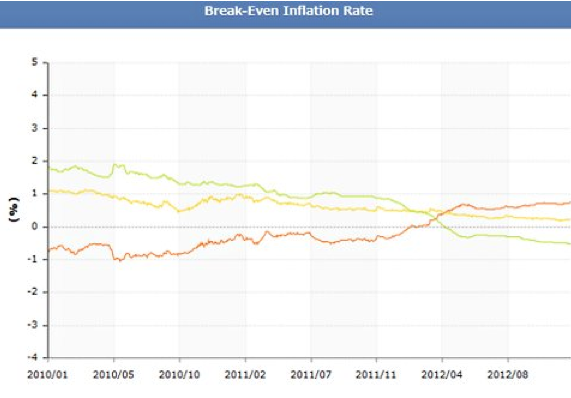
That data looks wrong to me.  It seems to show 10 year Japanese bonds yields (yellow line) falling to about 0.25%, whereas they are actually over 0.80%.  But is the nominal rate wrong, or is the breakeven inflation rate (red line) wrong?  It appears to me that the nominal rate is wrong, as the other graphs Krugman provides suggest 10 year yields are near 0.80%, which is correct.  In contrast, the inflation spreads seem right, as they are consistent with his other post, close to the 5 year spreads.  But that means the real interest rate (green line) must be incorrect, it should be closer to zero.

Even stranger is the fact that the real interest rate estimates provided would be roughly correct for the US, where 10 year real rates have fallen from positive to significantly negative in the past year or two.

Putting aside the question of whether the real rate estimates are correct, what do we make of Krugman’s claim that easier money will reduce real rates, and not raise nominal rates?  I have an open mind on this question.  In the past I’ve seen easier money raise both real and nominal rates, but I don’t think it raises real rates all that often.  The effect can depend on lots of factors, including whether the policy is a one time change, or expected to lead to permanently higher inflation and NGDP growth.  With QE combined with IOR in the US there might also be a market segmentation argument.  So Krugman might be right.

But I think it’s also possible he is wrong to get optimistic about the fall in Japanese real rates.  (Never reason from a . . . )  David Glasner has talked a lot about the fact that the zero rate bound is a problem because it can prevent nominal rates from falling to equilibrium, and hence can hold real rates above where they need to be for macro equilibrium.

Now consider the fact that in the US the real yields on 10 year Treasuries has been on a downtrend since the early 1980s, from about plus 7.0% to negative 0.6%.  That’s a huge drop, and it obviously is not all due to “easy money.”  Indeed inflation has fallen sharply over that 30 year period, as has NGDP growth.  Maybe the recent drop is easier money, that’s debatable, but surely not the entire 30 year downtrend.

Now consider that the reasons offered for lower trend real interest rates in the US, hold even more strongly in Japan, which is gradually dying out as a country.  It’s very possible that the last 12 month’s worth of lower real yields on 10 year Japanese bonds in not easier money, but rather part of a long term trend similar to the US.  If so, the zero bound problem might well get worse in the future.

The lower the equilibrium real rate, the higher the expected inflation rate required to keep (Wicksellian equilibrium) nominal yields above zero.  If the equilibrium real rate falls to negative 1% on 10 year bonds, it’s probably even lower on short term debt.  In that case even raising Japanese inflation from minus 0.3% to plus 0.7%, would do nothing but offset the fall in the equilibrium real rate, leaving Japan just as stuck at the zero bound as before, with the credit markets not able to reach equilibrium.

Just so I am not misunderstood:

1.  I agree with Krugman that the modestly higher inflation expectations since November are policy related, and are good news.

2.  I worry that the much larger fall in real rates over the past 12 months may reflect increasing pessimism about Japan’s long term equilibrium growth, and lower expectations of its long term equilibrium Wicksellian real interest rate.  I hope I’m wrong.  I hope it is due to expectations of stimulus.  But we pretty much know that the recent big move in Japanese equities and the yen was driven by policy rumors, and yet the Japanese equivalent of our TIPS spread moved up only about 10 basis points on the news.  That tells me that the markets are slightly more hopeful, but on balance are just as skeptical of Abe as Noah Smith.

PS.  I do expect Japan’s birth rate to bounce back at some point, so the “dying out” comment should not be taken literally.


How to say “East Asian countries” in 27 words

Via Tyler Cowen, here’s Barry Eichengreen, Donghyun Park, and Kwanho Shin:

We analyze the incidence and correlates of growth slowdowns in fast-growing middle-income countries, extending the analysis of an earlier paper (Eichengreen, Park and Shin 2012). We continue to find dispersion in the per capita income at which slowdowns occur. But in contrast to our earlier analysis which pointed to the existence of a single mode at which slowdowns occur in the neighborhood of $15,000-$16,000 2005 purchasing power parity dollars, new data point to two modes, one in the $10,000-$11,000 range and another at $15,000-$16,000. A number of countries appear to have experienced two slowdowns, consistent with the existence of multiple modes. We conclude that high growth in middle-income countries may decelerate in steps rather than at a single point in time. This implies that a larger group of countries is at risk of a growth slowdown and that middle-income countries may find themselves slowing down at lower income levels than implied by our earlier estimates. We also find that slowdowns are less likely in countries where the population has a relatively high level of secondary and tertiary education and where high-technology products account for a relatively large share of exports, consistent with our earlier emphasis of the importance of moving up the technology ladder in order to avoid the middle-income trap.  (emphasis added)

And speaking of China, in earlier posts I expressed skepticism about China’s high speed rail program.  It seems to me that a country as poor as China ought to first focus on building up its basic rail infrastructure. I still sort of believe that, but was taken aback by this report:

Perhaps the hundreds of billions already spent on high-speed railways might have been more effectively spent upgrading the entire network-enhancing overall mobility and helping reduce tensions between rich and poor. Yet China’s technocratic leaders have a deep belief that elites should lead the way, and high-speed rail is their vision for the future.

And in some ways, perhaps they are right. A recent report says that on many key high-speed lines, fares are covering debt costs, confounding skeptics who said high-speed trains were purely prestige projects.

The Beijing to Guangzhou line just opened.  The 1,428 mile trip has been cut from 24 hours to 8 hours.  And 155 pairs of trains will run each way daily.  China just might end up with the only large high speed rail network that actually makes sense.  The Chinese cities are often too far apart to make driving appealing, and would you fly 500 to 1000 miles if you could take a 200MPH train?

And Chinese economic growth is entering a new upswing, which I’ll report on later.

PS.  When I say “East Asian” I actually mean “ethnically Chinese, Korean, Japanese, Vietnamese.”  That’s 5 words.

PPS. I’m really looking forward to that Fresno to Bakersfield link, maybe in a decade.  By then China’s system will be mostly completed.  All the way out to Urumqi.

Abe’s first mistake

I can’t say this was unexpected, as Abe indicated he’d do this during the campaign:

Japan’s $117 billion economic stimulus package is a positive start to revive a frail economy. But the government needs to follow this up with long term structural changes and the central bank has to chip in with some bold moves – otherwise disappointment is sure to follow, analysts said Friday.

Faced with an economy in recession, Japan’s new government unveiled the country’s biggest spending boost since the financial crisis and one it hopes will boost economic growth by 2 percentage points and create 600,000 jobs.

Japan’s economy, the world’s third largest, has contracted for two quarters running, pushed into a recession by weak global demand for its exports.

“Japan’s economy has been very weak over the past couple of quarters and some stimulus is necessary to get the growth rate up at least over the near term,” Thomas Byrne, senior vice president at Sovereign Risk Group, Moody’s Investors Service, told CNBC Asia’s “The Call.” “Other things are necessary to keep the growth rate up over the longer-term though.”

Shinzo Abe, who became Japan’s new prime minister last month after his Liberal Democratic Party was returned to power with a comfortable election win, has promised to revive the economy and urged the central bank to introduce aggressive monetary easing and double its inflation target to 2 percent.

(Read More: Bank of Japan to Consider Easing Again in January)

But analysts said that Friday’s stimulus measures are likely to have only a short-term boost and should be just the start of steps needed to really kick start the Japanese economy.

“The latest package is big and I expect there would be a bigger bump to growth, but I would also expect that it would have the same short-lived impact as past stimulus and growth would fall back,” said Tim Condon, head of research, Asia ING Financial Markets in Singapore.

“I would be much more positive if the Bank of Japan (BOJ) says it agrees with Mr Abe and that it is going to change the way it does do monetary policy and become much more accommodative,” he added.

The expectation of aggressive monetary easing and a much bolder BOJ since Abe, who was prime minister in 2006-2007, returned to power has sparked a bull run in Japanese markets.

But nonetheless very disappointing.  Obviously fiscal stimulus hasn’t worked in the past.  Japan has run massive budget deficits, producing a mindbogglingly large national debt, and has seen NGDP fall for 20 years—perhaps the worst long term aggregate demand performance by a developed country in recorded history.  That’s right, the worst—and in a country where the national debt has soared to over 200% of GDP. When you have a central bank that repeatedly raises interest rates during a period where (GDP deflator) inflation is negative, you aren’t going to get any “ooomph” from deficit spending.

How do New Keynesians define the stance of monetary policy?

When I started blogging I kept claiming that the steep recession of 2008-09 was caused by ultra-tight Fed policy.  I had the distinct impression that almost no one agreed with me.  Even some who favored NGDPLT preferred to call the mistakes “errors of omission,” not tight money causing a recession.

Then I found out that Bernanke agreed with me.  No, he didn’t say the Fed caused the recession under his leadership, but he did agree that it is NGDP growth and inflation that matter, not interest rates or the money supply:

The imperfect reliability of money growth as an indicator of monetary policy is unfortunate, because we don’t really have anything satisfactory to replace it. As emphasized by Friedman  . . . nominal interest rates are not good indicators of the stance of policy . . .  The real short-term interest rate . . . is also imperfect . . .  Ultimately, it appears, one can check to see if an economy has a stable monetary background only by looking at macroeconomic indicators such as nominal GDP growth and inflation.

At least he felt that way in 2003, maybe not today.  In any case, since mid-2008 the average growth in those two variables has been lower than at any time since Herbert Hoover was President.

Now there is an indication that Michael Woodford agrees with Bernanke.  Not the Bernanke of 2013, who obviously can’t admit that monetary policy has been really tight since 2008, but rather the Bernanke of 2003.  Unfortunately I cannot find a link, but highly reliable commenter “Integral” sent me this report about Woodford’s comments at the recent AEA meeting:

As for Woodford and Gertler, their comments were verbal. An audience member asked how they would gauge the stance of monetary policy, given that one shouldn’t use the money supply or level of the interest rate. Woodford replied with, loosely quoting, “one should look at outcome variables…inflation and nominal GDP.”

So I’m in a quandary.  Commenter “K” claims there is nothing new in my claim that money has been tight.  He says the New Keynesians agree with me.  OK, maybe he is right.  But then someone tell me why during the past 5 years I’ve read approximately zero articles written by New Keynesians talking about tight money causing a recession in 2008-09?  And a zillion articles that monetary policy is highly accommodative.

I suppose one could argue that NKs don’t think the Fed can do anything about the tight money, as we are in a liquidity trap.  But Bernanke doesn’t believe that.  And I recall Brad DeLong asking Bernanke why the Fed didn’t just raise the inflation target to 3%.  That would count as “doing something” in the NK model, wouldn’t it?  So DeLong must not believe the Fed can “do nothing.”

BTW, consider the following:

1.  In his writings on Japan, Bernanke often talked about the problems caused by a shortfall in NGDP.

2.  He seemed to refer to the concept of NGDP more than most elite macroeconomists (at the time.)

3.  People with views on monetary policy that are very close to those of Bernanke have recently converted to NGDPLT.

4.  The Fed explicitly set a 2% inflation target, right before the NGDP bandwagon gained momentum.

5.  The Fed obviously cannot switch targets right after explicitly adopting a 2% inflation target.

Suppose Bernanke were asked:  “Off the record, would your job over the last 5 years have been easier with an inflation target or an NGDP target?”  What do you think he would say?