
Archive for September 2012


It is what it is

Twelve basis points on the 5 year TIPS spread

Two hundred points on the Dow.

Fed lowers its 2014 unemployment estimates by 0.3% or 0.4%

People are getting very excited by the Fed’s new initiatives, and rightly so.  But it’s important to keep things in perspective.  There’s a big difference between moving slightly toward level targeting/targeting the forecast, and actually doing those things. The markets are telling us that expected NGDP growth accelerated.  So the policy “worked.”  But it’s not enough to promote rapid recovery.  On the other hand we have to be realistic, the policy will be judged on the basis of subsequent events, not yesterday’s changes in market expectations (as it would be judged if macroeconomics were a science, not a branch of astrology.)

In my view the most important gain might be in future business cycles. The Fed has implicitly acknowledged that they should have paid more attention to market monetarists and Woodfordians back in 2008-09. Like most big institutions, the Fed evolves gradually over time. Perhaps the best analogy I could provide would be the Keynesian revolution. It had a small impact on 1930s policy-making, but not enough to promote a fast recovery. On the other hand it became conventional wisdom among policymakers after WWII (for better or worse–and I’d say “both.”) I expect the Fed to do some hard thinking about signaling/level targeting/etc between now and the next recession, and to be better prepared next time.  And the smartest teenage economists in the blogosphere (Soltas, Wang, etc) have also been pushing the Fed to move in this direction.  That bodes well for the future.

On a lighter note, yesterday was “Scott Sumner day” and yet I had to go to work.  That doesn’t seem fair!  I’d also note that Cardiff Garcia at FT Alphaville mentioned David Beckworth and I (along with Woodford), in their discussion of economists who had played a role in the debate. Don’t get me wrong, I realize that Woodford’s 100 times more influential than I am.  But I also think we’ve had some impact, mostly by putting out ideas that other more famous people have discussed and/or advocated (Christy Romer, Krugman, DeLong, Jeffrey Frankel, Jan Hatzius, etc.)  So it’s a good day for market monetarism.

In a recent post I mentioned Evan Soltas’s tweet on how the decision seemed to affect the Obama contract over at Intrade.  A few months back a blogger named “redonkulus” sent me a link showing that the Obama contract is positively correlated with the TIPS spread, which jumped last night.

PS.  A patron of the arts is a wealthy individual who is skilled at finding and nurturing talented artists.  Tyler Cowen is sort of a patron of the economics blogosphere. He was the first to promote my blog, and he saw the quality of Evan Soltas’s blogging even before I did.

PPS.  I just noticed some very kind comments from my favorite progressive blogger, Matt Yglesias.  He credits me with influencing his thought on monetary economics.  I can honestly say that he’s influenced my thought on public policy issues more than any other blogger.  I’d also like to thank Ryan Avent, who’s helped promote our ideas, and who can  express then much more eloquently than I can.

PPPS.  Also thanks to all the other market monetarists.  The list is getting so long that I won’t try to name them (and offend someone by leaving out the name) but you all know who they are.
 

The Bernanke press conference

I heard much of the press conference (not all) and I must say that I thought Bernanke was far better than in the past.  I initially underestimated the Fed’s move (in the previous two posts.)  The markets may have initially made the same mistake; they rose further as they had more time to digest the new policy.   Here are a few observations:

1.  Bernanke emphasized that monetary stimulus is not like fiscal stimulus, it actually reduces the budget deficit.  That’s right.

2.  He said it was an 11 to 1 vote.  The Fed is clearly behind him and hence the policy has credibility.

3.  He kept talking jobs jobs jobs.  And he emphasized that the Fed would do pretty much whatever it takes to get some progress on the employment front.  Of course by itself that would be a bad policy.  But when combined with the 2% inflation target (which he said had equal weight) it’s getting pretty close to NGDP targeting.

4.  Speaking of NGDP targeting, Bernanke brought up the idea (without any prompting by reporters) and talked about Woodford’s plan for NGDP level targeting.  He didn’t endorse it (how could he when the Fed only recently adopted a 2% inflation goal) but he certainly wasn’t critical of Woodford.  I had the impression that if he wasn’t constrained by being head of the Fed right now, he’d be pretty sympathetic to Woodford’s proposal.  And why do I have to call it “Woodford’s proposal?”

5.   I’ve gotten a lot of criticism from people, even my friends in the blogosphere, for going too easy on Bernanke.  Talking about how he’s well-intentioned, etc.  I think this press conference shows that my comments were justified.  A commenter named Mark C recently sent me a survey by Bloomberg that showed that the vast majority of economists did not think money was too tight, and only 1 out of 66 thought money was far too tight.  Even though Bernanke is a Republican, he’s to the left of the mainstream of a profession that votes 70% Democratic.  His call for doing whatever it takes to get more jobs was clearly sincere.

I’ve gotten a flood of comments and emails, and won’t have time to respond for several days.

PS.  I notice that Twitter has an Evan Soltas tweet showing that the odds of Obama being re-elected rose on the news.  Justin Wolfers wondered about the long and variable lags.  My hunch is that Obama’s re-election odds are positively correlated with the S&P500.  I.e. a rising stock market makes people more optimistic that things are getting better.  Does anyone know if such a correlation exists?

PPS.  Kudos to commenter Saturos, who seemed to be one of the first to notice the importance of what happened today.

One down, two to go

In June I proposed a “pragmatic” plan for the Fed.  It wasn’t my first choice, far from it.  But it was something that I thought was politicallly feasible, and also something that could help quite a bit.  Today the Fed adopted one of those three recommendations; open ended QE.  At least that’s how I interpret the following:

To support a stronger economic recovery and to help ensure that inflation, over time, is at the rate most consistent with its dual mandate, the Committee agreed today to increase policy accommodation by purchasing additional agency mortgage-backed securities at a pace of $40 billion per month.

Note that there is no indication of the total amount to be purchased.  In addition, they did move closer to level targeting, something I didn’t think was politically possible:

To support continued progress toward maximum employment and price stability, the Committee expects that a highly accommodative stance of monetary policy will remain appropriate for a considerable time after the economic recovery strengthens.

What’s changed since June?  That’s pretty easy to answer; Woodford’s paper was obviously very influential, and that changed the politics on level targeting.  So Woodford also deserves a lot of credit.  It’s not as specific as Woodford or I would like, but it’s something.  More specifically it’s a dog whistle that Bernanke hopes the markets will hear, but which he also hopes will be missed by the Tea Party.

Lars Christensen has some astute comments.

Thank God the Bernanke/Woodford policy has failed!

There’s enough news here for a month’s worth of posts.  Matt Yglesias has my general take on things, although my hunch is that we are a bit too little and too late to significantly affect this business cycle.  However this is really good news for monetary policy going forward, especially for the next recession.  It’s baby steps toward level targeting.

Now for the title of this post.  Here’s what the Fed says it’s trying to do:

These actions, which together will increase the Committee’s holdings of longer-term securities by about $85 billion each month through the end of the year, should put downward pressure on longer-term interest rates, support mortgage markets, and help to make broader financial conditions more accommodative.

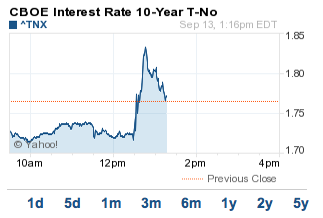
Nope.  Long term yields increased on the news, just as market monetarist’s would have expected.  And thank God they did!  The higher yields are an indication that markets have (slightly) raised their NGDP forecasts going forward.  The jump in equity markets suggests that RGDP growth will also rise (albeit modestly.)  The bad news is that 100 points on the Dow is indicative of a really small change in the RGDP growth rate, basically within the margin or error.  So we’ll never know any more than we know right now about whether the policy will “work.”  Of course that won’t prevent hundreds of economists from making silly pronouncements a few months from now, based on actual changes in RGDP.  I beg you to ignore them all.

One other thing.  The rise is interest rates undercuts the Keynesian model (although I suppose the sophisticated version merely predicts that long rates would fall relative to the (rising) Walrasian equilibrium value.)  But the markets are even more strongly rebuking John Cochrane’s claim that Bernanke’s promises would not be credible.  Even a very vague and inadequate promise from the Fed was enough to boost markets significantly.

PS.  I kind of regret the sarcastic tone of the title of this post.  Bernanke deserves a lot of credit for what the Fed did today.  It’s not as much as I’d like, but he’s way out in front of the median economist.  It could be much worse.

Update:  The one percent jump in stocks obviously just reflects the unexpected part of the announcement.  Most observers expected the Fed to do something, and it seems likely that the rally over the last few weeks reflects (in part) hints from Bernanke that more would be done.  So maybe it’s a 2%, 3%, or 4% jump.  That’s not game-changing, but it’s also not chopped liver.  (I see commenter O. nate beat me to it.)

Update#2:  The jump in long term rates strongly supports David Beckworth’s argument in this excellent post.

Does barter provide evidence against the sticky wage model?

Tyler Cowen seems to think so:

One interesting feature of these enterprises is that they push a bit of emphasis away from sticky wage and price theories of depressions.  In essence the sellers participating in these exchanges are price discriminating, by trying to sell more of their output “” for lower prices “” through credit or barter mechanisms.  Getting back credits in return really is like receiving a lower price or wage.  So these exchanges show that at least some people are wildly willing to cut prices, wages, and returns, if only to sell more.

I see the Spanish barter exchanges described in Tyler’s post as powerful evidence in favor of sticky wages.  Recall that the sticky wage theory suggests that nominal wages can get stuck above their true Walrasian equilibrium value (either due to long term contracts or money illusion.)  Workers actually would prefer to produce more, and there are people who would like to buy that output, but sticky wages prevent the transactions from occurring.  This would lead some workers to exit the formal labor market, and try to pick up some of these mutually advantageous trades via barter.  And that’s seems to be what occurs.  Unfortunately the informal labor market is far less efficient in a technological sense (even if being more efficient in a market equilibrium sense.)  So the earnings from barter will be far lower than from formal jobs, and it doesn’t really “solve the problem.”  It just makes the depression slightly less bad.

Tyler Continues:

So which factors behind depressions receive marginal support from the prevalence of these practices?  First, these exchanges are a substitute for dysfunctional credit markets.

I’d say they are substitutes for dysfunctional labor markets.