
Archive for September 2012


Noah Millman on NGDPLT

Many blogosphere critics of market monetarism are sloppy and obnoxious.  Thus it’s a pleasant surprise to come across a critique as polite and thoughtful as Noah Millman’s recent piece in The American Conservative:

NGDP targeting is usually advocated in the context of advocating a “catchup” plan. Because we went through a period of deflation and contraction, the price level is now under trend, and the Fed should commit to remaining maximally loose until we’ve caught up with the price level.

But, if NGDP really is a new framework, and not just a rationale to keep monetary policy loose, to be discarded when conditions change, then we have to look back at how it would have worked in a period of high nominal growth – and high inflation. Moreover, we’d have to look at how “getting back to trend” would have worked once the back of inflation was broken.

And it seems to me that it would have worked disastrously. From 1965 to 1980, nominal GDP growth never dipped below 6%, and got as high as 12%. To return to “trend” would require keeping nominal GDP well below the economy’s potential for years. You remember “Morning in America?” Well, if we were following a nominal GDP target it would never have happened. The Fed would have raised rates sharply in 1984, as nominal GDP growth spiked up from 6% all the way to 10%.

Of course, nobody would have followed such a policy, even if, in theory, there were some advantage to “undoing” the “Great Inflation.” A policy of “opportunistic disinflation” was much more rational, precisely because much more moderate.

That’s obvious. So why isn’t it obvious that the converse is true?

I have no objection to the actual disinflation during the 1980s; I think Volcker got it about right (after a misstep in 1979-80.)  But Millman raises a very good question; when we introduce a new NGDPLT policy, where do we start the trend-line?  It seems to me that this decision unavoidably involves some degree of discretion.  My basic operating principle is to use a trend line that minimizes disequilibrium in the labor market.  Thus in 2009 I assumed that wages had been negotiated on the basis of the preceding 5% trend line, which had lasted for several decades.  I favored returning to that trend line, as that would bring the labor market back close to equilibrium.  As more time has gone by, I’ve now come to believe that it is no longer wise to return to the original trend line.  Too many wage contracts have been signed on the expectation that we will never return to the old trend line.  Similar discretion would have been appropriate in the early 1980s.

This may seem to conflict with my preference for a fully automatic system with no discretion.  I still favor a rigid rule-based policy, but only after the policy has been implemented.  It is impossible not to use discretion when implementing a new policy.  Choices always must be made.  Consider the reductio ad absurdum of NGDP staying 10% below trend for 100 years.  No one, not even the most fervent “level targeting” proponent, would still consider the pre-2008 trend line to be relevant.

The most interesting implication of NGDP targeting, one that I have come to agree with, is that supply shocks should not drive monetary policy – or should drive it the opposite way than you’d think. A spike in oil prices, which pushes up inflation, should lead to easing, not tightening, because it also causes a hit to real growth, and the second effect dominates, resulting in a lower NGDP.  .  .  .

On the other hand, nominal growth has historically been quite a bit more volatile than the inflation rate, so an NGDP target would require a much more volatile Fed – or one that was much slower on the draw. And NGDP expectations have been more volatile still – and it’s never been clear what metric the Fed would use to measure those expectations.

During the period when the Fed was doing a policy close to 5% NGDP targeting (2% inflation targeting plus what Robert Hetzel calls “leaning against the wind” on real GDP fluctuations), they actually kept NGDP very close to trend (say from 1990 to 2007.)  If they explicitly did NGDPLT I’d expect the result to be at least as good, probably slightly better.  And I have doubts about Millman’s claim that “NGDP expectations have been more volatile still” I am pretty sure the reverse is true.  Indeed under one version of my proposal (futures targeting) there would be no volatility at all in NGDP expectations.  And in the other version (Svensson’s “target the internal Fed forecast”) there is no volatility in the Fed’s internal NGDP forecast.  I don’t see how we can do much better than that.

Then there’s the problem that NGDP targeting implicitly assumes that we know what the long-term real growth potential of the economy is. Scott Sumner, one of the most capable exponents of NGDP targeting, says I have this backwards, but I think he’s confusing the short with the long term. A 2% inflation target is a prudential measure, based on the assumption that we want to get as close to zero (true price stability) as possible without dipping under. I understand the logic of it. Where does a 5% NGDP target come from? Implicitly, it comes from a 3% real growth potential plus 2% inflation. But where does the 3% come from? How do we know that our economy can continue to grow at 3% per year? How do we know that its real potential isn’t lower – or higher? Suppose technological advances push productivity way up. Why should the Fed raise interest rates in response? Suppose a drop in population growth and a slow-down in technological advance pushes the real growth potential of the economy below 2%. Why should the Fed remain persistently looser in response? I understand the logic behind the NGDP-targeting approach to supply shocks. I don’t understand the logic behind the NGDP-targeting approach to changes in productivity and labor-force growth.

Millman’s right about one thing, we should target NGDP per capita, not total NGDP. I’ve always thought the per capita target is best. I often omit that detail, as population growth in the US has been remarkably stable at about 0.9% per year. But he’s wrong on his other points.  There is no good economic argument for price stability.  Zero inflation is just another number.  On the other hand there is something very special about zero wage growth (due to money illusion) and zero interest rates (because of cash, nominal interest rates can’t fall below zero.)  It turns out that what most people regard as the “welfare cost (and benefit) of inflation” is actually better described as the welfare costs and benefits of faster NGDP growth.  The problem with high NGDP growth is that it raises nominal returns on capital, and this increases the tax rate on capital (which should be zero.)  The benefits from higher NGDP growth are that it moves you away from the zero wage boundary, and thus there is less labor market distortion caused by workers refusing to take nominal wage cuts, when market conditions would call for them (and when they would accept real wages cuts via inflation.)  And of course you are less likely to get stuck at the zero interest rate bound.  On the other hand zero inflation is almost a meaningless number.  It doesn’t mean product prices are not rising, it means the prices of computers, cars, TVs, etc, rise at a rate equal to the BLS estimate of quality improvement.  But why would that number matter in a welfare sense?  It doesn’t.

So NGDP growth matters, not inflation.  Thus I didn’t pick 5% because it was 3% plus 2%, rather I picked it for two reasons.

1.  It was the historical trend before 2008.  So it seemed like that was Fed policy.  I argued they should have stuck to their old policy, not changed radically in 2008.  Policy stability leads to macroeconomic stability.

2.  It seemed high enough to keep us away from those two black holes (zero wage boundary and zero nominal interest rates) but not so high as to put a heavy tax burden on capital.  It was a compromise.  I’d be fine with 4% or 6%, as long as it was stable, and level targeting.

Moreover, the whole idea of targeting nominal GDP assumes the Fed is able to command an increase in inflation. Which, I agree, it can do – but it can’t do it without side effects so long as we have a cash economy. In a theoretical world where there was no cash, the Fed could push the Fed Funds rate to negative levels, which it seems reasonable to assume would have similar effects to a cut in rates under normal, positive-rate conditions. In the world we live in, the Fed has to buy up other assets – longer-term government bonds, primarily – in order to further loosen monetary policy. But this isn’t really the same thing as lowering the Fed Funds rate, and it has a variety of distorting effects on both investment decisions and the behavior of the Treasury.

This may or may not be a problem (I don’t think it is) but let’s be clear about one thing; it has nothing to do with NGDPLT.  The amount of debt the Fed must buy depends on the rate of NGDP growth.  The higher the rate of NGDP growth, the higher the nominal interest rate (i.e. Australia) and the lower the ratio of base money to GDP.  So if you want a small Fed balance sheet, there’s only one way to get it—have the NGDP trend growth rate be high enough to keep us above the zero nominal rate bound.  Conversely if you have very low trend NGDP (i.e. Japan) the base to GDP ratio will be very high, and the central bank will have to buy lots of debt.  The base is 4% of GDP in Australia, and 23% of GDP in Japan.

 And some of the main channels by which the Fed affects consumer behavior are blocked right now, preventing monetary policy – even extraordinary policy such as the Fed has been following – from being effective. So long as we have a huge overhang of nonperforming mortgages, refinancing will be difficult. But refinancing is the main mechanism by which the Fed can drive an increase in demand.

In my view refinancing has virtually zero impact on “demand.”  The key is to boost expectations of future NGDP.  That will raise asset prices today, and boost thus demand.

More generally, I agree with economists like Joseph Stiglitz and Jeffrey Sachs that focusing too much on monetary policy is a distraction from the need to address the economy’s structural problems – from the overhang of mortgage debt to wasteful spending on health care to the collapse in manufacturing to a backlog of basic infrastructure needs – which must be addressed for the real economy to improve in a sustainable fashion. These structural problems can be tackled with a view to improving the short-term employment situation, rather than in a way that ignores that situation. But they have to be addressed for the economy to sustainably improve. A monetary-driven expansion in the absence of such an effort will just lead to another crash down the road, and progressive erosion of real wealth.

If the Fed does NGDPLT, there may be recessions down the road, and there may be financial distress down the road. But there certainly won’t be any more “crashes” like 2008.  That requires a crash in NGDP expectations.  And it will be exceedingly hard to do structural reforms if we don’t have faster NGDP growth.

I’m not quite sure what Millman means by “monetary policy is a distraction.”  There is no such thing as “not doing monetary policy.”  Or “not using monetary policy.”  There is only good and bad monetary policy.  Millman’s a reasonable guy, so I’m certain he prefers good monetary policy to bad monetary policy.  But the final paragraph is written in such a way as to suggest that we don’t want to focus too much on monetary policy right now.  I understand how that view might be appealing from a common sense perspective (we do have lots of other structural problems), but on closer inspection I don’t think it makes much sense.  Having a good monetary policy doesn’t require a lot of “effort.”  Congress is not involved at all; it’s up to the Fed.  So I don’t see how it could be viewed as something that distracts Congress from doing sensible reforms in other areas.

Stiglitz has some rather  . . . how shall I put it . . . unconventional views of monetary policy.  I’m pretty sure he would regard Millman’s views on monetary policy as nonsensical, as he doesn’t see the Fed as driving AD, he thinks fiscal policy determines AD.  Stiglitz is the sort of economist who would be likely to say; “now’s not the time to use monetary policy” even though taken literally that statement only has meaning if the speaker is advocating barter.  Obviously people who say that are not advocating barter, which means they don’t actually understand what monetary policy is.  (Stiglitz needs to study Woodford more carefully.)  Millman clearly does understand monetary policy, and his critique of NGDPLT is one of the most thoughtful that I have read.  Thus I was disappointed in the final paragraph of his otherwise fine essay.
Debt, sticky prices, and bubbles

I’m still morose about Arnold Kling’s retirement from blogging, but the entry of Garett Jones into the blogosphere is a nice silver lining.  I plan on welcoming him the only way I know how—attack, attack, attack.

Garett argues that the sticky wage/price mechanism is not strong enough to create major business cycles, and that debt is the key sticky price:

Any force strong enough to fight against the power of prices should be a strong force indeed, strong enough for all to see.  But when economists talk about the “frictions” that keep gluts alive, we usually talk about “sticky prices” and “sticky wages” and cultural norms and public sector unions and a few other forces.  Strong forces, yes, and forces I believe in, but stronger than creative destruction and supply and demand?  For years on end?

Here’s my favorite friction, one that exists by force of contract, not because of worker sociology: Debt.  Debt in the household, debt in the firm, and–for state and local governments at least–government debt.

I have several objections to this.  Debt prices are not sticky at all (check out the bond market.)  I believe Garett is referring to debt payments, which are sticky.  That’s true, but they aren’t prices.  Debt coupon payments are sunk costs and benefits that have almost no effect on the incentive to produce output at the margin.  Even worse, any impact they do have goes the wrong way.  A debt crisis often makes people poorer.  But we have a lot of evidence that leisure is a normal good, and hence people work harder when they are poorer.  Americans used to work six day workweeks.  If I became bankrupt, I’d work much harder, I wouldn’t take a vacation.

There is a long literature on how very small amounts of wage and price stickiness can have surprisingly large macro effects.  (I’ve forgotten the authors; maybe commenters can help me out.)  I’ve already discussed the basic idea—wage stickiness in sectors like health care and education often results in job losses in other areas, such as manufacturing and construction.  In other words, there are very large negative externalities.  By analogy, it would make no sense to argue that US Steel has no incentive to pollute just because the managers of US Steel also breathe the polluted air.

In another post Garett addresses the issue of bubbles:

Did we see liquidity pushed into the housing market?  Of course we did.  Not just the Federal Reserve’s low rates in the mid-2000s (lower than the Taylor Rule recommended); we also saw the massive entry by Fannie and Freddie into the fringes of subprime, the most dangerous portion of the market.

You probably already know what I’m going to say here.  I always dredge up the Friedman quote that low rates usually mean money has been tight.  Garett may have anticipated that objection, as he referred to the Taylor Rule benchmark when arguing money was easy.  But even that won’t work, as the Taylor Rule is highly unreliable.  For instance, John Taylor has a recent post showing that (according to the Taylor Rule) money was too easy during 2008.  That’s right, even though 2008-09 saw the biggest drop in NGDP since the Great Depression, the Taylor Rule says money should have been even tighter!  And the rule also implies money is too tight easy right now!!  I wonder how the stock market, and the global economy, would react to a tightening by the Fed at this afternoon’s meeting.  (Hint:  Check out 1937.)

I’m with Ben Bernanke, the only reliable indicators of easy and tight money are NGDP growth and inflation.  (Preferably NGDP growth, but I’ll take the TIPS market if that’s all we have.)  Using those criteria, money during the 2000s was either about right, or a bit too easy. But even if you agree with David Beckworth, who argues that it was a bit too easy, it remains true that NGDP growth during the 2001-07 expansion was (I’m pretty sure) the lowest of any business cycle expansion of my lifetime.  So even if money was a bit too easy, it can’t possibly explain the huge housing bubble.

Garett is right about Fannie and Freddie, they did contribute to the problem.

Don’t get the wrong idea from this post—I’m a big fan of Garett Jones, and look forward to reading his future posts.  Indeed so far he seems to be filling in admirably for Arnold Kling.  Recall that I also thought Kling was a wonderful blogger, even while disagreeing with his views on money/macro.

George Soros endorses a 5% NGDP target

Remember back in 2008, when one almost never saw the term “nominal GDP” in the blogosphere?

Here George Soros:

The same result could be achieved, with less cost to Germany, if Germany chose to behave as a benevolent hegemon. That would mean implementing the proposed European banking union; establishing a more or less level playing field between debtor and creditor countries by establishing a Debt Reduction Fund, and eventually converting all debt into Eurobonds; and aiming at nominal GDP growth of up to 5%, so that Europe could grow its way out of excessive indebtedness.

HT:  Libertaer and Cthorm

Mike Konczal explains it all

Check out this post.

I detect a cameo role for market monetarism.  The third to the last video shows the reaction in the blogosphere to our ideas.

BTW, the Konczal post mentions Ed Lazear.  I did the following post a week ago, but never got around to posting it:

Jim Glass sent me a new paper by Ed Lazear and James Spletzer. Here’s the abstract:

The recession of 2007-09 witnessed high rates of unemployment that have been slow to recede. This has led many to conclude that structural changes have occurred in the labor market and that the economy will not return to the low rates of unemployment that prevailed in the recent past. Is this true? The question is important because central banks may be able to reduce unemployment that is cyclic in nature, but not that which is structural. An analysis of labor market data suggests that there are no structural changes that can explain movements in unemployment rates over recent years. Neither industrial nor demographic shifts nor a mismatch of skills with job vacancies is behind the increased rates of unemployment. Although mismatch increased during the recession, it retreated at the same rate. The patterns observed are consistent with unemployment being caused by cyclic phenomena that are more pronounced during the current recession than in prior recessions.

And this is from the conclusion:

During the recent recession, unemployment rates rose to very high levels and then started to retreat. At the same time, some industries, like construction, manufacturing, and retailing, experienced disproportionately large increases in unemployment. But the patterns observed on the way up were mirrored on the way down. Those industries that contributed much to the increase in unemployment between 2007 and 2009 were the same that accounted for decreases in unemployment since 2009.

The same is true for mismatch, which measures the difference between vacancies and unemployed in an industry, occupation, or location. Industrial mismatch rose substantially during the recent recession, but retreated just as quickly even as unemployment rates have remained high. What happened on the way up happened symmetrically on the way down.

Additionally, the current recession does not appear fundamentally different from prior ones, except that it is worse. One exception is that the ratio of long-term unemployed to total unemployed is higher than it was in prior recessions including recessions with comparable unemployment rates. However, this is not due to any observed structural change, but rather to the depth of the current recession.

I actually think structural factors are slightly more important that they do.  In particular, I believe the 40% jump in the minimum wage and the unusually long extension of unemployment benefits play a modest role on boosting unemployment.  But the evidence strongly suggests that the main problem was (and is) cyclical.

HT:  Bill Ellis

Everyone thinks they’re an expert

Stefan Elfwing sent me the following email:

The riksbank has finally loosened their policy a little by lowering the repo to 1.25% from 1.5%.
http://www.riksbank.se/en/Press-and-published/Press/Press-Releases/2012/Press-release-Repo-rate-cut-by-025-percentage-points-to-125-per-cent/

.  .  .

[A] few months ago there was basically no discussion about monetary policy in Swedish press (aside from noting that L.E.O. [Svensson] and Ekholm were in opposition). This changed over the spring and summer:

* Matt O’Briens Atlantic piece  “How Much Is a Good Central Banker Worth?” got some play in the media, especially this part:

“Let’s try a thought experiment. Say that Lars Svensson — one of the world’s top monetary economists and the current deputy governor of Sweden’s central bank, the Riksbank — could get our economy back to trend in half the time Ben Bernanke could. It’s actually plausible-ish. Like Bernanke, Svensson spent his academic career championing unconventional monetary policy as a “foolproof” way to escape a liquidity trap. (Coincidentally, they were colleagues at Princeton). But unlike Bernanke, Svensson’s Riksbank has been much more willing than Bernanke’s Fed to experiment with these kind of heterodox policies. Perhaps unsurprisingly, Sweden’s recovery has been the envy of the developed world. So I ask again: How much is a good central banker worth? Put simply, how much cash should we throw at Svensson to steal him away from Sweden?
.   .   .

* Svensson’s paper about .  .  .  the riksbank policy being too tight for over 15 years (causing 0.8%, 40 000 people, extra unemployment) had a big impact. I have seen it cited in a lot of articles (however, in 99% of the cases the authors have no clue about monetary policy).

* Svensson’s decision to go public has also made a big impact, i.e., basically calling the majority incompetent fools. The clearest example was an interview in Sweden’s biggest national daily (we only have two and the second one is not really national) http://translate.google.com/translate?sl=sv&tl=en&js=n&prev=_t&hl=en&ie=UTF-8&layout=2&eotf=1&u=http%3A%2F%2Fwww.dn.se%2Fekonomi%2Fstriden-som-splittrar-riksbanken.

* So before this meeting there was suddenly pressure from everywhere to lower the rate. Export firms complaining about the strong krona, which rose over the summer. Labor unions and other persons worrying about the unemployment rate quoting the “40 000 extra unemployed” claim. Economists, who almost all have been quiet up to now, voicing their support for the minority view. Op-ed in all the four biggest paper wanting a lowered rate and writing about Ingves and co:s “inflation-paranoia”.

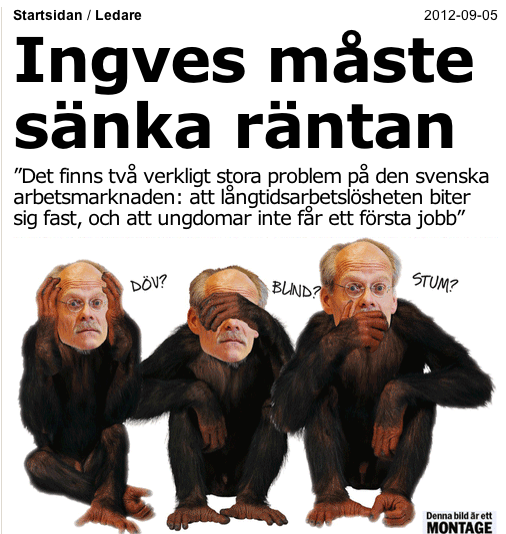
* So, even if the fundamentals were much better than before the last meeting (e.g., they increased their RGDP forecast for 2012 from 0.6% to 1.5%), they lowered the rate.  Several bank-economists were surprised, but I think Ingves feared for his reputation and legacy. One example of an op-ed with a hear-see-speak no evil illustration
http://www.aftonbladet.se/ledare/article15388656.ab

The next meeting is in the end of October and Svensson had to do some damage control (the incompetence meme was becoming a little too widespread) before the next meeting, and also increase the probability of another rate decrease this year.  This was published 1-2 day after the decision (I would bet some money that LEO S would not have written it if the rate stayed the same).  http://translate.google.com/translate?hl=en&sl=sv&tl=en&u=http%3A%2F%2Fwww.dn.se%2Fledare%2Fjag-beklagar-djupt-hur-uttalandet-tolkats

Back in 2009 I wrote the following:

Someone either understands that the only reliable speedometer is NGDP (or inflation) or they don’t.  Governor Strong got it.  So did the author of Lords of Finance (Liaquat Ahamed), and so did Friedman and Schwartz.  Strong’s death really was a tragedy.

The elite bankers and financiers of Wall Street were pretty smart people.  So were the central bankers of the US, Britain, and France.  But they weren’t smart enough.  After Strong died the best central banker was probably Montegu Norman, but the central bank he led (in England) lacked the gold reserves to decisively influence world conditions.  Today the world’s best central banker might be Lars Svensson, but he can’t even muster a majority in Sweden.

So the wealthy conservatives of the interwar period who dominated central banking dug their own graves, and the graves of millions of others.  Not through greed but through ignorance.  The few people who were able to see the big picture; Keynes, Fisher, Hawtrey, etc, did not have a voice in policy.

I don’t care how much is costs, even if we have to pay FOMC members a billion dollars a year, we will save much more money in the long run if we can get “strong” central bankers (pun intended) who have the vision to see what needs to be done, and who understand that effective policies require explicit target paths for macro aggregates.

Recall that a “gaffe” is when a policymaker accidently tells the truth.  Svensson had to apologize for his gaffe.  But he’s right, most central bankers in Sweden (and the US in my view) are in way over their heads, they simply don’t have the necessary expertise in monetary economics.  I’m not a policymaker, so I don’t have to apologize for saying that.

PS.  Matt O’Brien has written a number of pieces that are sympathetic to market monetarism.  Good to see that his views were heard in Sweden, and may have helped trigger a healthy debate in that country.

Update:  Johnleemk reminds me that Michael Kinsley came up with that definition of ‘gaffe.’