These money illusions
Readers who weren’t with me back in 2009 might not know why I chose the moniker “TheMoneyIllusion.” From the beginning I realized that the term had multiple connotations, almost all of which dovetailed nicely with the content of my blog:
1. In 1928 Irving Fisher wrote a whole book entitled “The Money Illusion,” full of delightful examples. He was referring to the tendency of people to confuse real and nominal variables, or perhaps it would be more accurate to say people tend to see nominal variables as being in some sense “real.” I still recall when we got no pay increase back in 2009, a year of minus 1% inflation. My colleagues at Bentley greeted the anouncement very differently from when we got a 4% increase during a year of 3% inflation. I see money illusion everywhere I look, so I didn’t need much convincing.
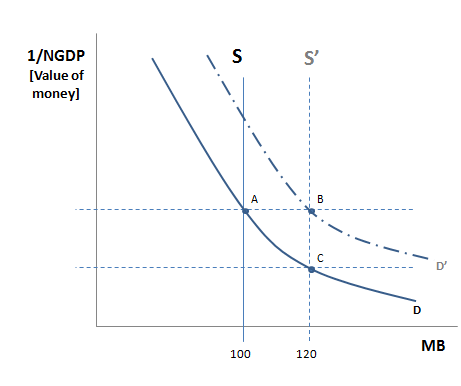
2. Another form of money illusion is confusion about the nature of monetary policy. The liquidity effect is actually just an epiphenomenon, and yet most people see it as not just a side effect, but rather as monetary policy itself. And “most people” includes the Fed. For this reason, policy is often perceived as being ineffective at the zero bound, unless perhaps longer term rates can be lowered via QE. In fact, in the long run more money lowers the value of money (value in terms of the share of NGDP which can be bought with each dollar) for exactly the same reason that more apples lowers the value of apples. (Admittedly the problem of expectations is more complicated in the money market.)
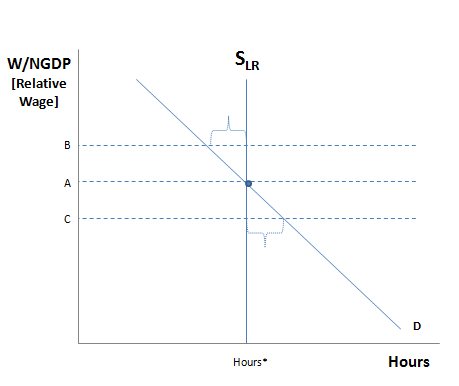
These two forms of money illusion have some interesting parallels. In both cases the problem becomes much more severe at the zero rate bound. For psychological reasons that are quite frankly irrational, both workers and central banks behave bizarrely at the zero bound. Workers start being much more resistent to wage cuts necessary to restore labor market equilibrium. And central banks become much more resistent to monetary policy steps needed to keep NGDP on track. Their superstitious fears of the number zero (which after all is a foreign concept borrowed from the Islamic world) causes them to behave in ways that are both personally and socially destructive.
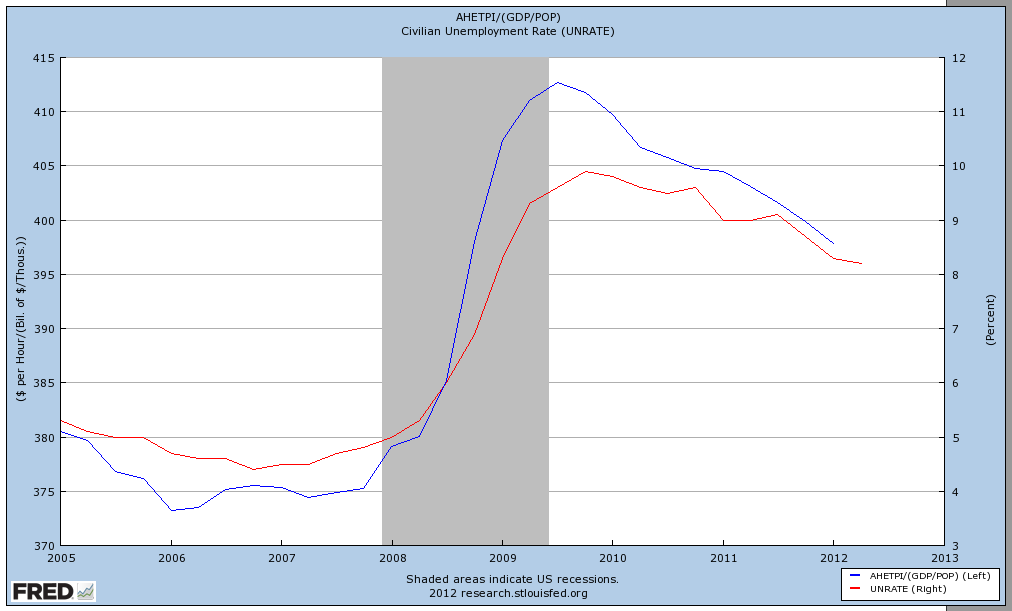
In terms of the previous post, the zero interest rate boundary contributes to the Fed’s failure to hit its NGDP target, causing NGDP instability. Then the zero wage change boundary takes that NGDP instability and converts it into relative wage instability (unstable W/NGDP).
3. There’s a third form of money illusion, to which economists are also subject. Economists have just as much trouble as the Fed does in identifying the stance of monetary policy. Because they think ultra-tight money is actually ultra-easy money, then are often not able to perceive the impact of very tight money. This means that they find some other explanation for economic distress, such as financial instability. Fisher said the business cycle is nothing more than the “dance of the dollar.” Fisher defined monetary policy in terms of the price of money (1/P), not the rental cost of money (i.) Because modern economists see tight money as high interest rates they confuse cause and effect, not understanding that financial distress is a symptom of a monetary policy-induced recession, not the cause.
I’ve followed Fisher’s approach, except that I believe the inverse of NGDP is a more useful indicator of the stance of monetary policy than the inverse of the price level. One of my goals in the previous post is to get people to think about my message in a different way. I’d rather people not think of me as calling for the Fed to stabilize NGDP (although obviously I am calling for that) but rather to see me as calling for the stabilization of its inverse—i.e. 1/NGDP. Obviously those two goals are identical from a purely mathematical perspective. So why do I prefer 1/NGDP?
I’ve often seen commenters, particularly those of the Austrian persuasion, complain that I favor some sort of central planning. I’ve always found this claim to be rather bizarre, but haven’t been able to rebut it in a persuasive fashion. If we talk about targeting 1/NGDP, then it will become clearer that all I want the Fed to do is stabilize the value of money. Since they have a monopoly on the production of base money, is it really that unreasonable (even from a libertarian perspective) to ask them to at least try to stabilize the value of cash in terms of the share of NGDP that can be bought with each dollar?
This blog is about controlling the value of money, and letting the rest of the economy be determined by market forces. I notice that critics of my blog often make the following claims:
1. They claim the free market economy is so delicate and fragile that even the very small changes in the per capita money supply, or price level, or NGDP, during the 1920s somehow brought on major economic dislocation.
2. Or, at the other extreme, they claim that even massive injections of money couldn’t possible be expected to create jobs. Money just causes inflation, there are no real effects.
Oddly, many of my critics seem to hold both views at once.
And finally, you may wonder why I didn’t simply call the blog “Money Illusion,” which would sound more hip. I seem to recall a scene in The Social Network where Justin Timberlake was discussing “The Facebook” with Zuckerberg. Then he got up and left with a couple of starlets on his arms, and turned with one final piece of advice: “By the way, drop the ‘the’, just Facebook.”
When I started out I tried to buy “MoneyIllusion,” but it cost $1800. So then I checked “TheMoneyIllusion” and it was $12. Keep in mind that I’m not as rich as either Timberlake or Zuckerberg. If it had also been $1800, you’d be reading something like “TheseMoneyIllusions,” or God forbid “TheMoneyAllusion” (yes, I’m that cheap) so count your blessings.
PS. This article discusses the actual origins of zero. It was invented multiple times, and as usual not by the people who got credit (which were the Arabs.) Interestingly, however, it appears to have been first invented in what is now an Arab country (Iraq.) Didn’t the Iraqis also invent writing, law, money, literature, the calendar, and pretty much everything else?
PPS. Ambrose Evans-Pritchard once called me the “eminence grise” of market monetarism. I’m going to return the favor, calling him the poet laureate of market monetarism.
HT: Lars Christensen