Is the ECB making “rookie mistakes?”

Vaidas sent me an interview with ECB board member Benoit Coeure.  Here’s the sort of quotation that I’ve made fun of in the past:

On the definition of medium term:

“There is an academic definition of ‘medium term’ which is the Milton Friedman definition. That’s 18 months. But it has always been recognized by the ECB, from inception, that the path through which inflation reverts back to the 2 percent number depends on the nature of the shock and it depends on the type of nominal rigidities that you have in the economy. In the current situation, where you have this enormous structural adjustment going on and enormous deleveraging pressures that are obviously weighing a lot on prices, contributing to the subdued price pressures, it is only normal that we see inflation coming back more slowly to the medium term objective. That’s compounded by the fact that a number of European countries are going through a relative price adjustment which is a necessary adjustment, since it’s part of regaining competitiveness. This is temporary, and should not be confused with deflation. Mechanically, this relative price adjustment weighs down on the average euro-zone inflation number. For all these reasons, inflationary pressures will be very subdued for an extended period of time. The definition of medium term is probably more extended now than it could have been in other circumstances because of the situation the euro area economy is in. And we have to acknowledge it.”

It’s hard to imagine an American macroeconomist saying it’s healthy for inflation to be running below target because the economy is so weak.  On second thought . . .

At least it would be correct to say that Paul Krugman and many other American pundits have picked on the ECB for making statements like this in the past.  So what could be going on here?

It occurred to me that this is exactly the sort of thing that people at the Fed used to say in the first few decades of its operation, when it hadn’t yet figured out what it was doing.  We went from a classical gold standard to a managed gold standard to Bretton Woods to a pure fiat regime, and each time a new approach to monetary policy was needed.  Often the Fed was stuck in its old way of thinking, old rules of thumb, and did not rise to the challenge.

You might assume that the Europeans already had plenty of central banking experience, so the ECB should have done fine.  But perhaps that’s exactly the problem.  They had lots of experience, but of the wrong kind.  Maybe they thought that running the ECB would be like running the central bank of a small open economy, whereas it’s more like running the central bank of a large closed economy.  More like the Fed.  But over in the eurozone they don’t yet realize that fact.  They are running years behind the Fed in figuring out how to do things.

Think about what’s wrong with that quotation.  The emphasis on weak economies cutting costs. That’s not a bad way of looking at things when you run a central bank in a small open economy, and need to make your economy more competitive. In that setting, however, when things get way out of line you devalue—that’s how you make the domestic economy competitive.  But the individual members of the eurozone no longer have the ability to devalue, and the ECB doesn’t seem to realize that the only way for the eurozone as a whole to become more “competitive” is to raise the inflation rate. Counterintuitive, but true.

PS.  I have a new post at Econlog.

PPS.  Marcus Nunes has a post on a different Coeure interview.


Central banks do monetary offset even while denying doing so

Mark Sadowski has some nice comments that provide data backing up a comment in my previous post.  When I was young the Fed liked to blame inflation on the fiscal authorities.  Suppose you asked the Fed the following question in early 1968:

LBJ plans to raise income taxes to slow inflation.  If he does this will you offset the effect with easier money, thus preventing a fall in inflation?

I guarantee the answer would have been no.  But they did!  Inflation rose from a little over 4% in 1968, to around 5% to 6% in 1969 and 1970.  It did fall modestly in 1971 and 1972, due partly to price controls.  However NGDP growth continued at a very rapid rate throughout the 1970s.  And note that this policy failure occurred well before the first oil shock of late 1973.  Here’s Mark:

The delusion that fiscal deficits were one of the primary causes of the Great Inflation is still very widespread. This delusion can often be cured with the simple facts.

True, fiscal policy was expansionary in fiscal years 1964 through 1968. The cyclically adjusted Federal budget balance was reduced from (-0.5%) of potential GDP in fiscal year 1963 to (-4.4%) in fiscal year 1968, and the deficit was increased annually during that time:

http://www.cbo.gov/sites/default/files/cbofiles/attachments/43977_AutomaticStablilizers3-2013.pdf

But a 10% income surtax was enacted in 1968 and remained effective through 1970. The cyclically adjusted budget balance rose to (-1.1%) by fiscal year 1970 and remained in the relatively narrow range of (-2.7%) to (-1.3%) from fiscal year 1971 through 1982. In fact despite the image of a deficit prone decade the 1970s were one of the most fiscally responsible decades on record with gross Federal debt setting a post WW II record low of 32.5% of GDP in fiscal year 1981 (President Carter’s last budget).

True between 1963 and 1968 NGDP growth averaged 8.1% and core inflation (to strip out the effects of energy prices) accelerated from 1.3% in 1963 to 4.4% in 1968:

http://research.stlouisfed.org/fred2/graph/?graph_id=155542&category_id=0

But NGDP growth was double digit every year from 1976 through 1979, peaking at 13.0% in 1978, and core inflation accelerated to 9.2% by 1980.

Then, under Reagan, cyclically adjusted Federal budget balance was reduced from (-1.5%) in fiscal year 1981 to (-4.6%) in fiscal year 1986 (the largest cyclically adjusted budget deficit since 1960 prior to the Great Recession). And yet from 1981 to 1986 NGDP growth averaged 7.4% and core PCEPI fell to 3.4% by 1986.

The Great Inflation and the Great Disinflation are perhaps the greatest examples of monetary offset of fiscal policy away from the zero lower bound in US history, because fiscal policy was relatively tight during the height of the Great Inflation, and became exceptionally loose during the Great Disinflation, exactly the opposite of what fiscalists predict.

Yes, the US was not at the zero bound, but this directly addresses Matt Yglesias’s point about central banks denying that they engage in monetary offset.  We know for a fact that in the past they have denied doing so even as they did engage in offset.  Mark has more great evidence from Japan, and some of this does occur at the zero bound:

The following is from my guest post at Historinhas “Richard Koo also misinterprets Japan´s lost decades (Part II)” on June 11, 2013:

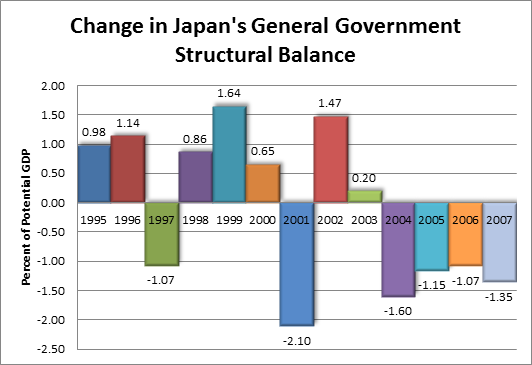
“…In my opinion the most objective way of judging fiscal policy stance is the change in the general government structural balance. The structural balance is adjusted for the business cycle and thus any changes should represent policy rather than the state of the economy. The IMF provides estimates of Japan’s general government structural balance from 1994 on so we can compute the changes from 1995 on:

http://thefaintofheart.files.wordpress.com/2013/06/sadowski2b_4.png

With the exception of calendar years 1997 and 2001 fiscal policy was expansionary during 1995-2003. Do we know anything about the fiscal policy stance prior to 1995? An excellent summary of the Japanese discretionary fiscal stimuli programs is Anita Tuladhar and Marcus Bruckner’s “Public Investment as a Fiscal Stimulus: Evidence from Japan’s Regional Spending during the 1990s” (IMF Working Paper No. 10/110, April 2010). Appendix Table 8 lists two fiscal stimuli for 1993 and one each for 1992 and 1994, so fiscal policy was obviously expansionary for the entire 1992-96 period. It also lists nine fiscal stimuli and three tax cuts during 1995-2002, but none during 2003-07. The fiscal tightening in 1997 is explained by the fact that Japan raised its consumption tax from 3% to 5% on April 1, 1997. The fiscal tightening in 2001 seems to have been passive. The expansionary fiscal policy of 2003 represents a carryover of the effects of the 2002 fiscal year, which ended on March 31, 2003.

Considering that the BOJ’s call rate wasn’t lowered below 1% until July 1995 and didn’t get below 0.25% until November 1998, Japan’s fiscal policy seems a bit backwards. Away from the zero lower bound there’s absolutely no rationale for doing fiscal stimulus unless one wants to see the spectacle of competing policy levers cancel each other out, and yet Japan did eight fiscal stimuli and three tax cuts during 1992-98. On the other hand, if one truly believes in the Keynesian concept of the liquidity trap, then one would want to do fiscal stimuli when the policy rate is pinned to the zero lower bound, and yet Japan practiced five consecutive years of consolidation during fiscal years 2003-07, a time when the policy rate was never as high as 0.5%.

So with that background out of the way, and recalling that Japan’s QE was announced in March 2001 and didn’t really kick into gear until December 2001, how did the Japanese economy do? Here’s a graph of Japans’ annual CPI inflation and harmonized unemployment rate:

http://thefaintofheart.files.wordpress.com/2013/06/sadowski2b_5.png

Note that aside from the consumption tax induced increase in 1997 Japan’s inflation rate dropped nearly every year from 1991 through 2002 and then edged upward until there was consecutive years of consumer price inflation in 2006-07 for the first time in nearly a decade. Unemployment increased nearly every year through 2002 and then dropped in 2003 for the first time since 1990, and then continued to drop every year through 2007. And it’s worth noting that even the Nikkei 225 gave its thumbs up during 2003-07, with the index rising from less than 7900 in April 2003 to over 18,000 in June 2007, which is still by far the greatest stock market rally in Japan since the beginning of the Lost Decade(s)…”

So once again, the Japanese disinflation proceeded unimpeded during the time fiscal policy was exceptionally expansionary, and came to an end when fiscal policy became contractionary. This is another excellent example of monetary offset of fiscal policy, however in this case, the latter half took place at the zero lower bound, precisely when Keynesians predict monetary policy is impotent.

The second graph is a real eye-opener.

PS.  The failed austerity of 1968-70 is one of the factors that boosted Milton Friedman’s reputation, and led to the rise of monetarism in the 1970s.

Reply to Matt Yglesias

Matt Yglesias has a new post challenging my views on monetary offset:

Scott Sumner became famous in the world of popular economics writing with the bold contention that even at the “zero bound” the Federal Reserve both could and should bring the economy back to full employment even in the face of contractionary fiscal policy. But he’s always paired this with a stronger claim, namely that the Fed does in fact bring about exactly the level of Aggregate Demand that it wants to have regardless of the tightening or loosening of fiscal policy.

And he’s become pretty testy about people like Larry Summers who think that looser fiscal policy would be a helpful means of restoring full employment more swiftly.

A curious issue that in my opinion he and other proponents of the full monetary offset thesis haven’t fully grappled with is that Federal Reserve officials keep saying it’s not true.

Those three paragraphs are a bit misleading, but that’s partly my fault.  It’s a complex and subtle topic, and I’m sure I’ve occasionally taken shortcuts in some of the things I’ve said, which left those impressions.  I’ve probably said the Fed is satisfied with this crappy economy—out of sheer frustration.  First a few clarifications, and then what I actually do believe:

1. In 2009 NGDP growth was clearly far below what the Fed wanted, in 2010-13 it was modestly lower than they would have wished.  So the first paragraph is not really accurate.

2.  The second paragraph is accurate but slightly misleading.  I did get testy, and Summers did argue that fiscal stimulus would help boost employment.  But what I was testy about was his other claim, that he’d favor fiscal stimulus even if monetary policy (by itself) led to on-target AD.  Summers argued that the private sector would waste resources when interest rates were low, and hence the government should be more heavily involved in allocating resources.  Matt Yglesias once characterized those views as “socialist”, and I made the mistake of also using that term in the post he links to.  I apologized in my next post.  What can I say; I pick up terminology from blogs I like. Matt’s encouraging me to talk like Rush Limbaugh.

3.  I have done several posts discussing the fact that Fed officials don’t seem to believe in monetary offset.  So the third paragraph is also inaccurate. But I suppose most of the discussion has been in comment sections that few people read.

Here are a few thoughts that come to mind:

1.  One has to be careful interpreting the statements of Fed officials.  First of all, monetary offset can sound unpatriotic if framed one way, and not doing monetary offset can sound unpatriotic if framed another way.  Thus Fed officials sometimes say that that they take fiscal policy as a given, and do what’s best for the country given the stance of fiscal policy.  That implies offset.  They say that QE3 and forward guidance were done partly in order to offset the effects of fiscal austerity in 2013.  On the other had if you ask Ben Bernanke “If Congress does fiscal stimulus to boost employment, will you sabotage their effort with higher interest rates?” Then I’m sure he will answer no.  But that’s also the answer to that question that he would give when interest rates are positive, and even Matt Yglesias agrees that monetary offset is the right model in that case.  Framing effects.  Now of course none of this proves there is complete monetary offset, and I’ve always acknowledged that fact.  But much of the analysis of fiscal stimulus in the blogosphere, including at the highest level (i.e. Krugman) simple assumes there is no monetary offset.

2.  In the 1970s Fed officials said they could not be expected to offset the inflationary effects of budget deficits.  We now know those protestations were incorrect.  Were they untrue at the time?  Depends on your theory as to what caused the Great Inflation.  But we know that when Reagan dramatically boosted the budget deficits the Fed did offset.  They also offset the LBJ tax increase of 1968, which therefore failed to reduce inflation.  The BOJ offset fiscal stimulus for more than a decade.  They presumably denied doing so.

3.  Matt also discusses a theory that I first heard from Andy Harless, that the Fed views unconventional monetary stimulus as costly, and hence fiscal stimulus might not lead to 100% offset.  This is a very logical theory, and might be true.  But it’s not as self-evident as one might assume.  For instance, the fact that the Fed has fallen short of its goals for AD might well reflect bad forecasting.  I seem to recall Yglesias pointing out that GDP growth has consistently underperformed Fed forecasts. So perhaps they tried to offset and failed.  Another possibility is that the Fed would prefer not to do monetary stimulus, and favors fiscal stimulus for that reason.  But that doesn’t mean they won’t act if necessary, just that they would prefer someone else deal with the complaints from the Ron Paul’s of the world.  There are many occasions when I hoped someone else would do something unpleasant, but when they didn’t I went ahead and did what I thought needed to be done.  Like taking out the trash.

I’ve also argued that the Fed tends to overestimate the impact of conventional policy tools (such as interest rate changes), and underestimate the impact of unconventional tools such as forward guidance.  Suppose the Congress had done no stimulus in 2009.  Would Bernanke have said to himself; “Oops, looks like I’m going to go down in history as the worst Fed chairman since 1930, as another depression is on the way.”  Or might he have decided to do some of the things that he had earlier recommended the Japanese do, such as level targeting?  I happen to think level targeting is much more powerful that the Fed itself probably believes.  If they had done level targeting in 2009 to make up for a lack of fiscal stimulus, in my view the recovery would have been even faster.  So more than 100% monetary offset is perfectly possible.  As long as we are in the realm of irrational behavior, anything is possible.  I’ll wager that if you asked the average Fed official whether the recent decision to taper would turn out to be expansionary, approximately 100% of them would have said no.  But it was! That’s because they “offset” the taper with more extended forward guidance, and the forward guidance turned out to boost AD more than the taper reduced it.  Stocks rose on the news.

4.  At this point we are left with a few basic facts:

a.  Monetary offset is the standard assumption at positive interest rates.

b.  Monetary offset should be the baseline assumption when rates are zero.  Alternative assumptions require explanations.  They might be true, but they require Fed stupidity.

c.  It’s an empirical question as to how actual, real world central banks will behave, when faced with shifts in fiscal policy.

As I look at the empirical evidence several points seem clear.  First, the Fed would have done more monetary stimulus back in 2008 and 2009 if they knew then what they know now.  They are perfectly willing to boost the balance sheet by many trillions.  They did not do so in 2009 because they thought their earlier actions were enough.  They were wrong.  But if the Congress had done less the Fed would have done much more QE and much more forward guidance in 2009.  Second, several Keynesians including Paul Krugman said that 2013 would be a test of monetary offset.  When the results came in exactly as the market monetarist predicted, they changed their minds. There was no test. Yes, it was far from a decisive empirical test, but where are the empirical tests in the other direction?  Are we to spend hundreds of billions of dollars on fiscal experiments that (by assumption) doesn’t pass conventional cost-benefit tests because there are theories out there that fiscal policy can work if the Fed officials are incompetent, and although we don’t have any empirical evidence to back that up other than public statements which may be little more than CYA, we’ll go ahead anyway?  Remember that Congressmen are the lunatics and Fed officials are the “grownups” in the policymaking realm.  My opponents want to base stabilization policy on a regime that ASSUMES the lunatics know better than the grownups how to stabilize the economy.  How likely is that to work in the long run?

I’ve argued that estimates of the fiscal multiplier are nothing more than estimates of central bank incompetence.  A point in Matt’s favor is that central banks are in fact somewhat incompetent.  But to make fiscal stimulus work they have to be incompetent in a very specific and peculiar way.  In the end we will never have an answer to the interesting policy counterfactuals.  By the time we get there, central bank behavior will have changed, and the reaction function will be different.  The Fed of 2014 is not the same as the Fed of 2008.  The search for “the multiplier” is futile; it’s a chimera. Monetary offset in the purest form is also probably false, in the sense that all social science theories are false.  But it seems to me to be the most useful place to begin the analysis.

And finally, my crusade for monetary offset is both positive and normative.  Obviously fiscal stimulus is a moot point in the US anyway; Congress isn’t going to do any.  But if I can convince other people that monetary offset is the most natural thing in the world, and also that not only is monetary stimulus not risky, but that not doing monetary stimulus can be highly risky, then monetary offset will be much more likely to be true in the future.  Even if my theory is false, it should be true, and we need to make it true.  We don’t do that with defeatist talk about monetary impotence that you hear from the world’s most famous blogger, rather we get there with a coalition of market monetarists and progressives like Yglesias who keep insisting the Fed can and should do more.

I suppose one can argue that it’s a mistake to mix up positive and normative analysis.  But then I’m not the only one who makes this mistake.  Here’s Matt Yglesias sounding very monetary offsetish:

Conventional wisdom in DC is that not only would the full expiration of the Bush tax cuts make people grumpy as they find themselves needing to pay more taxes, it would also provide the macroeconomy a job-killing dose of fiscal drag. .  .  .  I don’t buy it.

The problem is that this chart ignores what I think we’re now going to call the Sumner Critique. In other words, it assumes that the Federal Reserve is somehow going to fail to react to any of this. You can probably construct a scenario in which the Fed is indeed caught unawares, or is paralyzed by conflicting signals, or is confused by errors in the data, or any number of other things. But Ben Bernanke knows all about the scheduled expiration of these tax cuts.  .  .  . Maybe he and his colleagues won’t do anything to offset this drag on demand, but if they don’t as best I can tell that’s on them. This is the very essence of a predictable demand shock, and the policymakers ultimately responsible for stabilizing demand are the ones who work at the Fed.


The Fed struggles to find the right guidepost

Tim Duy has a very good post discussing the Fed’s current policy dilemma:

The drop in the unemployment rate, however, is something more of a challenge.  The Evans rule simply isn’t looking quite so clever anymore:

EMPd011214

Monetary officials generally believed not only that 6.5% unemployment was far in the future, but also that policy would become much more obvious as we approached that target because inflation pressures would be evident.  Neither has been true.  Not only has unemployment fallen more quickly than anticipated, but inflation remains stubborningly low.

It was a mistake to put the unemployment rate into the Evans rule, it’s simply too unreliable.  We don’t know exactly where the natural rate is, nor do we know the size of the output gap.  And inflation also his its problems, as it can reflect either supply or demand-side factors, and the Fed should only be concerned with demand-side inflation.  So which aggregate is not susceptible to being distorted by either supply shocks or changes in the natural rate of unemployment?  If you have any good ideas please leave them in the comment section.  Or better yet send them on to the Fed.  Basically we

Need a

Good

Demand

Proxy


China: The problem is easy credit, not easy money

Tyler Cowen linked to this interesting NYT story:

HONG KONG “” Move over, Janet Yellen and Ben Bernanke. Step aside, Mario Draghi and Haruhiko Kuroda. When it comes to monetary stimulas, Zhou Xiaochuan, the longtime governor of the People’s Bank of China, has no rivals.

The latest data released by China on Wednesday shows that the country’s rapid growth in money supply has continued. Mr. Zhou and his colleagues at the Chinese central bank have only begun the difficult and dangerous task of reining it in.

The amount of money sloshing around China’s economy, according to a broad measure that is closely watched here, has now tripled since the end of 2006. China’s tidal wave of money has powered the economy to new heights but it has also helped drive asset prices through the roof. Housing prices have soared, feeding fears of a bubble while leaving many ordinary Chinese feeling poor and left out.

.   .   .

This means the money supply is still charging well ahead of inflation-adjusted economic growth, which has been about 7.6 percent; the exact figure for the fourth quarter of last year is scheduled for release on Monday.

Growth in M2 almost reached 30 percent at the end of 2009, when China was using monetary policy to offset the effects of the global financial crisis. China has reduced the pace of money supply growth since then, but kept it well above the pace of economic growth throughout, which means it has done little to sop up the extra cash issued during the crisis.

The question now is whether the central bank can further slow the growth of credit and the money supply without causing a slump in housing prices or a sharp slowdown in the credit-dependent corporate sector. Even the very modest slowdown in money supply growth so far has already contributed to two sharp but short-lived increases in interbank interest rates in June and December, which roiled markets in China and around the world.

China’s central bank “is in a very difficult situation; it needs to tighten but the whole system is not used to tightening, they are used to money printing,” said Shen Jianguang, a China monetary economist in the Hong Kong office of Mizuho Securities, a Japanese investment bank.

M2 encompasses money in circulation, checking accounts, savings accounts and certificates of deposit. It is the main money supply indicator watched by the People’s Bank of China in trying to balance the need for economic growth with the dangers of inflation.

M2 has grown so fast in China not just because the central bank has been issuing a lot of renminbi but also because the state-owned banking system has lent and relent those renminbi with encouragement from the government, creating a multiplier effect.

China has also undergone a financial liberalization in the past five years that has accelerated the pace of lending. An extensive and loosely regulated shadow banking system has emerged, partly because of the willingness of regulators to allow banks to classify loans to new financing companies not as corporate loans but as interbank loans, for which little capital needs to be reserved.

.   .   .

Consumer inflation has not yet become a big problem in China: Falling commodity prices and widespread manufacturing overcapacity held down consumer inflation to 2.6 percent last year.

This is what happens when a journalist confuses money and credit.  Monetary policy is not especially easy by Chinese standards.  Yes, NGDP growth is running around 10%, but that number is down from previous decades.  Even if the number is too high (and it probably is) it’s changes in the rate of NGDP growth that really matter.  A NGDP growth rate that is gradually slowing year by year does not causes rapid RGDP growth in China.  It’s productivity growth that explains the China boom.

Now when we turn to the broad M2 “money supply” we are actually looking at credit, not money. This is a completely different issue.  I’d expect credit to grow faster than money in a developing country like China, but even so, I think it quite likely that credit growth (and hence M2 growth) is too rapid. The moral hazard problem in China is an order of magnitude worse than in the US.  This means there is a lot of misallocation of resources by the big banks.  Too much housing and infrastructure construction in secondary cities, for instance.

But the solution is not “tight money,” which would simply cause another sort of misallocation of resources.  Instead of too much construction you’d get too much leisure time, aka unemployment. The solution is a tighter credit policy, not tight money, which is of course politically difficult to do under the Chinese economic regime.  This is why they need to reform the banking system by making it less bad.  Adopting the horrible US banking system would be a huge improvement for China.  The Canadian system would be far better.

For the moment they’ll stick with their current system and continue to misallocate resources.  At some point there may be a tipping point and they’ll get a little bit of stagflation if they are lucky, or mass unemployment if the follow the BOJ/Fed/ECB playbook.  Let’s hope they keep NGDP growth stable and opt for stagflation.  Or better yet market reforms.

PS.  I have a post offering half-hearted praise to Keynesians, over at Econlog.