I welcome “abrupt policy adjustments”

Here’s an interesting report on unemployment:

The concurrent decline in labor force participation, however, has prompted many assertions that unemployment is falling “for the wrong reasons” “” i.e., the unemployment rate is falling because unemployed Americans who can’t find work are becoming discouraged and dropping out of the labor force.

This idea has had profound implications for Fed policy.

Fed officials have sought to de-emphasize the decline in the headline unemployment rate “” previously considered a key input to policy decision “” suggesting it does not reflect the true health of the labor market. This orientation toward the labor market is being used as a justification inside the Fed for continued extraordinary monetary stimulus. 

Yet contrary to this popular narrative, the data suggest that the vast majority of the decline in labor force participation in recent years can be accounted for by the retirement of the “baby boomer” generation of American workers.

Consider the findings of a recent study by  Shigeru Fujita, a senior economist at the  Federal Reserve Bank of Philadelphia, titled “On the Causes of Declines in the Labor Force Participation Rate.”

.

Reasons for leaving the labor force

Federal Reserve Bank of Philadelphia, BLS

Reasons for leaving the labor force can be broken down into three categories: retirement, disability, and “other.” The “other” category is made up partly of discouraged workers. The chart illustrates that in recent years, retirement has been the primary driver of the decline in labor force participation.

Fujita demonstrates that “discouraged workers” only made up about a quarter of those leaving the labor force between 2007 and 2011, while “t he decline in the participation rate since the first quarter of 2012 is entirely  accounted for by increases in nonparticipation due to retirement.”

So far I am 100% on board with this “hawkish” article.  But then they begin to lose me:

If this is in fact the case, the current headline 6.7% unemployment rate may indeed reflect the true health of the labor market, the inflation the Fed is trying so hard to stoke may be a lot closer at hand than it expects, and the central bank risks falling behind the curve with regard to policy.

I see little risk of that happening, at least under the Evans Rule.  Remember, under the Evans Rule the Fed also looks at inflation.

The counterargument is that a wave of discouraged workers will re-enter the labor force as the job market improves, sending the labor force participation rate “” and therefore, the unemployment rate “” higher again.

Such developments would perhaps constitute a proper justification for continued zero-interest rate monetary policy, in line with the Fed’s projections, which imply no rate hikes for nearly two more years.

Nope, the real argument is that even under the assumption of this hawkish article we still have several millions of unemployed workers who need to find jobs.  There is still an output gap.  What’s their counterargument?

“Should we really be concerned about the Fed  being ‘behind the curve’ given that a rebound in participation should be  forthcoming with a rebound in the economy?” asks Drew Matus, deputy chief U.S. economist at UBS, in a note to clients.

Matus implies that the answer is yes.

“Although we believe that  there could be a modest cyclical rise in participation as the economy  improves, we believe the likely scale of the increase will not  significantly alter the basic equation,” he says.

“Payroll growth averaging 200,000  per month should continue to pull down the unemployment rate under all  but the most aggressive labor force expansion estimates.”

All of this suggests that labor market conditions are tighter than the popular narrative about the “accuracy” of the headline unemployment rate would have you believe.

If that is the case, the inflation that has thus far been elusive in this economic recovery may be closer than the consensus expects, especially if the unemployment rate continues to plummet toward the Fed’s estimated range of the unemployment rate in the long run between 5.2% and 6.0%.

The Fed should heed the message being transmitted by the headline unemployment rate if it wants to avoid the need for abrupt policy adjustments as the economy continues to improve.

We should welcome an “abrupt policy adjustment.”  It’s much better to get to full employment in one year and then abruptly adjust policy to keep NGDP rising along a 4.5% trend line, than it is to have a gradual recovery that asymptotically approaches full employment over many years.  Which has been the actual policy since 2009, in case anyone didn’t notice.

Despite my objections this is a very informative article, and should be read by all my fellow “doves” who believe there is a hidden army of 20 million unemployed just itching to get back to work.  There isn’t.  But 3 to 5 million excess unemployed for demand-side reasons is still a tragedy.  After we re-employ them we need to start working on the supply-side problems that reduce employment in America. Step one—replace the minimum wage with a wage subsidy.

PS.  Notice the retirement surge after 2011?  Count back 65 years and you get 1946.  Hmmm, what began in 1946?  For the foreseeable future we’ll have roughly as many workers retiring as entering the labor force.  (A bit fewer retiring right now, but a bit more than new entrants retiring in 10 years, ignoring immigration.)


Goodbye BRICS, hello IndoAsia

I never really bought into the BRICs concept.  It’s a hodgepodge. Brazil and Russia seem closer to Mexico and Turkey than to India and China.  But it did capture the growth spurt in the emerging markets after 2000.

To me the real story was China and to a lesser extent India.  And now the NYT says China is beginning to shift to a new trajectory:

Rocketing wages and benefits reflect an acute shortage of manufacturing labor, as a younger generation goes to college instead of heading for factories and as rural China has mostly run out of young adults to send to the cities.

.  .  .

The trade gains for China are magnified because over the last several years many companies have shifted the production of components from high-wage Asian countries like Japan and South Korea to China itself. So China is producing more of the value in each product, and not just doing the final assembly of products produced elsewhere.

.  .  .

In separate interviews this week with nearly a dozen Chinese exporters, at Hong Kong trade fairs or by telephone, all said that their biggest problem lay in labor: finding enough blue-collar workers and paying for their soaring wages.

Mr. Cheng said that a decade ago he paid about $75 a month for entry-level industrial workers and provided virtually no benefits. Now, he said, his 200-worker business, the Hangzhou Luyi Arts & Crafts Company, pays $570 a month plus $100 a month in government-mandated benefits.

That works out to compensation roughly three times as high as in Indonesia, four times as high as in Vietnam, five times as high as in Cambodia, and as much as 10 times as high as in Bangladesh. But all of those countries have other problems, such as overburdened, unreliable electricity grids, which force companies to install costly generators and buy expensive diesel instead.

Like many companies in China, Hangzhou Luyi has responded to surging wages with increased investments in automation.

So what does all this mean?  First of all Chinese labor costs will continue soaring if China follows the path of South Korea and Taiwan, which seems likely to me, but not certain.  So what then?  Who makes the world’s sneakers in 2030?

Latin America is already a mature economy.  Mexico will keep growing, but it doesn’t have global implications.  Africa will grow with a commodity model, manufacturing will come later.  The Middle East is only good at doing two things, producing oil and fighting.  The developed world is already developed.  That leaves places like this (data from The Economist):

Country      Population   GDP (PPP) per person    RGDP growth/2014

Bangladesh     157 m              $2130                           5.7%

India             1,260 m            $4350                           6.1%

Indonesia       253 m             $5470                            5.4%

Philippines      108 m             $4620                            6.6%

Vietnam         91 m                $4020                           5.5%

That’s 1.87 billion people.  Throw in a bunch of similar smaller places like Sri Lanka, Cambodia, etc., and you have 2 billion out of the global population of 7 billion.  By comparison developed East Asia plus China has roughly 1.5 billion, the Western developed world 1 billion, Latin America 1/2 billion, sub-Saharan Africa 1 billion, and the other billion in places like the Middle East, Pakistan, Russia, etc.

Unlike the BRICs, it seems to me that IndoAsia is an actual category of similar countries.  It’s the next China, but it won’t be as dynamic as China.   I tried to come up with a clever acronyn for those 5 countries but failed.  In any case, they share pretty similar GDP growth rates and income levels (except Bangladesh for income.).  And while China’s population will soon start shrinking, they will keep growing.  IndoAsia will have the young workers of the 2030s that will produce all that cheap stuff that used to be made in China.

If you believe that China depressed wages in the West, do much higher wages in China make that problem go away, or does it simply shift to IndoAsia?  I can see arguments both ways.  IndoAsia has enough labor to pick up the slack, but does it have the productivity to depress US wages?  It seems to me that by the time Bangladesh gets to the point where it could threaten the US autoworkers, those workers will be replaced by robots and 3D printers anyway.  So my hunch is that IndoAsia is a nonissue for US inequality going forward.  It will be increasingly the case that most US workers do things that need to be done in the US for various reasons, or where we have strong productivity advantages.

Also note that these countries are growing at 6%, not the 10% that China grew when it was that poor.  That suggests they’ll get stuck in the middle income trap unless they do more reforms.  Or perhaps I should say until they do more reforms.  In the very long run all countries may escape the middle income trap, the question is whether in the interim they go through decades of mediocre growth like Latin America.

I was skeptical until I saw the phrase “nuclear mathematician”

This was in my email box this morning:

Dear Reader,

I admit, an 18.79% annual return for the rest of your life sounds too good to be true.

You have every right to be skeptical of such claims.

I certainly was skeptical when a colleague of mine told me he had developed and back-tested a system for making such profits.

But then he divulged the entire story . . . how he discovered a secret calendar that Wall Street uses to grab 250% gains, and how he teamed up with a nuclear mathematician to perfect the calendar to pick winning trades 96% of the time.

It truly is one of those marvels that “you have to see to believe . . .”

Which is why my colleague was kind enough to put a video together revealing this secret calendar, and how anyone could use it to profit.

Back-tested?  Then count me in.

Even better, the company was strongly recommended by a famous conservative newsmagazine.

Humor that went right over my head

Here’s Noah Smith, (world-renowned crusader for civility in blogosphere discourse) on Brad DeLong:

But when agents of the overgrown conservative hive-mind needed skewering, he skewered without mercy. And despite fighting against the conservative hive mind, DeLong has never become a thrall to the liberal one.

DeLong is often criticized for being mean – he did, after all, invent the “Stupidest Man Alive Award (TM)” – but I think that the exigencies of the moment justified that meanness; the Conservative Reality Bubble just had to be stopped.

And here’s Noah on The World’s Most Fanatical Open Borders Advocate (and perhaps the least disingenuous person I’ve ever met):

Screen Shot 2014-01-18 at 12.13.47 PM


Screen Shot 2014-01-16 at 10.52.40 AM

I consider myself a moderate supply-sider, however . . .

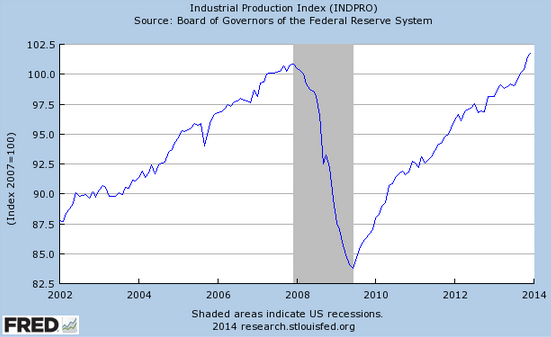
.  .  .  does this look like a supply shock?

Screen Shot 2014-01-17 at 3.14.11 PM

I’ve seen economists like John Cochrane express doubts as to whether demand-side models can explain what’s going on with the US economy.  If he means “can fully explain” then I’m completely on board.  If someone wants to argue that Obamanomics has shifted the trend line for real GDP down by 1% or so (not the growth rate), I can entertain that hypothesis.  What I don’t get is how people explain this sort of cycles without discussing AD?  Why does industrial production plunge from 101 to below 84 in less that 2 years, and then soar by 22% in the next 4 1/2 years?  Did something incredibly bad happen to the supply-side of the economy between December 2007 and mid-2009?

Believe it or not the answer is “perhaps.”  There were things like a 40% jump in the minimum wage and an unprecedented extension of unemployment insurance benefits.  Casey Mulligan has documented other policies as well.  But here’s my problem—those factors haven’t gone away. Indeed we’ve added Obamacare.  So why the steep recovery?  This is exactly what demand shocks look like–an output gap opens, and then a reversal.  Can someone explain to me why there is so much skepticism that this was an adverse demand shock?  NGDP fell.  Check.  Both RGDP and inflation slowed.  Check.  The ratio of nominal wages to NGDP rose. Check.  Lots of involuntary unemployment.  Check.  Stocks start reacting strongly and positively to TIPS spreads changes. Check.  Stocks start reacting to monetary policy surprises as if AD is the problem.  Check.

PS.  Industrial production rose at a blistering 6.8% rate in Q4.  I was one who argued that the October shutdown would be a modest negative supply-shock, and hence a slight drag on the economy.  Looks like I was wrong.  Remember that nursery rhyme—When the cat’s away the mice will play.

PPS.  The post was partly motivated by this comment by John Cochrane:

I think we’ve left the point that we can blame generic “demand” deficiencies, after all these years of stagnation.

OK, that’s vague enough where perhaps we aren’t far apart.  I agree that the trend RGDP growth rate is slowing.  But it also seems almost certain that industrial production in the US is still rising at well above trend (which is only about 1% to 2% for IP).  The unemployment rate is still falling. That tells me that we are still recovering.  Could we be overheating?  Possibly, but I don’t see any signs of it, nor do the asset markets.  AD is still a problem, that’s why we are still recovering.

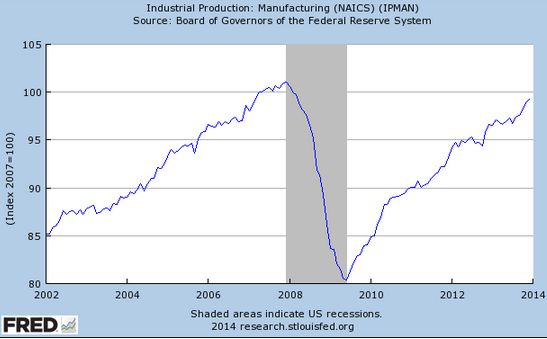
Update:  Several people mentioned the mining component as possibly driving the cycle.   Manufacturing has a deeper drop and a more rapid recovery (up 23.6%.)  Here’s manufacturing:

Screen Shot 2014-01-18 at 10.16.35 AM