Thank God for the “Shy Tory factor”

Back in 1992, the incumbent Conservatives led by John Major went into the election slightly trailing the Labour Party in public opinion polls.  In fact, they won a reasonably comfortable victory.  Here’s what Wikipedia says:

Almost every poll leading up to polling day predicted either a hung parliament, with Labour the largest party or a small Labour majority of around 19 to 23. Polls on the last few days before the country voted predicted a very slim Labour majority.[8]

With opinion polls at the end of the campaign showing Labour and the Conservatives neck and neck, the actual election result was a surprise to many in the media and in polling organisations. The apparent failure of the opinion polls to come close to predicting the actual result led to an inquiry by the Market Research Society. Following the election, most opinion polling companies changed their methodology in the belief that a ‘Shy Tory Factor‘ affected the polling.

That was when the Labour party was still mildly socialist, before the Blair reforms. (Indeed the election led to the Blair reforms.) Based on the exit polls, it looks like a repeat of 1992.  Perhaps Tory voters are a bit embarrassed to admit voting their pocketbook.

There is no better time to begin introducing NGDP into the monetary policy process. In the past few years it would have been entangled in election politics, with Labour claiming the Tories were abandoning control of inflation (even if they privately supported the move.)  The BoE should consider a NGDP target with revisions every 5 years to account for changes in trend RGDP growth.  Since trend growth changes very slowly, that (unnecessary) compromise is a small price to pay for NGDP targeting.

Congratulation to the Tories—the better party won.  (Something I could not honestly say about America’s right wing party.)

PS.  I love British humor.  A disgruntled Labour MP called their unusually left-wing 1983 party platform; “The longest suicide note in history.”

Update:  If my math is right the UKIP would have had about 75 seats under proportional representation, even more with small parties excluded.  They are forecast to end up with 2 seats.  The SNP would get perhaps 33 seats, whereas they actually got about 56. And that’s assuming they get the 5% that is the threshold in countries like Germany. The Lib Dems would have gotten about 50 seats, whereas they’ll end up with about 10. It pays to be a regional party in Britain.

Bankrupt Greece breaks promise, rehires 15,000 public employees

That’s equivalent to about 450,000 new public employees in the US.  Here’s the FT:

Opposition lawmakers accused Syriza of violating that agreement with the new laws, which could expand the government payroll by as many as 15,000 employees.

But government ministers remained defiant. “We aren’t going to consult [bailout monitors], we don’t have to, we’re a sovereign state,” Nikos Voutsis, the powerful interior minister, told parliament.

Yes, and other sovereign states “don’t have to” give Greece any more money.

The municipal police force, which was disbanded 18 months ago, will be revived and several thousand caretakers at state schools, known as “guards”, are to be rehired.

Kyriakos Mitsotakis, who “” as the previous government’s minister for administrative reform “” implemented past cuts, said Syriza’s legislation marked a return to the clientelist practices of the past.

“It’s not just the hirings, but a lack of transparency”‰.”‰.”‰.”‰and the reversal of new disciplinary procedures that had proved very effective,” Mr Mitsotakis said.

Nikos Pappas, minister of state with responsibility for the media, said the reopening of the state broadcaster would include the rehiring of 1,500 employees at a cost of €30m to be covered from the auction of television licenses.

When Antonis Samaras, the previous prime minister, closed ERT in a deeply unpopular move, he called it a “haven of wasteful spending.”

Imagine if the US hired another 45,000 “workers” for NPR at a time when the old and sick couldn’t get public health care at hospitals.  Perhaps those public school “guards” and state broadcaster “workers” will build some of that “infrastructure” that Greece needs.

I can’t wait to see how the left defends this move.

PS.  I relied on sources like the “World Socialist Web Site” for this post, in case you were wondering.

Xenophobia plus cognitive illusions = mass ignorance

Don’t be offended by the title of this post.  I’d guess 99.9999999% of people don’t understand currency manipulation or quantum mechanics.  So I’m using the term ‘ignorance’ loosely. And of course since I’m in the tiny minority (of seven people, based on the percentage above), there’s always the small chance that I’m the stupid one.  This post is to organize my thoughts, as I’m going to be interviewed on “currency manipulation” tomorrow.

Let’s start with the term ‘currency manipulation.’  That’s what central banks do.  They manipulate the nominal value of currencies.  Period. End of story.  On the other hand:

1.  Monetary policy has no long run effect on real exchange rates.  Once wages and prices adjust, real exchange rates go back to their equilibrium values.

2.  In the short run, central banks can reduce real exchange rates via easy money, however . . .

a.  There is little evidence that this creates a more “favorable” trade balance, for standard income and substitution effect reasons.

b.  The term “favorable” is misleading, as trade surpluses do not steal jobs from other countries, they do not depress AD in other countries, for standard monetary offset reasons.

3.  Real and nominal exchange rates are so different that they should not even be covered in the same course.  And yet 99% of the discussion of exchange rates doesn’t even make clear which concept is being discussed.

4.  Currencies can be manipulated equally well under fixed and floating exchange rates.  That distinction has no importance for any policy issue that I know of.  The fact that a country “pegs” an exchange rate doesn’t mean it manipulates it, except in the sense that all central banks manipulate the value of their currencies.

5.  Many people focus on long run chronic current account (CA) surpluses, and regard those currencies as “undervalued”.  If that’s your concern then you should focus on the real exchange rate, as the nominal exchange rate doesn’t matter in the long run.  (Here I’m thinking about complaints of chronic CA surpluses in Germany, China, Japan, etc.)

6.  There is no theoretical justification for assuming that long term CA surpluses imply undervalued currencies.  None.  At the cyclical frequency there is a Keynesian argument against CA surpluses, which I regard as beyond lame, bordering on preposterous.  But for long run surpluses in China or Germany, there is no argument at all.  The idea that CA surpluses help a country “develop” is laughable.

7.  Monetary policy can’t generate a “undervalued currency” in the long run.  It’s not clear if any government policy could, but the best argument would be that pro-saving policies could lead to lower real exchange rates and CA surplus.

8. This means that in the long run it makes no difference whether a country has its own currency or not. Germany and the Netherlands can “manipulate” their real exchange rate just as easily as Britain, even though they lack their own currency.  They can do so (if at all) by implementing pro-saving policies.

9.  Any pro-saving policy will do, it makes no difference whether the government buys foreign bonds, domestic bonds, or domestic stocks.  If Germany stops taxing capital gains, that will boost domestic saving.  If Singapore and Norway create sovereign wealth funds for future retirees, that’s pro-saving.  And of the PBoC buys lots of Treasuries bonds at a fixed currency peg, that’s pro-saving.  It’s impossible to say that one country “manipulated” its currency more than the other.  But that doesn’t stop 99.9999999% of people, including most economists, from pointing at China.

So basically nobody knows what currency manipulation is, or how to identify it. Almost no one understands the crucial difference between real and nominal exchange rates. No one seems to understand that all central banks manipulate nominal exchange rates, and in the short run, real exchange rates.  No one understands that currency manipulation has nothing to do with fixed vs. floating rates.  No one understands that (in the long run) eurozone countries can manipulate their currencies (real exchange rate) just as easily as countries with their own central bank.  No one understands that currency manipulation may not even affect the CA in the short run, or that changes in the CA don’t affect AD in other countries.

And yet there is room for hope!  Despite this tale of woe, all is not lost. It turns out that complainers are paper tigers.  Countries are often falsely accused of currency manipulation, but no one ever does anything about it.  Is that because they secretly know I’m right?  Don’t make me laugh.  They are cowards, thank God.  The Great Depression and WWII made countries more passive.  I hope they stay that way.

PS.  The real exchange rate is the nominal rate (value of domestic currency) times the domestic price level, divided by the foreign price level.

PPS.  Do I still believe in the wisdom of crowds, despite 99.9999999% being wrong? You bet I do!  I believe that if the Fed “manipulates” the dollar lower at the next FOMC meeting, foreign stock markets will rise, despite our “beggar thy neighbor” policy. People are stupid but markets are very, very wise.


The Economist dispels some China myths

A few years back I commented on a “Ghost Cities” story on 60 minutes:

They pointed to a “ghost town” development in Zhengzhou, which is capital of a province of 90 million people.  I’d expect its current population (4 million in the urban area) to grow to 10 to 20 million in a few decades.  How much longer will that development seem unneeded?

Here’s The Economist:

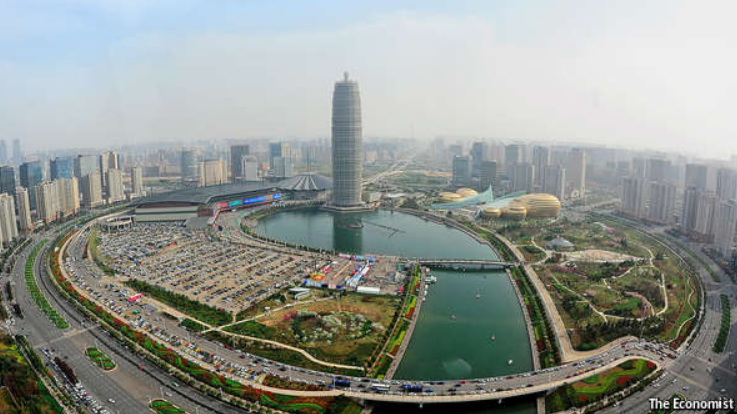
WHEN “60 Minutes”, an American television news programme, visited a new district in the metropolis of Zhengzhou in 2013, it made it the poster-child for China’s property bubble. “We found what they call a ghost city,” said Lesley Stahl, the host. “Uninhabited for miles and miles and miles and miles.” Two years on, she would not be able to say the same. The empty streets where she stood have a steady stream of cars. Workers saunter out of offices at lunchtime. Laundry hangs in the windows of the subdivisions.

The new district (pictured), on the eastern side of Zhengzhou, a city of 9m in central China, took off when the provincial and city governments relocated many of their offices there. Then, high schools with university-sized campuses began admitting students, drawing families to the area. Last autumn one of the world’s biggest children’s hospitals opened, a gleaming facility with cheery colours and 1,100 beds. Chen Jinbo, one of the area’s earlier residents, bemoans the lost quiet of a few years ago. “Rush hour is a hassle now.”

The success of Zhengzhou’s development belies some of the worst fears about China’s overinvestment. What appear to be ghost cities can, with the right catalysts and a bit of time, acquire flesh and bones. Yet it also marks a turning-point for the Chinese economy. Zhengzhou still has ambitious plans, not least for a massive logistics hub around its airport. With such a big urban area already built up, though, vast construction projects have a progressively smaller impact on the economy. The city’s GDP growth fell to 9.3% last year from an average of more than 13% over the preceding decade. The downward trend will continue. As the capital of Henan, one of the country’s poorest provinces, Zhengzhou had anchored the country’s last, large, fast-growth frontier. Its maturation signals that the slowing of China’s economy is not a cyclical blip but a structural downshift.

Screen Shot 2015-05-03 at 10.47.46 PM


Of course there are actual ghost towns in China, such as Ordos, and more are likely in smaller cities.  But overall the problem was exaggerated by the media.

Until recently China could grow its way out of debt trouble. That is no longer an option. With deflation arriving and the economy weakening, nominal growth is a third as fast as a few years earlier. In the year to the first quarter of 2015, nominal GDP grew by only 5.8%. The financial system is also far more complex than it was in the late 1990s, the last time China had a surge in bad debts. State-owned banks accounted for almost all lending back then. Since the financial crisis their share has fallen to less than two-thirds. Loosely regulated “shadow banks” make up much of the rest.

That NGDP growth rate is not unreasonable, but China needs to be careful not to allow NGDP growth to slow too rapidly.  That could trigger a debt crisis.

A much-needed shift towards consumption-led growth is just getting under way. Investment accounts for 50% of economic output, well beyond what even Japan and South Korea registered in their most intensive growth phases. Without rebalancing, overcapacity in industry would only get more severe, further undermining the return on capital. At last, there are glimmers of hope. Investment growth has halved in recent years but consumption growth has held steady; in future, as China’s growth slows, consumption should contribute a bigger share of it (see chart 3).

.  .  .

Still more important is a change in economic structure. Services took over from industry a couple of years ago as the biggest part of China’s economy, and the gap has widened. Last year services accounted for 48.2% of output; industry’s share was down to 42.6%. Services are more labour-intensive, which brings two benefits. First, China is now able to generate many more jobs at lower levels of growth. Though growth dipped to its slowest in more than two decades last year, China created 13.2m new urban jobs, an all-time high. Second, the strong jobs market has allowed wages to keep on rising at a steady clip, a prerequisite for getting people to consume more.

Even in Gushi, a county officially classified as impoverished, people throng to clothing stores, beauty parlours and the town’s one foreign restaurant (a KFC). Like many there, Zhang Youling, 43, spent much of his adult life away, going to where the jobs were. He worked as a builder in Beijing, a courier in Shanghai and an ice-cream wholesaler in Zhengzhou before returning to Gushi to be with his wife and two children. For the coming summer, he has set aside 6,000 yuan ($970) to take them to Beijing on holiday. “We used to save everything. These days we have the confidence to spend some of what we earn,” he says.

That last paragraph may not seem surprising to a westerner, but to anyone who spent time in China in the 1990s the idea of a migrant worker family blowing a thousand bucks on a family vacation is utterly mind-boggling.  Living standards are rising very fast.

Monetary policy is virtually unrecognisable from five years earlier, when the central bank controlled all key interest rates. Funding costs throughout the economy are now more market-based. Banks compete for deposits with an array of investment products; households place 30% of their savings in bank-account substitutes, up from 5% in 2009. Official deposit rates are still fixed, but regulators have given banks flexibility (currently, a 2.5-3.25% range) and hint at full liberalisation within a year.

The government has also relaxed capital controls. Companies previously needed approval for overseas investments above $100m; late last year the threshold was raised to $1 billion. In recent months, capital outflows have surged. Some say this is because Chinese are losing faith in their country. Regulators are far more sanguine, pointing to it as a sign of a better-balanced economy. The alternative””trapping money in China at artificially low interest rates and encouraging wasteful investment””was bound to be more destructive.

With so many downbeat stories in the media, thank god for the Economist, where you can get some accurate information about China:

China has also disappointed those hoping for bold reforms of sluggish state-owned enterprises, but smaller shifts may help. By injecting assets from unlisted state parents into listed subsidiaries, groups such as Citic will face closer market scrutiny. At the same time, the government is loosening its grip on other important levers. It has simplified the process for registering new companies. Entrepreneurs can now, for instance, use non-cash assets as capital. They created some 3.6m firms last year, up by nearly 50% from 2013.

Reforms are themselves generating new risks. A bull run in the stockmarket over the past six months is beginning to resemble the asset bubbles that often arise when countries plunge into financial liberalisation. But keeping the previous economic system in place would be more dangerous. It would make growth faster in the short term but at the cost of ever more debt, heightening the risk of an eventual crash. Taken together, the policy shifts should smooth China’s transition to slower but more resilient growth.

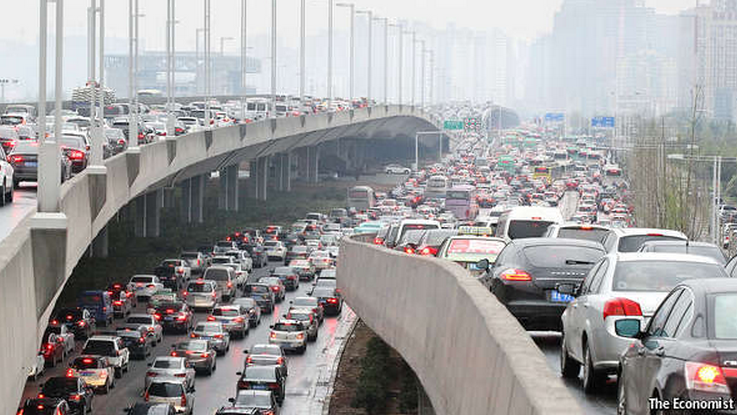
The transition will take time. For now, investment still accounts for half the economy. In Zhengzhou, a layer of construction dust covers much of the city’s southern half. Along with building a vast new airport terminal, workers are digging tunnels for five new subway lines. Traffic is snarled for hours in the evening as trucks haul pillars into place for elevated highways. The pressing concern for residents stuck in the congestion is not economic collapse but rather the continued headaches of growth, even if it is a little weaker than last year.

Take a look at the traffic jam in this photo, and think about the fact that in the 1990s, or even the early 2000s, essentially nobody in Zhengzhou even owned a car.

Screen Shot 2015-05-03 at 11.08.33 PM

How many more populist “victories” can we survive?

Here’s Salon on the Greece government’s “victory” last February:

One week after Greece’s leftist government reached a new debt deal with its creditors, Paul Krugman argues in his New York Times column today that left-wing criticism of the deal is misguided, obscuring larger victories secured by Greek negotiators.

And here’s Paul Krugman in 2012 on Argentina’s “remarkable success.”

Matt Yglesias, who just spent time in Argentina, writes about the lessons of that country’s recovery following its exit from the one-peso-one-dollar “convertibility law”. As he says, it’s a remarkable success story, one that arguably holds lessons for the euro zone.

I’d just add something else: press coverage of Argentina is another one of those examples of how conventional wisdom can apparently make it impossible to get basic facts right. We keep getting stories about Ireland’s recovery when there is, in fact, no recovery “” but there should be, darn it, because they’ve done the “right” thing, so that’s what we’ll report.

And conversely, articles about Argentina are almost always very negative in tone “” they’re irresponsible, they’re renationalizing some industries, they talk populist, so they must be going very badly.

In fairness, they did have a very strong cyclical rebound after easing monetary policy (an issue on which I agree with Krugman.)  Where I disagree is his tendency to sort of wave away supply-side concerns—which are what matters in the long run.  It looks like the long run has arrived, as the Argentine economy has sputtered over the three years since he wrote this post, and 2015 will be downright ugly.

From the same post, Krugman has good things to say about Brazil’s slightly more moderate, but still hopelessly statist policy regime:

Just to be clear, I think Brazil is going pretty well, and has had good leadership. But why exactly is Brazil an impressive “BRIC” while Argentina is always disparaged? Actually, we know why “” but it doesn’t speak well for the state of economics reporting.

Why was Argentina disparaged?  Perhaps because some of us don’t have a “in the long run we are all dead” Keynesian obsession with the demand-side.  We saw problems down the road. BTW, the Argentine president who created the disaster died in 2010, leaving his wife to inherit the mess “in the long run.” Brazil has also done very poorly in the three years since Krugman praised its (incompetent) leadership, and the forecasts reported in the next link call the outlook for Brazil’s economy in 2015 “grim.”  Nor will boosting AD perform miracles, Brazil and Argentina already have lots of inflation.

Here’s the outlook for the key economies in Latin America next year:

Many Latin American economies will continue to face increasing growth divergence this year, which is neatly defined by the two oceans that envelop the region. The Atlantic-facing economies of Argentina, Brazil and Venezuela””the largest members of the Mercosur bloc””will contract 0.2%, 0.9%, 5.5%, respectively, according to LatinFocus Consensus Forecasts panelists. On the other side of the continent, Chile, Colombia, Mexico and Peru””which make up the Pacific Alliance””will expand 2.9%, 3.4%, 2.9% and 3.5%, respectively.

Let’s see, I’m trying to remember which side had the more statist policy regimes, the Atlantic or the Pacific bloc?  The next paragraph answers the question:

This division has little to do with the western countries’ orientation toward a more dynamic Asia and the eastern countries’ exposure to the European economies, which are still weak. In fact, the growth divergence is mainly the result of the substantial differences in each country’s economic policy during a decade-long economic boom, which was fuelled by high commodities prices and strong inflows of foreign direct investment. Throughout the boom years, Atlantic countries spent more and saved less, while the Pacific-facing countries invested more. Moreover, many governments in the Atlantic-facing countries implemented more interventionist economic policies, which put a dent in businesses’ profits and discouraged investment. Conversely, countries bordering the Pacific undertook agendas of economic reforms, which investors welcomed.

But that doesn’t make any sense. How could the Pacific countries be doing better, when they relied more on the brain dead supply-side approach of the GOP?  Of course Krugman told us that Chile’s supposed free market success is just “Fantasies of the Chicago Boys.

But there’s another point: the economics of Chile under Pinochet are a lot more ambiguous than legend has it. The way the story is told now, the free-market guys moved in, liberalized, and then there was a boom.

Actually, as you can see from the chart above, what happened was this: Chile had a huge economic crisis in the early 70s, which was, yes, partly due to Allende and the accompanying turmoil. Then the country experienced a recovery driven in large part by massive capital inflows, which mostly consisted of making up the lost ground. Then there was a huge crisis again in the early 1980s “” part of the broader Latin debt crisis, but Chile was hit much worse than other major players. It wasn’t until the late 1980s, by which time the hard-line free-market policies had been considerably softened, that Chile finally moved definitively ahead of where it had been in the early 70s.

There’s no question the Chicago Boys screwed up in the early 1980s, by ignoring Milton Friedman’s (and Paul Krugman’s) advice to float your currency.  But what about that supposed “softening” of free market policies?  Here’s the Fraser Institute rankings of economic freedom in Chile (index number out of 10, and then global ranking), since the Chicago-style reforms began in 1975:

1975:    3.60  (71)

1980:   5.38  (48)

1990:    6.78  (27)

2000:   7.41  (33)

2010:   7.94   (7)

If there are “fantasies,” it’s the idea that Chile became less market-oriented after the late 1970s.

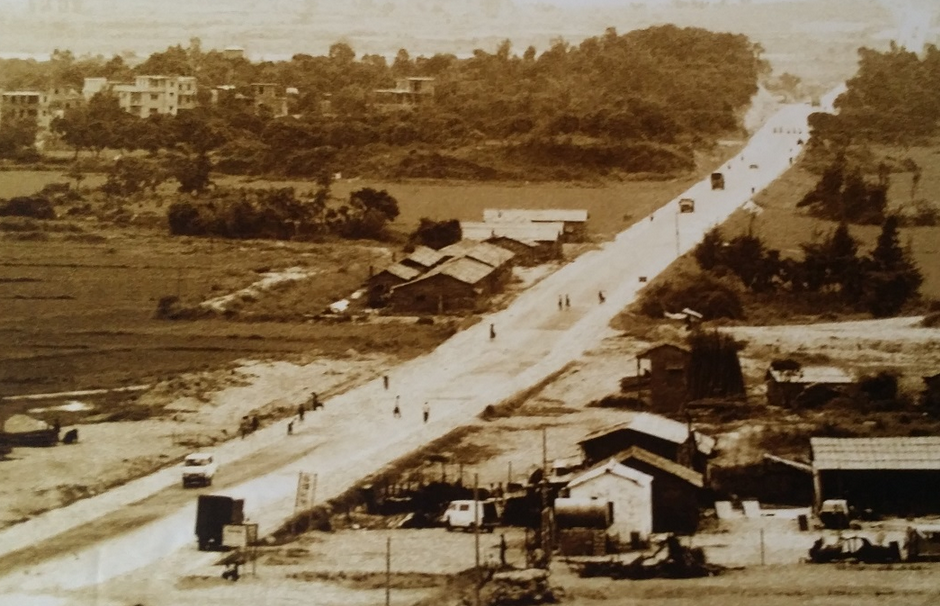
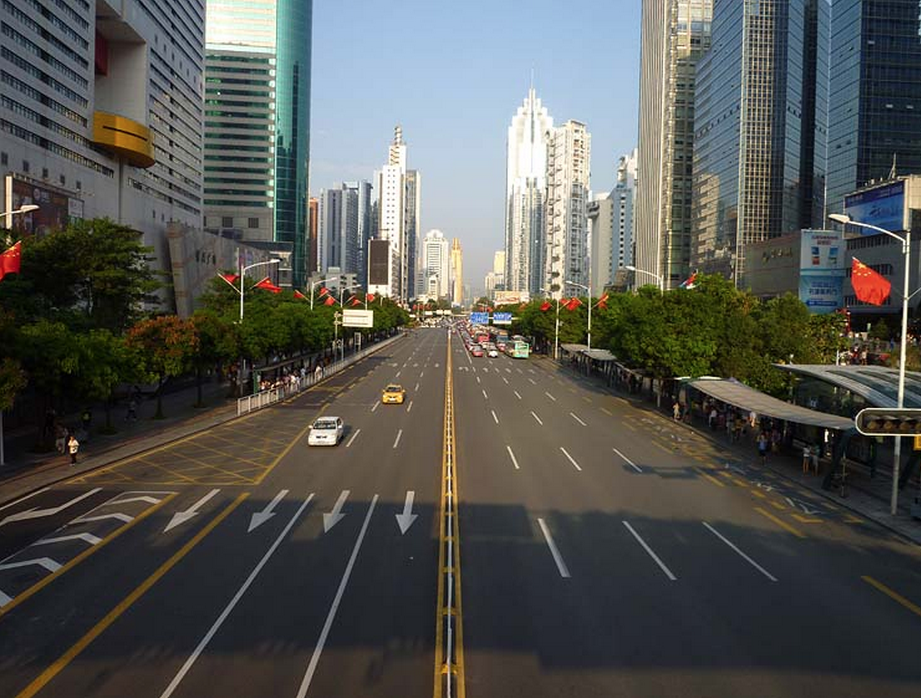
Perhaps Brazil could try some Paul Romerstyle charter cities on its poverty-stricken northeast coast.  You know, the kind of free trade zone that was adopted by another country advised by Friedman at about the same time he advised the brutal Pinochet regime. This regime was far more brutal, and yet oddly Friedman got no criticism from the left for his advice, perhaps because the left was embarrassed by the fact that so many of their famous intellectuals had praised the regime over the previous decades, as they killed tens of millions of people.  Have you guessed which one?  Hint, it’s right after Chile in alphabetical order.  And the main street in its biggest free trade zone went from looking like this in 1981:

Screen Shot 2015-04-29 at 6.21.04 PM

To this in 2013:

Screen Shot 2015-04-29 at 6.21.24 PM

Brazil might want to contact Mr. Romer.