Do you remember when . . .

The GOP favored free trade

Democrats worried about immigration

The GOP favored tight money

Liberals favored free speech

Conservatives thought it was naive to claim that North Korean nukes are no threat to the US

Liberals supported Israel

Conservatives worried about the Russian threat

Liberals mocked the conservative fear of Russia

Conservatives worried about sex scandals

Liberals thought it was hip to ignore sex scandals

The GOP opposed increasing government spending faster than GDP

Liberals opposed Harvard admission quotas on high achieving minority groups.

Conservatives were skeptical of antitrust laws

Liberals favored a colorblind society

Conservatives wanted to ban non-PC art

Liberals liked activist judges

Conservatives thought the President should be forced to testify under oath, and get impeached if he lied

Liberals liked Al Franken, Woody Allen, Garrison Keillor, Bill Cosby, Charlie Rose and Bill Clinton

Conservatives liked George Bush, Mitt Romney, Paul Ryan, and John McCain

Republicans “believed the women”, and Democrats did not.

Just to be clear, I’m in favor of some of these changes and opposed to others.  It’s sad that I have to make this disclaimer.  But it’s the internet.

PS.  File this story under Trump Derangement Syndrome

To boldly go where America has never gone before

Which of these statements is true:

1.  Tight labor markets are almost always followed by recessions within a year or two (1966 was an exception).

2.  Inverted yield curves are almost always followed by recessions within a year or two (1966 was an exception.)

3.  The US has never experienced an expansion lasting more than 10 years.

Actually, all three are true.  And none of the three have any necessary implication for current monetary policy. (Over at Econlog, I explain why I believe labor markets are currently tight.)

Suppose we took the first statement seriously.  If the labor market is getting tight, then the Fed might want to tighten monetary policy to get the labor market less tight.  After all, tight labor markets are often followed by recessions.  In contrast, if the yield curve inverted, then the Fed might want to loosen policy to avoid a recession.  And if the expansion has lasted for 9 years, then the Fed might want to simply throw in the towel, as history tells us that there is nothing that can be done.  A recession is inevitable in the near future.

In fact, history is not destiny.  It’s quite possible this expansion lasts for more than 10 years.  It’s quite possible that (as in 1966) a tight labor market doesn’t lead to a recession.  And its quite possible that (as in 1966) an inverted yield curve is not followed by a recession.  Unfortunately, we responded to the inverted yield curve of 1966 with an easy money policy, which created something even worse than a mild recession—the Great Inflation (which itself led to more severe recessions later on.)

History is no guide when the Fed is trying to achieve something that it has never achieved in all of American history—a soft landing.  So why am I so naive as to think this time is different?  Because Trump is President!  (Just kidding.)  One reason is because other countries have recently achieved soft landings.  Examples include the UK in the early 2000s and of course Australia.  Furthermore, the history of American monetary policy can be seen as a series of mistakes, and each time the Fed learns a lesson.  The Fed no longer creates 10% deflation.  They no longer create 10% inflation.  Now they must learn to avoid severe recessions.  I see no reason why they can’t succeed in that endeavor—Australia has already done so.

Update:  Let’s define ‘soft landing’ as at least three more years of growth once the labor market has become tight.

Screen Shot 2018-09-25 at 5.52.46 PM

Undoubtedly the US will still experience the occasional mild recession.  But we can, should, and probably will do much better than in the past.  Recall that in the 1970s, people like me who claimed the Fed could control inflation were viewed by the Very Serious People as being hopelessly naive and utopian.  The VSPs are always behind the curve on monetary policy.  They don’t understand monetary theory, and hence rely on “history”.  But history is a very poor guide when it comes to monetary policy.

And if you insist on going with “history”, then don’t tell me what the Fed needs to do to avoid the next recession.  History says a recession is inevitable, within 9 months.

Meanwhile the NGDP prediction market is up to 5.2% growth, and the number is rising.  I’ll go with the prediction market over “history”.

PS.  I increasingly believe the Fed has (perhaps subconsciously) absorbed the most important lesson in monetary policy:

Screen Shot 2018-09-11 at 2.08.35 PMPPS.  Trump in 2014:

We need a President who isn’t a laughing stock to the entire World.

The entire world today at the UN:

Ha ha ha ha ha ha ha . . .

All things must pass

This post is highly speculative; take it with a grain of salt.

Traumatic events such as wars are often followed by a backlash. The side that feels vindicated will lash out against those seen as being on the other side. After the Civil War, the radical Republicans went after (moderate) President Andrew Johnson. After WWI, the statists went after the anarchists and pacifists. After WWII (and Korea) you had a wave of anti-communism.  After Vietnam, liberal Democrats went after Nixon.

Don’t get bogged down in the details; there are generally broader trends at work. Thus Nixon’s downfall is directly linked to the Watergate break-in, but Nixon was actually attacked for a wide range of abuses, involving domestic spying, war crimes in Southeast Asia, and lots of other stuff. Congress passed laws reining in institutions such as the CIA.

I wonder if the Trump era will fall into this pattern. Obviously there is no major war going on, but at a psychological level it feels a bit like a civil war. Perhaps the Trump era will be followed by the same sort of “reign of terror” as followed earlier traumatic events. Eventually Trump will fall, and the establishment (led by the Democrats) will at some point seek to punish Trump and the administration officials that implemented his policies.

I suspect the “political correctness” movement will play the same role in the 2020s as the anti-communist movement played in the 1950s. Let’s think about some parallels. These backlash movements are often tied to very justified causes, but occasionally overreach. Thus the Confederacy really was evil, but there was overreach in trying to impeach Johnson for not being sufficiently punitive toward the South. Communism really was evil, but there was overreach in going after Hollywood screenwriters. Trump really is evil, but there is occasional overreach in going after people not deemed sufficiently “politically correct”.

Let me use an example that may at first seem off topic, but is actually linked to all the current craziness. The Me-Too movement is a long overdo attack on powerful men who abuse women. And I’d also argue:

1. Trump is a sort of anti-Me-Too figure. (The same could be said for substantial parts of the GOP.)
2. Some liberal anti-Trumpers who are mildly supportive of Me-Too are getting attacked for not being sufficiently closely allied with the Me-Too movement.

The first point is pretty obvious. Trump himself has been accused of abuse by many women, and he frequently defends other men who have been accused of abuse. Many of the women that support Trump are themselves skeptical of Me-Too, and of feminism more broadly.

On the second point, a good example occurred recently with the New York Review of Books.  Ian Buruma (editor of the NYRB) agreed to publish a piece by a Canadian media figure that had been accused of abusing 23 women. Buruma was interested in publishing an account of what it was like to be publicly shamed.  Not surprisingly, many people were outraged, as they viewed this decision as Buruma allowing the abuser to whitewash his actions in a prestigious media outlet.

I think you can make a good argument that Buruma used poor judgment in this case. On the other hand, the firing of Buruma was clear overreach and not justified by his decision, even if mistaken. Honest people can disagree about how to reconcile the public’s interest in learning the perspective of shamed people, with the public interest in shaming bad people.

I expect the eventual downfall of Trump to unleash a huge wave of political correctness across the country. It’s important to put these sorts of waves into perspective, and not overreact either way. Thus the McCarthy era persecution of the Rosenbergs was justified, whereas the attacks on the Hollywood screenwriters were not. The underlying “cause” of anti-communism was of course quite justified, right up there with the anti-slavery movement of the 1800s and the war on fascism during the 1940s. But, as with any movement full of passionate, self-righteous people, there will be occasional overreach.

It’s quite likely that I’ll eventually become caught in the anti-Trump backlash, as “collateral damage”. This might seem surprising, as I’m among the most outspoken anti-Trumpers in the econ blogosphere. If you are surprised, then you’ve never studied the Chinese Cultural Revolution, where even the devout communists eventually became shamed and persecuted.  I’ll eventually become seen as a Trumpian old white male, who just doesn’t “get it”.  Someone will dig up my old posts where I mock certain tenets of political correctness, such as the recent hysteria over cultural appropriation.

So why am I not worried about my likely fate? Let’s go back to Trump for a moment. Trump clearly has fascist instincts, and idolizes strong authoritarian leaders. But he’s also enmeshed in an American constitutional system that gives him relatively little power. So he governs as a fairly conventional Republican, except for a few symbolic actions such as the recent trade war. I’ve consistently argued that not much would change under Trump, and so far I’ve been right.

Similarly, although the eventual overreach of anti-Trump political correctness will resemble the Chinese Cultural Revolution on a stylistic level, in fact it will be mostly empty theatre—not mass murder. I’m in the fortunate position where I’m not vulnerable to public shaming. It makes no difference to me if I lose my job–heck I’d love an excuse to retire! I don’t care what others think of my political views; indeed I’ve always been a contrarian thinker.  And I don’t follow Twitter, which is where the shaming often occurs.  (Others will not be so lucky.)

In the post-Trump era, I’ll cheer the attacks on Trump officials who did abuse government power and I’ll attack the excesses of left-wing PCism where appropriate. Classical liberalism is my lodestar, an ideal that never needs replacement. Both the left and the right have periods where they reject classical liberalism. Right now, the biggest threat in the world is right wing, xenophobic, misogynistic, authoritarian nationalism. And that’s where I focus my attacks. But there will come a day where the biggest threat will be left-wing PCism run amuck, and when that occurs I’ll focus my attacks on that group.

BTW, one aspect of the current moment that is often overlooked is that there is a sort of generational war simmering below the surface. During the 1960s, the hippies were not just horrified by the Vietnam War and racism; they were horrified by the older generation. After all, the older generation had produced the system that the hippies despised. Something similar is occurring with the Me-Too movement. The younger generation is clearly contemptuous of the older generation, at least regarding the sexual harassment issue. And how could it be otherwise? The older generation tolerated these abuses for decades. Indeed someone recently dug up a tape of a “roast” at one of the major networks, where several participants made fun of Matt Lauer’s practice of abusing women. To my generation, this stuff was just a big joke—the “casting couch” phenomenon. How could the younger generation not be horrified by us old fogies, who just don’t get it?

Earlier I referred to the Buruma firing, and this seems relevant:

Were there in-house objections to the piece?

No. We had a proper office discussion and everybody expressed their views and not everybody agreed. But all views were aired and in the end, when the decision was made, the office stuck together.

Was there a gender breakdown during the discussion?

How old are you?

I’m 66

I like Buruma a lot, but he comes off poorly in this interview.  People of my generation need to spend some time rethinking their assumptions and at the very least come up with better defenses for their views, assuming they decide not to change their views.  (Of course it goes without saying that younger SJWs need to be more tolerant of views with which they disagree.)

I’m already looking past the Trump era, and even past the post-Trump backlash excesses.  Its helps to view the past, present, and future from a “timeless perspective”.  At least it’s less stressful to see things that way. All things must pass.

PS.  Here’s what the NYRB should have done.  Hire someone to write an opinion piece on Me-Too.  Have them interview a few abusers to get a sense of what it’s like to be shamed, and whether they’ve rethought their attitude toward women.  But also include interviews with the women who have suffered emotional trauma from the abuse, to put things into perspective.


 

The Tea Party won

The Tea Party has finally achieved its objective.  The GOP is in control of all branches of government and Tea Party favorite Donald Trump was elected President.  They won.

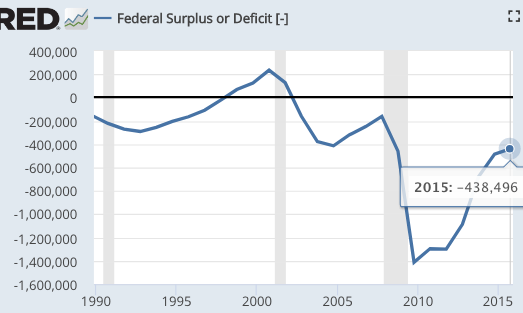
But what exactly did they win?  Their big issue was the budget deficit, which as of 2015 was rapidly shrinking (as is generally the case during economic recoveries.)

Screen Shot 2018-09-19 at 12.22.54 AM


The recovery has since picked up speed, so the deficit should be falling especially fast right now.  Unfortunately, the FRED data site does not have updated figures, but the deficit is no longer falling.  Indeed it’s exploding, expected to reach $1.1 trillion in 2019.  Nothing like this has ever happened in America during a period of peace and prosperity.  There is such a firehose of spending that Washington is hardly able to shovel dollars out the door as fast as they are being appropriated:

The federal government is primed to spend as much as $300 billion in the final quarter of fiscal 2018 as agencies rush to obligate money appropriated by Congress before Sept. 30 or return it to the Treasury Department.

The spending spree is the product of the omnibus budget agreement signed six months late in March coupled with funding increases of $80 billion for defense and $63 billion for civilian agencies. The shortened time frame left procurement officials scrambling to find ways to spend the money.

Through August, defense and civilian agencies obligated some $300 billion in contracts. But to spend all the money appropriated to them by Congress, they may have to obligate well over $200 billion more in the final quarter of fiscal 2018, which ends in two weeks.

“It is not impossible for this to happen, but it is unprecedented for that high of a percentage to be obligated to contracts for a fiscal quarter,” David Berteau, president of the Professional Services Council, told Nextgov. “You’d have to spend almost 50 percent of the yearly total in three months.”

And yet the federal government may do just that.

This is what happens when you give the GOP full control over the government.

Hardly anyone is reporting this story, even though it’s one of the most bizarre things to have happened in America during my lifetime.  Perhaps this is because none of our “tribes” has an incentive to acknowledge these facts.  The GOP wants to tell voters that it’s a responsible, small government, conservative party, pushing back against the deficit spending of the Obama years.  The Dems want to tell voters that the GOP is a mean-spirited, small government, conservative party.  Both are lying.  The press plays along with this framing, because it lets the two tribes set the terms of the debate.  The GOP is actually a big government party.  Neither the NYT nor Fox News will tell you that.

To get a sense of the weirdness of this state of affairs, imagine the right-to-life movement were to get control of all branches of American government.  And then assume that they immediately proceeded to make abortion mandatory for all pregnancies involving unmarried women.  Because deficit spending is a dry economic issue, people don’t grasp the strangeness of what’s happened.

PS.  Off topic, this FT piece made me smile:

The US and Canada have been sparring over access to the protected Canadian dairy market, American insistence on scrapping a dispute settlement mechanism in the original pact, and Ottawa’s request for cultural exceptions to be maintained in the media sector. . . .

On Tuesday, Steve Scalise, a Louisiana Republican and the House majority whip, fired off a statement attacking Ottawa, saying there was growing “frustration” that Canada was not “ready or willing” to make a deal.

“Mexico negotiated in good faith and in a timely manner, and if Canada does not co-operate in the negotiations, Congress will have no choice but to consider options about how best to move forward and stand up for American workers.”

Good to see the GOP standing up for Johnny Depp, Brad Pitt, Robert Downey Jr., Tom Cruise, and other “American workers”.


About that “malinvestment”

When I first started blogging, a number of Austrian commenters told me the real problem was not tight money.  Rather there had been “malinvestment” in housing, especially in the “sand states”.  The recession was the price we had to pay for all of this poorly thought out investment.

That theory never even made sense in 2009.  If the problem was malinvestment in housing, then resources would have shifted to the other 95% of the economy. Instead, output fell in almost all sectors.  (I’m referring to 2008-09; resources did shift to other sectors during the 2006-07 construction slump.)

Today it makes even less sense. The NYT has an article on the housing market in North Las Vegas, which was the epicenter of the bust. It’s now booming:

Amazon has opened two huge centers in North Las Vegas for distributing goods and handling returns, bringing thousands of jobs. A third facility is on the way. Sephora, the cosmetics company, recently broke ground here for a giant warehouse.

With nearly a quarter-million people, North Las Vegas is one of the fastest-growing cities in the country. It’s also young — the average resident is just 33 years old.

The Times reports that prices are soaring and homes typically sell in three days.

I agreed that there had been some excessive housing construction in the inland portion of the sand states, perhaps because builders expected the US population in 2050 to be 50 million higher than is now predicted.  (Recall that 2006 was the year of the immigration crackdown.)  But I argued that these cities were fast growing, and this problem was relatively mild.  In my view the malinvestment is better termed “too early investment”—some houses were built a few years before they were needed.  The Austrian counterargument was that these houses would remain empty for decades, and eventually depreciate sharply (in a physical sense.)  It looks like I was closer to the truth.

I would add that Kevin Erdmann’s take on the crisis is being increasingly confirmed by events:

Jazzmine Guiberteaux moved here a few years ago from Oakland, Calif. — one of many California real estate refugees who headed to Nevada in search of more space and cheaper housing. But she is increasingly being priced out.

A 35-year-old mother of two, with another child on the way, she works in a clothing shop and drives for Uber to earn extra cash. She has had to move three times in five years.

Ms. Guiberteaux’s previous landlord terminated her month-to-month lease on Mother’s Day. It took her 10 days to get a new place. “The rent is higher,” she said. “But it’s in a better neighborhood.”

When Kevin’s book comes out in a few months, it may end up being the most important housing book of the decade.

BTW, the NYT has this picture of a downtrodden resident, who is forced to rent rather than own:
Screen Shot 2018-09-14 at 8.34.30 PM

You can see the picture more clearly in the NYT article. I couldn’t help but notice the Pottery Barn look.  The downtrodden have certainly come a long way from the 1960s, when the NYT carried pictures of shacks in Appalachia and slums in the Bronx.

I know, I’m a heartless out of touch elitist who doesn’t understand how much people are suffering.

PS.  Ten years after Lehman, market monetarists should feel really good about how things are playing out.  Not only is the boom in the housing market tending to confirm the MM/Erdmann view of the world, but more and more policymakers are talking in terms that sound suspiciously market monetarist.  Clare Zempel directed me to an article discussing Janet Yellen’s take on what we should do next time:

Elaborating on how the central bank should think about what to do if rates have to be cut to zero again in the future and can’t go any lower, she said the Fed should promise now that it will keep rates low enough to let a hot economy make up for lost time.

Does that remind you of anything?  Hint, here’s my new California license plate, which I picked up a few days ago:

Screen Shot 2018-09-11 at 2.08.35 PMOh, and NGDP just keeps chugging along at a fairly stable rate.

There may be no blogging tomorrow, as I plan to attend a 13-hour film in crime-ridden Santa Ana.  Wish me luck.