Somebody should look into wage inflation targeting

That was the message at a recent Brookings conference, which looked at why inflation has remained lower that predicted in Phillips Curve models.

At one point (around 3:28), Olivier Blanchard suggested a wage inflation target made more sense, as the wage inflation Phillips curve is much more reliable than the price inflation Phillips curve. Then Blanchard said this about wage inflation targeting:

. . . which I think hasn’t been examined and should probably have been . . .

This made me smile, as back in 1995 I published a paper showing that wage inflation targeting might be superior to price inflation targeting. Mankiw and Reis (2002) also suggested that wage inflation targeting might be superior.  And of course other economists like Earl Thompson did so even earlier.

In the end, I decided that wage inflation targeting was not politically feasible, as tightening money to slow wage growth would be too controversial.

Later in the session, Paul Krugman indicated that he also found the idea of wage inflation targeting to be appealing, but worried that wage inflation targeting was not politically feasible, as tightening money to slow wage growth would be too controversial.

As David Beckworth recently tweeted, seeing the advantages of wage targeting is the first step in convincing people that NGDP targeting is the way to go, as the ideas are related (albeit not identical.)

It’s interesting to see big names in the field coming around to ideas that George Selgin and I have been advocating for decades.

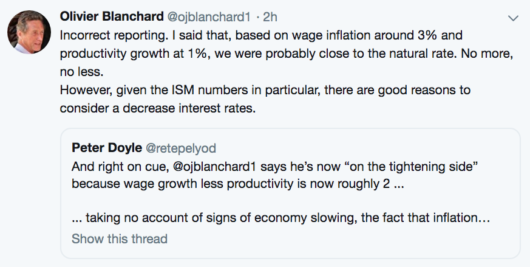
PS.  Blanchard recently tweeted:

Actually Doyle’s tweet was accurate, and referred to comments Blanchard made between 3:29 and 3:30.  Glad to see that Blanchard changed his mind.  The Fed needs to be more expansionary.

Should the Fed’s “public option” be only for banks?

Consider a country with a very simple monetary base, just government issued coins made out of gold, silver and copper. And then someone decides that it would be more efficient to supplement the coins with paper money in larger denominations. Initially, only commercial banks are allowed to hold currency. They use the currency to clear balances between banks.

This example is not historically accurate, but it’s also not as far-fetched as it seems. Back in 1912, the entire monetary base was cash and coins, and very large bills were used almost exclusively to clear balances between banks:
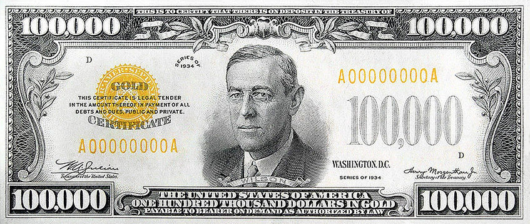
Obviously it would be a weird system, and in fact the public always has been allowed to hold currency notes and coins.

Now imagine that the public can hold currency and a third type of base money is created, non-interest bearing deposits at the central bank, which are a sort of “electronic cash” that doesn’t face the risk of theft or fire. Once again, let’s assume that only commercial banks were allowed to hold this new and more efficient type of government created base money. That would be kind of weird, wouldn’t it? It certainly seems weird to me. But that’s exactly what we did in 1913.

Tyler Cowen has a new post that discusses proposals for central banks to create e-currency:

The various proposals are works in progress, but share one basic feature: Central banks would issue electronic deposits. These deposits would be available to eligible citizens or businesses, allowing a greater number of parties direct access to the accounting and payments mechanisms of the central bank. One simple version of the proposal would let individuals hold an account at the Federal Reserve, just as they can hold an account at Bank of America. It would be like a “public option” for banking, albeit with an electronic focus and direct access to the Fed.

I think it’s misleading to suggest these accounts are sort of like a bank account at Bank of America. If I have $10,000 in bills in a shoebox under my bed, is that sort of like an account at BOA? Clearly not. A commercial bank account is a loan of money from me to a commercial bank. A box of cash under my bed is not really a loan of money to the government in the conventional sense of the term (although it may be a sort of zero interest quasi-loan if the government commits to stabilize its value.) But a loan to BOA is risky, whereas a loan to a fiat money central bank is no more risky that holding cash. It may lose value from inflation, but default is very unlikely.

BTW, there is already a “public option” for deposits at the Fed, but it’s only for commercial banks.

On the other hand, deposits at the Fed would compete with commercial bank deposits, as commercial banks thrive on their ability to offer a close substitute for a deposit at the central bank—a commercial bank deposit insured by taxpayers at up to $250,000.

Tyler worries that this might put us on the path to a more socialist economy:

An alternative scenario is that the central bank decides to enter the commercial lending business, much as your current bank does. Will the central bank be a better lender than the private banks? Probably not. Central banks are conservative by nature, and have few “roots in the community” as the phrase is commonly understood. The end result would be more funds used to buy Treasury bonds and mortgage securities — highly institutionalized investments — and fewer loans to small and mid-sized local businesses.

This seems to mix up two issues. We’ve already essentially socialized the deposit side of the banking industry, at least from a risk perspective. Tyler suggests that this might lead central banks to begin lending to ordinary businesses. But if that were to happen it would mean we were already far down the road to socialism, and it’s not likely to hinge on a minor issue like whether or not the public is allowed to hold base money in deposits at the Fed.

I understand that many free market economists are skeptical of allowing central banks to offer deposits to the public. So am I. Indeed I’m probably about the only person in the world who has advocated totally abolishing accounts at the Fed, even for banks, and going back to the cash and coin monetary base of 1912. That system seemed to work fine (at least in Canada, where they didn’t have an insane set of banking regulations.) So I’m hardly a socialist on this issue. More like a reactionary.

On the other hand, I wish free market economists gave a bit more thought as to why both the public and banks can hold two of the types of base money (coins and currency) but only banks can hold the third (deposits at the central bank.) There may be a reason for that asymmetry, but I’ve never seen a convincing explanation.

Here’s Tyler:

This leads to my primary objection to an official government e-currency: It would, in effect, make many more economic institutions more like banks. Over time, those institutions would probably be regulated more like banks, too. For instance, if the Fed is directly transmitting payments made by a private company, it might be wary of credit risk and impose capital and reserve requirements on that company, much as it does on banks. Banks also might complain that they are facing unfair competition, and ask that consistent regulations be imposed. In any case, more of the economy likely will be subject to financial regulation, not just the relatively narrow core of the banking system.

I don’t follow this. Where is the risk in the public having deposits at the central bank? I don’t get regulated for having a shoebox of cash under my bed, why would moving that money into an account at the Fed cause the government to begin regulating me like a bank?

Again, I’m not saying that offering Fed accounts to the public is a good idea. Rather I’m waiting for free market economists to give me a plausible explanation as to why these deposits are not a good idea for the public, but are a good idea for commercial banks. What makes banks so special that they deserve this subsidy? Isn’t this like when the government says that only car dealers can sell new cars, not manufacturers? We don’t have a special regulatory burden on banks because they have deposits at the Fed, we have special regulations for banks because of FDIC and too-big-to-fail, which exposes taxpayers to losses resulting from moral hazard.

PS. One compromise might be to allow both the public and banks to have deposits at the Fed, but insist that they not earn any interest. That would make clearer their essential “cash-like” nature.

PPS. Whatever we do, I’m certain that it will be the wrong thing. Banks have way too much political power and any new regime will undoubtedly cater to their interests.


Much worse?

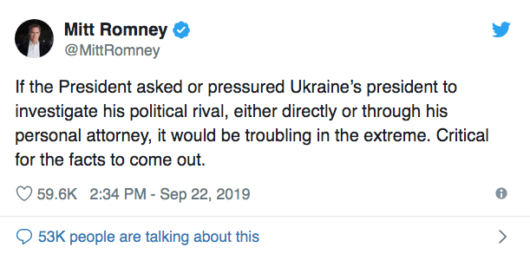
The Ukraine is a US ally, and we don’t have any major disagreements with their government. And yet, Mitt Romney had this to say:

China is very different. The US regards China as our number one rival. They are seen as a threat. We worry about their spying, their attempts to subvert our political process. On top of everything else, we are currently engaged in a major trade war with China.

Just just imagine if Trump were to ask the Chinese to dig up dirt on his number one political rival!!

Umm, he just did. In public:

President Trump called for Ukraine and China to investigate his political rival, Joe Biden, doubling down on his efforts to push foreign countries to undertake probes that could benefit his re-election campaign.

If China wants a good trade deal, they’d better come up with some dirt on Biden.

But hey, I’m sure it’s fake news. They doctored the video and the audio. No doubt 60% of Republican voters will deny he said this.

Here’s my question for Romney. If doing this with Ukraine is “troubling in the extreme”, how would you characterize doing it with China?

(Watch the commenters who tell me that I don’t understand the China threat now tell me that it’s good when China tries to influence the outcome of our presidential elections—as long as it’s in Trump’s favor.)

Everything you want to know about NGDPLT

In the past, when people have asked me about NGDP targeting I’ve often pointed to my own Mercatus paper. In the future, I’ll probably point to an excellent paper by David Beckworth, which just came out today.

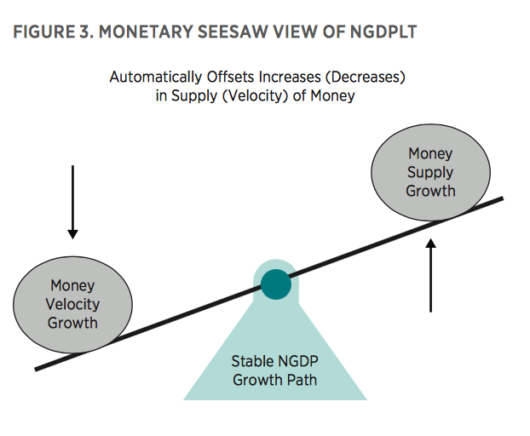
David is especially good at explaining the intuition behind NGDP targeting. Here’s one diagram:

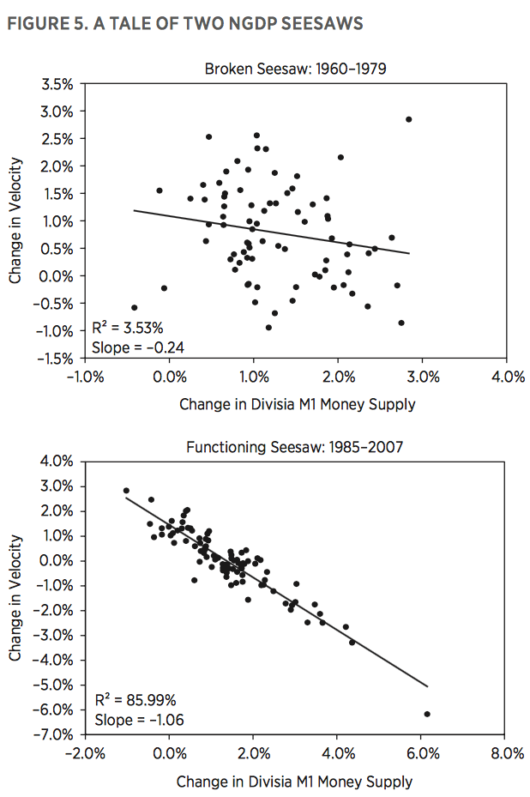
And this figure shows how it works out with actual data:

Notice how during the Great Moderation, the Fed tended to adjust the money supply to offset changes in velocity, whereas during the less stable 1960s and 1970s they did not do so.

David looks at NGDP targeting from many different angles, and in the second half of the paper he considers a number of objections that have been raised.  One issue is whether the Fed would be able to bring NGDP back to the trend line after an overshoot.  Would that be too controversial?  David offers three counterarguments:

First, as mentioned earlier, if the public understands NGDPLT and finds it credible, then it will have less incentive to engage in excessive spending that pushes NGDP above target in the first place since the Fed will be expected to offset it. The public’s expectation of stable total dollar spending growth, then, will become self-fulfilling. This lowers the likelihood of the Fed having to correct an overshoot of the target. Second, even if there were an overshoot, the Fed need not engineer an outright contraction of NGDP. As seen in panel B of figure 2, the Fed could simply slow down the rate of NGDP growth until its level returned to the targeted growth path. Finally, the existing monetary policy framework faces its own version of this fear. Yet policymakers have found ways to tighten monetary policy when needed. It should be no different under NGDPLT.

I’d add a fourth factor.  The public thinks in terms of levels, not growth rates.  That’s why they view years like 2010 as “recession years”, whereas economists see them as recovery years, as “expansion”.  If there is an overshoot of NGDP that means the economy is overheating.  Going back to “normal” does not feel at all (to the public) like going from a normal to a below normal economy.  There is generally very little increase in unemployment when the economy reverts down to the trend line from overheating, unless it’s been overshooting for a long time, in which case you do want to return to normal at a very gradual pace.  (And you also want to replace the Fed chair.)

PS.  I also recommend a new book based on a Mercatus/IHS conference from early 2018, which has a number of excellent papers on monetary policy.  The conference honored Allan Meltzer’s contributions to monetary economics.  Meltzer was one of the most influential monetarists of the 20th century.

You’re making me look like an idiot!

To be outraged by Trump is to play into his hand.  Better to laugh at him.  And I have to say that in my 64 years on this planet, I’ve never enjoyed the political news as much as right now:

The Oval Office meeting this past March began, as so many had, with President Trump fuming about migrants. But this time he had a solution. As White House advisers listened astonished, he ordered them to shut down the entire 2,000-mile border with Mexico — by noon the next day.

The advisers feared the president’s edict would trap American tourists in Mexico, strand children at schools on both sides of the border and create an economic meltdown in two countries. Yet they also knew how much the president’s zeal to stop immigration had sent him lurching for solutions, one more extreme than the next.

Privately, the president had often talked about fortifying a border wall with a water-filled trench, stocked with snakes or alligators, prompting aides to seek a cost estimate. He wanted the wall electrified, with spikes on top that could pierce human flesh. After publicly suggesting that soldiers shoot migrants if they threw rocks, the president backed off when his staff told him that was illegal. But later in a meeting, aides recalled, he suggested that they shoot migrants in the legs to slow them down. That’s not allowed either, they told him.

Trump fans will insist he was just joking.  But comedians don’t generally shout at their audience:

In the Oval Office that March afternoon, a 30-minute meeting extended to more than two hours as Mr. Trump’s team tried desperately to placate him.

“You are making me look like an idiot!” Mr. Trump shouted, adding in a profanity, as multiple officials in the room described it.

When I was young, there was a TV commercial where people argued over the best quality of a certain beer:

Tastes great!

No, less filling!

With Trump there’s such a plethora of bad attributes that one hardly knows where to start:

Idiot!

No, liar!

No, thug!

No, creep!

The debates will go on forever, to be rehashed in future history books.

But just as Miller Lite can be enjoyed on many levels, Trump’s “snakes and alligators” approach to border security (or his “nuke the hurricanes” approach to climate policy), can be appreciated on multiple levels.

There’s another wonderful thing about Trump; he shows it doesn’t matter who is president.  He consistently undermines our intelligence services and insists the Russians are innocent.  He’s constantly trying to cozy up to bloodthirsty dictators and undermine our allies. And none of it seems to matter.

He hasn’t been able to remove the sanctions on Russia.  Trump shows that even in the worst case, even if Putin achieved all his devious foreign policy goals in one fell swoop, it would still be all for naught.  US presidents just aren’t that influential.  We have a Russian mole in the White House and things still go on as usual.

And you wonder why I don’t worry about Chinese spying.  What do the Chinese hope to achieve?  They are decades behind Russia in their ability to influence US policy. And Russia is gaining nothing from its efforts.

PS.  A new poll suggests that 60% of Republicans believe that Trump is lying about the Ukraine conversation:

new poll shows that only four in 10 Republicans believe President Donald Trump talked to the Ukrainian president about investigating political rival Joe Biden, even though Trump has acknowledged doing so.

PPS.  Why didn’t Trump suggest that the spikes be tipped with poison?

PPPS.  Doesn’t Trump know that crocodiles are more dangerous than alligators?