The dual relationship between the interest rate and QE debates
The recent debate between Keynesians and NeoFisherians has received a lot of attention. Keynesians argue that a low interest rate policy is inflationary, whereas NeoFisherians argue that a low interest rate policy is disinflationary. I say they are both wrong, as interest rates are not “policy” at all. Both sides are reasoning from a price change.
It’s less well known that this debate has a “dual” or a parallel debate involving quantities. Just as one should never reason from a price change, one should also never reason from a quantity change. An increase in quantity might be associated with lower or higher prices, depending on whether it is caused by a supply or demand shift.
Suppose that in 2019 I told you that the monetary base was likely to double over the next 12 months. How would that forecast influence your expectations for inflation in 2020? Would you raise or lower your inflation forecast?
Would your answer depend on whether the doubling of the base occurred in the US or in Zimbabwe?
If it were in the US, would it matter if the forecast occurred in 1979 or 2019?
If the QE forecast had occurred in Zimbabwe, I’d expect hyperinflation. Zimbabwe is not the sort of country to engage in American-style QE, as it doesn’t face a zero bound problem.
If the forecast occurred in the US in 2019, I’d probably expect lower inflation in 2020. I’d assume the Fed was doing QE to counter a deflationary shock to the economy, perhaps from a trade war. (I wouldn’t have expected Covid-19.)
If the forecast had occurred in the US in 1979, I’d probably expect higher inflation, as soaring inflation was on everyone’s mind and there was absolutely no thought of “liquidity traps”.
Thus the question “Is QE likely to lead to higher inflation?” is every bit as nonsensical as the question “Are lower interest rates likely to lead to higher inflation?” Without context, it’s a meaningless question.
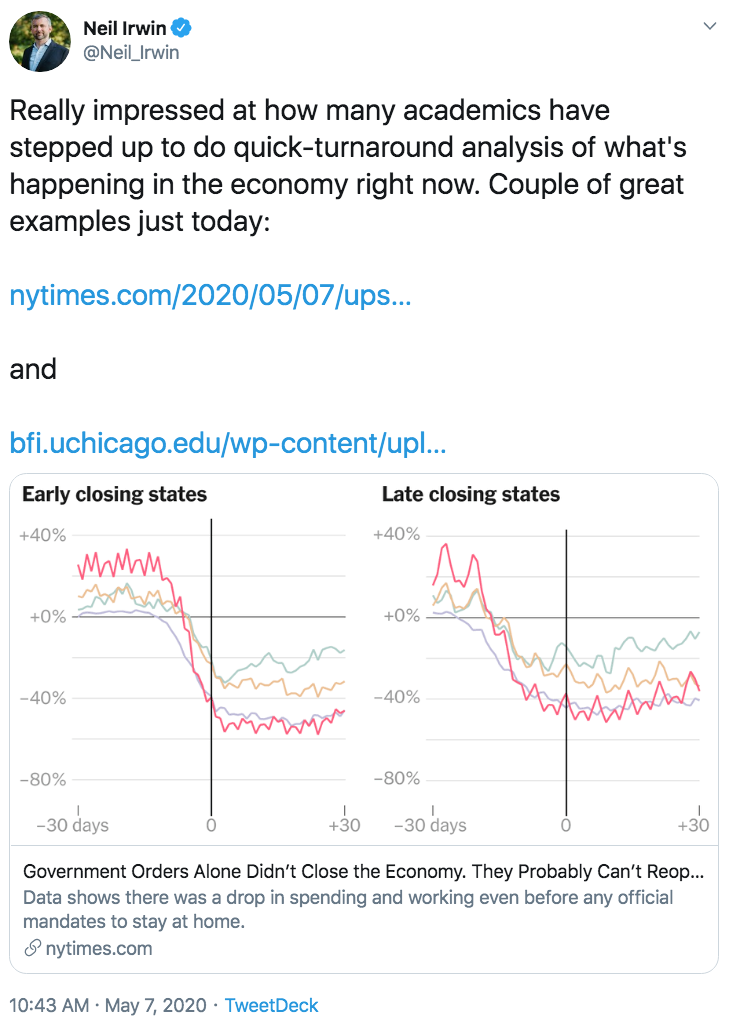
I sometimes read the economic debate on twitter but have no desire to jump in. My view of interest rates and QE is so radically different from the rest of the profession that I would hardly even know how to converse with my colleagues. Twitter is done in quick sound bits, but I need longwinded blog posts to even begin to explain where I’m coming from.
To me, twitter is a place where people think fiscal policy works, or (on the right) doesn’t work because nominal shocks don’t matter. Where central banks are frequently “out of ammo”. Where a change in interest rates or a QE program constitute “monetary policy”. Where negative interest rates are viewed as a “monetary policy choice”. Where moral hazard is not taken seriously.
I could try to jump into the debate, but I don’t think I’d even know where to begin. People would think I’ve just arrived from another planet, speaking some language like Klingon.