Archive for the Category Monetary Theory


The Fed proposes, the bond market disposes

Here’s what almost everyone is wrong about.  There’s a debate about whether the Fed should gradually “normalize” interest rates over the next few years.  And indeed the Fed has laid out a plan to raise rates into the 3% to 4% range over the next three years.

Unfortunately, the Fed doesn’t get to decide the path of interest rates.  It looks like they do, but that’s a cognitive illusion. The bond market determines the path of interest rates, reflecting factors such as global credit markets, as well as NGDP growth and the level of NGDP in the US.  If the Fed tried to independently determine the path of interest rates it would lead to hyperinflation or hyperdeflation.

Today was another lesson in humility for the Fed.  Bond yields have been plunging, which is the bond market’s way of saying, “Oh no you don’t, there’s going to be no normalization of interest rates over the next few years.”

Resistance is futile.  The more the Fed resists and tries to force rates sharply higher, the more the economy slows, and the more downward pressure on rates in the bond market.  In the end, the bond market always wins.

The Fed should stop focusing on trying to hit its interest rate targets, and start focusing on hitting its inflation target.  It’s not the Fed’s job to set interest rates. Even better, we should make their job much simpler by switching to NGDPLT.

PS.  The most noteworthy aspect of today’s jobs report is that the wage acceleration that everyone’s expecting again failed to show up.

PPS.  Can someone find me a link to where I can observe fed funds futures prices? Thanks. (I’d guess they are moving in a “Kocherlakota direction.”)

PPPS.  Some die hard opponents of “The Great Stagnation” had held out hope that a fall in U-6 unemployment (the broadest measure) would propel future growth.  Now even that option is mostly gone, as it plunged to 10.0% in September, the same level as in February 1996.)  It will go a bit lower, but it no longer represents a large cache of workers waiting in the wings to propel us forward.  Get ready for the new normal—3.0% NGDP growth—it’s coming soon.

Nominal shocks have real effects

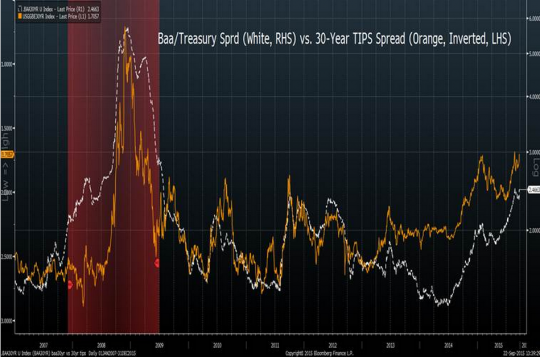
Michael Darda sent me a graph that provides another good example of how nominal shocks have real effects.  The graph compares the spread between Baa bond yields and T-bond yields (white line) with an inverted measure of 30 years TIPS spreads (orange line).  The TIPS spreads are inverted because the BAA/Treasury spread is a countercyclical variable, whereas TIPS spreads are procyclical:

Screen Shot 2015-09-23 at 10.52.52 AM

I really love this graph, because it shows an underlying relationship that many people over look.  Always focus on the deep forces driving the macroeconomy, not the symptoms of those deep forces.

So here’s what’s going on.  Tight money leads to lower expected future NGDP growth.  I don’t think that can be disputed.  And I’d also claim that slower expected NGDP growth usually leads to lower TIPS spreads.  In addition, slower nominal GDP growth usually leads to increased fears of debt defaults.  Recall that NGDP represents total gross nominal income, the total resources that people, businesses and governments have available to repay nominal debts.  Squeeze that amount and defaults increase.

When NGDP grows more slowly, TIPS spreads fall and debt defaults increase.  That is even true in an economy where wages and prices are flexible, but debt is denominated in nominal terms.  But it’s even worse in the actual economy we live in, where wages are sticky.  In that case slower NGDP growth also leads to lower RGDP growth, which puts even more pressure on borrowers, leading to even more defaults.  Hence the Baa/Treasury spread widens.  And note that the Baa/Treasury spread is a real variable. Hence nominal shocks have real effects.

Of course the correlation is not perfect because TIPS spreads aren’t really the variable we care about, it’s NGDP expectations that really matter.  Notice the gap in the first half of the recession (roughly the first half of 2008.)  That was a period where inflation diverged sharply from NGDP growth.  Money was tighter than the inflation numbers suggested.

Asking too much of a central bank

Here’s an article discussing Bill Gross’s views on monetary policy:

Bond guru Bill Gross, who has long called for the Federal Reserve to raise interest rates, urged the U.S. central bank on Wednesday to “get off zero and get off quick” as zero-bound levels are harming the real economy and destroying insurance company balance sheets and pension funds.

In his October Investment Outlook report, Gross wrote that the Fed, which did not raise its benchmark interest rates at last week’s high-profile policy meeting, should acknowledge the destructive nature of zero percent interest rates over the intermediate and longer term.

“Zero destroys existing business models such as life insurance company balance sheets and pension funds, which in turn are expected to use the proceeds to pay benefits for an aging boomer society,” Gross said. “These assumed liabilities were based on the assumption that a balanced portfolio of stocks and bonds would return 7-8 percent over the long term.”

But with corporate bonds now at 2-3 percent, Gross said it was obvious that to pay for future health, retirement and insurance related benefits, stocks must appreciate by 10 percent a year to meet the targeted assumption. “That, of course, is a stretch of some accountant’s or actuary’s imagination,” he said.

Not only are Bill Gross’s views wrong, they aren’t even defensible.  Let’s look at several perspectives:

1.  Money is neutral.  In that case the Fed can only impact nominal returns.  If it wants higher nominal returns then it needs to adopt a more expansionary monetary policy. That’s the opposite of what Gross is proposing.

2.  Money is non-neutral.  In that case the Fed can raise nominal returns on debt with a tight money policy, but only in the short run.  And Gross says the problem is that long-term returns are too low.  However to raise them you need to raise NGDP growth, which means easier money.  Even worse, a contractionary monetary policy that raises the return on T-bills will reduce the return on stocks.

Why is there so much confusion on this point?  Perhaps because people forget that most central bank decisions are endogenous, on any given day or week the Fed usually follows the market.  Here’s a perfect example of why people get confused, look at the first paragraph of a recent Reuters article:

Euro zone government bond yields dropped by more than 10 basis points on Friday after the U.S. Federal Reserve prolonged the era of nearly-free money amid concerns about a weak world economy.

Most readers probably think there is a connection between these two events.  And there may be one.  But it’s not the connection you might assume at first glance. It’s obviously not that case that the Fed deciding to keep rates steady on Wednesday caused eurozone bond yields to fall on Friday.  That makes no sense. Instead both the Fed and the bond market are reacting to the same facts—a weakening global economy.  People see short and long-term rates rise and fall at about the same time, and draw the erroneous conclusion that Fed policy is causing those changes.

The Fed can’t magically produce strong long run real returns on investment for insurance companies, especially with tight money.  That’s far beyond their powers, according to all models I’m aware of (monetarist, Keynesian, Austrian, etc.)  If Bill Gross has a new model, I’d love to see it.  In the 21st century, insurance companies will have to learn to live with lower returns.  They may have to raise the price of insurance. If they lose business, then . . . well, tough luck!

Off topic, Tyler Cowen recently noted that China’s September PMI fell to 47, and then asked:

How quickly do services have to be expanding for the entire Chinese economy to be growing at anything close to six percent?

Since I’m on record predicting 6% RGDP growth, I’ll address this question.  First we need to determine how fast industrial production is growing.  Here’s a graph of the growth rate of IP since 1990:
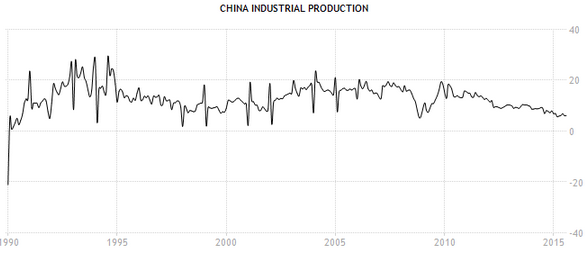
Screen Shot 2015-09-23 at 11.12.40 AMOther than the post-Tiananmen crash, China’s industrial production has maintained a strong upward trend.  However there are three notable slowdowns.  The slowdown in the late 1990s was caused by China’s currency being overvalued due to its peg to an appreciating dollar, at the same time the emerging markets were struggling and devaluing, and at the same time the US and Europe were growing. Sound familiar? And notice that the gradually slowdown since 2012 looks a lot like the late 1990s.  And then there was a sharp but brief slowdown during the global recession of 2008-09.

The most recent figures show 6.1% growth (YOY) in August, and September may show further deterioration.  After than I expect Chinese IP growth to begin recovering, although the YOY figures may worsen for some time.

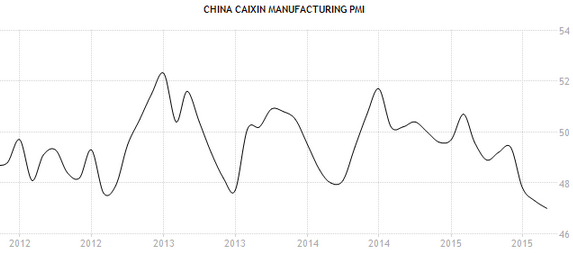
So to answer Tyler’s question, if industry is growing at 6%, then services would also need to be growing at roughly 6%, in order to produce 6% GDP growth.  Is it plausible that China’s industrial production could be growing at 6% with such horrible manufacturing PMIs?  See for yourself, here’s the PMI index as far back as I could find:
Screen Shot 2015-09-23 at 11.20.34 AM

The recent numbers are a bit worse than usual, but as you can see the PMI often dipped to 48, with no obvious ill effects on the China boom.  I believe that this time China is slowing a bit more than usual, which explains my bearish forecast of 6% growth in 2016, vs. the consensus of 6.7% by China experts.  So like Tyler I’m currently bearish on the Chinese economy, just not as bearish.  My bearishness comes from the fact that I believe China experts are underestimating the impact of the strong dollar, which is making China’s currency overvalued.

I’m also more bearish than the Fed on the US economy, for much the same reason.

Williamson on NeoFisherism (define “loosening”)

Stephen Williamson has a new post that interprets recent monetary history from a NeoFisherian perspective.  It concludes as follows:

What are we to conclude? Central banks are not forced to adopt ZIRP, or NIRP (negative interest rate policy). ZIRP and NIRP are choices. And, after 20 years of Japanese experience with ZIRP, and/or familiarity with standard monetary models, we should not be surprised when ZIRP produces low inflation. We should also not be surprised that NIRP produces even lower inflation. Further, experience with QE should make us question whether large scale asset purchases, given ZIRP or NIRP, will produce higher inflation. The world’s central bankers may eventually try all other possible options and be left with only two: (i) Embrace ZIRP, but recognize that this means a decrease in the inflation target – zero might be about right; (ii) Come to terms with the possibility that the Phillips curve will never re-assert itself, and there is no way to achieve a 2% inflation target other than having a nominal interest rate target well above zero, on average. To get there from here may require “tightening” in the face of low inflation.

I partly agree, but disagree on some pretty important specifics.  I thought it might be instructive to start out by rewriting this paragraph to express my own view, with as few changes as possible (in bold):

What are we to conclude? Central banks are not forced to adopt ZIRP, or NIRP (negative interest rate policy). ZIRP and NIRP are choices. And, after 20 years of Japanese experience with ZIRP, and/or familiarity with standard monetary models, we should not be surprised when ZIRP results from low inflation. We should also not be surprised that NIRP results from even lower inflation. Further, experience with QE and inflation forecasts embedded in TIPS should not make us question whether large scale asset purchases, given ZIRP or NIRP, will produce higher inflation. The world’s central bankers may eventually try all other possible options and be left with only two: (i) Embrace ZIRP, but recognize that this means a decrease in the inflation target – zero might be about right; (ii) Come to terms with the possibility that the Phillips curve will never re-assert itself, and there is no way to achieve a 2% inflation target other than eventually having a nominal interest rate target well above zero, on average. To get there from here may require “loosening” in the face of low inflation.

Why do we reach such differing conclusions?  I think it’s because I have a different understanding of recent empirical data.  For instance, Williamson’s skepticism about monetary stimulus in Japan is partly based on his assumption that the recent sales tax increase raised the Japanese price level by 3%. But there’s never a one for one pass through, as it doesn’t cover major parts of the cost of living, such as rents.  So the Japanese price level (net of taxes) has risen by considerably more than Williamson assumes (albeit still less than 2%/year).  Even more importantly, Japan had persistent deflation prior to Abenomics.  And if Williamson is going to point to special factors such as the sales tax rise, it’s also worth mentioning that his recent data for Japan (and the other countries he considers) is distorted by a large one-time fall in oil prices.  Almost all economic forecasters (and the TIPS markets) expect inflation to soon rise from the near zero levels over the past 12 months.  Abenomics drove the yen from 80 to 120 to the dollar—-is that not inflationary?

In the Swiss case Williamson mentions low rates and asset purchases, but completely misses the elephant in the room, the huge upward revaluation of the franc earlier this year, which was widely condemned by economists (and even by many Swiss).  This policy was unexpected, unneeded and undesirable.  It immediately led forecasters to downgrade their forecasts for Swiss inflation, and those bearish forecasts have turned out to be correct.  I hope that’s not the sort of “tightening” of monetary policy that Williamson believes will lead us to higher inflation rates.

Seriously, I’m confident that Williamson would agree with the conventional view that currency appreciation is deflationary. That should send out warning signals that terms like “loosening” are very tricky.  Before we use those terms, we need to be very clear what we mean.  You can achieve higher interest rates through either loosening (a crawling peg devaluation forex regime) or tightening (open market sale of bonds), it all depends how you do it.  More specifically, it depends on the broader policy context, including changes in expectations of the future path of policy.

I think he also gets the Swedish case backwards.  The Swedish Riksbank tried to raise interest rates in 2011.  Instead of producing the expected NeoFisherian result, it led to what conventional Keynesians and New Keynesians and Market Monetarists would have expected—falling inflation. It led to exactly the type of bad outcome that Lars Svensson predicted. So Svensson was right.  And contrary to Williamson, the Riksbank did not turn around and adopt Svensson’s preferred policy, which is actually the “target the forecast” approach; rather they continued to reject that approach.  They continued to set rates at a high enough level so that their own internal forecasts were of failure. Once a tight money policy drives NGDP growth lower, the Wicksellian equilibrium rate falls and policy actually tightens unless the policy rate falls as fast or faster.  That did not occur in Sweden.

Let me try to end on a positive note.  I have a new post at Econlog that took a position roughly half way between the NeoFisherians and the Keynesians.  Brad DeLong had noted that Friedman often claimed that low rates are a sign that money has been tight. I’d emphasize, “has been.”  Krugman said this was wrong, at least over the time frame contemplated by Friedman.  I disagreed, defending Friedman.  I believe that Keynesians overestimate the importance and durability of the so-called “liquidity effect” and underestimate how quickly the income and Fisher effects kick in.  At the same time, as far as I can see the NeoFisherians either ignore the liquidity effect, or misinterpret what it means.  (My confusion here depends on how literally we are to take the “tightening” claim in the quote above.)

Question for the NeoFisherians:

I often discuss the Fed announcements of January 2001, September 2007 and December 2007.  That’s because all three were big shocks to the market.  In all three cases long-term interest rates immediately reacted exactly as Irving Fisher or Milton Friedman might have expected.  In the first two cases, easier than expected policy made long-term rates (and TIPS spreads) rise.  And in the last case tighter than expected policy made long-term rates (and TIPS spreads) fall.  Please explain.

To me, that’s the Fisher effect.  But here’s the problem, the Fed produced those three results using the conventional manipulation of short-term rates.  Thus in the first two cases the Fed funds rate was cut more than expected, and vice versa in the third case. From a Keynesian perspective this is really confusing—why did long-term rates move in the “wrong way”? From the NeoFisherian perspective this is also really confusing—why did moving short-term rates one way, cause TIPS spreads (and long term rates) to move the other direction?  From a market monetarist perspective this all makes perfect sense.  (It doesn’t always play out this way, but if you look at the really big monetary shocks the liquidity effect is often swamped by the long-term effects.)

HT:  Marcus Nunes

Pop Monetary Economics

Paul Krugman has an excellent post demolishing the following claim by William Cohan, in the NYT:

The case for raising rates is straightforward: Like any commodity, the price of borrowing money “” interest rates “” should be determined by supply and demand, not by manipulation by a market behemoth. Essentially, the clever Q.E. program caused a widespread mispricing of risk, deluding investors into underestimating the risk of various financial assets they were buying.

BTW, Krugman’s post is the one to read (not mine) if you only look at one post on this topic.  He carefully walks through an explanation of what’s wrong with this paragraph, in a way that would be recognizable to any competent monetary economist. But in some ways it’s even worse than Krugman assumes.  Here’s Krugman:

The Fed sets interest rates, whether it wants to or not “” even a supposed hands-off policy has to involve choosing the level of the monetary base somehow, which means that it’s a monetary policy choice.

That’s also my view, but I suppose one could argue that from a different perspective if you set the money supply you are letting markets determine interest rates, whereas if you actually target interest rates, then you are “interfering” in the market.  Not exactly my view, but let’s go with it.  Let’s put the best spin on Mr. Cohan’s essay.

Now here’s the big irony.  For the past seven years the Fed hasn’t been targeting interest rates, they’ve been using base control to influence the economy, increasing the monetary base through QE programs.  They switched from interest rate control before 2008 to monetary base control after.  And now Cohan is calling for the Fed to raise interest rates.  That means he wants the Fed to go back to manipulating interest rates.

So the great irony here is that in the paragraph I quoted from above Cohan says:

Like any commodity, the price of borrowing money “” interest rates “” should be determined by supply and demand, not by manipulation by a market behemoth.

And yet in the essay he’s actually calling for the exact opposite; he wants the market behemoth (the Fed) to start manipulating interest rates, something it hasn’t been doing for the past 7 years.

Unlike quantum mechanics, monetary economics doesn’t seem too hard.  As a result the media produces a non-stop stream of stories on monetary policy that are utter nonsense.  And by “utter nonsense” I don’t mean stories that disagree with my particular market monetarist views (Cohan might be correct that the Fed should raise rates), but rather stories that are simply incoherent, that are completely detached from the field of monetary economics.

We don’t hire plumbers to teach quantum mechanics at MIT.  We don’t put plumbers on the Supreme Court.  But we do put Hawaiian community bankers on the Board of Governors.  It’s not just that our media and Congress and President don’t understand monetary economics, they don’t understand quantum mechanics either.  The real problem is that they don’t even understand that they don’t understand it.  So they have unqualified people write op eds, and sit on the Board of Governors.  People ask me what Trump or Sanders think about monetary policy.  They don’t even know what it is!  What they think doesn’t matter, even if they were to get elected.  Just as it doesn’t matter what their view is on the best trajectory for NASA’s next Saturn bypass.

BWT, I have no problem with Hawaiian community bankers having important policymaker roles at the Fed, but put them on the committee for banking regulation, not monetary policy.

The title of the NYT piece said the Fed needed to “Show Some Spine”.  Over at the Financial Times they want the Fed to “Show Steel.”  (I guess that makes Paul and me wimps.)  Here’s the argument at the FT:

Yet monetary policy cannot confine itself to reacting to the latest inflation data if it is to promote the wider goals of financial stability and sustainable economic growth. An over-reliance on extremely accommodative monetary policy may be one of the reasons why the world has not escaped from the clutches of a financial crisis that began more than eight years ago.

I suppose that’s why the eurozone economy took off after 2011, while the US failed to grow.  The ECB avoided our foolish QE policies, and “showed steel” by raising interest rates twice in the spring of 2011.  If only we had done the same.

Of course I’m being sarcastic, but that points to another problem with the Cohan piece. Rates are not low because of QE (as Cohan implied), indeed Europe didn’t do QE during 2009-13, and that’s why its rates are now lower than in the US, and will probably remain lower.

If this stuff is published in the NYT and FT, just imagine what money analysis is like in the average media outlet, say USA Today or Fox News.

HT:  Tom Brown, Stephen Kirchner