Archive for the Category Monetary Theory


Markets set interest rates

Patrick Sullivan sent me a link to a talk by John Taylor.  Around the 15 minute mark Taylor recounts an amusing conversation he was part of with James Tobin and Paul Volcker, back in 1982:

I remember very well Jim [Tobin] asking Paul “Why don’t you lower interest rates, Paul?”  And Paul Volcker said, “I don’t set interest rates; I set the money supply and the market reacts [with] the interest rate.”

John seemed to say “to” not “with”, but in context I think he meant, “reacts with changes in interest rates.”

I love that quote.  Great to know that central bankers occasionally see the light.

Those who want higher interest rates need to tell me precisely what they want the Fed to do to cause rates to be higher.

PS.  I have a new post at Econlog.  The first of many, many posts to comment on Bernanke’s new memoir.

PPS.  Bob Murphy has a new post criticizing my recent post on real shocks.  He starts off as follows:

Sumner’s whole purpose with this post is to argue that shocks in “real” factors can have huge impacts on welfare. However, they do not correspond to the business cycle. So long as the central bank exercises wise monetary policy, real shocks can be offset and full employment can be maintained. In contrast, we don’t need a real shock to get a recession and rising unemployment; all we need is the central bank to stupidly let NGDP growth fall below trend.

Actually, there are real shocks like a $20 minimum wage that could cause recessions and much higher unemployment.  I was trying to show that as a practical matter the fluctuations in unemployment in the US and Australia are mostly about NGDP shocks. I probably should have been clearer; sometimes I assume there are certain things that “go without saying.”

In the rest of his post Bob belatedly discovers something I have said dozens of times here over the past 5 years, that for commodity exporters like Australia I view total nominal labor compensation as better than NGDP.  I’ve also explained why this compromise is a clear implication of the musical chairs model.  Bob seems to think that somehow undercuts my whole message, but I’m not quite sure why nuance is worse than fanatical devotion to fitting one single model into all conceivable circumstances. I’m a pragmatist, so sue me.

But yes, I should have made that point explicit in the post.

AD curves don’t actually exist

Here’s Nick Rowe:

I got this idea from reading a Matt Rognlie comment on a previous post. (But Matt may or may not agree with what I say here).

A. Suppose the government sells bonds, and finances those bonds by imposing a 10% sales tax on (say) milk.

B. Suppose the government sells transferable milk quotas, and sells just enough milk quotas that milk prices rise 10% above marginal costs.

C. Suppose the government sells transferable local monopoly rights to sell milk, and those local monopoly rights cause milk prices to rise 10% above marginal costs.

A, B, and C are basically [weasel word] all the same.

.  .  .

If you think you understand how fiscal policy works, in a Keynesian or New Keynesian model, you should be able to see the equivalence. Though macroeconomists who believe it is nominal wages rather than nominal prices that are sticky, and think that the AD curve slopes down (e.g. Scott Sumner), will object that increased monopoly power raises P, which moves us the wrong way along the AD curve in a recession.

Because I’m a really shallow person, my brain cells all light up like a police car flashing light whenever I see my name mentioned in another blog.  Hence I need to comment on this.

Nick’s right that I view the AD curve as downward sloping, but I don’t quite like the way Nick phrased this.  It would be more accurate to say I think it’s useful to view AD as a rectangular hyperbola.  But I certainly don’t think Nick is wrong if he prefers something else, say a horizontal line.  I just don’t think it’s as useful.  In my view the AS/AD model is most useful when it tries to separate out nominal shocks (to M*V) and real shocks (which affect the composition of P*Y).

I should add that it’s not quite right to say that I think “nominal wages rather than nominal prices” are sticky.  I do acknowledge that there is substantial price stickiness, but I don’t view it as being very important.

Let me explain my focus on wages with a thought experiment.  Consider the sales tax increase discussed by Nick, and also consider two possible monetary policy targets, NGDP and nominal national income (NNI).  National income is GDP minus depreciation and indirect business taxes.  Thus a sales tax or VAT increase will drive a larger wedge between NGDP and NNI.  In that case, which should the central bank target?  In my view, the level of employment will track NNI/W much more closely than NGDP/W.  If wages are sticky, then a stable growth path for nominal national income will tend to stabilize employment.  If the central bank targets NGDP, then a rise in the VAT will reduce NNI, and with sticky wages this will also reduce employment.  Price stickiness might play a role in this process (by changing the labor share of NNI), but it would be a very minor role.

The preceding suggests that the most useful way of thinking about AD might be as a given level of NNI, not NGDP.  In that case, the vertical axis of the AS/AD diagram is still P, but the horizontal axis is now real national income, not real output. Or call it “real before-tax net output.”

As a practical matter, NGDP and NNI in the US track each other very closely over the business cycle.  Hence there is almost no difference between a monetary policy that targets 12-month forward NGDP growth at 4%, and one that targets 12 month forward expected NNI growth at 4%.  In other countries with national VATs, there may be a significant difference at times.

PS.  Last night I returned from a lot of travel with a bad cold.  I just feel like sleeping.  I do plan to start on Bernanke’s book today, and know that I have lots of catching up to do.  I have a new post at Econlog.

Don’t raise rates in order to be able to cut them later

W. Peden sent me the following from the British Shadow Monetary Policy Committee:

In its latest email poll, the Shadow Monetary Policy Committee (SMPC) voted to raise Bank Rate by 0.25% in October, the second consecutive month it has voted for an increase. The vote came against the backdrop of the US Fed leaving rates on hold, citing China as one reason.

Those voting for a rate hike continue to warn – amongst other things – that in any future economic slowdown, the UK would not have the flexibility to respond by cutting rates if they are not raised soon. One argues that recent data revisions show that there is no negative output gap in the UK, and that is why earnings growth is rising so quickly, a sign that monetary policy is too loose. Those voting for unchanged rates continue to cite little price inflation in the actual data, slow growth in monetary statistics and signs that the economy may be losing momentum.

I don’t know enough about Britain to have an opinion on where they should set rates (although I do have the opinion that they should not target interest rates at all.)  But there is one serious flaw in the quote above.  And before explaining the flaw, let me point out that it is not one of those debatable issues, like whether QE is a good idea, or whether Switzerland should have abandoned the peg.  There’s a basic economic error in this part of the quote:

Those voting for a rate hike continue to warn – amongst other things – that in any future economic slowdown, the UK would not have the flexibility to respond by cutting rates if they are not raised soon.

That’s just wrong.  Monetary stimulus does not come from cutting interest rates; it comes from cutting them relative to the Wicksellian natural rate.  You can raise rates to 1000% if you want, but then cutting them back to 2% doesn’t make policy expansionary.  The problem with raising the target interest rate is that this would reduce the Wicksellian equilibrium rate.

If they are worried about having enough room to stimulate the economy in the next recession, before hitting the zero bound, then they should unquestionably NOT raise interest rates right now.  Raising them would reduce the Wicksellian equilibrium rate, and give the BoE less future room to maneuver. Period. End of story. I see this mistake all the time, and I don’t understand why it keeps being made.

Just to be fair and balanced, the other information in the quote does support a rate increase.  The rapidly rising wage growth is more important than the inflation, money supply, and real GDP data.  So I’m agnostic on the rate question.  But please, don’t raise rates to give yourself room to cut them in the future.

PS.  Don’t believe me?  Check out what the ECB and Riksbank rate increases of 2011 did to their Wicksellian equilibrium interest rates.

PPS.  I’ll be at a conference, and thus comment replies will be slow for a few days.

Garcia-Schmidt and Woodford on Neo-Fisherism

In the 1950s and 1960s, many liberals were anti-anti-communists.  In retrospect that was not a very wise political stance, but it was far better than being a communist. After reading part of Mariana Garcia-Schmidt and Michael Woodford’s new NBER paper on Neo-Fisherism, I’m inclined to call myself an anti-anti-NeoFisherian.

John Cochrane had shown that some New Keynesian models led to NeoFisherian conclusions, i.e. that cutting interest rates leads to lower inflation.  Garcia-Schmidt and Woodford propose an alternative approach, which replaces rational expectations with “reflective expectations”:

We argue that predicting what should happen as a result of a particular policy commitment requires that one model the cognitive process by which one imagines people to arrive at particular expectations taking that information into account. In this paper, we offer a simple example of such an explicit model of reasoning. Under our approach, a perfect foresight equilibrium (or more generally, a rational-expectations equilibrium) can be understood as a limiting case of a more general concept of reflective equilibrium, which limit may be reached under some circumstances if the process of reflection about what forward paths for the economy to expect is carried far enough. Our concept of reflective equilibrium is similar to the “calculation equilibrium” proposed by Evans and Ramey (1992, 1995, 1998): we consider what economic outcomes should be if people optimize on the basis of expectations that they derive from a process of reflection about what they should expect, given both their understanding of how the economy works and (as part of that structural knowledge) their understanding of the central bank’s policy intentions.

Here’s where Garcia-Schmidt and Woodford lose me:

In particular, we show that in our model, a commitment to maintain a low nominal interest rate for a longer period of time “” or to maintain a lower rate, for any fixed length of time “” will typically result (under any given finite degree of reflection) in increased aggregate demand, increasing both output and inflation in the near term, though the exact degree of stimulus that should result depends (considerably) on the assumed degree of reflection. This is true regardless of the length of time for which the interest-rate peg is expected to be maintained, and even in the limit of a perpetual interest-rate peg. Thus consideration of the reflective equilibrium resulting from a finite degree of reflection yields conventional conclusions about the sign of the effects of commitments to lower interest rates in the future, and does so without implying any non-negligible effects of changing the specification of policy only very far in the future.  (emphasis added)

I’m not denying that “the model” produces this result, but how is this any less far-fetched than Neo-Fisherism?  Indeed it seems even worse.  What would you think of a statement by the BOJ that they intended to keep nominal rates at zero forever?  I’d probably have the same reaction as John Cochrane.  Perhaps I’m missing something, these models are way over my head.

Let me propose a solution that is intermediate between the two extremes.  There is no paradox.  Easy money always raises inflation.  But easy money may or may not raise nominal interest rates. Even with complete rational expectations. Consider these two cases:

A.  The BOJ uses pure discretion.  Wages and prices are sticky, and expectations are rational.  The BOJ suddenly reduces the money supply unexpectedly.  Real money balances fall, and as a result short term interest rates rise. Inflation falls. This is all consistent with rational expectations. I don’t know whether it’s consistent with ratex NK models, but if it isn’t then perhaps the models should be revised.

B.  The BOJ commits to a 2% per year depreciation of the yen against the dollar (or 2% more than currently expected). Interest rates rise at all maturities due to the interest parity condition.  They simultaneously do a once and for all currency depreciation large enough to offset the impact of the higher interest rates.  There is no instantaneous change in AD, by assumption, but over time inflation rises by 2% due to PPP.

In both cases the BOJ raised interest rates immediately, and in case A the inflation rate fell and in case B it rose.  One produced a NeoFisherian result and one produced a conventional result.  This is how the world actually works, AFAIK. And we were able to get this result without jettisoning rational expectations.  Also notice that in case A the money supply fell, and in case B it probably rose, and certainly rose in the very long run.

Instead of focusing on ambiguous indicators such as the path of interest rates, we need to come up with a clear, unambiguous real time indicator of the stance of monetary policy.

NGDP futures anyone?

PS.  I would appreciate any help you can offer with the second quoted paragraph.  I should add that Garcia-Schmidt and Woodford are not recommending that central banks make commitments to hold rates low regardless of macro conditions, and later point out that this sort of open-ended policy could lead to wildly unstable results.

HT:  Thomas Powers

Multiplier mischief

Multipliers are ratios. That’s really all they are. There is the money multiplier (M2/MB), the fiscal multiplier (1/MPS) and the velocity of circulation (NGDP/MB, or NGDP/M2). If you assume these ratios are stable, you can derive some very interesting policy results. Of course the ratios are not completely stable, but may be stable enough to be of some value. Sometimes. My own view is that multipliers aren’t particularly useful, but today I’d like to assume the opposite, and show that the implications are not necessarily what you might assume.  (And please, no comments from MMT zombies “explaining” to me that multipliers don’t exist.)

Milton Friedman faced a quandary when trying to explain how bad government policies led to the Great Depression. If he defined the money supply as “the monetary base” (as I prefer), people would have pointed out that the base increased sharply during the Great Depression. Alternatively, he could have adopted the market monetarist practice of defining the stance of monetary policy in terms of changes in NGDP. Thus falling NGDP during 1929-33 was, ipso facto, tight money. His critics would have objected that this begged the question of how could the Fed have prevented NGDP from falling.

So he split the difference, and settled on M2 as both the definition of money, and the indicator of the stance of monetary policy. He suggested that, “What is money?” was essentially an empirical question, not to be determined on theoretical first principles. His statistical analysis led him to conclude that M2 (which unlike the base did fall during the early 1930s) was the preferred definition of money. And also that growth in M2 should be kept stable at roughly 4%/year.

In my view M2 no longer represents a good definition of money, using Friedman’s pragmatic criterion. Look at M2 growth in recent years:
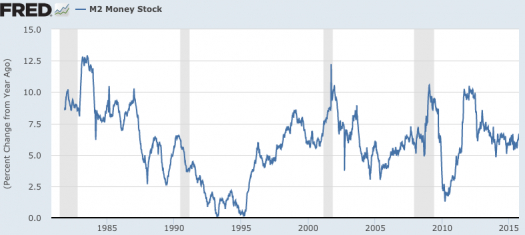
Screen Shot 2015-10-05 at 3.38.24 PMI don’t know about you, but I see almost no correlation with the business cycle. Indeed M2 growth soared in the first half of 2009, making money look “easy”, which is obviously crazy. So if Friedman were alive today, how would he define money? The base still doesn’t work, as reserves also soared in 2008-09. Nor does M2. I don’t have a good answer, but I suspect that coins might be the best definition. Unlike the base and M1, periods of illiquidity probably don’t lead to massive hoarding of coins.  They are primarily useful for making transactions (although a sizable stock is held in piggy banks.)

Unfortunately, I could not find any data for the stock of coins in circulation. (Which is a disgrace, when you think about the 100,000s of data series the St Louis Fred does carry. As I recall, back in the 1990s coins were almost as important a part of the base as bank reserves.) But I did find data on annual coin output. For simplicity, I chose unit output, but value of output (which counts quarters 5 times more than nickels) would almost certainly lead to broadly similar results. In the list below I will show the change in annual coin output, compared to the year before, and also the change in the unemployment rate at mid-year (June) compared to the year before. The unemployment rate change is in absolute terms:

Year  * Coin Output  * delta Un

2000:   +28.1%           -0.3%
2001:    -30.9%          +0.5%
2002:    -25.7%          +1.3%
2003:    -16.5%          +0.5%
2004:    +9.5%          -0.7%
2005:   +16.1%          -0.6%
2006:    +1.4%           -0.3%
2007:    -6.9%             0.0%
2008:    -29.8%        +1.0%
2009:   -65.0%          +3.9%
2010:   +79.6%          -0.1%
2011:    +28.7%         -0.3%
2012:   +13.9%          -0.9%

Unfortunately my data ends at 2012, but that’s a really interesting pattern. Especially given that I don’t have the data I’d actually prefer.  I’d like the change in the size of the coin stock; instead I have the change in the flow of new coins (but not data on old coins withdrawn.)  It’s more like a second derivative.

In any case, it’s an amazing correlation. The signs are opposite in every case except the one where unemployment doesn’t change at all.  Coin output falls during years when unemployment is rising, even years like 2003 when unemployment is rising during a non-recession year.  And even better, the biggest change by far in coin output (proportionally) is in 2009, which also saw the biggest change by far in unemployment.

If you are not good at math then you’ll have to take my word for 2010 being a smaller change in proportional terms.  Indeed if you look at actual coin output in levels, 2010 was the second smallest in the sample, 2011 the third smallest, and 2012 the 4th smallest.  The decline in 2009 was so great that we never really climbed out of the hole.

Now let me emphasize that there’s an element of luck here.  If we had coin data for 2013 and 2014 I doubt the relationship would hold up.  Coin output seems to be in a steep secular decline.  So it’s partly coincidence that the signs are reversed in virtually every case.  But not entirely coincidence.  Perhaps someone could do a regression (using first differences of logs of coin output—so that the 2009 change will be larger than 2010) and confirm my suspicion that this relationship does show something real.  Falling coin output is associated with recessions.

But does it cause recessions?  If only you knew how tricky the term ’cause’ really is!  Krugman basically called Friedman a liar (soon after Friedman died) for claiming that tight money caused the Great Depression, whereas in Krugman’s view Friedman’s data pointed to the real problem being a non-activist Fed—they didn’t do enough to prevent M2 from falling. But they didn’t cause it to fall with concrete steppes.  The base didn’t fall.

I’ve always believed we should think of “causation” in terms of policy counterfactuals.  Suppose the Fed had acted in such a way that M2 didn’t fall.  And suppose that in that case there would have been no Great Depression.  Then if the Fed was capable of preventing M2 from falling (which is itself a highly debatable claim) then there is a sense in which Friedman was right, the Fed did cause the Great Depression.  Again, that’s if they could have prevented M2 from falling, and if stable M2 would have prevented a depression–both debatable (but plausible) claims.

My claim is that if we use Friedman’s pragmatic criterion for defining money, then coins might possibly be the best definition of money for the 21st century.  If the Fed had acted in such a way that coin output was stable in 2007-09, or at worst declined along its long run downward trend, then there would have been no Great Recession.  So in that sense the fall in coin output “caused” the Great Recession. But I could also find a 1000 other “causes,” such as plunging auto sales.

Can the Fed control the coin stock?  I’d say they could in exactly the same way they can control M2 (or nominal auto sales), via a multiplier.  The baseline assumption is that both the coin stock and M2 move in proportion to the base.  That would be the case if the M2 and coin multipliers were stable.  If the multipliers change, then the Fed simply adjusts the base to offset the effect of any change in the coin multiplier.

No let me quickly emphasize that I view the preceding as an extremely unhelpful way of thinking about monetary policy and the Great Recession.  I still prefer to define money as the base, as the base is directly controlled by the Fed.  And I prefer to define the stance of monetary policy as NGDP growth expectations.  And I prefer to think of tight money as setting the monetary base at a level where NGDP growth expectations fall below target, as in 2008-09.  I’d just as soon leave coins to children with piggy banks and nerdy collectors.  But if you insist on defining money using Friedman’s pragmatic criterion, then coins are my definition of the money stock.

A penny for your thoughts?

PS.  I have a new post on the Phillips Curve at Econlog.