Archive for the Category Exchange Rates


An American whine

Paul Krugman recently did a post mocking those Europeans who complain about the Fed actually trying to do its job.  He quoted a European policymaker whining that monetary stimulus in the US would depreciate the dollar and thus hurt Europe.  Here’s Krugman’s response:

In other words, how dare you act to protect your economy from deflation and double-digit unemployment? By doing so, you make our inappropriate tight-money policy even more destructive!

I love it.  But at the same time it’s important to recall Bryan Caplan’s admonition that we Americans are much too quick to perceive harm inflicted by others, and reluctant to recognize when we are the villains.  So I tried to re-work the quotation, so that we could see how our complaints might appear to someone living in China:

In other words, how dare you Chinese act to protect your economy from deflation and double-digit unemployment by refusing to revalue the yuan? By doing so, you make our inappropriate tight-money policy even more destructive!

I look forward to future Krugman posts that point out how America’s China-bashers overlook the fact that the Federal Reserve System has the power to do much more, but simply refuses to use that power.  And how do I know this?  By reading a Paul Krugman post written just one day earlier.

Two visions of macro

There seem to be two approaches to macro policy, once interest rates hit the zero bound:

1.  The pessimistic view:  In this view, monetary policy can do no more.  Trade balances become a zero sum game.  The US gains from some (not all) contractionary policies adopted by other countries, such as currency revaluation.  If China sharply revalues its currency, it may cost millions of jobs in China, and hurt countries that export materials and machines to China, but it will boost jobs here.  It might not be accurate to claim this is a zero sum game view of the world, but it comes pretty close.  (By the way, I used the term ‘sharply revalue’, as I think a gradual revaluation is in China’s own interest.)

2.  The optimistic view:  Even at the zero bound monetary policy is still the most important factor driving NGDP growth.  It’s not a zero sum game.  A sharp Chinese revaluation might reduce world AD.  A dramatic easing by the Fed would not just depreciate the dollar against goods and services, it would sharply raise world AD, and world RGDP if there is slack in labor markets.  This could easily help overseas firms, even in countries whose currencies might rise a bit against the dollar.  In this view, you don’t look for jobs by trying to take them away from other countries, even countries that might be “misbehaving” according to some sort of arbitrary “rules of the game” that never did and never will exist, but rather you try to generate jobs in your own country by boosting your own AD.

Check out this recent news story—I could have found 100 similar ones over the last month (in case anyone thinks I’m cherry-picking.)

LONDON (AP) — World markets mostly rose Thursday as investors remained buoyed by the prospect of more monetary stimulus from the Federal Reserve. However, predictions of looser U.S. policy have not done the dollar any good as it slid to a 15-year low against the yen and multi-month troughs against the euro and the pound.

.   .   .

Once again the main focus in the markets is on what the Fed is planning to do at its next rate-setting meeting in early November to shore up the U.S. economy and prevent prices from falling. The minutes to the last meeting of the Federal Open Market Committee gave a big hint that the Fed is planning another monetary stimulus, that could involve the setting of an inflation target.

All eyes will be on Fed chairman Ben Bernanke Friday when he delivers a speech on monetary policy, more or less at the same time as monthly inflation figures are set to show price pressures in the U.S. economy remain subdued.

Analysts said it’s no longer a question of if but how and how much money the Fed will pump into the U.S. economy.

Stocks have been buoyant for over a week as investors have priced in the growing likelihood that the Fed would join the Bank of Japan in easing monetary policy further in an attempt to further drive down rates on mortgages, corporate loans and other debt in the ultimate hope of boosting economic activity and supporting prices.

For those who don’t follow world equity markets, the strong stock market rally since September 1 that most are attributing in large part to growing expectations of Fed easing, has been mirrored in the major overseas markets.  Yet a “beggar-thy-neighbor” view of economics would predict that foreign firms should be hurt if the US depreciates the dollar.

After my most recent defense of the EMH, some commenters asked me incredulously whether I really thought investors understood complex economic models as well as the model builders, who are some of the smartest people around.  You misunderstood my argument.  I’m not saying markets are as smart as elite macroeconomists, I’m saying they are much smarter.  Individual investors are often dumb as door knobs, but collectively they understand how the world works even better than some Nobel Prize-winning economists.

That’s why 1000 people can look at a jar of jelly beans and individually not have a clue as to how many there are.  But collectively they know the right answer.  It’s all about the wisdom of crowds.

PS.  Commenters;  I hope to catch up on comments this weekend.

World stocks rise on yen devaluation

Here’s something for fans of the Keynes/Krugman “beggar-thy-neighbor” model to think about:

NEW YORK (AP) — U.S. stock futures and forex signals are rising, following world markets higher after the central bank of Japan moved to weaken the yen.

Japanese stocks jumped 1.5 percent after the Bank of Japan moved to push the yen down, a move that will help big Japanese exporters like Toyota.

Japan’s central bank cut its key interest rate to virtually zero and is looking to buy government bonds in an effort to boost the faltering Japanese economy.

The most important concept in economics:  It’s not a zero-sum game.

One way or another (a tale of two presidents)

Here’s what FDR told the country in October 1933, when the recovery was faltering under the higher business costs imposed by the National Industrial Recovery Act (perhaps the most misnamed act in US history.)

“although the prices of many products of the farm have gone up . . . I am not satisfied . . . If we cannot do this [reflation] one way we will do it another.  Do it, we will. . . . Therefore the United States must firmly take in its own hands the control of the gold value of the dollar . . . I am authorizing the Reconstruction Finance Corporation [RFC] to buy gold newly mined in the United States at prices to be determined from time to time after consultation with the Secretary of the Treasury and the President.”  (NYT, Oct. 23, 1933, p. 3.)

FDR doesn’t blame foreigners; he realized we needed to put our own house in order, make our own monetary policy much more expansionary with an explicit price level target, and reduce the value of our own dollar.

And here is President Obama:

UNITED NATIONS “” President Obama increased pressure on China to immediately revalue its currency on Thursday, devoting most of a two-hour meeting with China’s prime minister to the issue and sending the message, according to one of his top aides, that if “the Chinese don’t take actions, we have other means of protecting U.S. interests.”

No call on the Fed to adopt a higher price level target.  Instead, we are blaming foreigners for our weak aggregate demand.  Of course the “other means” refers to protectionism, which FDR understood was not the answer.  And what does he mean by “protecting US interests?”  Not yours or mine, but rather car parts makers in the rust belt threatened with Chinese competition.  I suspect it’s too late; five weeks from now the rust belt will vote Republican, repudiating a modern technocratic Democratic party that has lost touch with its working class constituents.

Where’s our modern William Jennings Bryan?

My friends, we declare that this nation is able to legislate for its own people on every question, without waiting for the aid or consent of any other nation on earth; and upon that issue we expect to carry every state in the Union. I shall not slander the inhabitants of the fair state of Massachusetts nor the inhabitants of the state of New York by saying that, when they are confronted with the proposition, they will declare that this nation is not able to attend to its own business. It is the issue of 1776 over again. Our ancestors, when but three millions in number, had the courage to declare their political independence of every other nation; shall we, their descendants, when we have grown to seventy millions, declare that we are less independent than our forefathers?

No, my friends, that will never be the verdict of our people. Therefore, we care not upon what lines the battle is fought. If they say bi-metalism is good, but that we cannot have it until other nations help us, we reply that, instead of having a gold standard because England has, we will restore bi-metalism, and then let England have bi-metalism because the United States has it. If they dare to come out in the open field and defend the gold standard as a good thing, we will fight them to the uttermost. Having behind us the producing masses of this nation and the world, supported by the commercial interests, the laboring interests and the toilers everywhere, we will answer their demand for a gold standard by saying to them: “You shall not press down upon the brow of labor this crown of thorns! You shall not crucify mankind upon a cross of gold!”  (italics added)

A triumph of hope over experience

Between 2005 and 2008 the Chinese yuan appreciated by a bit over 20%.  Then when the recession got bad in late 2008, the yuan was (wisely) re-pegged to the dollar.  Now Fred Bergsten calls for another round of yuan appreciation:

C. Fred Bergsten, director of the Peterson Institute for International Economics, a leading research organization here, told House lawmakers on Wednesday that a similar increase over the next two to three years would create about 500,000 jobs. He said it would reduce China’s current account surplus by $350 billion to $500 billion, and the American current account deficit by $50 billion to $120 billion.

The United States should seek to mobilize the European Union and countries like Brazil, Russia and India to press China to realign the renminbi, and should seek W.T.O. authorization to impose restrictions on Chinese imports if it does not do so, Mr. Bergsten said.

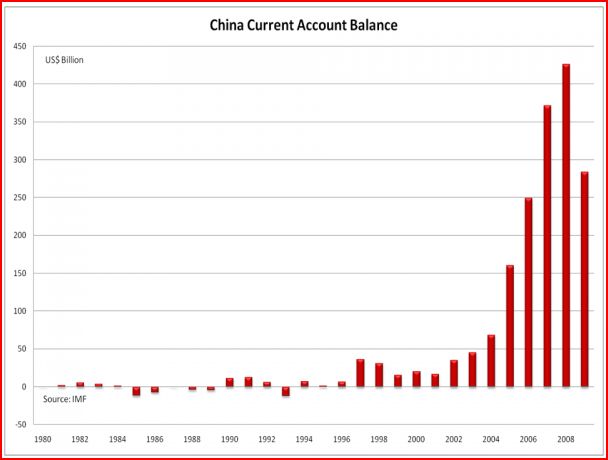
I’m not opposed to modest yuan appreciation, and indeed I think it will gradually occur over the next three years.  But I am opposed to a trade war, which is utter madness in a world struggling to recover from the Great Recession.  Here’s what I don’t understand however.  Between 2004 and 2008 the Chinese CA surplus rose from about $70 billion to about $430 billion.  Why does Bergsten now expect “a similar [yuan] increase over the next two to three years” to reduce the Chinese CA surplus by roughly that amount?

And for those of you expecting a Republican Congress to rescue us from Obama’s foolish statist polices, check out this quotation:

Mr. Grassley added: “The administration should go one step further and bring a case against China’s unfair currency manipulation at the W.T.O.”

In 1985 Paul Krugman (p. 7) argued that the dollar needed to fall sharply in order to prevent chronic CA deficits, which he said would lead to “infeasible” foreign debt levels.  He was right about the dollar, it did fall sharply after 1985.  But we’ve had 25 years of almost nonstop CA deficits, and no sign of a light at the end of the tunnel.  Why?  Because the falling dollar didn’t address the fundamental cause of the CA deficit, a saving/investment imbalance produced by a fiscal regime that is profoundly anti-saving.  You can’t fix that with a band-aid.

Policymakers need to go back and reread Mundell.

PS. Perhaps the term ‘reread’ represented my own triumph of hope over experience.

HT:  Mike Belongia