
Archive for the Category Efficient markets hypothesis


The Chicago coup

I already commented on this Paul Krugman post, but I thought of another angle that seems kind of odd.  See what you guys think.  Krugman was commenting on this statement by Laurence Meyer:

There’s also another tradition that began to build up in the late seventies to early eighties””the real business cycle or neoclassical models. It’s what’s taught in graduate schools. It’s the only kind of paper that can be published in journals. It is called “modern macroeconomics.”

I found this confusing, as it wasn’t clear where Meyer put new Keynesianism, which is surely the dominant macro paradigm in the last 30 years.  Paul Krugman also seemed a bit perplexed, and offered this interpretation:

My first reaction, on reading this, was to say that Meyer overstates the case “” and he does, a bit. It has been possible to publish New Keynesian models in the journals, and these models do, I think, provide some useful guidance “” if only as a consistency check on more ad hoc approaches.

But fundamentally Meyer is right. And it has been going on a long time. By the early 1980s it was already common knowledge among people I hung out with that the only way to get non-crazy macroeconomics published was to wrap sensible assumptions about output and employment in something else, something that involved rational expectations and intertemporal stuff and made the paper respectable. And yes, that was conscious knowledge, which shaped the kinds of papers we wrote.

When I left Wisconsin for Chicago in 1977, some of my professors suggested that it was a rather nutty place.  Most schools were Keynesian in 1977, only Chicago and a few others (Rochester, Minnesota, etc) dissented from this orthodoxy.  Certainly the elite Ivy League universities that dominated the field were not sympathetic to Chicago.

Here’s what I’d like to know.  How was it that just a few years later it was almost impossible to get anything published without assuming rational expectations, efficient markets, etc.  I’d like to offer two hypotheses:

1.  Sometime around 1980 an elite team of Chicago macroeconomists stormed the offices of all the major economics journals with AK-47s, ousting all the editors and replacing them with inferior people who just happened to have studied under Lucas and Fama.  Call it the academic equivalent of the Chilean coup.

2.  The discovery of rational expectations and the efficient market hypothesis at the University of Chicago caused a scientific revolution.  A paradigm shift.  Economists began to realize that the expectations assumed in a model ought to be consistent with the model’s predictions.  That it made no sense to have models that assume the world works one way, and populate it with people who believe the world works in an entirely different way.  And economists also realized that it made no sense to build models that implied it was easy to set up mutual funds that would out-perform an indexed fund, simply by following the implications of a model.  After all, it’s really hard to beat indexed funds, despite the fact that lots of very smart people try hard to do so.

So which view seems more plausible?

I hope I haven’t unfairly stacked the deck by presenting only these two hypotheses.  I’ve tried to present both views in an even-handed way.  Please let me know what you think.  (I don’t doubt that readers will provide a third hypothesis in the comment section.)

HT:  Matt Yglesias

PS,  I recall that Yglesias is highly critical of conservatives who reject the scientific consensus on global warming.  I agree.  But I wonder how he feels about liberals who reject the economic consensus about rational expectations and efficient markets.  Krugman says you can’t get published without assuming ratex—doesn’t that sound a lot like climate science, where it’s almost impossible to get published without assuming global warming?  (And don’t say economics is a soft science where proof is difficult to achieve.  Prediction is also difficult in climate science; and for the same reason—both the economy and the climate are very complex.)
Does modern macro rely too much on Ratex and EMH?

This post was motivated by the following comment in a recent Paul Krugman post:

By the early 1980s it was already common knowledge among people I hung out with that the only way to get non-crazy macroeconomics published was to wrap sensible assumptions about output and employment in something else, something that involved rational expectations and intertemporal stuff and made the paper respectable. And yes, that was conscious knowledge, which shaped the kinds of papers we wrote. So you could do exchange rate models that actually had realistic assumptions about prices and employment, but put the focus on rational expectations in the currency market, so that people really didn’t notice. Or you could model optimal investment choices, with the underlying framework fairly Keynesian, but hidden in the background. And so on.

I can’t quite tell whether Krugman thinks “rational expectations and intertemporal stuff” are counterproductive, so the following isn’t really aimed at Krugman, but rather the many economists who I am quite certain do regret the influence of ratex and the efficient markets hypothesis.

The most important macro event of my lifetime was the precipitous drop in inflation and NGDP growth expectations during the late summer and early fall of 2008.  Because inflation had been running around 5% over the previous year, antique macro models based on adaptive expectations were completely useless during this period.  Indeed, I’m guessing that one of the reasons why the Fed was behind the curve in the fall of 2008 was precisely because their models were far too backward-looking.  During the financial crisis Fed policy got effectively tighter and tighter, and as a result there was a whole lotta “rational expectations and intertemporal stuff” going on.

Here’s what I find so ironic.  Everyone talks about how the profession became obsessed with ratex and the EMH after 1980, but from my perspective most economists still seem stuck in the adaptive expectations era.  If you really believed in ratex and the EMH, wouldn’t you be really, really interested in market forecasts of the policy goal variable?  I would be.  Yet instead of trying to infer market forecasts, they built elaborate structural models to try to forecast the goal variables.  In the 1980s when I tried to peddle my futures targeting approach, no one seemed interested.  I presented papers at the AEA meetings, the NY Fed, the Philly Fed, and everyone just yawned.  So from my perspective we face exactly the opposite problem; the profession doesn’t take ratex and the EMH seriously enough.  If the Fed really believed in ratex and efficient markets, they would have put the pedal to the metal in the infamous September 16, 2008 meeting.  Instead they yawned, and left rates unchanged at 2%.

PS.  Perhaps me and the other futures targeting proponents were just ahead of our time.  One famous macroeconomist endorsed futures targeting just recently.  A sign of things to come?

PPS.  Yes, the Fed did use the EMH as an excuse not to intervene in the housing bubble.  But that’s exactly where it was not appropriate.  The existence of FDIC and TBTF means the EMH provides no justification for not regulating bank risk-taking.

There’s only one way to test the EMH

Before beginning, I like to point out that I have a new essay over at The Economist.

Commenters often present me with market anomalies, which supposedly “prove” the efficient markets hypothesis is wrong.    I always respond that they’re just engaging in data mining.  They retort that no theory that can’t be disproved is worth anything.  But the EMH can be disproved.  The tests have been done, and it passes.  Sort of.

Finance professors have done many different tests of the EMH, and I’d guess 90% of the published tests (but only 5% of the actual tests) show that the EMH is wrong.  (Yes, I’m pulling these numbers out of thin air, but you get the point.)  They’ve found January effects, small stock effects and value stock effects.  They’ve found the market does better when P/E ratios are low.  They found the market does worse on rainy days (a study published in the AER!).  Of course you’d expect to find 5 anomalies for every 100 tests you do, and for the most part you only get published if you find an anomaly, and finance professors have a lot of computer power, so . . .

Here’s my analogy.  Suppose Stephen Wynn was concerned that some mysterious gamblers were getting away with cheating at one of his casinos.  He’d heard rumors, but had no proof, or even suspects.  You are statistician brought in to investigate.  You study 600 slot machines, and find 30 of them produced three cherries more often than you’d expect from mere chance.  You suggest that the anomalous slot machines be destroyed.  How should the casino owner react to that “investigation?”  I’m guessing Wynn wouldn’t be impressed.

I think you see the problem.  The investigator assumed he could figure out how the cheating was occurring.  He assumed that certain individuals had spotted slot machines with predictable tendencies, and that he (the investigator) could also find those machines.  But it’s really hard to walk into a casino and walk out with lots of money.  So how likely is it that an academic statistician is going to know where to look for cheating?  How likely is it that they would know how it’s done?  Not very, and that’s why their statistical search for anomalous machines will almost certainly be fruitless.  Oh, the data mining will unearth a few suspicious machines, no doubt about that, but only the number predicted by chance.

So how would one determine whether people were cheating?  Start by being humble—admit that you probably don’t know how it’s done.  If someone did have a secret formula, they wouldn’t put it in a book called “How to cheat at casinos” for all the world to see.  Any system that works is almost certain to be kept secret.  It’s like alchemy.  If anyone did have a formula to turn lead into gold, they would keep it secret; as the formula’s value would plunge to zero the instant it was released.

To find out whether cheating is occurring you need to look at whether the winnings of gamblers are serially correlated.  Are those who win once, more likely to win next time.  That’s the proper test, indeed the only practical test, of whether people are cheating the casino.  And it’s also the only test of the EMH.  Don’t look for “the system,” the secret way to beat the stock market.  Look for whether other people have found it.  Look to see whether people who did better than average one year, tended to do better than average the next year.  Don’t look for market anomalies—look for evidence that other people have found market anomalies.

Of course the study has been done.  I recall that Fama and French found that mutual returns were approximately serially uncorrelated, but not exactly.  There appears to be a slight serial correlation among the very best funds (top 3%), but not enough to give the average investor any advantage.

And that’s what I would have expected.  The EMH is approximately true; indeed it’s almost impossible for me to imagine any other model of financial markets.  But it’s not precisely true, again, just as you’d expect.  After all, if the EMH were perfectly true then no one would have any incentive to estimate fundamental values.  We know people are imperfect and hence that any real world human institution, including markets, will be at least slightly imperfect.

A smart person like Eugene Fama should have been able to come up with both the EMH, and its limits, by just sitting in a room and thinking.  Much as David Hume got the QTM by imagining what would happen if everyone in England woke up one morning with twice as much gold in their purses.  Or Fisher’s theory of inflation and nominal interest rates.  Or Cassel’s purchasing power parity.  Or Friedman/Phelps’ natural rate hypothesis.  Or Muth and rational expectations.  Certain ideas are simply logical, and that’s why I have no doubt that despite all those economists on the left arguing the EMH has been discredited, it will still be taught in every top econ/finance grad program 100 years from now, whereas fiscal stimulus will be long gone from macro textbooks.

PS.  Why will fiscal stimulus be gone?  Because even Krugman admits it only makes sense at the zero bound.  And we are rushing headlong into a world of all electronic money–probably within 50 years.  There is no zero lower bound with electronic money, and hence the Taylor Rule is all you need.  Old Keynesian economics will vanish, leaving only new Keynesianism.

Bubble predictions: better late than early

Reader comments often inspire new posts, and this is a good example.  In my post on Krugman’s 2005 prediction of a housing bubble, a number of commenters pointed out that Dean Baker made the same call three years earlier, in 2002.  The clear implication was the earlier was better, and that Krugman was late to the game—just copying Baker.  I think that’s wrong.

Just so I am not misunderstood, this post is not a criticism of Dean Baker.  Commenters sent me links to bubble predictions Baker made in 2002 and also 2005.  I am going to argue that the 2002 prediction was neutral, neither particularly good nor bad, and the 2005 prediction was a good one.  All in all a decent record, nothing that deserves criticism.  Rather I’d like to focus on a narrow technical point, and argue his 2005 prediction was actually far superior, even though it came later.

Precisely what does it mean to predict a housing bubble?  Are people predicting that one will occur in the future?  That prices will rise very rapidly?  Or are they predicting that one is already here, that prices are too high relative to market fundamentals?  I think it is usually the latter.  If the term ‘bubble’ is to have any meaning at all (other than the trite observation that prices have recently risen) there must be an implied prediction that in the not too distant future (i.e. not 100 years out) prices will fall back closer to their fundamental value.  I’ve argued this point ad nauseum, and won’t repeat it here.  My hunch is that people confuse these two issues, which is why many people assume it is easier to spot bubbles than it really is.

Here is what Dean Baker said in 2002:

This paper examines whether the increase in home prices can be grounded in fundamental economic factors or whether it is simply a bubble, similar to the stock market bubble. It concludes that there is a housing bubble. While this process can sustain rising prices for a period of time, it must eventually come to an end.

He does acknowledge prices might rise before dropping, which is of course what happened.  But that comment is so vague that I take it as one of those things you almost have to say.  After all, if prices have been rising fast, only a fool would predict an immediate and sharp decline, especially given that housing prices have a bit more momentum that stock prices.  In a nutshell, I infer that he is mostly saying that housing prices have risen above their fundamental value and that at some point the real price of housing should drop to more reasonable levels.

In this paper from late 2005, he and David Rosnick again make a bubble prediction.  This time much more accurately, in my view.

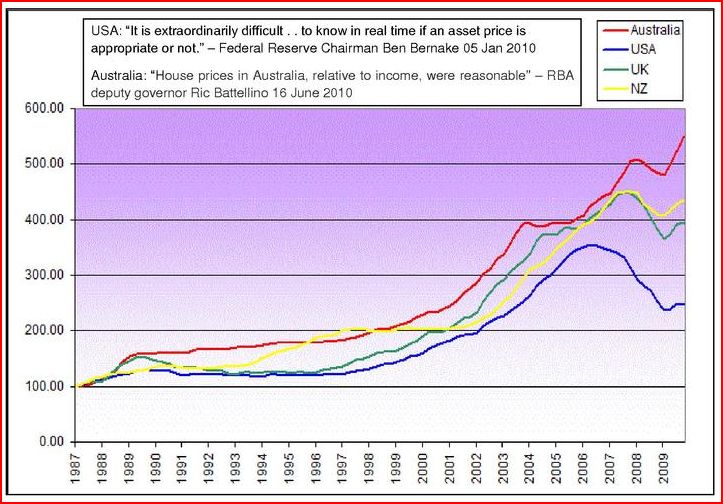
In my Krugman post, I used this graph to think about the accuracy of bubble predictions.  I argued that those seeing a bubble in the US in 2005 were right, but in Britain, New Zealand and especially Australia they were wrong (thus far.)

If you just eyeball the data, to me it looks like these prices occurred in the US:

2002:  200

2005:  300

2006:   350

2010:   250

So it’s fair to say that 2005 bubble predictions turned out to be accurate.  But what about 2002?  Well the actual price seems to have risen about 25% in 8 years.  That’s not too different from the overall inflation rate, and hence I’d say there hasn’t been much change in real housing prices.  So I’d call that a neutral, where lower real prices in 2010 would be a win for Baker, and higher real prices would have been a loss.

I’d like to use an analogy, to suggest why it’s better to be late than early, why Krugman actually deserves credit for being late to the bubble party.  I recall after the 1987 stock market crash that someone praised John K. Galbraith for having predicted a stock crash.  He made the prediction in January 1987, when the Dow was around 1700.  It then rose to 2700 in August, before crashing to 1700 in late October.  So was Galbraith right?   As this post shows, people seem to assume he was.  But I’d say no, as his prediction really didn’t convey useful information:

1.  If you sold stocks on his prediction, you would not have made money—even in the long run.

2.  It was an implied prediction that stocks were overvalued relative to fundamentals.  But today very few people would say the Dow was overvalued in 1987 at 1700, indeed if anything it might have been a bit undervalued.  This shows how hard it is for even a very smart person to know whether something was overvalued in real time.  I could say the same about Boston house prices in 1987, and I’m sure people living in Manhattan, London, Vancouver or San Francisco could provide similar examples of prices that once seemed insane, but now (even in this recession) actually look (in retrospect) like equilibrium prices.

I think a good prediction, a useful prediction, would be someone that predicted a stock market crash in August 1987, not January 1987.  Those are the people who deserve credit if you (unlike me) believe market predictions aren’t just dumb luck.

I can think on one counterargument.  One could argue that an early prediction might have resulted in public policy changes that prevented the worst of the housing bubble.   But I favored those public policy changes even without being able to predict the bubble.  And I’m claiming it’s not obvious there was a bubble in 2002.  I’d hate to have public policy decisions based on inaccurate bubble predictions.

So from now on when someone tells you that Dean Baker predicted the housing bubble back in 2002, the correct response is “You think that’s impressive, well Krugman predicted it in 2005!”  Enjoy the puzzled look in their eyes, and savor the thought that you are soon about to show your superiority by setting them straight.  At least if you’re as big a jerk as I am.

PS.  Take a look at the link discussing Galbraith.  It was from 1994, and they assumed we were in the midst of another speculative bubble—when the Dow was trading in the 3500 to 4000 range.  What do you want to bet that they said “I told you so” in 2003, after the crash brought prices down to 8000?

A few of my mistakes

Other bloggers have recently listed some important mistakes they made.  The trick is to decide on the number.  Pick too few and you will seem too cocky, unable to see your own faults.  But pick too many and people will think you are bragging about how brutally honest you are.  So I’ll pick 10:

1.  In the 1970s I thought we were on the road to serfdom.  I bought the whole Mancur Olson argument that modern democracies gradually became more statist, as they get captured by special interest groups.  (I haven’t read him in a while, so I am probably oversimplifying.)

2.  In the 1970s I thought communism was more of a threat than it turned out to be.  (Ditto for Iraq in 2003.)

3.  In the 1970s I thought monetary policy operated with long and variable lags, and thus fine-tuning would make things worse.

4.  In the 1970s I thought the Nordic economic model was much more seriously flawed than it really is.

5.  I used to think moral and aesthetic beliefs were ‘”mere opinion” and scientific beliefs were “objective facts.”

6.  I used to think I was smarter than other people who are just as intelligent as I am.  Actually I sort of still believe this, but at least now one half of my brain knows how silly the opinion held by the other half of my brain really is.

7.  In 2007 I thought it very unlikely that there would be a severe US banking crisis.

8.  In 2007 I thought the Fed would be able to avoid a Japanese-style zero rate trap.

9.  I predicted that aggressive QE would raise long term interest rates, a view which seemed to be refuted by the response on T-bond yields to the March 2009 Fed QE announcement.

10.  I thought Brett Favre really was going to retire this year, after he said he was going to.  Arguably my most embarrassing error.

I’d like to talk about number 9 for a moment.  Any effective monetary stimulus would be expected to raise long term rates.  We have plenty of examples of that occurring.  My favorite is the surprise stimulus announcement of January 3, 2001, which caused long term (nominal) rates to soar.   Thus I was shocked to see long term rates fall sharply on the day of the March 2009 QE announcement.

I don’t have a good theory for why that happened.  One could point to the fact that they quickly reversed, and soon rose far above the pre-announcement level.  So maybe markets made a mistake and I was right all along.  But that means the EMH is wrong, a theory I hold even more dearly.  So either way I’m screwed.

If I had to guess I’d say it might have something to do with the type of stimulus.  It didn’t so much raise the monetary base (indeed the Fed was correct in denying that it really was QE) rather it changed the composition of their balance sheet.  Even so, other markets (stocks, foreign exchange) reacted as if it was bona fide monetary stimulus.  So I am not really satisfied with that explanation either.

I am reluctant to form a firm opinion based on a single observation, so I will watch market reactions to other QE-type actions, to see if a pattern develops.  If I was forced to critique my own blog, the market response to the Fed’s March 2009 “QE” would be my number one weapon.