Just my luck
Patrick Horan and I produced a new Mercatus policy brief on improving the Fed’s toolkit.
I did a long interview on money with John Papola. (He did that famous rap video of Hayek debating Keynes. And a Mises/Marx video as well.) Unfortunately, my interview is likely to be considerably less entertaining. But if you’re stuck at home . . .
Last year I thought that whatever happened would be good for market monetarism. If NGDP growth slowed and we had a recession, we could say “We told you not to let NGDP growth fall.” If it kept going at 4%/year then we could say “We told you that stable NGDP growth would prevent recessions.”
Instead we have a very unusual real shock recession, where monetary policy is not the cause. Even worse, my new book on market monetarism will probably come out at the worst possible time—when everyone’s focused on a crisis that MM doesn’t help us to understand. Just my luck.
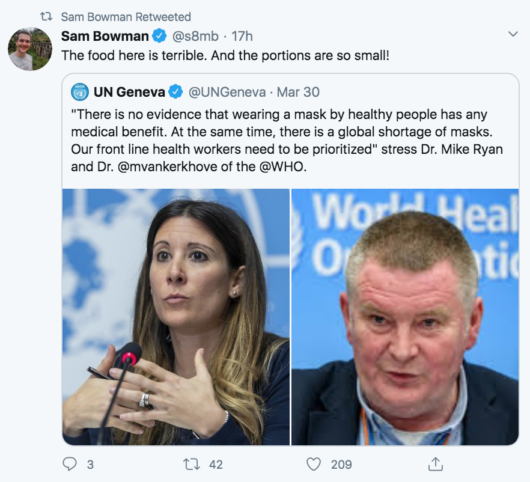
Not to beat a dead horse, but did you see this:
When the coronavirus outbreak first hit in the U.S., public health officials urged most people to forego wearing a face mask. Not anymore: Experts are calling for masks or other facial covering in public as confirmed cases in the U.S. increase.
“I do think we need to have facial coverings for folks, so everyone has to wear one and we are protecting others from us,” Dr. Dena Grayson, an infectious disease specialist, told Yahoo Finance (video above). . . .
Jospeh Allen, the director of the Healthy Buildings Program at Harvard University’s T.H. Chan School of Public Health, wrote a Washington Post op-ed arguing for Americans to wear masks.
“The debate is over,” Allen wrote. “You should be wearing a mask when you go out.”
He added that doing so would “prevent the user from infecting others by acting as a physical barrier that will block large droplets from coughs and sneezes… protect you from others around you who might be sick… serve as a reminder not to touch your face… [and serve] as a vital social cue. You are sending a signal to others that there is a real threat out there.”
Given the mask shortage, Allen suggested that people make their own. . . .
Desai noted that the U.S. is likely going to start seeing government support for everyone wearing masks, due to the number of asymptomatic individuals.
“By wearing a mask, what it really comes down to is: Does that help prevent you from touching your face?” he said. “And I think overall, the answer’s gonna be Yes. Generally speaking, when you have a mask on your face, it prevents you from touching your face.”
Wait, aren’t those the points I was making when the experts were arguing against average people wearing masks?
My current view is this:
Right now we need social distancing. But in a month or two we need to start thinking about getting people back to work with strong personal protection for employees and widespread testing to figure out who is infected and who is not. Over at Econlog, I suggest we may reboot the economy too slowly.