Archive for November 2020


Betting markets >>>>>>> polls

I don’t know the outcome of the election, but several points are already clear:

1. Betting markets like emoneyindeed are more reliable than polls. The 538 poll average ended at about 8.5% for Biden. I believe they made some adjustments that brought it down to 7.8%. But this is obviously going to be a very close election—similar to 2016—and Trump might well win.

The betting markets understood it was close, albeit favoring Biden. If Biden were to win based on a 1% or 2% lead in Pennsylvania, that would be right about what the betting markets thought was the median outcome. When looking to make profits for actually betting some money, here are some popular bingo offers you should check.

2. A very close loss for Trump would set-up a rematch in 2024. He might be the first president since Cleveland to have two terms separated by the opposition party. The ones that want to gamble, they can go on https://www.slotsformoney.com/casinos/us/texas/ to find better and more interesting ways.

3. I feel good about my wishy-washy election forecast post. In September, I had forecast a Trump win but then later backed off when he had a horrible month. But some of the specific points seem accurate:

In addition, the polls in the US and UK have pretty consistently understated the support for unfashionable right wing populists. I noticed this with Brexit in 2016, but foolishly ignored this in my 2016 US forecast. Just as with Brexit, Trump did a couple points better in the popular vote than in the polls. This pattern repeated recently with Boris Johnson’s landslide win, and I expect a similar pattern here in November. Thus Biden needs to lead in the polls by about 5% on election day in order to win the popular vote by 3%. And that’s not even accounting for the high rate of invalid mail-in ballots, which some feel will hurt the Dems this year.

Commenters told me that polls had been fixed to account for less educated white males. I doubt it.

I also feel very good about my claim that if Biden’s lead in the polls had been less than 5% then he’d lose. Indeed 5% was too low—he might lose with an 8% national lead!

4. People should have paid more attention to news stories of Hispanic and black male voters shifting somewhat toward Trump. And also polls that said most people thought Trump would win.

Again, I don’t yet know the final outcome, but whoever wins it’s a real black eye for polling. And a win for betting markets. This is a very close election. To learn betting online, get help from www.sickodds.com who are the best in online betting business.

Update: New Jersey legalized pot! New York and Pennsylvania will likely be forced to follow suit, or else they’ll lose tax revenue to NJ.

Update#2: Arizona also legalized pot. Oregon decriminalized small amounts of hard drugs. DC decriminalized magic mushrooms.

Update#3: South Dakota legalized pot.

Overall, a very good night for ending the war on drugs.

Post-election thoughts

I wanted to post my reaction to the election outcome early, so that I’d be the first pundit out of the gate with a reaction. Please wait until the winner is announced, then immediately read the appropriate part of this post and discard the rest:

If Trump wins:

No matter how many times Nate Silver (correctly) says that 10% events happen more often than you assume; a Trump win would be a catastrophe for the polling industry and the web sites that rely on it (like 538). The problem here is that it already happened in 2016, and measures were taken to prevent a repeat. If the polls are now much further off in missing the Trump vote than in 2016, that’s a huge problem for polling.

Not much more to say. Obviously Trump will become much more Trumpian now that he doesn’t need to worry about public opinion. More corrupt, more racist, more lazy, more authoritarian, more immature. I was far too easy on him during the first term, commenting on only 10% of his outrages. As a result, many commenters here were simply unaware of the awfulness of Trump. Never again! Over the next four years I’ll dramatically ramp up the Trump criticism.

In other words, the Trump beatings will continue until the morals of my commenters improve.

If Biden wins (lots more to say here):

1. No sugar-plums. Progressives will have sugar-plums dancing in their heads, as they anticipate a Biden administration finally delivering a liberal utopia. Not me—I live in California and thus know how Dems govern when given extensive power. I have some hope for modest improvements in a few areas like immigration, Cuba/Iran sanctions, federal pot enforcement, etc. And I won’t blame the Dems for higher taxes, as the GOP always spends money like a drunken sailor and then lets the next Democratic administration pick up the tab. But overall I expect a bad set of economic policies.

2. The bursting bubble. Over the next few weeks there will be a torrent of stories about how Trump is one of the worst politicians in the history of the world. These stories have been held in check thus far by the nagging thought that Trump did win in 2016, and maybe those claiming he is a “master manipulator” might be on to something. If Trump loses, all the idiotic things he did in the campaign will be clearly exposed as being – – – well, idiotic.

3. The second Bush was a lousy president, but unlike Trump he was re-elected. That’s partly because after 9/11 he pretended to be a strong leader. He took a strong (and often misguided) stance against terrorism. Trump never even tried to look like he cared about the biggest crisis since 2008. Why? That will always remain a mystery. You don’t get re-elected by producing good results (1933-36 and 2001-04 were bad years) you get re-elected by playing a decisive leader.

4. Trump never tried to enact popular measures that he seems to have supported. Prior to being elected, he often spoke positively about popular causes such as infrastructure, higher minimum wages, leaving pot laws up to the states, etc. Matt Yglesias points out that he seemed too lazy to take up these causes as president, and just farmed policy out to mainstream GOP operatives who focused on stuff like corporate tax cuts.

5. No FDR/Reagan/Thatcher. Successful politicians change the opposition, making them accept their policy innovations. Not Trump. The corporate tax rate will soon go up to 28%, exactly where I predicted 4 years ago that Hillary would have placed it. Much of the “deregulation” (always greatly overrated) will be swept away. Perhaps the only enduring change will be a tougher line on China. But that came from a change of mood in our foreign policy establishment; Trump actually likes that fact that Xi put a million Muslims into concentration camps (as long as China bought a few bushels of soybeans from us.)

The almost unique awfulness of Trump will make it hard to continue his policies, even when Biden might otherwise be inclined to do so. Think of the criticism Biden would get from his own party if he continues Trump’s mean-spirited policy toward refugees. Or the Muslim ban. No one will want to be accused of “Trumpism”. Even protectionist trade policies are now tainted. NIMBYism has been exposed as a part of “structural racism.”

6. Are we facing a bad interregnum, as during 1932-33? Perhaps, especially if Trump becomes bitter and blames the American people, much as Hitler blamed the Germans for letting him down. (Oops, I’m not allowed to compare Trump to Hitler.) Perhaps the only constitutional amendment with a prayer of passing is to have presidents take office in early January with the new Congress, or better yet right after the Electoral College votes in mid-December. It’s hard to see how either party would object, at least if the interregnum ends up being a mess.

7. A leaderless GOP. Either Trump continues to be the leader of the GOP or the party will have no leader. Trump has completely emasculated the party. (OK, not Romney, but he’ll be toxic to the Trumpistas.) Read the story of how Trump publicly humiliated McSally in Arizona. Pence may be the favorite for 2024, but he’s obviously no leader.

8. Trump should be investigated and put behind bars if found guilty. It won’t happen because this is America, where the powerful are above the law.

9. The Roe v. Wade bubble may soon burst, and the public will discover that the contours of this issue are not at all what they imagined. Most interesting will be the reaction in purple states. In those states where the legislature goes back and forth between the two parties, a stable equilibrium will have to be found. The public will not accept abortion flipping between legal and illegal every 5 or 10 years. One party will be forced to accept defeat in the purple states. Which one loses will help us to better understand the actual politics of the issue.

If the Supreme Court doesn’t overrule Roe v. Wade, then the GOP will finally have to give up on the notion that appointing conservative judges will solve the “problem”.

10. We’re still becoming a banana republic! Time to turn all our guns around and begin relentlessly attacking the Woke People, just as the US military switched to fighting Japan after defeating . . . oops, I can’t keep making that comparison.


The past 12 weeks

North Dakota has 762,000 people. Vermont has 624,000 people.

I know what you all are wondering—how many people have died of Covid in each state over the past 12 weeks?

North Dakota: 427
Vermont: Zero

North Dakota now has more Covid deaths per capita than Italy. Their biggest city is Fargo (pop. 124,000). Perhaps there’s overcrowding in the Fargo subway system.

Someone needs to investigate:

My thoughts on monetary policy

Each spring, the Hoover Institute has a conference on monetary policy.
Over at Econlog, I recently published a book review of the 2019 conference volume.

Recommended if you are looking for a change of pace from the usual political nonsense on this blog. It’s definitely higher quality than what I post here. (I wrote it several months ago, so I don’t have any discussion of the recent adoption of average inflation targeting.)

I also recommend my new Econlog post on how we should teach monetary policy.

That was some election!

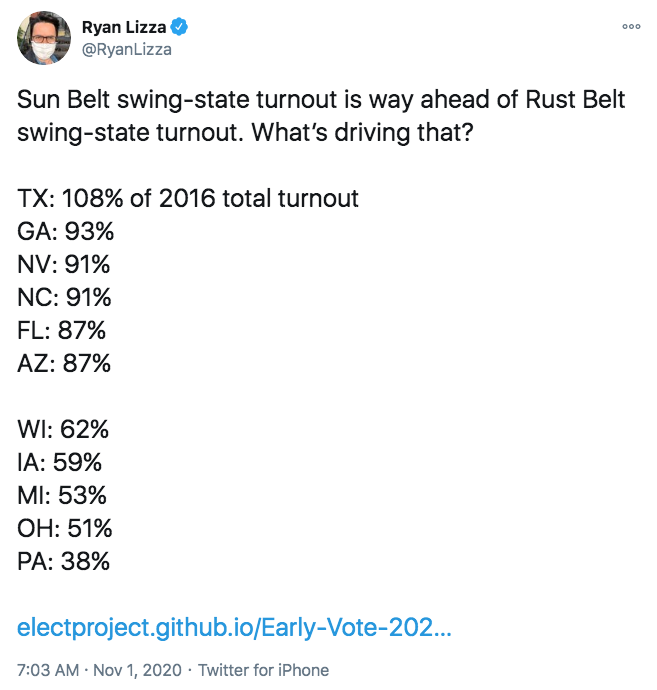
This tweet caught my eye:

Texas has surpassed 2016 even if you account for population growth. (Many sunbelt states have seen 4% to 6% population growth since 2016.) In September, my Trump win prediction was based on three factors, each worth close to 3%; Electoral College bias, polls narrowing, and poll bias due to shy Trump voters. (Many Trumpistas are beta males, who are too timid to proudly state their beliefs in the way that you and I do.)

Obviously things are not looking good for my hypothesis. The polls actually got worse for Trump in October, before narrowing recently to about 8%. While the EC bias is still about 3%, Trump will need a 5% polling error to win. Even worse, many of the votes were cast when the polling margin was a bit higher.

Another problem for Trump is that we’re headed for a big turnout. That doesn’t necessarily favor the Dems, but it tends to. Hillary was clearly hurt by a low turnout of minority voters. For instance, Texas is typically a low turnout state. It’s hard for me to believe that Texas would still be strongly red if turnout were very high, given that only 41% of Texans are white non-Hispanic. (I emphasize “strongly”, as Texas Hispanics are less Democratic than in California.)

Another problem for Trump is that polls suggest that Dems are very enthusiastic about voting this year. And other problem is that polls show the Dems likely to do very well in House races, where the shy Trump voter bias is not much of an issue. So he has his work cut out for him in the next two days.

[And he’s being outspent, which seems impossible for a man who claims to be worth $10 billion. But . . . ]

Some people say “Don’t look at the national polls; look at the swing state polls. In my view, that’s only useful for ascertaining the EC bias. Once you’ve done that, the national polls are what you want to look at. Here’s why:

Let’s say the national polls are roughly correct, or at least within 3%. In that case Trump loses even if he wins Pennsylvania, and even though PA is the mostly like swing state. That’s because if the national polls are within 3%, then any extremely surprising result in one state (like PA) must be offset by a weaker Trump performance somewhere else (like Arizona or North Carolina.) If Biden wins the popular vote by 5%, he will win the election. If he wins by 4% he’ll probably win the election. If he wins by 3% then Trump will probably win the election.

Here’s another way to think about polling errors. Last time around, the national error was 2% and the polling error in midwestern swing states was 4% or more. But that means the polling error in places like Arizona was less than 2%. So unless the national polling error is really large, another big miss in the Midwest would imply that Biden is likely to win states like Arizona and North Carolina.

If we assume that Wisconsin and Michigan are out of reach, then Trump doesn’t need to just hold Pennsylvania; he needs to win all the states on the list above except Nevada.

[Technically speaking, Biden picking up WI, MI and AZ would yield a tie, but Biden’s also leading in Omaha. Believe it or not, Omaha might well be the “swing state” in an election where Trump wins PA and loses AZ. I only know one Omaha resident (Buffett) and I assume he’s voting for Biden.]

It’s probably pointless for me to predict the presidential election, given that I’ve lost touch with American politics. (I got them all correct from 1968-2012, before missing badly in 2016.) Instead I’ll just predict a very strong pro-Trump EC bias, even stronger than in 2016 (when it was about 2.9%.) Just to make things interesting, let’s say an EC bias of 3.5%. I base that prediction on the assumption that the Dems continue to gain ground in states that they would likely lose in a close election, such as Texas and Georgia. (They might win Georgia, but they’d lose it in a close election.)

Totally off topic, a week ago I forgot to link to this amusing NY magazine story about Jay Powell:

While Powell is a Republican, all three of these shifts are victories for the mostly left-leaning crew of Fed watchers who spent the past decade pushing the central bank to focus less on inflation and more on employment. This movement has included organized groups, like Fed Up, that exist to lobby the bank and make it more accountable to the public. It also includes academics and journalists who seemed a decade ago to be mostly a bunch of borderline cranks talking about nominal GDP targeting in op-eds and on Twitter. But you never know who you’ll reach on Twitter — and Powell, like Romney before him, has a secret Twitter account, and he pays attention to what is being said there.

The borderline crank comment probably doesn’t refer to me, as I’m definitely not “borderline”. Probably they were thinking of the more respectable member of the Mercatus team, David Beckworth. I’m an out and out crank, approaching MMT levels of weirdness.