I recall when Biden was elected to the Senate in 1972 (when I was still in high school.) Now I’m old enough for Medicare.
The Chinese pronounce Biden’s name as “bai deng”. This means something like, “a long wait for nothing”. Of course without the Senate, he won’t be able to get his program through Congress.
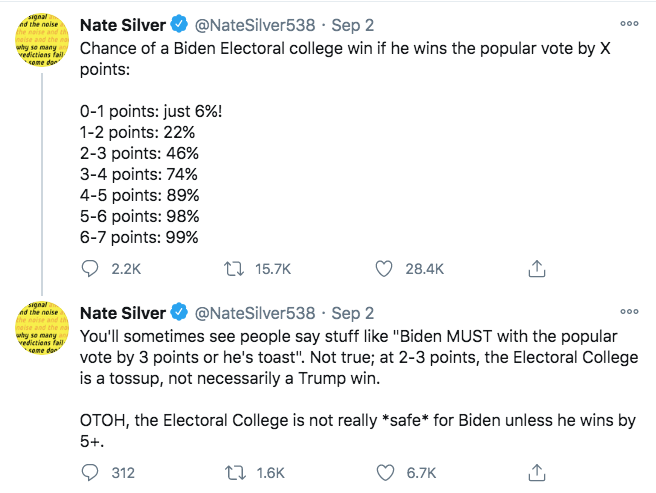
PS. Nate Silver now says the popular vote margin may rise up to 5%, which will make the Electoral College bias even larger than I forecast. Wisconsin still looks like the tipping point state, with a 0.6% margin. That’s depressing news for Dems. Going forward, the GOP strategy should be to lose the popular vote by 5 million votes (3%).
There are more than 10 million votes still to be counted. What a disgrace.
The unemployment rate in July was 10.2%. At the end of July, the fiscal stimulus ran out and Keynesians predicted a disaster if it were not renewed.
Three months later, unemployment was down to 6.9%, far lower than Keynesians predicted. Probably even lower than what they would have expected if a second round of fiscal stimulus had been enacted.
Sort of the opposite of 2009, when the unemployment rate with fiscal stimulus ended up even worse than what was was predicted to happen if Congress had failed to enact fiscal stimulus.
In 2016, the Electoral College favored the GOP by about 2.9%, the difference between Hillary’s popular vote margin and Trump’s margin in the tipping point state (Wisconsin.) The conventional wisdom was that the EC bias would be about 2% to 3% in this election:
If you insist on a point estimate, it looks like Nate Silver is at around 2.6% or 2.7%. But in October, I argued that the EC bias was growing and would be even larger this year, say about 3.5%:
It’s probably pointless for me to predict the presidential election, given that I’ve lost touch with American politics. (I got them all correct from 1968-2012, before missing badly in 2016.) Instead I’ll just predict a very strong pro-Trump EC bias, even stronger than in 2016 (when it was about 2.9%.) Just to make things interesting, let’s say an EC bias of 3.5%. I base that prediction on the assumption that the Dems continue to gain ground in states that they would likely lose in a close election, such as Texas and Georgia. (They might win Georgia, but they’d lose it in a close election.)
[Not bad! Biden will probably eke out a narrow win in Georgia, but would have lost it in a closer election.]
We don’t yet know for sure, but it seems highly likely that Wisconsin will once again end up being the tipping point state. Silver estimates the national popular vote margin will be about 4.3% when all votes are counted, and that implies an EC bias of 3.7% (given that Biden won Wisconsin by 0.6%.) That’s huge.
The shy voter bias was even larger than I anticipated. The 538 website had a pre-election margin of 8.5% in the national polls, and a “model” forecast of 7.8% (I believe incorporating state polls as well.) Even using the conservative 7.8%, that’s a 3.5% miss in the national polls, much worse than last time.
Add the EC bias and the shy Trump voter bias, and Biden needed 7.2% of that 7.8% poll lead in order to win this election. Back in September when Biden led by 7%, the race was probably even, which is why the betting markets had it even at the time. My Trump victory prediction in September was obviously wrong, but not as crazy as some commenters might have assumed.
Biden really did need at least a 7.2% lead in the polls. And even this may understate the shy Trump voter bias, because many votes were cast in mid-October, a period during which Biden’s poll lead often exceeded 10%. The average vote was probably cast at a point in time when the poll lead was roughly 9%!
Trump’s almost unbelievably inept campaign might actually have hurt him.
And then there’s Scott Adams, who should have quit while he was ahead.
PS. American elections are annoying in many different ways. Here are just a few:
1. Vote counting slows down each day, for no obvious reasons. In places like Pennsylvania and Georgia, the vote count today was much slower than yesterday. Why? Just get it over with. The final vote count probably won’t be known for weeks, which is a disgrace. Florida is the nation’s third most populous state, and had almost all votes counted on election night.
But then why be surprised? We are a banana republic.
2. Networks call states for no apparent reason. Fox News and AP called Arizona days ago, despite no clear evidence that Biden had won. It was just a guess. In contrast, it’s obvious that Biden has won Nevada and Pennsylvania, and yet the networks have not called those states. Networks should establish a consistent procedure and stick with it. I could do better than the clowns they hire.
If you don’t know, then don’t call it. How hard is that?
Update: Biden will apparently be the first challenger to get 51% of the vote since FDR in 1932. And in a year when most voters gave the incumbent good marks on the economy.
I often argue that presidents are responsible for about 3% of outcomes, and also that most people overrate the importance of presidents. (Perhaps this is a trait that evolved in pre-historic times, when tribal leaders were relatively more important.)
We don’t know the final outcome of the election, but the stock market seems to be reacting based on the most likely outcome, Biden plus a GOP senate. Why the big increase? Wasn’t Trump good for the stock market? Should Trump feel bad that investors seem to be celebrating his (likely) defeat?
I do think that a few of Trump’s initiatives helped stocks–mostly the corporate tax cuts. But of course the tax bill was mostly created by Congress; Trump merely signed the legislation. After that, Trump did little to help stocks, and his trade war reduced stock prices. The market knows this, and knows that McConnell will prevent a repeal of the corporate tax cut.
I think you could argue that both voters and investors are slightly more favorable toward the GOP than toward Trump. GOP Congressional candidates seem to be running 1.2% ahead of Trump, on average. That’s not a lot, but of course it’s a huge sample and thus “statistically significant”. And most people are basically party line voters.
Trump is such a polarizing figure that people (on both sides) have tended to think of politics in terms of Trump. But if you take a closer look it seems like voters and especially investors see things a bit differently. They wish to discard Trump’s trade/immigration policies, but not his conservative economics.
The stock market soared under Obama. I don’t think many conservatives attribute that to Obama, nor do I. Stocks also soared under Trump. But why not call the 2017-20 stock rally the “Mitch McConnell rally”. That may not be accurate either (perhaps he deserves 3% credit), but it’s no worse than calling it a “Trump rally”.
PS. If you say stocks are not rallying on Trump’s defeat, rather it’s the gridlock in Congress, I agree. That’s my point; Trump himself is not all that important.
PPS. Is this the first election where both sides seem disappointed? Trumpistas love Trump more than his policies, and Dems like Biden’s policies more than Biden. Trumpistas are (likely) losing Trump, and Dems are losing their chance at enacting their policies.
Only investors seem happy. Cold, inhuman, robotic investors, with no heart, no human feelings.
Neoliberalism is like a monster that cannot be destroyed.
PPPS. I just saw that Nevada seems to be going for Biden. According to Fox News and AP that means Biden has won. But I’m still not convinced on Arizona; indeed I’ve never believed that call. On the other hand, he seems to have a good chance in PA and GA. So he’s got three paths.
But what if Trump somehow won? How would stocks react?
Early in the evening I was rooting for a Biden win. But when I saw how close the election was, I wondered if we’d be better off with a Trump win. That would mean at most 8 years of Trump, then we get the virus out of our system.
Now with a “stolen election” we face a scenario where Trump returns in 2024 (possibly from jail, just as Napoleon returned from Elba) and runs against an old and likely unsuccessful Democratic president, who disappointed his supporters by being unable to get anything through the Senate. Or perhaps against a minority woman candidate. Trump will say, “Remember how good you had it in 2019!”
Meanwhile, we face 4 years of non-stop Trump tweets. A grand total of 12 years of Trump trolling. You heard it here first; Trump wins the 2024 election. (From the guy that was wrong about 2016 and (probably) 2020.)
But I’m actually feeling pretty good about my prediction for this election. I predicted a huge gap between the roughly 8% lead that Biden had in the national polls (at 538) and the final outcome in the tipping point state—perhaps a 5% gap. Now it looks like the actual gap will be at least 7%, as Biden will probably win the tipping point state by about 1%, if not less.
Here’s what I said on November 1st:
Let’s say the national polls are roughly correct, or at least within 3%. In that case Trump loses even if he wins Pennsylvania, and even though PA is the mostly like swing state. That’s because if the national polls are within 3%, then any extremely surprising result in one state (like PA) must be offset by a weaker Trump performance somewhere else (like Arizona or North Carolina.) If Biden wins the popular vote by 5%, he will win the election. If he wins by 4% he’ll probably win the election. If he wins by 3% then Trump will probably win the election.
Here’s another way to think about polling errors. Last time around, the national error was 2% and the polling error in midwestern swing states was 4% or more. But that means the polling error in places like Arizona was less than 2%. So unless the national polling error is really large, another big miss in the Midwest would imply that Biden is likely to win states like Arizona and North Carolina.
If we assume that Wisconsin and Michigan are out of reach, then Trump doesn’t need to just hold Pennsylvania; he needs to win all the states on the list above except Nevada.
[Technically speaking, Biden picking up WI, MI and AZ would yield a tie, but Biden’s also leading in Omaha. Believe it or not, Omaha might well be the “swing state” in an election where Trump wins PA and loses AZ. I only know one Omaha resident (Buffett) and I assume he’s voting for Biden.]
At the moment, it looks very possible that Omaha will be the deciding EC vote. (I believe commenter Christian List predicted exactly this scenario.)
BTW, the most scientific way to think about prediction accuracy is point estimates, not who wins the horse race. In 2016, one pollster bragged after predicting Trump by 3%, a 5% error when the average poll was off by just 2% (in the other direction) in the popular vote. That’s the sense in which betting markets did very well this year, although of course they also (probably) got the “horse race” correct.
PS. Warning: We won’t know the popular vote margin for days, as the California mail-ins are counted very slowly and will add millions to the Biden margin. But even if the popular vote is not all that far off from polls (say a 4% to 5% popular margin), the polls had a 5% lead for Biden in the predicted tipping point state. Because betting markets gave Biden a 65% chance of winning, the implied point estimate of the tipping point margin was 1% or 2% Biden in the betting markets. Over the course of October, the betting markets saw this election much more clearly than the polls, even if the market went a bit irrational for a brief period last night.
PPS. Stock investors love this. I suspect today’s big increase reflected the fact that markets like Biden better than Trump on stuff Biden can control (like trade wars and immigration) and like a GOP Senate as a block to higher corporate taxes.
PPPS. I should be happy about a likely Biden win and a GOP Senate to create gridlock, but I’m disgusted by the increasing banana republicization of America. Our president says the election is being stolen. Is this Bolivia?
PPPPS. I watched Borat last night. My enjoyment was hindered by the thought (at the time) that these people might actually win. Yes, I know, in the real world Trump voters are no better or worse than Biden voters, but movies manipulate a person’s perspective.
PPPPPS. I agree with John Cochrane about California.
Welcome to a new blog on the endlessly perplexing problem of monetary policy. You’ll quickly notice that I am not a natural blogger, yet I feel compelled by recent events to give it a shot. Read more...
My name is Scott Sumner and I have taught economics at Bentley University for the past 27 years. I earned a BA in economics at Wisconsin and a PhD at Chicago. My research has been in the field of monetary economics, particularly the role of the gold standard in the Great Depression. I had just begun research on the relationship between cultural values and neoliberal reforms, when I got pulled back into monetary economics by the current crisis.
"This man is the devil. Look at his eyes. Same as Soros. All baggy and nasty. Good people dont age like that. Its the sign of a madman. A negativity..."
"I watched Satantango on video over 3 days. I found it absolutely gripping, but one must surrender for a time one's idea of what a movie should be. Instead, you..."