Archive for February 2015


Charles Plosser on Fed discretion

Charles Plosser makes a very good point:

Date-based guidance sometimes seems like a way for the Fed to achieve a consensus without actually achieving agreement.

That’s actually part of a challenge for the goal of consensus policy-making. To build a consensus you make vague statements that everybody can interpret any way they want to. Is that good communication? No, because everyone on the committee gets to interpret it their own way and then people get confused as to what it really means.

In retrospect, in reflecting upon the way that policy gets made, I think the desire to create big tents in the language actually becomes somewhat counterproductive to effective communication. I don’t have an easy answer. But it’s something that’s worth thinking about.

You go to the Bank of England, you see votes there 5-4, 6-3, all the time, and it’s not a big deal. People disagree but by disagreeing it allows the statement to more accurately reflect the views of the people that voted for it, and so the people that didn’t vote for it can be more articulate about why they disagree, so the differences and the range of views becomes more clear.

A lot of people speculated when the Bank of England started doing this that it was going to cause disruptions. It didn’t. It allowed people to better assess what the future might look like because the differences weren’t papered over.

Basically prioritize precision over consensus.

Yeah.

Some of your colleagues don’t see dissent as a useful gesture. Do you think your dissents have been effective?

I don’t know how effective it has been. I’m trying to accomplish a couple of things. I think it’s very important in the Fed and in other organizations that we openly discuss and debate different points of view. I think this has been extraordinarily important, even more so in challenging times than in normal times. We’ve entered a period where we’re kind of in uncharted territory. We don’t fully understand what happened or what made it happen. Economists are still debating the Great Depression. We’re going to be debating this for a long time, too. So this is a period of uncertainty and so you have good people sitting in that room, smart people, trying to figure it out. And it shouldn’t be surprising at all that all of these smart people have different ways of thinking about this. This is not a conventional episode.

I also think it’s an important thing to convey to the public that all of these different views are being debated within the Fed. It ought to be “” I know the markets don’t like it “” but ought to be reassuring in terms of public confidence that there’s a healthy debate going on. Always striving for unanimity creates a false sense of certainty that we know more than we actually do.

I also think if I’m going to go out in speeches and communicate ideas and differences of opinion and then not vote, that’s not very credible. That’s saying one thing and doing another. Why would you have a different view in public but not live up to that view inside the meeting when you take a vote? I think I have to match those two things.

One key problem that Plosser doesn’t really address is differences in strategic goals vs. differences in tactics.  The easiest way to see that is to assume the Fed switched to something like NGDPLT.  In that case with a clear strategic goal there would no longer be hawks and doves, just people with different views on the technical problem of which setting of the monetary instrument(s) is most likely to produce on-target NGDP.  But we don’t have that regime, and hence the fight is over both tactics and strategy.  Quite simply, Plosser would prefer a lower inflation rate, on average, than Janet Yellen. The people who implement policy should not be engaged in disputes over near term strategic goals, as it leaves the public hopelessly confused about where the Fed is going.

So yes, Plosser is right that disputes should be in the open.  Perhaps each member could write down their preferred instrument setting, and the Fed could then set the policy instrument at the median vote.  But that won’t solve the problem, at least if they can’t agree on a common strategic goal.

Plosser also had some comments on Switzerland:

In Switzerland’s case they tried to peg their currency as a way to keep it from rising and support the real economy. But Europe is weak. The E.C.B. can’t solve the structural problems that Europe has, and if Europe is going to remain weak, Switzerland also has a problem. And they can’t cover it up with monetary policy. They can’t afford to do it anymore. They can’t solve the fundamental problem of the trade relationship between a small open country in the middle of Europe and the rest of the continent.

Here I have the same problem as with most hawkish pundits, it’s not clear what they are trying to achieve, and how they expect to do so.  When inflation is high they say we need price stability, and hence tighter monetary policy.  And when prices are falling (as in Switzerland) you’d expect them to say we need price stability, and hence easier monetary policy.  But they don’t.  Instead they criticize monetary policy for being too expansionary, for papering over real problems, even if that monetary policy was already producing deflation.  That makes no sense to me.  What do the hawks want Switzerland to do, and how are they supposed to do it?

PS.  At Econlog I have a new post on the jobs figures.

HT:  Tyler Cowen
The lesser of evils and the art of compromise

[Before starting, let me point out that this has been a challenging period for me, with record snow levels (40 inches in a week, and more coming.)  I’ve spent many hours out shoveling, which has slowed things down in other areas of my life.  I have a particularly difficult two family house with a long drive and nowhere to put the snow.  And I’m 59, an age where this stuff gets harder to do. I’m exhausted. Where are the unemployed?  Not around the Newton area.]

Many commenters ask me why I don’t compromise, and support a “helicopter drop,” which is usually meant as a metaphor for a combined fiscal and monetary stimulus.  One answer is that it may not work, as the Japanese showed between 1997 and 2012.  Another is that it’s wasteful, and that monetary stimulus alone is much more efficient.  But to give a better answer let me list government stabilization policies that might have been adopted in 2008, in order of preference:

1.  NGDPLT.

2.  A 4% inflation target

3.  Monetary stimulus combined with tax cuts that lower inflation (VAT, employer-side payroll taxes.)

4.  Monetary stimulus and more government spending.

5.  Hard money (i.e. tighter than the actual Fed policy post-2008.)

6.  Fiscal stimulus without monetary stimulus.

7.  Statist policies without monetary stimulus (i.e. Syriza policy.)

In criticizing policies 2 through 7, I may have fallen short in giving readers a sense of my views as to the lesser of evils.  If you pair any two items and convince me that they are the only two feasible alternatives, then this list tells you which one I will “support.”  But of course bloggers have to be careful, as when this information gets passed down the line, it gradually morphs from “Sumner considers X less bad than Y” to “Sumner supports X.”

Obviously NGDPLT is the market monetarist proposal.  Smarter Keynesians like Krugman, Rogoff and Blanchard tend to support item 2.  Christina Romer has advocated option 3 (and also supports NGDPLT.)  Most Keynesians also support option 4.  Some left-wing Keynesians are strangely hostile to monetary stimulus, and support option 6.  Some Austrians and older monetarists seem to support option 5, as they criticized Bernanke’s policies for being too expansionary.  Syriza would clearly like the ECB to do more, but that’s not Greek policy.  Greek governments can only affect monetary conditions in Greece by deciding to leave the eurozone.  Because Syriza wants to stay in, they are (de facto) adopting tight money.

Now let’s say you put a gun to my head and force me to “compromise” with Keynesians.  I won’t just compromise; I’ll completely cave, and accept their 4% inflation target.  I won’t try to talk them down to 3%.  It’s not my preferred policy, and it punishes saving and investment, but it’s better than 3 through 7.  So if you want compromise, if you want to lock Krugman and me in a room until we agree on something, then 4% inflation is the policy that will come out of that room.  It’s high enough to keep us above the zero bound, and Krugman’s always insisted that fiscal stimulus is only needed at zero interest rates.  (Of course he also favors bigger government for other reasons, having nothing to do with stabilization policy.)

Why is the list constructed this way?

2.  There is relatively little cost to anticipated inflation rates that are fairly low (and 4% was consider low under Volcker.) The main problem is that inflation raises taxes on capital.  But in the past the federal government has offset this with tax cuts on capital.  Then when inflation fell to low levels in recent years, taxes on capital were raised again.  If we go to 4% inflation (again, not my preferred policy) we could cut taxes on capital to offset any negative effects on growth.

3.  Option three is also not very costly, but I have doubts about its effectiveness, and about the ability of Congress to move tax rates around in a timely and effective manner. Better to avoid the zero bound entirely.

4.  Option 4 is far inferior to 3, as it contemplates government spending that does not meet classical cost/benefit test, i.e. that can only be justified assuming a stimulative effect.  In contrast, under option 2 there is never any need for infrastructure programs to put people back to work, as you are never at the zero bound.

5.  Option 5 makes the demand shock even worse, and the recession even deeper.

6.  Option 6 combines a deep recession and wasteful spending programs that result in higher future (distortionary) taxes.

7.  Greece under Syriza — ’nuff said.

To summarize, if forced to compromise, 4% inflation is the Keynesian program I accept, not helicopter drops.  If I criticize Paul Krugman more than old monetarists, it’s because I take his ideas more seriously.  Recently I have also avoided saying much about Marxists, MMTers, internet Austrians, etc.; that doesn’t mean I do not oppose their policies even more strongly than I oppose helicopter drops.

PS.  OK, maybe fiscal stimulus in the snow removal area would be justified.  🙂


Where would an aggregate nominal labor comp target fail?

In the US, labor compensation is about 52% of nominal gross domestic income (or NGDP.)  Another 26% is capital income, 15% is depreciation and 7% is indirect business taxes such as sales and excise taxes.  (Income taxes are of course a part of labor compensation, and corporate income taxes are a part of capital income.)

I don’t recall ever seeing an economist propose targeting aggregate nominal labor compensation (NLC), and I’m not exactly sure why.  The purpose of this post is to figure out where that sort of policy target is likely to fail.  Because no one is proposing NLC targeting, it’s presumably a bad idea.  I am especially interested in how it compares to inflation targeting, NGDP targeting, etc.  By the way, don’t be fooled by the fact that NLC is only 52% of NGDP.  Depreciation is extremely inertial, and hence of little interest in business cycle analysis.  Sales taxes tend to follow the economy.  The two key components are labor and capital income, and NLC is 2/3rds of that aggregate.

Let’s start with one stylized fact that almost everyone accepts.  Nominal hourly compensation looks very sticky.  That doesn’t mean it is sticky, just that it tends to be much less volatile than NGDP.  My NLC targeting proposal is based on the assumption that hourly wages would not become more volatile if NLC was targeted (indeed I’d expect wages to become less volatile.)

If hourly comp remained fairly stable, and the Fed targeted NLC, then total hours worked would also become relatively stable.  However RGDP might still be somewhat volatile, if productivity was unstable. And even if RGDP was stabilized, inflation might become more unstable.

So I can think of three arguments against stabilizing NLC:

1.  The Lucas Critique—as soon as you start targeting NLC, negotiated wages would become very unstable.

2.  When hours work stabilize, there would still be output instability due to productivity shocks.

3.  Inflation might become more unstable.

Are there other potential problems?

FWIW, here’s my intuition on the three possible problems:

1.  I can’t imagine why stabilizing NLC would make hourly wages more unstable.  It might, I just don’t see the mechanism. I’d expect the opposite.

2.  I view instability in hours worked (i.e. unemployment) as THE business cycle problem. It’s the sine qua non of old Keynesian economics. I see no reason to assume that variations in output for any other reason are suboptimal. In other words, the RBC model is probably the appropriate way to think about output variations not caused by involuntary unemployment.

3.  If inflation is the proper way to measure the welfare cost of nominal instability (and I doubt it is) then surely core inflation is more useful that headline inflation.  I can’t imagine any welfare costs flowing from fluctuations in flexible food and energy prices.  And isn’t core inflation closely linked to wage inflation?  Which leads back to point one.

In other words, I have a hard time imagining where a NLC target would fail.  Hours would become more stable, and core inflation would remain well behaved.  There’s probably enough wage flexibility in the long run to accommodate gradual changes in the labor force associated with declining birthrates, etc.  I actually find it easier to visualize a NGDP target failing than a NLC target failing, especially for small un-diversified economies.  For the US, I’d expect a NLC and NGDP target to produce very similar results.  If one were highly effective, the other would be too.

Then why even bring up the NLC target?  Because it’s easier to visualize the “musical chairs model” using NLC shocks than NGDP shocks.  It simplifies things, as you no longer have to model the impact of changes in NGDP on NLC.  You model the growth rate of the total revenue used to compensate labor (monetary policy), assume nominal hourly wages are sticky, and you end up explaining employment. What could be simpler?

PS.  Back in 2013 Miles Kimball and Matt Rognlie had a very good discussion of the relative plausibility of sticky-wage and sticky price-based models.  Both make excellent points, but Matt’s defense of the sticky-wage assumption is as good as I’ve ever seen.  I’d like to think that if I were 30 years younger and 30 IQ points higher I would have made similar arguments.

PPS.  Between mid-2008 and mid-2009, NGDP (actually NGDI) fell by 2.9%, NCL fall by 3.8%, capital income fell 2.4%, business taxes fell by 2.3% and depreciation fell by 0.2%.

PPPS.  One area where NGDP targeting might be better than NLC targeting is financial market stability.  NGDP is the total income available to repay nominal debts.  As noted earlier, however, the two are highly correlated.

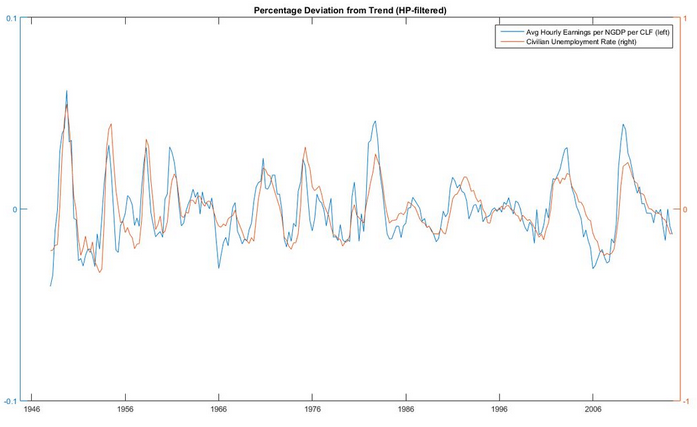
Update:  Commenter Rob sent me a graph with unemployment compared to W/(NGDP/Labor Force).  He smoothed it using the Hodrick-Prescott filter.

Screen Shot 2015-02-03 at 10.23.30 PM

The NGDP moment

Back in 2008 you rarely heard economists talk about nominal GDP.  Now it’s the hot new idea in monetary policy targeting. But that’s not all, we are also seeing more interest in nominal GDP-linked assets.  Most famously, Robert Shiller has proposed “trills,” which would be assets with a value linked to one trillionth of nominal GDP. They could be used to hedge against aggregate nominal income risk. I’ve proposed nominal GDP futures markets, which are probably more accurately termed “prediction markets.” And now we have the new Greek government talking about NGDP-linked government debt:

Greece’s radical new government unveiled proposals on Monday for ending the confrontation with its creditors by swapping outstanding debt for new growth-linked bonds, running a permanent budget surplus and targeting wealthy tax-evaders.

Yanis Varoufakis, the new finance minister, outlined the plan in the wake of a dramatic week in which the government’s first moves rattled its eurozone partners and rekindled fears about the country’s chances of staying in the currency union.

After meeting Mr Varoufakis in London, George Osborne, the UK chancellor of the exchequer, described the stand-off between Greece and the eurozone as the “greatest risk to the global economy”.

Attempting to sound an emollient note, Mr Varoufakis told the Financial Times the government would no longer call for a headline write-off of Greece’s €315bn foreign debt. Rather it would request a “menu of debt swaps” to ease the burden, including two types of new bonds.

The first type, indexed to nominal economic growth, would replace European rescue loans, and the second, which he termed “perpetual bonds”, would replace European Central Bank-owned Greek bonds.

.  .  .

“What I’ll say to our partners is that we are putting together a combination of a primary budget surplus and a reform agenda,” Mr Varoufakis, a leftwing academic economist and prolific blogger, said.

A former blogger becomes a finance minister and proposes NGDP-linked bonds. What a crazy world we live in!

PS.  I have a post on Greece over at Econlog

HT:  SG

Japan continues to add jobs at an astounding rate, as unemployment falls to the lowest level in decades

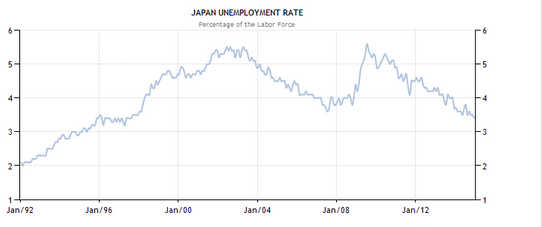
That’s right, the Japanese “recession” grinds on.  A few months ago bloggers on the left and right, as well as the mainstream news media, reported that Japan had fallen into a “recession.”  Only TheMoneyIllusion pointed out that this was nonsense, as analysts were confused by Japan’s falling population.  Japan’s trend rate of RGDP growth is currently no higher than zero, and the post-sales tax increase RGDP slump was completely expected.  The Japanese stock market was not fazed, Japanese companies continue to add workers at a rapid rate, and unemployment just fell to 3.4%, the lowest rate since the 1990s.

Japan’s seasonally adjusted unemployment declined to 3.4 percent in December compared to 3.7 percent reported in the same month of 2013 as the number of employed rose 0.6 percent and the number of unemployed decreased 6.7 percent.

The number of employed persons in December 2014 was 63.57 million, an increase of 380 thousand or 0.6% from the previous year.

The number of unemployed persons in December 2014 was 2.1 million, a decrease of 150 thousand or 6.7% from the previous year.

The jobs-to-applicants ratio increased to 1.15 from 1.12 in the previous month, the highest since March of 1992.

The number of new job offers rose 4.7 percent in December from previous month and rose 5.6 percent from the same period a year ago.

To the uninformed, the 0.6% rise in Japanese employment might seem unimpressive.  But the Japanese working age population is falling by 1.5% per year, so this is equivalent to 2.1% employment growth in a stable population country, or 2.4% employment growth in a country with 0.3% growth in the working age population (such as the US.)  Of course our employment only rose by about 2% last year, and yet that was the strongest performance since the late 1990s.  In other words, the Japanese labor market is even hotter than the US labor market in a cyclical sense.  All the claims to the contrary are written by people ignorant of Japanese demographics.

Abenomics has done the two things that it was capable of doing (reducing unemployment and slightly easing the public debt problem) and failed to do the thing many hoped for, but was never realistic given the demographics (create rapid RGDP growth.)

The people that disagreed with me, claiming Japan really was in recession, told me that unemployment is a lagging indicator (it actually is not, at least not significantly.)  OK you guys, go on record and tell me when the delayed rise in Japanese unemployment will occur.  I want a specific date, or at least a specific year.  Will it be 2015?  If not, then when? How about 2016?

Screen Shot 2015-02-02 at 3.04.14 PM

Off topic, there are times that I just want to give up.  From today’s news:

LONDON/SYDNEY (Reuters) – European and Chinese factories slashed prices in January as production flatlined, heightening global deflation risks that point to another wave of central bank stimulus in the coming year.

While the pulse of activity was livelier in other parts of Asia – Japan, India and South Korea – they too shared a common condition of slowing inflation.

Central banks from Switzerland to Turkey via Canada and Singapore have already loosened monetary policy in the past few weeks.

Switzerland!?!?!?