
Archive for October 2013


A note on exchange rate regimes and macro outcomes

Tyler Cowen links to an interesting study by Andrew Rose, which found little difference in the macroeconomic outcomes of fixed and floating exchange rate regimes, during the recent crisis.  This surprised me a little, until I found out that the study excluded the eurozone.  Then it didn’t surprise me at all.  On the other hand almost everyone seems to have interpreted the results differently than I do, so perhaps I should be surprised.

It’s true that floating rate proponents like Paul Krugman and I have occasionally blamed the euro for the problems of Greece, Spain, Portugal, etc.  This might leads one to conclude that we predict that countries will do better, on average, with floating rate regime.  Indeed Krugman seems to have implicitly accepted that view.  But that is not the implication at all.  Rather the fundamental criticism of fixed rates regimes is not that they produce slower growth on average (impossible in natural rate models), but rather that they lead to greater variability.  The famous “one-size-fits-all” problem.

Here’s an easy way to see what I’m talking about.  All 50 American states operate with no monetary flexibility, as they are part of a single currency zone—the dollar. Ditto for the 18 members of the eurozone. Thus you would not expect the eurozone to perform differently than the US dollar zone, on any test of the effects of currency flexibility. Yet any study of fixed versus flexible exchange rate regimes would code the US as a “flexible rate” regime and each eurozone country would be coded as a “fixed rate” regime. At first glance, that would seem to imply that if flexible rates improve performance then the eurozone as a whole should do better than the average performance of its 18 members! Of course that’s impossible.

Instead, what you would expect is that the economic performance of floating rate regimes as a group would show less variability than the economic performance of individual countries within a fixed rate regime. Actually even that is perhaps an excessively rigorous test, because single currency zones tend to be composed of countries with similar structural characteristics. But even so I think it’s fair to say that this hypothesis holds up pretty well if you compare the eurozone with a group of floating rate developed countries including Switzerland, Sweden, Britain, Norway, Iceland, the US, Canada, Australia, New Zealand, S. Korea, Taiwan and Japan.  The eurozone may or may not have done worse on average than this group of countries (probably worse), but surely there’s been more variability in the eurozone. Countries like Germany have seen virtually no increase in unemployment, whereas unemployment in places like Greece, Spain and Portugal rose much higher than in any of the floating rate developed countries.

PS.  All fixed-rate currency blocs float against the rest of the world. There is no obvious reason why the monetary policy of fixed-rate currency blocs would be less effective than the monetary policy of individual floating-rate countries, at least when averaged over the entire currency bloc.

PPS.   When I disagree with the findings of studies, it’s not usually due to their formal technical analysis, but rather to interpretation.  Some of my recent “Mark Sadowski” posts are a good example. Another recent case like this occurred when Raj Chetty seemed to imply that the Oregon Medicaid study provided support for the Medicaid program:

Other economic studies have taken advantage of the constraints inherent in a particular policy to obtain scientific evidence. An excellent recent example concerned health insurance in Oregon. In 2008, the state of Oregon decided to expand its state health insurance program to cover additional low-income individuals, but it had funding to cover only a small fraction of the eligible families. In collaboration with economics researchers, the state designed a lottery procedure by which individuals who received the insurance could be compared with those who did not, creating in effect a first-rate randomized experiment.

The study found that getting insurance coverage increased the use of health care, reduced financial strain and improved well-being “” results that now provide invaluable guidance in understanding what we should expect from the Affordable Care Act.

Here’s one (anonymous) criticism of this interpretation:

With regards to Medicaid, Chetty also paints a surprisingly incomplete picture of the Oregon Medicaid experiment. As you will recall, Chetty is correct in pointing out that expanding Medicaid seems to have increased usage of health care, decreased financial strain, improved mental health, and improved self reported well being, but he, quite surprisingly given the caliber economist Chetty is, leaves out the less flattering (for supporters of the ACA) part of the study that found no statistically significant increase in objective measures of physical health for patients who received Medicaid.

At best, the Medicaid study was a mixed result for supporters of expanding the Medicaid program (which the ACA does quite dramatically). At worst, the study is a sad demonstration of how bad Medicaid (and perhaps insurance in general) is at improving objective physical health. Why Chetty presented this study as an unambiguous victory for the pro Medicaid crowd is a mystery to me (although I suspect support of ACA has something to do with it)?

In my view the Oregon Medicaid study provides support for replacing Medicaid with a new program called “Mediplacebo.”  I think the improvements in mental health identified in the Oregon study were real, and were important. But surely they can be produced at much lower cost. I know that every time I’ve had “cancer,” I’ve felt much better after going to the doctor and being told that I don’t have cancer. Under my plan, consumers would receive the same care provided to the uninsured for things like traffic accidents. For those health problems where the uninsured would not normally receive coverage, health consumers would receive a placebo.

Of course I’m joking, but there is a serious point here. Medicaid is a very expensive program. Unless and until it is possible to show clear physical benefits to health, the per capita spending on Medicaid should be scaled back to the levels that you see in other developed countries such as Singapore.  Ditto for Medicare.

We have a Cadillac health care system.  I don’t consider “no physical improvement” to be satisfactory, given the cost.
A puzzling paper from the St. Louis Fed

Several commenters sent me a paper by Yi Wen of the St. Louis Fed:

Currently the U.S. real GDP is about 10% below its long-run trend (see Figure 2) and total asset purchases stand at $3.7 trillion (or less than 25% of GDP). Our model predicts that this level of asset purchases (even if permanent) would have little effect on aggregate output and employment even though it could reduce the real interest rate significantly by 2 to 3 percentage points. These predictions are consistent with the empirical evidence. Thus, based on our model the Federal Reserve’s total asset purchases must be more than quadrupled and remain active for several more years if the Fed intends to eliminate the 10% output gap caused by the financial crisis.

Lots of things puzzled me about this paragraph. How could there be a 10% output gap, if unemployment is only 7.2%? More importantly if the asset purchases are permanent, why wouldn’t the US experience hyperinflation when we exited the liquidity trap? It’s widely believed that that exit will occur within the next few years. If so, how can it be that a permanent QE would only reduce real interest rates by 2 to 3 percentage points?

The conclusion seems to answer these questions:

We provide a general equilibrium finance model featuring explicit government purchases of private debt to evaluate the efficacy of unconventional monetary policies. We show that when inflation is fully anchored, such policies can reduce the borrowing costs (the real interest rate) and relax borrowing constraints by raising the collateral value of fixed assets. However, to have a significant impact on real economic activities at the aggregate level, the scope of asset purchases must be extraordinarily large and the extent highly persistent. These predictions are not inconsistent with the empirical evidence provided in the Introduction.

.  .  .

Our model predicts that when inflation is fully anchored, LSAP can lower the real interest rate on both public and private debt and raise the collateral value of productive capital, thus increasing the number of borrowers and the aggregate quantity of debt. However, unless the extent of asset purchases is extremely large and highly persistent, CE through LSAP cannot effectively offset the negative impact of a financial crisis on aggregate output and employment.  [emphasis added]

Well now I’m totally confused. The assumption that inflation is fully anchored does explain the weak response of real interest rates. But since monetary policy affects economy via shifts in aggregate demand, the assumption that inflation is fully anchored is equivalent to an assumption the nominal GDP growth is fully anchored. In other words, this seems to be saying that if the monetary policy regime tries to avoid any increase in aggregate demand, it will succeed in avoiding any increase in aggregate demand. Yes, but if the goal was to boost recovery, why would they anchor aggregate demand?  Why not try to increase aggregate demand at a pace likely to yield the desired inflation/employment outcome?

Obviously I’m missing something. Can someone help me?

PS.  Some people must have thought I’d lost my mind when I endorsed Kevin Erdmann’s theory that tight money might have contributed to the housing bubble.  Gregor Bush sent me this article by Lars Svensson.

Leaning-against-the-wind monetary policy may lead to a Fisherian debt deflation, since it may lower prices below the anticipated level and therefore raise real debt above what was anticipated. This is what the Riksbank has done by keeping average inflation significantly below the inflation target for a long period. This has caused household real debt to be substantially higher than it would have been if inflation had been on target.

So is Svensson also crazy?

HT:  Saturos, Morgan, et al.

Did tight money cause the 2006 housing bubble?

According to a very interesting post by Kevin Erdmann, the answer may well be yes.  Here is a comment he left, which summarizes his argument:

The housing boom was caused by TIGHT money!

What I realized was that there were many parallels between the 1970″²s and the 2000″²s, and that both periods saw similar demographic trends and low or negative real interest rates. Relative home prices rose in both time periods, but the reason they didn’t rise so much in the 1970″²s is because the Fed was actually loose in the 1970s. Since home finance is treated as consumption financing, high inflation in the 1970″²s kept home prices down. (Banks approve mortgages based on current income compared to the monthly payment, not based on something like a long term cash flow analysis of real estate versus a risk free bond investment.) Since the Fed was tight in the 2000″²s, real and nominal interest rates were low. This meant that, unlike in the 1970″²s, the size of the monthly payment was not a limiting factor. Homes were a reasonable investment in both periods of time. In the 1970″²s, they were a killer investment if you could afford the monthly payment. The financial engineering used in the 2000″²s to lower equity and down payments in exchange for higher monthly payments was simply a reasonable way to make this investment available to more people. Those methods were not relevant in the 1970″²s because the monthly payment was already the limiting factor, because of high nominal rates.

I go into the details a little more here:
http://idiosyncraticwhisk.blogspot.com/2013/08/real-interest-rates-and-housing-boom.html

This is going to be really fun, so let’s back up a bit.  I don’t want you to miss any details, so you can blow people away at the water cooler tomorrow morning.

I’ve frequently commented on the puzzling fact that so-called “bubbles” seemed to occur more often during periods of relatively slow NGDP growth (1929, 2000, 2006), not periods of relatively high NGDP growth (1964-81).  Because periods of slow NGDP growth represent periods of relatively tight money, I always tended to discount arguments connecting easy money with bubbles.

But I never actually reversed the argument.  After all, why should tight money lead to bubbles?  Wouldn’t you expect more real estate bubbles during periods when inflation is pushing house prices higher at a rapid rate?  Perhaps, but as Kevin points out it’s real house prices that matter.  Even so, perhaps real house prices might be expected to go up during periods of high inflation, as houses are a sort of inflation hedge.

But Kevin noticed a powerful force pushing the other way.  In America mortgage debt is commonly structured so that monthly payments stay constant over 30 years.  This means that during periods of high NGDP growth, when nominal interest rates are also high, monthly payments will start very high in real terms, and then fall rapidly in real terms.  But your ability to qualify for a house depends on how large the initial nominal monthly payment is, relative to your current income.

This means that average people will have much more difficult time qualifying for a mortgage when both nominal GDP growth and nominal interest rates are relatively high. As a result, real estate “bubbles” are more likely to occur during periods when nominal interest rates are relatively low and average people find it easier to qualify for mortgage loans. I initially missed this point because I focused too much on the Fisher effect and not enough on the strange practice in America of structuring mortgage payments in nominal terms.

In this blog I frequently focused on two types of money illusion, downward wage rigidity and nominal debt. Sticky wages lead to unemployment when nominal GDP falls. Nominal debt leads to debt crises when nominal GDP falls. And now we have a third, monthly mortgage payments that are stable in nominal terms lead to real estate booms when nominal interest rates are relatively low. And of course nominal interest rates are relatively low when nominal GDP is relatively low. And of course slow nominal GDP growth is an indication of tight money.

I feel like I’ve hit the trifecta. The title of my blog now has three important implications. Money illusion contributes to business cycles, debt crises, and so-called “housing bubbles.”

PS.  I don’t know whether I ever mentioned this story, but I was originally going to entitle this blog “moneyillusion.” However the company selling Internet names charged $1800 for that name. So then I checked what the name “themoneyillusion” would cost. It was $12 per year. I’m a cheapskate. So it’s sort of the reverse of that scene in The Social Network where Sean Parker casually mentions that they should drop the “the.”

PPS.  A couple years ago I did post with an almost identical title, but a completely different story.  I guess I’m a born contrarian.

Choices, choices

Much of the ideological debate in the US revolves around the question of size of government.  Size matters, but so do lots of other things.  Let’s take infrastructure.  Here are some data on government spending as a share of GDP:

Singapore:  17.0%

China:  20.8%

Chile 21.1%

Switzerland 32.0%

US 38.9%

Brazil 41.0%

Let’s compare China and Brazil for a moment.  China has lousy infrastructure.  So does Brazil.  But China is rapidly building a first class set of infrastructure, and Brazil decided long ago to put their money into social programs, lavish pensions for public employees, etc.  China’s already ahead of Brazil in infrastructure, and will soon be far ahead.  Brazil is still richer than China, but will soon fall far behind. It’s hard to leave the middle income trap with horrible infrastructure. I added Chile simply for comparison purposes.  Brazil’s level of government spending is high for a Latin American country (Mexico is at 23.7% and Argentina is at 24.7%).

America has decent infrastructure, but I consider it rather poor quality for a country as rich as the US. Why is this?  It’s certainly not because we are a low tax economy.  Switzerland has excellent infrastructure, and universal healthcare and all sorts of other excellent public services, and has a much smaller government than the US.  So does Singapore.  It’s all about where you allocate the money, and how effectively you spend it. America allocates lots of money to social programs, and to national defense.  The money we do put into education, infrastructure, etc, is not spent very effectively.  That’s why even high income tax states like New York and California have such lousy infrastructure (Although California to its credit does have excellent universities).  Even when we try to build high speed rail, we fail. (Or are about to fail, as in California, where the dream of truly high speed rail has already been abandoned.)

America has two political parties:

1.  One is so anti-government that they refuse to do serious thinking about how to make government work.

2.  The other is so pro-government that they refuse to make the tough choices necessary to make government work.

As a result we may increasingly resemble Brazil, not Switzerland.

PS.  Tyler Cowen recently had this to say:

Last night I read the new and excellent Michael Pettis book Avoiding the Fall: China’s Economic Restructuring.  It is the single best treatment I know for understanding the dilemmas of the current Chinese economy and the need for restructuring.  My favorite bits are those comparing the current Chinese economy to the Brazilian growth of the 1960s and 70s, also investment-driven, and lasting longer than most people thought possible, and culminating in the crack-up of the 1980s, which turned out to be a lost decade for Brazil.

In my view the China of 2013 is quite unlike the Brazil of the 1970s, for all sorts of reasons.  One is infrastructure.  Another is education.  Another is culture.  Another is macro policy.  Another is non-commodity trade competitiveness. Brazil never seriously tried to become a developed country. They never really tried to build a developed country infrastructure. China is trying. They certainly may fail, but if they do fail it will almost certainly be for reasons unrelated to Brazil’s failure. China’s not about to stop building high speed rail and put 40% of GDP into things like public employee pensions.

Chinese people don’t make jokes like “China’s the country of the future, and always will be.” They are deeply ashamed of their poverty, and they know how to end it. That’s not a knock on Brazil—in lots of ways I prefer the Brazilian culture. But not for wealth accumulation.

PPS.  China is not a good development model.  Singapore and Hong Kong are much better models.

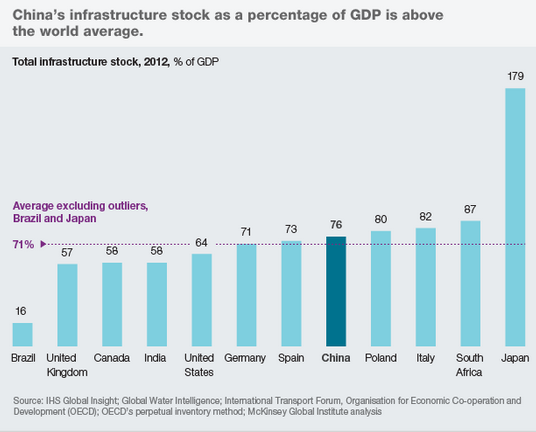
PPPS.  Here’s some data on infrastructure as a share of GDP:

Screen Shot 2013-07-23 at 7.39.32 PM


Mark Sadowski on Krugman

Mark Sadowski continues to provide excellent comments:

Scott,
Here is Krugman’s latest:

http://krugman.blogs.nytimes.com/2013/10/19/do-currency-regimes-matter/

“…First, nominal wage stickiness “” the key argument for the virtues of floating exchange rates “” is an overwhelmingly demonstrated fact. Rose doesn’t offer reasons why this doesn’t matter; he just offers a reduced-form relationship between currency regimes and economic performance, and fails to find a significant effect. Is this because there really is no effect, or because his tests lack power?

Second, there is the very striking empirical observation that debt levels matter much less for countries with their own currency than for those without. Here’s one view of the relationship between debt levels and borrowing costs (data from Greenlaw et al):

[Graph]

And here’s another view of the same data, with euro members identified:

[Graph]

It sure looks as if debt matters only for those on the euro, doesn’t it? For what it’s worth, here’s a regression of interest rates on debt that uses a dummy for euro membership, and allows an interaction between that dummy and debt:

[Table]

Indeed: debt only seems to matter for euro nations…”

So, four days ago Krugman posted a scatterplot in which the two thirds of the nations are eurozone members, igoring the effects of currency regime, in order to make the argument that fiscal policy matters at the zero lower bound. Today he posts another scatterplot in which a majority of the nations are eurozone members, but this time he literally highlights the currency regime, and tests for the effects of interaction, in order to make the argument that debt matters much less for countries with their own currency.

The fact that his previous post was the intellectual equivalent of Greenlaw et al, purporting to show a relationship through the use of a scatterplot consisting mostly of eurozone members without any recognition at all that the relationship is entirely driven by the fact that these nations do not have an independent monetary policy, seems to have completely escaped his notice.

Kevin Erdmann has some excellent new posts (here and here) that look at the causes of austerity, and how the effects depend on whether countries have an independent monetary policy.  There doesn’t seem to be any statistically significant relationship among countries with independent monetary policy.  My hunch is that a large enough study would show a significant relationship, but probably at least partly as a result of misidentification of “austerity.”