Archive for July 2013


President Obama is not pretending that monetary policy doesn’t exist

Matt Yglesias has a new post entitled:

It’s Time for Politicians to Stop Pretending Monetary Policy Doesn’t Exist

He focuses on President Obama.  But I think this is wrong.  Obama isn’t pretending anything.  President Obama does not believe that monetary policy exists at the zero bound.  It’s reported that he said so privately to Christina Romer.  And he’s acted that way since day one.

The US has been at the zero bound since before he took office, and it is likely to be there for at least several more years.  So I’m not surprised Obama pays no attention.  I am a bit surprised that the liberal economists surrounding him have not been able to convince him otherwise, but we can only presume that monetary policy expertise within the Democratic Party establishment has declined sharply since the days of William Jennings Bryan and FDR.

Or maybe that’s letting Obama off too lightly.  FDR knew enough to listen to George Warren, whereas Obama didn’t know enough to listen to Christy Romer.

Yglesias also reports that Obama is going to pivot to a focus on long term economic issues.  That would be a big mistake.  Obama needs to focus on getting the US out of the recession that began in 2007.  A good place to start is by appointing someone like Romer to replace Bernanke, and then two other like-minded people to the other two positions likely to open soon.

Then he can start his supply-side reforms.

PS.  I just noticed that Ezra Klein and Evan Soltas think the White House is paying attention to my Summers bashing:

But they’re not unaware that Summers is a polarizing choice. So some of what’s happening right now, I think, is that they’re figuring out whether opposition to Summers is soft or hard. There are trial balloons going to the kind of people who will be asked to render verdicts on the choice and, in the cases where those people are skeptics of Summers, efforts to see if they can be talked down a bit.

This has had the side effect “” probably anticipated, and perhaps even welcome “” of mobilizing Summers’s critics. I don’t know if the blowback (see Noam Scheiber, Felix Salmon, Scott Sumner, Dave Dayen, Senator Jeff Merkley, etc) is more or less than the White House expected. But they’re getting to see it. And remember that they’re also getting positive feedback from fans of Summers, who are underrepresented in the econo-blogosphere, but very present in the ranks of economic and Wall Street heavyweights who’ve worked or fundraised at high levels in Democratic administrations.

The result is that the White House is getting to test the reaction to a Summers pick at a time when they can still choose Yellen, or even go back to the drawing board and look at Roger Ferguson or Donald Kohn or Alan Blinder or anyone else.

I don’t like those three names any more than Summers.  Some people argue that Summers is a fine macroeconomist.  That’s not the issue.  In the 21st century the most important qualification for Fed chairman is the ability to understand that monetary policy must continue to steer AD at the zero bound, and supreme confidence that the Fed will do whatever it takes to get the job done.  Nothing else is remotely as important.  Any fool can do a Taylor Rule when rates are positive.

Please Mr Krugman, don’t sink to the level of your opponents

Paul Krugman must feel a need to churn out blog posts at a very fast rate (I know the feeling.)  Most are excellent.  But his newest post is just appallingly bad.  It starts off on solid ground, criticizing Martin Feldstein’s views on monetary policy. Krugman’s right that Feldstein has been too concerned about inflation, and that his recent comments on IOR are in conflict with the conservative position that QE makes inflation a big risk.  But then Krugman goes completely off the rails:

Even if this were right, wouldn’t it suggest that the Fed’s expansion poses no inflationary risk? I mean, if all that alleged pressure can be completely contained with a 1/4 percent interest rate, how big a problem can it be?

But it’s not right, as Noah shows logically; and of course the example of Japan, which did massive QE without paying interest on reserves, and saw nothing happen, reinforces the point.

I can forgive a young academic like Smith for making a bonehead argument that IOR can’t matter much because it only raises nominal borrowing costs by 1/4% (as if the impact on inflation and NGDP expectations don’t matter) but Nobel Prize-winning Paul Krugman?  There are very few things in monetary economics that can be shown “logically,” and Smith did not produce one of them.

But since Krugman brought up logic, let’s apply some logic to the rest of his post:

And let me admit that I’m especially exasperated “” actually, about the fiscal as well as monetary arguments “” because I went over all this ground fifteen years ago.

Look, please, at my Brookings Paper on the liquidity trap (pdf), especially pp. 155-159. (Those are pages in the volume “” the paper isn’t that long). You’ll find me explaining that once you’re up against the zero lower bound:

1. Changes in government spending are still effective, with a multiplier of 1, even with full Ricardian equivalence.

The problem with these multiplier estimates is that they assume that monetary policy is ineffective at the zero bound, and hence no monetary offset will occur.  Inflation targeting central banks will no longer target inflation.  But if that’s true THEN WHY THE HECK IS KRUGMAN COMPLAINING ABOUT TAPERING?

I’m sure that his defenders will dig up excuses.  “He said QE itself doesn’t matter, but perhaps is a signal of future policy actions that do matter.”  OK, I’ll buy that (although I think QE does matter directly to at least a small extent.)  That still leaves us with the question of why he’s so opposed to tapering.  If he’s really opposed to the signal, then he must think that signals matter.  In that case why not assume that central banks keep targeting inflation at 2%, even at the zero bound, albeit using signals instead of current changes in the base or fed funds target.  If the Fed is tapering, then aren’t they pleased with the likely future path of inflation?  Krugman and I agree they are wrong, but it’s what they think that drives policy.

For 5 years Krugman’s tried to have it both ways.  He needs to make up his mind.  Does money matter, or doesn’t it?  Why does Krugman suggest that Summers is OK on monetary policy, when Krugman thinks money is too tight and Summers doesn’t?  And while he’s at it, please explain why the severe austerity in 2013 led to a speed up of job growth to over 200,000/month, instead of the sharp slowdown predicted by the multiplier models.  Monetary offset?  Did the US do better than the eurozone because Bernanke’s so-so Fed is better than the appalling inept ECB?  I’d say so.

Debating the conservative inflationistas is like shooting ducks in a barrel for a brilliant economist like Krugman.  He can do better.  It’s time for a serious discussion of monetary offset.

PS.  Yes, the title is a weird sort of joke.  I hope at least Ken Rogoff finds it funny.

HT:  Travis V

China has a pathetically small infrastructure

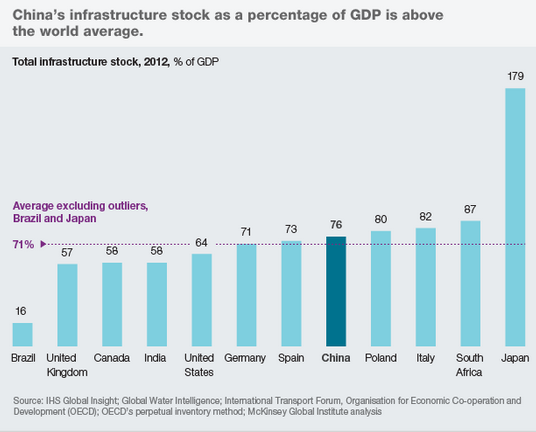
But that’s mostly because it’s a pathetically poor country.  Here’s is China’s infrastructure as a share of GDP:

Screen Shot 2013-07-23 at 7.39.32 PM

China’s infrastructure as a share of GDP is fairly normal, but because its GDP per capita is so much lower than developed countries, it’s stock of infrastructure per capita is also far lower.  The real outlier is Japan, which did an orgy of infrastructure spending to boost AD, even as its central bank pursued a deflationary monetary policy, and ended up with lots of bridges to nowhere, and falling NGDP.

Yes, there is some infrastructure in the wrong place; Ordos, or the Binhai area of Tianjin.  But for the most part it’s where it should be:

1.  The subways are under the huge, densely populated cities, where they should be.

2.  The high speed rail mostly connects big cities.

3.  The larger ports and airports are mostly near the bigger cities.

4.  The motorways mostly connect highly populated areas in eastern China.

5.  The housing is mostly being built in the cities that are receiving massive rural to urban migration.

And remember, if China ever becomes developed it will need far more housing, subways, airports, roads, rail, water systems, power, etc, etc, than it has now.

China’s in a sweet spot where the inefficient SOEs don’t do all that bad—building big things.  As it moves to a more modern high tech/service/consumer-oriented economy it will need to reform, or else get stuck with lower living standards than other developed countries.

But for today, the biggest problem is not China investing too much in big projects, rather it’s the slowness with which they move away from the SOE model, combined with a set of policies that strongly discriminate against people in rural areas.

PS.  Matt Yglesias has a blog post that shows overcrowding on Beijing subway line 13.  I’d guess that (other than Michael Pettis) I’m probably the only western blogger who’s ridden that line (it’s not in a tourist area, and not underground.)  I’ve been through the Xizhimen station and seen the huge lines.  Beijing has gone from almost no subway system when I visited in the 1990s to one of the world’s longest subway systems, and it’s still way too small.   If you don’t believe me check out Matt’s video. Oddly, the system seems to get more crowded each time they add new lines.  I suppose that’s a sort of “network effect;” as the system becomes more complete, more people rely on it.

Replies to Selgin and Smith

1.  George Selgin expressed puzzlement over my recent criticism of Summers:

But even this more sophisticated objection to Kohn and Summers, understood (as I understand it) to imply that those experts have overlooked a potentially effective means for combating recession, seems wrong to me.  True, if prospective buyers expect prices to increase, that’s a reason for them to spend more now.  But if prospective sellers expect consumers to spend more, that is a reason for them to start raising prices now. So while a higher announced inflation target might be self-fulfilling, there’s no reason to suppose that by announcing such a target the Fed can achieve anything other than a higher rate of inflation.

Inflation expectations, in other words, inform the positions and rate of change of both demand and supply schedules–as should be especially obvious to anyone familiar with Wicksteed’s famous exposition in which the latter schedules are nothing other than flipped-over portions of total (“communal”) demand schedules.  Changes in inflation expectations will, in still other words, tend to affect in the same manner the decisions of both buyers and sellers.  Consequently, if sellers’ expectations have been excessively rosy, so that their pricing decisions have resulted in disappointing sales, there’s no reason to suppose that an announced increase in the inflation target won’t cause them to become rosier still, ceteris paribus. Expectations are a double-edged sword that policy tends to sharpen on both sides, or not at all.

I would agree with George if we started from a position of macroeconomic equilibrium, were wages and prices had adjusted to previous changes in AD, or nominal spending.  But suppose we start from a position of disequilibrium, where nominal wages are 5% too high to maintain full employment, at current levels of NGDP.  In that case the SRAS curve will slope upward, and we will be in a position to the left of the LRAS curve.  Now assume the Fed decides to announce a 5% inflation target for the next year.  Because the SRAS curve is upward sloping, it might take a 8% rise in NGDP to achieve that rise in prices.  In other words it would cause RGDP to rise 3% as well.

George might reply that the higher expected inflation will shift the SRAS curve to the left, preventing any rise in RGDP.  That would be true if we started from a position of equilibrium.  But I assumed that wages were 5% too high, and thus workers would not respond to the higher expected NGDP growth and higher expected inflation by demanding higher nominal wages.  That’s why the sticky wage assumption is so key.  I’m assuming they ask for the same nominal wage at a 0% or a 5% expected inflation.

Now that’s an oversimplification, as they’d surely ask for somewhat higher wages at 5% expected inflation.  But if nominal wage stickiness is as important as I believe it is, the difference in the equilibrium wage rate increase would be far less than the difference in the expected NGDP growth rate.  Does anyone believe that expected wage growth for 2008-09 fell as sharply in late 2008 as expected NGDP growth for 2008-09 fell in late 2008?  Of course not.  So at least on the downswing the sticky-wage assumption makes sense, and I think it would make sense in the recovery as well.

That’s not to say the labor market would not recover without monetary stimulus, indeed it has been slowly recovering despite below normal NGDP growth.  But it takes longer.

2.  Noah Smith responded to my previous post with this comment:

But Scott, that’s not what I’m claiming.

What I am NOT claiming: “0.25% is a low number, hence a 0.25% IROR indicates easy monetary policy.”

What I AM claiming: “0.25% is not much different from 0%, so monetary policy is not much tighter than it would be with an IROR of 0% AND a TBill rate of 0%.”

See?

I AGREE with you that the level of the interest rate doesn’t say much about the stance of monetary policy.

I’m afraid that doesn’t help, as changes in interest rates are almost as unreliable.  Nominal rates on short term credit cannot fall (significantly) below zero, at least in our current cash economy.  So if Noah was correct then it would imply that no potential Fed policy would be highly expansionary, as no hypothetical policy is likely to push nominal short term rates much lower.   (Obviously I’m abstracting from Miles Kimball’s negative rate proposal.)

In fact, FDR did what Smith claims is impossible. In 1933 he enacted a highly expansionary Fed policy, turning deflation into 20% inflation at the WPI level, and fast growth in industrial production, all without any significant effect on short term rates.  Conversely interest rates fell sharply during 1930, despite the fact that money got much tighter.  It’s not just the level of rates that’s highly misleading; it’s also the change in rates.

Having said that, I’m not claiming that Fed changes in the fed funds target are never meaningful.  If the Fed cuts or raises the ffr target by much more than markets expected, it tells us something about changes in the Fed’s intentions, and may be an important clue as to where NGDP will move over time.  But rate changes always need to be evaluated in that sort of context.

3.  Saturos asked me for areas where my views have been changed by bloggers.  I’d rather talk about bloggers who have influenced me.  MR is probably my favorite blog, but I’d single out 4 bloggers who often get me to rethink my assumptions; Bryan Caplan, Robin Hanson, Matt Yglesias and Paul Krugman.  In all four cases they often make claims with which I disagree.  After reading their arguments I still often disagree.  But I find that they seriously undermine my confidence in my own position.  That is, I find it hard to refute their arguments, even if the conclusion seems annoying.  Once and a while I am converted.

In some cases (such as the Cowen and the Tabarrok/Yglesias examples mentioned by Noah Smith), I have vague and free-floating intuitions that suddenly solidify into strong coherent arguments.  In others I go from strongly supporting X, to having some doubts.  It’s rarely a 180 degree turn.

I’d add that Yglesias influences me more than Krugman for two reasons.  First, he focuses more on narrow issues that interest me, such as progressive consumption taxes. (Has Krugman ever mentioned those?)  Yglesias does read my blog, and seems to be more a part of the monetary policy conversation as I see it.  Krugman almost never even nods to the monetary offset point.  He has a wider audience.  And second, Yglesias seems to come to positions from a more ideologically neutral perspective than Krugman.  That allows me to dismiss some Krugman arguments as “biased,” even if I really should not be doing so.

I probably shouldn’t have started this list, as I don’t know where to stop.  I like lots of the MM bloggers, but tend to already agree on most points.  Ditto for Ryan Avent.  Other talented bloggers like DeLong I don’t read as often, purely due to lack of time.  I’m always running behind these days.  Even the two teenage econ bloggers (Soltas and Wang), have influenced me on a few points.

Just shoot me

Here’s some depressing news from the well-connected Ezra Klein:

People dismissed Summers’s chances a month or two ago, but he’s increasingly viewed as the leading candidate today “” and opinions on this, for reasons I don’t fully understand (though I suspect have to do with a bunch of elite trial balloons going up at the same time), have really hardened in the last 72 hours.

People I respect like Matt Yglesias and Tyler Cowen don’t seem to have a big problem with Summers, but with all due respect I don’t think they’d paid close enough attention to his appalling record on monetary policy over the past 5 years.  In addition to his written comments, the evidence suggests that he failed to tell Obama how critical it was to have people at the Fed who would adopt a more expansionary monetary policy.

I’ve often argued that macroeconomists as a group caused the Great Recession.  Obviously “macroeconomists” is a vague term, but there are real flesh and blood individuals on both the left and the right who failed to forcefully advocate monetary policies that would lead to an appropriate level of AD.  Summers was one of the most important.

Amazingly, there isn’t even any discussion of Romer.

PS.  I do understand that the train may have already left the station on the Evan’s Rule, and that the choice may not make a huge difference in the short run.  But don’t we want to have a competent leader there for the next crisis?  These guys tend to stay in the position for a long time.  We are probably moving toward a world where the zero bound occurs much more often.  Do we really want to replace a guy who thinks the Fed can control AD at the zero bound, with someone that doesn’t?  I’m in a state of shock.

HT:  TravisV