Archive for March 2013


Morgan Warstler wants to auction the unemployed

I think his plan would work great . . . in Denmark.

The Danes would run it at the county level, both in terms of financing and distribution of benefits.  Very few would cheat.

Even in the US it would probably be better than the current system.

I’ve favored replacing “welfare” and the minimum wage with low wage subsidies ever since I was in grad school back in the 1970s.  It just seemed so obvious.  It’s interesting to see Germany doing well with wage subsidies and no (national) minimum wage.  They were the “sick man of Europe” back in 2003.

I’ll let Morgan defend the plan in the comment section.

PS.  I’m pretty sure Morgan would agree to combining it with NGDPLT at 4.5%

PPS.  Here’s the basics, but read the whole thing for details:

The Basic Plan

Using the Paypal and Ebay platforms, the US govt. should establish a Guaranteed Income of $240 per week. Anyone who wants to work registers, receives a Paypal Debit Card, and each Friday at 5PM has their GI deposited.

All GI recipients have their labor weeks auctioned online.

Job offers begin at $40 per week ($1 per hour).  Offers increase by .50 cents per hour ($20 increments).

At $40 per week, there’s no able bodied / able minded person that some rational returns bidder won’t find use for.  The 70 yr old woman in a wheelchair who wants to work to keep busy?  Plenty of teleservice operators have work for her to do from home for $1 per hour.

Note: I solve for the criminally lazy.  Identifying and fixing them is one of my plan’s advantages. I’ll get to it a bit later in the What Abouts plan.

So minimum take home cash under GI is $7 per hour or $280.  $240 is the social commitment paid out of taxes and $40 is the winning job offer.

To perfectly align incentives, for each $20 per week offer increase over $40, the govt. gets back $10 of our $240 social commitment, and the auctioned employed keeps $10.

So, on a offer of $100, the govt. is paying $210 and the auctioned receives $310.  A offer of $200, hits the govt. for $160 and auctioned receives $360.

The system ends at $10 per hour.  The maximum offer allowed in the GI Auction is $280 and the govt. is still kicking $120 netting the auctioned $400 per week.

Here is the actual schedule I’m suggesting:

Winning BID        GI paid by govt.              Payday: GI + BID
$40                      $240                               $280
$60                      $230                               $290
$80                      $220                               $300
$100                    $210                               $310
$120                    $200                               $320
$140                    $190                               $330
$160                    $180                               $340
$180                    $170                               $350
$200                    $160                               $360
$220                    $150                               $370
$240                    $140                               $380
$260                    $130                               $390
$280                    $120                               $400

At this point people tend to have lots of questions.  Since I’m writing this to woo progressives let’s starts here.  Companies like WalMart will now  need to pay more than $400 a week, to keep workers from choosing GI.

Here are the basic rules:

  1. Recipients can choose to take lower paying jobs.

  2. Recipients cannot be made to work outside a radius of 5 miles.  This is a guesstimate.

  3. Bidders must also establish their real identity and deposit money into system before they bid.  No more craigslist roofing scams paying after the fact.

  4. Bidders and auctioned cannot be related or cohabitating.

  5. Bidders must accurately describe the job (check boxes) and cannot add to it after winning bid or require work not checked.

  6. Feedback will be given both ways. If you are familiar with Ebay buyer / seller feedback, you understand what this accomplishes.  It makes it the whole thing work.   If you are not familiar with Ebay, get familiar with it before you state your opinion on this plan.

  7. There are no taxes paid by employer or employee.  There are basic workplace protection requirements. Umbrella insurance is sold on Ebay for folks bringing labor into their home.

  8. Upon meeting some fair criteria, the criminally lazy can be suspended from GI program. Perhaps 6 weeks as first suspension.

  9. Only individuals and incorporated SMBs earning less than $3M per year can bid.   This is not subsidized labor for Fortune 1000.  Under this plan, their labor costs go up.  I am proposing Internet based #Distributism.
Memories of the Eisenhower Administration

Paul Krugman argues that we need to look at the cyclically-adjusted budget deficit.  And it doesn’t even matter if we have a humongous cyclically-adjusted deficit, as long as the national debt is not rising as a share of GDP.  And even then it’ s not really a deficit problem, it’s a lack of health care financing reform problem:

So CBO is now out with its latest report on automatic stabilizers. It estimates that in fiscal 2013 these stabilizers will amount to $422 billion, accounting for just about half of a projected $845 billion deficit. So the cyclically adjusted deficit will be $423 billion.

How does this compare with the deficit consistent with fiscal sustainability? Well, there’s about $11.5 trillion in federal debt in the hands of the public. A reasonable, indeed fairly conservative guess is that nominal GDP will in future grow by 4 percent per year, half from real growth and half from inflation. This means that the sustainable deficit is 4 percent of $11.5 trillion, or $460 billion. Hey, we’re there!

.  .  .

Yes, late this decade deficits will start to rise again thanks to rising health costs and an aging population, yada yada. But I have yet to hear a coherent argument about why the long-term problem of paying for the benefits we want “” which will eventually have to be resolved through a combination of cost savings and revenue increases “” should constrain our fiscal policy right now, in the midst of what remains a terrible economic slump.

These are all defensible arguments (although I’d feel more comfortable if he’d been making them during the Bush administration.)  But I have a nagging feeling that he might be underestimating the challenge ahead of us.  Before making that argument, let me say that I agree with Krugman’s claim that the recession is currently a much more pressing problem, and that we need more demand stimulus (although obviously I’d prefer the Fed to do the job–partly for reasons that will later become clear.)

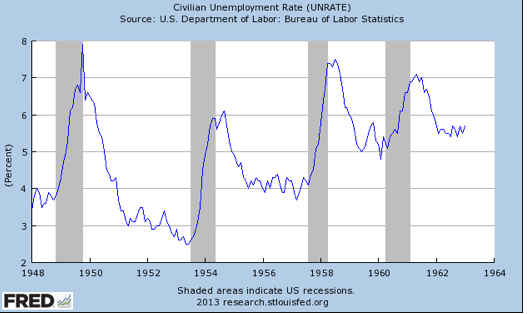
One of my nagging doubts has to do with the nature of the modern business cycle.  Krugman sometimes points to the 1950s as a sort of golden age, where income was much more equal that today.  But it was also different in terms of the frequency of business cycles; there were three during the Eisenhower administration alone:

Screen Shot 2013-03-09 at 4.58.24 PM

I doubt there’ll be any recessions during Obama’s 8 years of office, at least if you attribute the 2007-09 recession to Bush.  But in another sense Obama might preside over 8 years of continuous recession–with unemployment staying stubbornly high.

Does that affect Krugman’s argument?  I’m not quite sure.  We’ve never gone more than 10 years without a recession, and it’s already 5 years since the 2008 recession, with no end in sight for high unemployment.  If we have another recession in 2018, and the deficit gets massively larger, how reassuring will Krugman’s “cyclical deficit” argument seem?  If the debt/GDP ratio levels off in good times and rises in bad times, are we building a (debt) stairway to heaven?

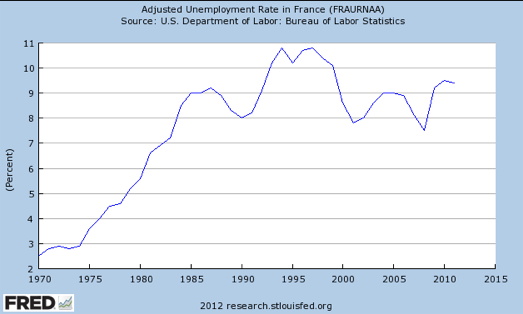
Now let’s go from one extreme to the other, from the Eisenhower administration to modern France:

Screen Shot 2013-03-09 at 4.54.13 PM

As you can see France never really recovered from the two oil shock recessions.  They’ve had nearly 30 years of unemployment fluctuating around the 8% to 10% range (it’s currently 10.5%)  Or maybe they did recover and what actually happened is the natural rate of unemployment rose to 9%.  They’ve been cycling around a new and much higher natural rate.

Why did this happen?  The progressive answer (lack of AD) doesn’t really work, as other European countries with similar AD policies have far lower natural rates. “Big government” is probably too simplistic, as some other European countries with big government have much lower unemployment.  Still, I’m more sympathetic to the supply-side explanations, which look at a wide range of labor market distortions.

I’m not predicting that we’ll follow in France’s footsteps, indeed I expect the unemployment rate to fall well below 7% if we return to 26 weeks maximum UI. But I do think we’ve got serious structural problems, a combination of a slightly higher natural rate of unemployment, more disability, and lower productivity growth (for reasons explained by Tyler Cowen and Robert Gordon.)  I lived through an earlier period where we were continually being surprised by bad news on the supply-side, and wouldn’t be surprised if it happened again.

Overall, I don’t think we are Eisenhower America, nor do I think we are France, rather somewhere in between.  If anything, I might be even more optimistic than Krugman about the persistence of low government bond yields, so I don’t see any imminent debt crisis ahead.  On the other hand I also think it might be harder to keep debt at a manageable level than Krugman assumes, as his “cyclically adjusted deficit” concept was actually developed for a 1950s-type business cycle, where you eventually returned to the old trend line.

Why have the last three recoveries been so slow?  Some people talk about factors like “financial problems”.  But that confuses real and nominal factors.  The RGDP recoveries have been slow because the NGDP recoveries have been unusually slow (compared to the 1950s, or just about any other decade.)  So the real question is; why have the NGDP recoveries been so slow?  It might be partly intentional—the Great Moderation and all.  Fast recoveries might trigger another recession.  But I think it’s also partly mistakes in monetary policy.  Obviously in this case the zero bound played a role, but the deeper explanation is that real interest rates have been steadily falling since 1983, from 7% to less than zero.  And this is precisely when the slow recoveries started.  The Fed isn’t easing as much as it thinks it’s easing in each recovery, because they have continually underestimated how much the (Wicksellian) equilibrium real rate of interest has fallen.  Thus they’ve overestimated how much monetary stimulus they’ve provided.  It’s all John Taylor’s fault.  (Just kidding.)

PS.  My previous post on this topic was called “Staircase to Heaven.”  I really am getting senile.

A consumption tax is a wealth tax

Josh Barro recently discussed a study which polled Americans on attitudes toward wealth:

Indeed, while the top quintile of Americans hold about 84% of national balance sheet wealth, survey respondents believe the figure is just 59% and would prefer a figure of 32%. The authors use the paper to argue for more redistributive policies — or rather, for the insertion of these public preferences into policy debates.

All that study shows is that Americans aren’t very good at math.  If every single American made an identical income at the same age, then wealth would still be more unequal than 32% in the top quintile.  Even if saving propensities were also identical, 18 year-olds typically have far less wealth than 55 year olds who are married and have kids.  And does anyone seriously believe Americans favor paying brain surgeons an identical salary to a clerk at Walmart?  Let’s get serious. Anyone who favors inserting that sort of “public preferences” into the policy debate needs to have his head examined. This is the sort of things that gives economists a bad reputation.  It may be a great study, but come on, use some common sense!

Ezra Klein recently suggested that the highly unequal levels of wealth (which by the way Josh Barro shows occurs in other developed countries as well), is leading to interest in a wealth tax:

So then, here’s what you should know about wealth inequality in the United States: It’s worse than Americans want it to be, much worse than they think it is, and it’s increased over the last few decades. Which is one reason that there’s been more talk of a wealth tax lately.

Matt Yglesias responds as follows:

If you want to think about taxing wealth more heavily, it’s probably worth trying to draw some distinctions. The old argument going back to David Ricardo and Henry George that you should tax land wealth very heavily seems quite sound to me. Levying heavy tax rates on valuable land (whether it’s valuable because it’s in San Francisco or valuable because it has oil in it) does not create any bad incentives. These days, a lot of wealth consists of patents that could be taxed more heavily but should probably just be abolished. But in terms of general taxation of financial assets, the basic concept of taxing estates rather than a steady drip-drip-drip of wealth taxes seems like a reasonably sound idea. We’ve reduced estate taxes a lot over the past 15 years, which seems like a very strange policy response to growing income inequality and some evidence of capital-biased technological change.

I partly agree with Yglesias—a land tax is sensible.  And I agree with his earlier calls for a progressive consumption tax.  But I strongly disagree with the inheritance tax.  Ironically, Matt has a picture of a mega-yacht on the top of his post calling for an inheritance tax.  But an inheritance tax specifically exempts services provided by mega-yachts, and instead taxes only the wealth of thrifty old guys who leave all their fortune to others!  Do we really want to tax the sort of old man or woman who puts all their wealth back into investments at a higher rate than we tax those hedonists who splurge on wine, women, and song? That seems morally grotesque, indeed I’d tax people on the basis of how many resources they consume, or take out of society, not what they produce.

Most people regard consumption as being much more equal than income, which is then much more equal than wealth.  But this is a cognitive illusion, as wealth is basically the present value of future expected consumption (for yourself, plus those you donate to.)  What causes this confusion? It’s partly life cycle effects and consumption smoothing, which I’ve already discussed.  It’s also partly due to the fact that the rich tend to have lots of easily measured wealth (financial assets) whereas the poor and middle class rely more on (difficult to measure) human capital as a form of wealth.

I can already anticipate commenters insisting that wealth is bad for other reasons—it gives people too much political power, for instance. Maybe, but it’s a pipe dream to think we can measurably reduce that problem via progressive policies.  Even the Nordic countries have very unequal wealth.

We need a mixture of the following, in this order:

1.  Taxes on externalities (carbon, but not cigarettes.)

2.  Taxes on land (by acreage, not value, with the tax rate varying by zip code.)

3.  Progressive consumption taxes.  These could include

a.  VAT with poverty level consumption exempted.  Progressive taxes on housing services (i.e. progressive property taxes.)

b.  Progressive payroll taxes—treating capital income that people earn from their own firm as wages, unless they can show otherwise.

c.  Negative taxes on low wage jobs (EITC.)

Do that, and you can pretty much adopt a radical libertarian policy in most other areas (with a few exceptions.)

PS.  Evan Soltas has some good arguments against wealth taxes.

What caused the Great Recession?

A collapse in AD.  But what caused that?

Excessively tight monetary policy. But what caused that?

Mistakes by the Fed.  But what caused that?

Misdiagnosis of the crisis by most macroeconomists.  But what caused that?

I’m not sure, but here’s an example from Jeffrey Sachs:

The US economic emergency in late 2008 and early 2009 wasn’t really an aggregate demand crisis but a financial crisis.

BTW, his essay makes lots of good arguments against foolish and wasteful fiscal stimulus.  But that sentence really jumped out at me.

Does anyone know of a model that suggests a big drop in nominal spending causes mass unemployment when the economy is otherwise healthy, but doesn’t cause mass unemployment when the economy also has financial problems?  And how would you expect a collapse of AD to affect the financial system?

HT:  Liberal Roman

PS.  Lars Christensen just sent me the most recent nonsense from John Tamny, the man who thinks New Keynesian inflation targeting means the Fed is trying to stabilize each and every single individual price in the economy.  I kid you not.  Forbes magazine continues its crusade to discredit the entire conservative movement.

“Ironically enough,” Bernanke is sounding increasingly market monetarist

A number of commenters have discussed Bernanke’s speech from nine days ago.  There are market monetarist ideas throughout the speech, including:

1.  Low long term rates do not reflect easy money.

2.  Slower growth in AD could worsen the financial crisis.

3.  We should address the risk of financial excess through better regulation, not tighter money.

4.  The downward trend in long-term real interest rates reflects sluggish growth, and expectations of slower growth going forward (in developed countries.)

5.  Tighter money could (paradoxically) lead to lower long term interest rates.

I certainly don’t believe that these are exclusively market monetarist ideas, but what struck me is how Bernanke seemed to emphasize the very same points that MMs tend to keep harping on.

If you were to boil the whole speech down to a couple paragraphs, I’d say these show what was really on Bernanke’s mind:

One might argue that the right response to these risks is to tighten monetary policy, raising long-term interest rates with the aim of forestalling any undesirable buildup of risk. I hope my discussion this evening has convinced you that, at least in economic circumstances of the sort that prevail today, such an approach could be quite costly and might well be counterproductive from the standpoint of promoting financial stability. Long-term interest rates in the major industrial countries are low for good reason: Inflation is low and stable and, given expectations of weak growth, expected real short rates are low. Premature rate increases would carry a high risk of short-circuiting the recovery, possibly leading–ironically enough–to an even longer period of low long- term rates. Only a strong economy can deliver persistently high real returns to savers and investors, and the economies of the major industrial countries are still in the recovery phase.

.  .  .

Conclusion

Let me finish with some thoughts on balancing the risks we face in the current challenging economic environment, at a time when our main policy tool, the federal funds rate, is near its effective lower bound. On the one hand, the Fed’s dual mandate has led us to provide strong support for the recovery, both to promote maximum employment and to keep inflation from falling below our price stability objective. One purpose of this support is to prompt a return to the productive risk-taking that is essential to robust growth and to getting the unemployed back to work. On the other hand, we must be mindful of the possibility that sustained periods of low interest rates and highly accommodative policy could lead to excessive risk-taking in some financial markets. The balance here is not an easy one to strike. While the recent crisis is vivid testament to the costs of ill-judged risk-taking, we must also be aware of constraints posed by the present state of the economy. In light of the moderate pace of the recovery and the continued high level of economic slack, dialing back accommodation with the goal of deterring excessive risk-taking in some areas poses its own risks to growth, price stability, and, ultimately, financial stability. Indeed, as I noted, a premature removal of accommodation could, by slowing the economy, perversely serve to extend the period of low long-term rates.

For these reasons, we are responding to financial stability concerns with the multipronged approach I summarized a moment ago, which relies primarily on monitoring, supervision and regulation, and communication.  (emphasis added)

Regular readers of my blog know that I focus on counterintuitive ideas. It’s not because I like counterintuitive ideas (although I do), but because in the area of monetary policy I think they are correct.  (In many other areas of econ I go with the conventional wisdom.)  That’s why I bolded “ironically enough” and “perversely.”   It really jumped out at me that Bernanke is becoming surprisingly counterintuitive for a Fed chairman.  But then he’s already looking beyond this job to his legacy, and doesn’t want to see all his hard work destroyed by a repeat of the “Folly of 1937.”

Or the eurozone folly of 2011.

PS.  David Beckworth, Joe Weisenthal, Ryan Avent, Jim Hamilton, and Marcus Nunes also comment.