Creep

Matt Yglesias directed me to this audio:

Obsession with George Soros? Check

Obsession with black women getting abortions? Check

Unease with women being free to travel to other states? Check

All in 48 seconds, three seconds longer than the shower scene in Psycho.

Yes, you could probably find just as many offensive statements in this blog. But guess what—I don’t plan to run for vice president.

Trump would be our oldest president and may not last for 4 1/2 more years. Cat ladies need to get ready for President Vance. (Here’s another Vance dig at the childless. Jesus?)

If you wish to read a more serious take on Vance, check out this Fukuyama essay. Or this Janan Ganesh piece.

PS. Strange new respect for Trump on my part. It seems he (correctly) wanted Doug Burgum and his sons talked him into (creepy) Vance. Trump has also come around to my view on TikTok and housing construction. He’s “evolving”.

PPS. Over at Econlog I’ve done some posts pointing out that taxes and subsidies are essentially the same thing. Matt Yglesias makes the same point in a more colorful way:

Facing or creating?

During the 2010s, Jim Bullard was probably my favorite Federal Reserve bank president. David Beckworth has an interview with Bullard, in which he makes a number of insightful observations. As usual, I’ll focus on an area where I seem to spot a difference of opinion:

Bullard: So, the mentality at the time [2020] was, still, that this shock was going to be like the global financial crisis shock, in the sense that it would take many, many years for the economy to fully get back to trend, and a lot of the rhetoric at the time was that this is not going to be V-shaped. This is going to be an L-shaped recovery, and all of those kind of things. So, there’s a lot of fighting the last war, and I would actually give credit to former Chair Ben Bernanke, who, I think, had a better analogy for the pandemic. He said that it’s like a big snowstorm, and you have to wait for the snow to melt, but it’s really just waiting for the snow to melt.

So, it’s not a fundamental disruption, the way that the financial crisis was, and you shouldn’t necessarily expect this very long recovery. Well, if you look at the data now— it’s about GDP anyway— It’s about as V-shaped as anything that you’ll ever see, and so I think that just this misreading of it and this kind of rhetoric around the idea that we were going to be in a very, very long recovery period, and so, therefore, if that’s what you thought, then you should say, for monetary policy, look, we’re not going to deviate from our balance sheet policy or our interest rate policy for a couple of years at least, because we think that the recovery is going to be so slow.

I would expect a slow recovery if a recession were caused by “real” or supply-side factors, and a fast recovery if the recession were a demand side problem. After all, demand shortfalls can be easily addressed with monetary stimulus. So was the 2008-09 more of a real shock whereas 2020 was a demand shock? I’d say the exact opposite. In 2008, the problem was a lack of aggregate demand (falling NGDP), whereas in 2020 the problem was real—much of the economy shutdown by Covid. That’s a harder problem to resolve.

Now of course the advent of vaccines in early 2021 made the real shock less persistent than expected in 2020. Even so, I cannot see why we’d expect a faster recovery from Covid than from the 2008 recession.

I worry that the Fed is too fatalistic. The Fed sees itself facing problems like an L-shaped recovery, whereas I see the Fed creating problems like an L-shaped recovery.

Bullard is a smart guy, and presumably would have a good response to this line of argument. He might argue that while inadequate NGDP was the problem after 2008, there was nothing the Fed could do about it. Or perhaps that there was something the Fed could have done about it, but it would have required such a rapid and radical regime change as to be politically impossible. If that is the argument, then I’d agree.

But my goal is not to discuss what’s politically feasible at a point in time; it’s to make people rethink the way the macroeconomy works so that ideas that once seemed politically infeasible (say NGDP level targeting), can move within the Overton window.

Later in the podcast, Bullard makes a strong argument for NGDP level targeting, which centers on the observation that almost all of our contracts are specified in nominal terms.


Children are the future

Back in 2010, I predicted that India would have the world’s largest economy (in PPP terms) within 100 years. A few months later, I moved up the predicted date to 2081. Based on this graph, I’d now say some time in the 2060s:

Today, India and China both have a bit over 1.4 billion people. But look at the disparity in births! India has 23.2 million births, whereas no other country has even 9 million. By the 2060s, those Indian babies will be 40 years old, right in the prime age for working. As long as India can get its productivity up to half of China’s level (which seems doable in the long run) then it should surpass China in GDP (PPP). Of course, long before that the US will have fallen to third place. (We’ll still be number one in per capita terms, which matters for living standards.)

I used to find these sort of predictions to be sort of intriguing. More recently, they’ve started to seem kind of pointless. That’s partly because I won’t live to see how all this pans out, and partly because AI is eventually likely to transform the world in such a radical fashion that all predictions about the 22nd century become about as meaningful as those a 13th century peasant might have made about the world of 2024.

It isn’t just that India has more births than China, even pre-breakup Pakistan has more births. That’s crazy. (When I was young, Bangladesh was part of Pakistan.)

PS. This is one reason I’m not part of the natalism panic. Even with low birth rates, the world’s population will reach about 10 billion in 2100. And after that it’s totally impossible to predict anything. I’m not saying the birth rate worriers are necessarily wrong, just that no one knows what the 2100s will look like.

Markets are smarter than you think

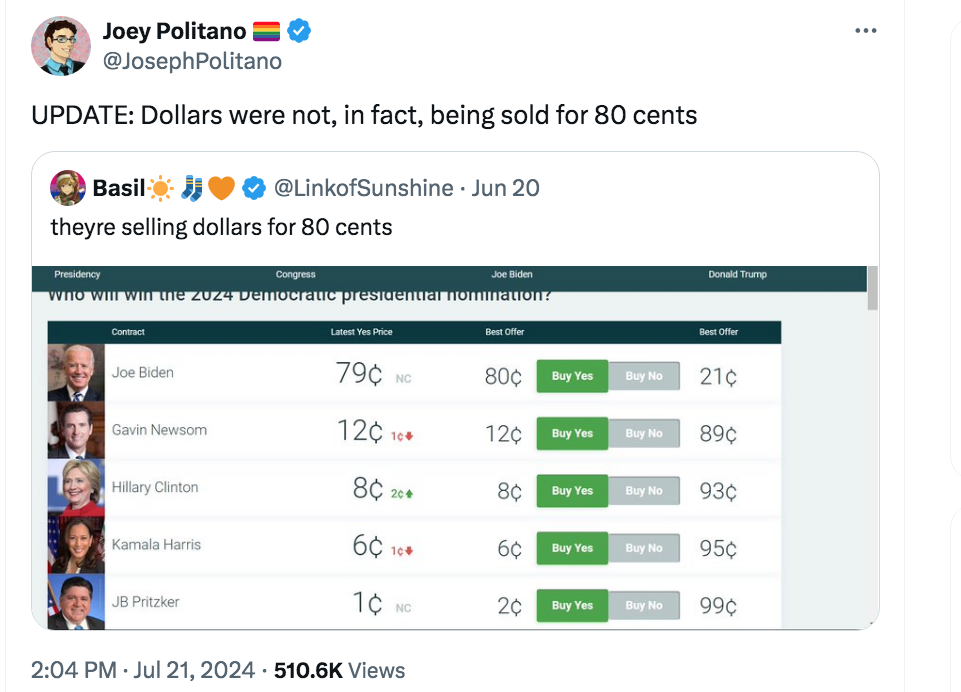
This tweet caught my eye:

If Biden had been nominated, I guarantee that this example would have been cited by anti-EMH types. “Markets were giving a 20% chance that someone else would be nominated, when it was obvious that Biden had things wrapped up.”

The market is smarter than you think.

PS. A few comments on Harris:

I often see right wingers making two points:

1. DEI programs that promote the unqualified are bad.

2. Problem X occurred in a system that had hired women and blacks, and hence DEI is to blame for problem X.

The first claim is true, while the second is usually sexist/racist.

The Harris case is particularly interesting. She was certainly “hired” because she is a black woman. And yet she’s far more qualified to be president than either Biden or Trump. Smarter, more articulate, more energetic, etc. (Of course I don’t agree with her politics, but that’s neither here nor there.)

On the other hand, she’s not the most electable Democrat, mostly because she is a black woman. That’s presumably why Obama has held back in endorsing her; he understands that someone like Beshear is more electable. Life is unfair.

No one looks good here. Not the DEI obsessed Democrats. Not the low news engagement swing voters that don’t like forceful black female personalities. Not the Republicans who whisper that Harris is a DEI hire. Very sad all around.

PPS. Can we please stop electing senile 80-year old presidents, especially ones who have committed dozens of felonies? Is that too much to ask? The same Republicans who (correctly) insisted Biden was senile see no problem with a very old man who rambles on interminably and incoherently in a major convention speech, in the way that you associate with leaders of countries like Cuba and Venezuela. Really?

PPPS. If we had to have a “thinker” as VP, couldn’t we choose one who is less shallow than Vance. (He’s not even able to hide his disgusting bigotry.) I recently met Rob Henderson at a book signing. His life story has some similarities to Vance’s but Henderson is a vastly more thoughtful intellectual.

PPPPS. When I say “markets are smarter than you think” I’m excluding Matt Yglesias, who doesn’t like headlines telling him that he doesn’t understand something.

The Age of Irony

That’s my prediction for the next 4 years.

Consider two definitions of Maoism:

1. Radical egalitarianism. Public shaming and forced apologies when people fail to spout obvious nonsense like, “All differences in pay between ethnic groups reflect racism.” (I guess there’s lots of racism against white Christian Americans, as they make less than Jews from Eastern Europe or Hindus from India.)

2. Resentment against the intellectual elite. Shut down the universities and send the intellectuals to the countryside.

Over the next four years, I expect to be eagerly munching on my popcorn as these two types of Maoists go after each other. Consider the following tweets:

Why not remove the tax exemption from all universities? Why would they go after only NGOs with more than $5 billion in assets? The answer is obvious. They are not upset by places like (relatively apolitical) Bentley College, where I used to teach. The right wing Maoists hate those pointy headed intellectuals at Harvard and Yale, as those are the people with real influence over our political system.

The ironies are rich. Our intellectual elite has an radical anti-elite ideology. Those who hate our intellectual elite, hate their anti-elite ideology. Thus they believe the elites must be punished.

Got that?

PS. Just to be clear. I’m not saying that going after tax breaks for universities is Maoist. (It may be good policy.) I’m saying that going after tax breaks for elite universities is Maoist.

HT: Razib Khan