
An old monetarist interpretation of interest on money (money isn’t credit)

Nick Rowe has an interesting new post:

We can imagine a world where all central bank money is electronic money, and the central bank can alter both the quantity of money and the interest rate paid on that money, and can make Rm and Rb move by different amounts, or even in different directions, if it wants to.

To my monetarist mind, an increase in Rm increases the demand for money, and that causes an excess demand for money, just like a reduction in the supply of money causes an excess demand for money. An excess demand for money, or an excess supply of money, has macroeconomic consequences. Any change in Rb is just one symptom of those macroeconomic consequences. We would get roughly the same macroeconomic consequences even if Rb was fixed by law, or if lending money at interest was tabu.

Let’s begin by looking at this from an old monetarist perspective.  They would argue that “the money supply” is some sort of aggregate, such as M1 or M2.  Here are four ways of reducing the supply of that aggregate:

A.  Reduce the supply of base money:

1.  Do open market sales

2.  Raise the discount rate to reduce discount loans

B.  Raise the demand for base money:

3.  Raise reserve requirements

4.  Raise the interest rate paid on base money

The first two policies reduce the supply of base money, and the second two reduce the money multiplier.  All four policies reduce the monetary aggregates such as M1 and M2.  Milton Friedman would regard all four as essentially the same policy, a reduction in the supply of money.

[Because I regard money as “the base,” I regard the first two as a lower supply of money and the second two as a larger demand for money.  But this is pure semantics; nothing of importance hangs on the difference between how I define ‘money’ and the definition used by old monetarists like Friedman.]

The interesting thing about interest on money is that it can be controlled even in a completely flexible price economy.  Recall that the only reason that changes in the monetary base lead to changes in market interest rates is that wages and prices and debt contracts are sticky.  If prices are completely flexible, as in a currency reform, a change in the money supply has no effect on interest rates. Indeed that’s even roughly true of a change in the aggregates caused by a change in the demand for base money (ignoring small “superneutrality” effect from a change in real base balances.)

A one time decrease in the money supply leads to a temporary rise in interest rates, but then when the price level adjusts interest rates fall back to their original level.

A one time increase in the interest rate on money causes a one time increase in market interest rates on bonds, but only because prices are sticky. In the long run the interest rate on money stays at its new and higher level, whereas the interest rate on bonds returns to its equilibrium level (consistent with money neutrality.)

Sticky prices make it seem like interest on money and interest on bonds are related, but that’s a cognitive illusion.  At a fundamental level a change in the interest on money is a change in the demand for the medium of account, and is a profoundly monetarist policy.  It is no different from changing the supply of base money.  In contrast, a change in the discount rate does have a direct effect on the cost of credit, and hence is a more “Keynesian” policy.  Unlike a change in the interest rate on money, which can be permanent, a change in the discount rate would lead to hyperinflation or hyperdeflation if permanent.  There is a long run Wicksellian equilibrium discount rate, whereas there is no long run Wicksellian equilibrium rate of interest on money.  The central bank is the monopoly supplier of base money and can attach any (reasonable) tax or subsidy it wishes, even in the long run.

Money is not credit.  That’s the whole point of this post.

Update:  Obviously the interest on money should not exceed the interest on bonds
The musical chairs model, updated

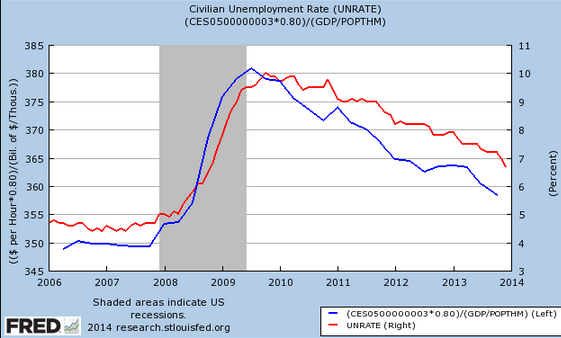
It’s been about 6 months since we’ve looked at the sticky wage model, so let’s see how it’s doing:

Screen Shot 2014-02-04 at 3.57.01 PMThe fit seems better than ever.  To my eyes it looks like “real wages” [(nominal average hourly earnings)/(NGDP/pop)] lead unemployment by about a month or two.  That’s partly an artifact of a flaw in the St. Louis Fred graphing program. The (W/(GDP/pop)) data for Q4 is put in the October 2013 slot, whereas it should be November 2013.  If you shifted the wage series one month to the right the correlation would look even closer.

The musical chairs model does a great job of explaining both the onset of the recession, its intensity, and the slow pace of recovery.  When the blue line gets down to about 350 the recession will be over and the red line (unemployment) will be in the 5% to 5.5% range.

More M*V plus sticky wages = recovery.  It’s that simple, and always has been.

PS.  Yichuan Wang has an excellent post over at Quartz explaining why it would be foolish for the Fed to try to pop bubbles.

About those high interest rates

I’ve recently read lots of articles claiming that the emerging markets are being hurt by the high interest rate policy of the Fed.  Obviously they don’t mean short-term rates, which are near zero, but rather long-term rates.  But 10 year bond yields are 2.6%.  Since when does 2.6% 10-year yields prevent EMs from achieving prosperity?  Those are amazingly low interest rates.  Is there a model that explains why 2.6% 10-year bond yields cause an EM crisis, or are people simply making a correlation ==> causation argument?

Some might argue that while interest rates are a poor indicator of the stance of monetary policy; EMs are nonetheless being hurt by tighter Fed policy.  But if that were true then US NGDP growth should be slowing, whereas it has actually been speeding up slightly.  Don’t get me wrong, I think policy is too tight, and a slightly easier policy would help the EMs.  That’s true and that’s important. But that was even more true a year or two ago when EMs were doing much better.  So why have they done much more poorly in recent months, even as US growth has sped up?

Lars Christensen says EMs need to make sure NGDP growth stays fairly stable, and I agree.  He points to Colombia as a country that is responding in the correct way to the global EM confidence shock.

I’m also confused by the constant complaints that the Fed is changing its forward guidance.  It’s true that the Fed recently made its forward guidance a bit more specific, and it’s true that the forward guidance is far from optimal.  But they certainly have not made any major changes.  Here’s a typical report:

Its communication strategy has been less than stellar, however. A misstep last summer by former Chairman Ben Bernanke left the markets believing that tightening would come sooner than expected, while recent trends have shown that the Fed almost certainly will have to abandon its 6.5 percent unemployment rate target for beginning to consider interest rate hikes.

It did not “abandon” anything last month, it clarified that it would not raise rates until either inflation rose above 2.5% or unemployment fell well below 6.5%.  That’s a more specific guidance than the previous 2.5% inflation/6.5% unemployment threshold.  It’s not clear why the market was confused by this switch, it was entirely rational.  Before the market was uncertain what would happen in the scenario where inflation is 2% and unemployment is around 6.4% or 6.5%.  They didn’t know if the Fed would raise rates in that case or not.  Now the Fed has clarified things, they will not raise rates in that situation. No promise was reneged upon. Indeed it would be better if the Fed dropped the unemployment threshold entirely and went with inflation, or better yet NGDP. But things are slowly improving in the guidance area.

The economics profession is very good at keeping secrets

The economics profession is very good at keeping secrets.  For instance, there has been very little discussion of how the effect of US fiscal austerity in 2013 was offset by monetary stimulus.  One year ago Joe Weisenthal wrote a story that shows another example of the secretive nature of economists.  He points out that economists were reluctant to publicly thank the Brits for running an experiment on monetary stimulus at the zero bound:

The Entire World Of Economics Is Secretly Thankful To The UK Right Now

Economists might not say it publicly, but privately, everyone is extremely  appreciative of the UK right now.

That’s because the UK has been a great laboratory of economic ideas in recent  years.

For one thing, the Cameron government came in with a mandate to undergo  austerity, and now people are talking about the country going into a  triple-dip recession.

Furthermore, the Bank of England has hired Mark Carney (the former Bank of  Canada) chief to be its next governor.

Carney is speaking today at Davos, taking the contrarian viewpoint that  monetary policy is not maxed out in most countries.

So Carney’s strategy at the BOE should be interesting to watch, to see if he  could conjure something up to reverse the UK’s slump.

All I can add is that over the past 12 months economists have done brilliant job of keeping the results of this experiment secret.  Economists should be put in charge of the CIA.

Do monetary shocks matter? And what is a monetary shock?

Mark Sadowski recently discussed a study by Harald Uhlig on the effects of monetary shocks on RGDP.  Uhlig didn’t find much effect.  I suggested that there is a severe identification problem, and that NGDP fluctuations are the best indicator of monetary shocks.  Mark replied as follows:

Scott,
Well if all NGDP shocks were treated as monetary shocks then we’re assuming that AD shocks are purely monetary in origin. Obviously that would result in much larger estimates for the proportion of RGDP variation attributable to monetary policy shocks.

That also seems like too strong an assumption to me. That is, I think that it is implicit that monetary policy is ultimately responsible for the level of NGDP at any point in time, but that doesn’t necessarily mean monetary policy is solely responsible for every shock to AD.

I don’t think there is any question that the vast majority of economists would agree with Mark and not me on this issue.  Let me try to explain why this stuff makes me a bit uncomfortable.  Here are some possible definitions of monetary shocks:

1.  Unexpected changes in the fed funds target

2.  Deviations of the fed funds target from the Taylor Rule value

3.  Unexpected changes in the monetary base

4.  Unexpected changes in M2

And there are many more.  For each proposed definition of a “monetary shock” you will get a different answer to the question; “How much impact do monetary shocks have on real output?” That makes it all seem quite arbitrary.

It might be helpful to return to the fiscal multiplier question as a point of comparison.  The multiplier might be defined as the impact of federal spending shocks on RGDP, holding both private investment and S&L spending fixed.  In fact, as far as I know economists tend to hold state and local spending fixed but not investment spending, which is allowed to vary for “crowding out” reasons when estimating the multiplier.  This makes no sense to me.  Federal authorities have no control over S&L spending.  Almost everyone agrees that the multiplier should be estimated holding monetary policy fixed, but no one seems to know what that means.

I have a completely different view.  I’m a pragmatist.  For me “the” fiscal multiplier is what happens when the federal fiscal authorities change federal spending, and all other sectors of the economy (S&L, the Fed, private investment) respond to that action in the way they actually do respond in the real world.  In other words, I want to know the counterfactual change in RGDP with or without that federal action, holding nothing constant.

Now let’s return to the puzzling problem of identifying monetary shocks.  To me the only interesting question is how much more volatile is RGDP as compared to an economy where the Fed has adopted the optimal policy.  That’s a pragmatic way to define the real effects of monetary policy.  It’s a definition with policy implications.  It tells us how much we can hope to improve things.  So if I knew how much more unstable RGDP has been over the past few decades, as compared to the volatility of RGDP in a policy regime that pegs the price of NGDP futures contracts to rise at 5% per year (assuming that policy is optimal), then that seems to me to be the most useful definition of the contribution of monetary shocks to the business cycle.  It’s a bit arbitrary, but every other definition I can think of is essentially 100% arbitrary.

Mark might reply that NGDP targeting cannot prevent all fluctuations in NGDP, which is true.  This is another reason why we need an NGDP futures market.  That market would provide a very good estimate of the amount of NGDP variation that was predictable, and hence preventable.  If we had that market, and if it was not targeted (and hence was volatile) it would be the ideal monetary shock indicator to put into these VAR studies.