
Brad DeLong needs to reread the Monetary History

Bob Murphy directed me to a Brad DeLong post bashing Milton Friedman:

In A Monetary History of the United States, published in 1963, Friedman and Anna Jacobson Schwartz famously argued that the Great Depression was due solely and completely to the failure of the US Federal Reserve to expand the country’s monetary base and thereby keep the economy on a path of stable growth. Had there been no decline in the money stock, their argument goes, there would have been no Great Depression.

I can’t understand how a brilliant economic historian like DeLong could make such a totally erroneous statement.  Milton Friedman and Anna Schwartz clearly documented the fact that the Fed increased the monetary base sharply during the Great Depression. They discussed the Fed’s QE policy of 1932.  So the preceding statement is flat out wrong.

And indeed the entire post is confused.  DeLong argues that the Great Recession was partly caused by the influence of Friedman’s ideas.  Actually, one could argue that the Great Recession happened because we did not pay enough attention to Milton Friedman.  Indeed this Friedman insight from 1998 was totally ignored in late 2008 by all but a tiny band of market monetarists:

Low interest rates are generally a sign that money has been tight, as in Japan; high interest rates, that money has been easy.

.   .   .

After the U.S. experience during the Great Depression, and after inflation and rising interest rates in the 1970s and disinflation and falling interest rates in the 1980s, I thought the fallacy of identifying tight money with high interest rates and easy money with low interest rates was dead. Apparently, old fallacies never die.

In early 2009 I wrote a piece sharply criticizing DeLong for claiming that monetary policy was ineffective at the zero bound and that we therefore needed fiscal stimulus. He finally got the message, and a few years later he was bashing the Fed for letting NGDP growth plunge.  Now he’s back to claiming there was nothing the Fed could do at the zero bound.

When I was in grad school in the 1970s, anyone claiming a fiat money central bank would be unable to debase its currency would have been laughed at.  As recently as the early 2000s mainstream economists like Mishkin, Bernanke, Svensson, etc., were still scoffing at that idea.  It’s a sad comment on modern macro that this bizarre theory has suddenly become mainstream without a single shred of evidence in support.  Even worse, most macroeconomists don’t even seem to know what evidence in support of monetary policy ineffectiveness would look like.

PS.  Bob Murphy also has a post on the same topic.  David Glasner criticizes the DeLong post for other reasons.

PPS.  I strongly believe that if the FOMC had been composed of 12 Brad DeLongs, the Great Recession would have been considerably milder.  Which means Brad is wrong.  🙂
What would blogger Bernanke have said in 2009?

Ben Bernanke has started a new blog.  That’s obviously good news.  At the same time I can’t help wondering what Bernanke would have blogged about in 2009, had he not been at the Fed.  In posts here and here I discuss a 1999 paper that is highly critical of the BOJ monetary policy, and pretty close to 100% market monetarist in its analysis. Here are a few examples, but read the entire two posts:

I do not deny that important structural problems, in the financial system and elsewhere, are helping to constrain Japanese growth. But I also believe that there is compelling evidence that the Japanese economy is also suffering today from an aggregate demand deficiency. If monetary policy could deliver increased nominal spending, some of the difficult structural problems that Japan faces would no longer seem so difficult.  (italics added.)

And:

The argument that current monetary policy in Japan is in fact quite accommodative rests largely on the observation that interest rates are at a very low level. I do hope that readers who have gotten this far will be sufficiently familiar with monetary history not to take seriously any such claim based on the level of the nominal interest rate. One need only recall that nominal interest rates remained close to zero in many countries throughout the Great Depression, a period of massive monetary contraction and deflationary pressure. In short, low nominal interest rates may just as well be a sign of expected deflation and monetary tightness as of monetary ease.  (Italics added.)

Not much time today; I’ll have lots more to say later.  I do regret the snarky tone of these two early posts.  When I started blogging I didn’t fully appreciate the restrictions imposed on a Fed chair.

Amazing coincidences

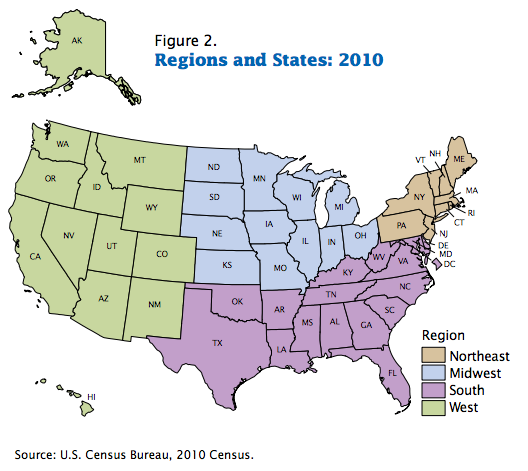
I don’t know why I have to keep shooting down this Sunbelt myth.  No, people don’t like hot weather, they like nice weather.  But they really, really like no state income tax. Here’s the US by region:

Screen Shot 2015-03-29 at 11.59.43 AMThis link has census data for the most recent decade (2000-2010).  The US population grew at 9.7% over that decade. Let’s start with the south central states, which are hot and muggy. Between Kentucky and Texas there are 8 purple states (9 if you include West Virginia). Six of the 8 (or 7 of 9) had population growth below the national average, including oil rich Louisiana and Oklahoma.  So much for the sun “belt.” Tennessee and Texas were the only two that grew faster.  And oh by the way, they are the only two with no state income tax.

On the west coast, all states grew faster than the national average. Yes, its climate is nicer that the south central region.  But look at the more detailed data and you’ll see that hot and sunny Washington state and Alaska grew the fastest of five bordering the Pacific.  And oh by the way, Washington and Alaska are the only two with no state income tax.

How about the 9 states in the northeast?  All grew slower than the national average, but tropical New Hampshire was the fastest of the tortoises.  And oh by the way, New Hampshire is the only one with no state income tax.

How about the 12 Midwestern states?  Like the northeast it was a slow growing area. But the best of a bad lot was South Dakota.  Non-American readers should know that South Dakota offers NOTHING.  Choosing to move to South Dakota over the Twin cities area of Minnesota is like choosing Belarus over Stockholm, Sweden.  Think of it as a slightly warmer “Fargo.” And oh by the way, South Dakota is the only Midwestern state with no state income tax.

In the inland southwest there are 5 fast growing states.  Nevada easily led the group. And oh by the way, Nevada is the only one with no state income tax.

Yes, there are a few outliers.  The only southeastern state with no income tax is Florida, which grew “only” by 17.6%.  Florida was narrowly edged out by Georgia (18.3%) and North Carolina (18.5%).  It’s worth noting that over multiple decades Florida has grown faster than the others, but with its population recently surpassing New York it may now be a bit congested.  In fairness, the same problem applies to California (which grew 10%).

And the ninth state with no income tax is Wyoming, which led Montana but trailed Idaho in the northern Rockies region.  Unlike Idaho, Wyoming basically has no cities. How many frustrated residents of Buffalo, NY suddenly decide, “I want to be a cattle rancher”?

For the US as a whole, only nine states lack a state income tax.  And the fastest growing state in the entire country was Nevada (at 35.1%), one of those nine.

Lots of amazing coincidences between having no state income tax and population growth relative to your neighbors.

Paul Krugman says:

So when you ask why Sunbelt states have in general grown faster than those in the Northeast, don’t credit Art Laffer; credit Willis Carrier.

I say credit both Laffer and Carrier, at the margin.  Good weather and low taxes are both important.  But people don’t like south central unless you also eliminate state income taxes.

However . . . I predict that tax differentials will play a less important role in the future. Tyler’s right that as the country gets ever wealthier, amenities will play an increasing role.  (The dramatic and underreported slowdown in New Hampshire’s growth is the canary in the coal mine for supply-siders.)

Some day I hope to move to sunny LA.

The right variable for the right argument

Tyler Cowen links to an Edward Hugh post:

So, what do you do about the problem of secular stagnation? Again here there is divergence of opinion. Some still seek to treat the phenomenon as if it were a variant of the liquidity trap issue. Most notable here is Paul Krugman, who continues to hope that massive quantitative easing backed by strong fiscal stimulus will push the economy back onto a healthy path. But if the issue is secular stagnation, and the root is population ageing and shrinking, it is hard to see how this can be. The fact that Japan is just about to fall back into deflation 2 years after applying a monumental Quantitative Easing problem seems to endorse the idea that the problem may have no “solution” in the classical sense of the term.

Hugh’s conclusion may be sound, but the analysis here is muddled.  First of all, the lack of inflation in Japan has the exact opposite implication of what Hugh assumes.  If Japan’s problems were structural, then this would show up as excessive inflation.  If Japan is falling back into deflation, then this suggests an AD problem, not a structural problem.

I frequently see people making arguments without knowing what data points they need to defend these arguments.  For instance people often use unemployment and RGDP data interchangeably, whereas they actually have very different implications. Because Japan faces a falling population, and a rapidly falling working age population, its RGDP growth prospects are quite weak.  So Hugh is right on that point; Paul Krugman’s proposed demand stimulus would not lead to a growth surge in Japan. But what about unemployment?  Here demand stimulus could help, if Japan had an unemployment problem.  But does it? The unemployment rate in recent months has been the lowest in decades.  Even the inflation data cited by Hugh is misleading. Abenomics has raised the price level in Japan, reversing a secular decline.  The near term expected deflation is associated with falling oil prices, and is probably just as transitory as the previous high inflation following the April 2014 sales tax increase. Trend inflation is well below Abe’s 2% target, but better than under the previous (deflationary) regime.

The focus of Hugh’s piece is Finland.  He points to the very weak recovery, and suggests that structural factors are involved. Perhaps so, but some of the data he cites point in exactly the opposite direction.  Finnish unemployment has been rising, and at 9.2% is at the highest rate in more than a decade.  Meanwhile Hugh’s post shows inflation in Finland falling to zero. Those data points suggest a lack of aggregate demand, not structural problems.

Despite all of these reservations, I actually agree with most of Hugh’s conclusions.  Austerity wouldn’t do much for Finland, nor would fiscal stimulus.  Finland probably does have some structural problems (he cites falling productivity and a rapidly falling working age population), and wage growth overshot productivity.  That’s why it’s not doing as well as Germany or Austria.  But if you are going to convince people like Krugman, you need to use the right data to support your arguments. Very few pundits do this.

Money illusion on steroids

Stephen Kirchner sent me the following from the Financial Times:

As economic growth returns again to Europe and Japan, the prospect of a synchronous global expansion is taking hold. Or, then again, maybe not. In a recent research piece published by Bank of America Merrill Lynch, global economic growth, as measured in nominal US dollars, is projected to decline in 2015 for the first time since 2009, the height of the financial crisis.

In fact, the prospect of improvement in economic growth is largely a monetary illusion.

I actually had to read this several times to make sure that my eyes were not deceiving me.  After all, this is the Financial Times, the world’s leading financial newspaper.  So we are to believe that even though real GDP is expected to rise, this isn’t actually “growth,” because output in Europe and Japan measured in US dollars is expected to decline.  OK, that’s pretty weird, and you wonder why he didn’t choose to measure Japanese output in terms of Brazilian reals or Indian rupees, but we’ll let that pass. What floored me was the next sentence, that measuring economic growth in real terms rather than nominal terms was an example of money illusion.

It seems like that since 2008 people can just say anything.  There are no rules anymore.  You can say that a good way to reduce inflation is cutting interest rates.  You can say that monetary policy is ultra-expansionary in countries suffering from deflation.  Say whatever you want, the lunatics have taken over the mental asylum.  It’s like the Chinese Cultural Revolution—all the old orthodoxies are discredited.  Anything goes.

One argument is that if central banks were not created to execute fiscal policy, then why require them to maintain any capital at all? Capital is that which is held in reserve to absorb losses. If losses are to be anticipated, then a reasonable inference is that a certain expectation of risk must exist. Therefore, central banks must be expected to take on some risk for policy purposes, which implies a function beyond the creation of a monetary base to maintain price stability.

Umm, how about bond price risk due to interest rate changes, not bond defaults?

In response to those who argue against the metamorphosis of monetary policy into fiscal policy, one need only point toward the impact of quantitative easing on interest rates. The depressed returns available on fixed income securities, largely as a result of QE, are acting as a tax on investors, including individual savers, pension funds and insurance companies.

Let’s see, the Fed did lots of QE over the past 6 years and is expected to raise rates later this year.  The ECB did none until a few weeks ago, and is expected to hold rates at zero for the next . . . well, basically forever.  Oh, and despite all the QE done by the Fed, the quantity of T-bonds held by the public has soared dramatically higher in recent decades.  But heh, whatever, go ahead and keep saying that QE is holding rates down.  Nobody cares about reality anymore; it’s all about throwing out catchy sounding observations.

Essentially, monetary authorities around the globe are levying a tax on investors and providing a subsidy to borrowers.

Yes, causing the biggest crash in NGDP growth since the 1930s sure helps borrowers.  They should all thank the Fed, and thank the ECB even more.

In the long run, however, classical economics would tell us that the pricing distortions created by the current global regimes of QE will lead to a suboptimal allocation of capital and investment, which will result in lower output and lower standards of living over time.

Which classical economists is he referring to?  I don’t recall that argument in any of the classical writers I read.  I do recall reading classical economists say that the sort of deflationary monetary policy that we see in Europe could reduce output and living standards. But QE? I must have missed that.

I sure wish America could go back to the boom year of 2009, when “living standards” soared much higher.  You remember, the year when America’s GDP soared higher at double digit rates (when measured in terms of euros.)