Why are Trumpistas so much nicer than Trumpian politicians?

We all know that Trump’s a bully.  What many people don’t seem to know is that bullying is an important attribute of many Trump-like politicians.  I’ll just provide a few examples here.  Let’s start with a recent article in The Economist, discussing Swedish politics:

Many municipalities, like Gothenburg, are already in this situation. The city’s 13-member executive is split between right and left; the odd seat was won by the Sweden Democrats in 2014. They are shunned by other parties. Besides ideology, says David Lega, the city’s deputy mayor, there is a character issue: the Sweden Democrats’ council member was expelled from his party for allegedly bullying subordinates.

OK, that’s just an anecdote.  But on the very same page of The Economist, there’s an article on Slovenia:

But the SDS has been unable to form a coalition. Many parties refused even to talk to it. Instead, five smaller centre-left parties banded together to form a minority government with outside support from the hard left. Other politicians justify their decision to exclude the SDS by arguing that Mr Jansa is a divisive bully. “When someone attacks us so personally and so aggressively, he should expect to see the results during negotiations,” says Vojmir Urlep, Mr Sarec’s economic adviser. Luka Mesec, of Levica, a leftist party, accuses the SDS of “scary anti-migrant discourse.”

OK, that’s just two anecdotes.  But the most powerful figure in Italy’s new government (Salvini) is almost universally viewed as a Trump-like figure, and he’s also a bully.  (In addition to being an overt racist and a fan of Mussolini. In other words he’s even worse than Trump.)

It’s also worth noting that Trump seems to despise polite leaders such as Obama, Trudeau and Merkel, whereas he’s drawn to leaders who are bullies, such as Duterte, Orban, Putin, etc.

However, I see no evidence that Trump voters are any less polite than Trump’s opponents.  When I moved from an anti-Trump area (Boston) to a pro-Trump area (south Orange County), I immediately noticed that people were nicer, on average.)  So why are Trumpian leaders such jerks?

One possibility is that Trumpistas have a more “tribal” view of the world.  People who travel to regions dominated by tribalism, say Afghanistan, often remark on how the people they meet are incredibly generous and kind.  This despite the fact that these societies are often tearing themselves apart with civil war.

Here’s a hypothesis.  The global rise of right-wing authoritarian nationalism is not really about immigration, it’s about Islam.  Consider the following regions, which have seen political developments that seem a bit “Trumpian”:

The USA, Europe, Russia, India, China, The Philippines, Burma, Thailand.

What do they have in common?  The public worries about Islam.

Now think about countries that have not seen such developments (Argentina, New Zealand, South Korea, etc.)

The first two regions with Trumpian problems (USA and Europe) face immigration issues. Maybe Russia to a lesser extent. But in the remainder, immigration is less of an issue. On the other hand, Islam is a big issue in all of the countries in the first list.  In each case, the majority of the population has a rather negative view of Muslims.  In my view, that’s what’s driving the global rise of Trumpism.  That causes even individually polite voters to support bullies—they want someone strong enough to fight against the perceived threat of Islam. (Yes, some Americans supported Trump for tax cuts or Supreme Court picks, but that’s not what got him the nomination.)

Burma is a particularly interesting case.  In perhaps no other country in the world would you less expect a Trumpian leader.  Burma’s leader is an almost universally revered Nobel Peace Prize winner.  Her career is almost a textbook definition of liberalism.  But the forces of anti-Islam in Burma are so strong that even she has turned into a right-wing authoritarian nationalist. If Burma is not safe, then nowhere is safe.  Except, of course, for countries where Islam is not viewed as a threat (like Argentina, New Zealand and South Korea.)  BTW, so much for the “great woman” theory of history.  If Burma doesn’t refute that theory, I don’t know what will.

You may recall from high school that bullies are less likely to be intelligent than non-bullies. A new book by Bob Woodward confirms that even Trump’s closest aides regard him as an idiot.  They see their job as protecting the country from his rash instincts:

The book is said to claim:

  • One month after Trump became president, he asked Chairman of the Joint Chiefs of Staff Gen. Joseph Dunford for plans for a preemptive strike on North Korea.
  • After a chemical attack in April 2017 was tied to the Syrian regime and President Bashar al-Assad, Trump told Defense Secretary James Mattis that he wanted Assad assassinated, saying, “Let’s fucking kill him! Let’s go in.”
  • During Trump’s practice session with his lawyers for a potential interview with special counsel Robert Mueller, he disastrously melted down — which led his then-attorney John Dowd to tell him, “Don’t testify. It’s either that or an orange jumpsuit.”

Much like Michael Wolff’s book Fire and Fury, the book portrays President Trump as detested and scorned by many of his top advisers, who are said to see themselves as working to protect the country from someone they see as ignorant and irresponsible.

  • White House Chief of Staff John Kelly purportedly called Trump an “idiot” and “off the rails,” and said “we’re in Crazytown.”

  • Mattis is described as telling associates that Trump acted like, and had the understanding of, “a fifth- or sixth-grader.”

  • Former National Economic Council director Gary Cohn purportedly took trade-related documents off Trump’s desk to prevent him from signing them and causing crises.

  • Dowd is described as believing Trump to be a “fucking liar.”

In fairness to Trump, he’s a bit better at noticing flaws in others:

Trump himself, meanwhile, is described insulting current or former aides such as Reince Priebus (“like a little rat”), H.R. McMaster (“like a beer salesman”), Jeff Sessions (“mentally retarded, he’s this dumb Southerner”), Wilbur Ross (“past your prime”), and Rudy Giuliani (“you’re like a little baby”).

The new Italian government is even more of a clown show than the Trump administration.  (The ruling party was literally founded by a clown.)  Because Italy has much weaker public finances than the US had when Trump took over, their crazy fiscal proposals threaten to cause a crisis, which might eventually blow the eurozone apart.

There’s another interesting trend in global Trumpism.  In almost every case the populist movement started as a “liberal” party (in the international sense of favoring small government.) In some cases it was a new party (the AfD, etc.)  In other cases they took over an existing party (the GOP).  As far as I can tell, the movement against Islam was almost always associated with a move away from small government ideology in the realm of economic policy.  These parties now favor high government spending.  It’s not obvious to me why these two trends are connected, but they seem to be. I’d be interested in your thoughts.  (This means Corbyn is not as far from Trump as many people assume.  He’s a bigot who talks about going after the “fake news” media.)

I am not interested in your thoughts on whether I was right about Trump.  The fact that his closest advisors have exactly the same view of Trump as I do seals the deal in my mind.  Case closed.  If you still can’t see it, then no amount of debating on my part will help you.

PS.  McCain’s body wasn’t even cold before Lindsey Graham starting kowtowing to Trump.  Sometimes these things just take one’s breath away.

PPS.  Trump’s not the first bully to reach the Presidency, LBJ and FDR also qualify.



What information should we consume?

This is my second “Ted talk”.  Ted asked:

How do you fight against selection bias as you consume information about the world?

One answer is to read “everything”, as does Tyler Cowen.

But you may not have the time, in which case I’d focus on a “diverse” set of reading material. This means much more than avoiding ideological bias (although that’s important too.)

1.  Read material on both sides of the ideological spectrum, indeed on many different sides.  I subscribe to three magazines, which represent three different ideological perspectives.  (NYR of Books, The Economist, Reason.)  I also spend a lot of time reading the NYT, WSJ, FT, WaPo, National Review, Bloomberg, South China Morning Post, Yahoo and lots of other outlets—mostly online.  Don’t let your ideological bias affect how you view a news outlet.

2.  Avoid geographic bias.  It’s almost inevitable that you’ll be biased toward your own country (I’m no exception), but push back against that bias.  Try to read lots of news about other countries.  Don’t focus on the countries that the news media considers important; focus on what’s actually important.  For instance, a few decades ago I decided to stop reading about the Israeli/Palestinian conflict.  I’d had enough.  It’s not that the conflict is not important; it is.  Rather it’s not as important as the news media (on both sides of the issue) assumes it to be.  There’s no objective reason why you would want to pay more attention to the Palestinians than to the plight of Muslim minorities in western Burma, northwest China, or some other region. (One exception is if you are Palestinian or Jewish, or in the case of Northern Ireland, if you are Irish.)

3.  Read about a wide range of topics.  I just read a book about psychedelics, and I now realize that prior to reading the book I knew almost nothing about the subject. That was because I had little interest in the topic, and had never really paid attention.  While reading Michael Pollan’s book I found some interesting material on a wide range of topics, such as mental health, meditation, drug laws, consciousness, the culture of Silicon Valley, etc.  Indeed the book might even be of some interest to a person who has absolutely no interest in LSD.  The book’s main flaw is that it focuses too much on the US (see previous point.)  My next book (on the Great Recession) has the same problem.

4.  Most non-economists assume that economics is the field that studies the economy.  In fact, it would be more accurate to describe economics as a certain way of thinking about the world.  (Think of the joke, “Economics is about how people make choices; sociology is about how people don’t have any choice.”)  If you are an economist you should occasionally look at other social sciences, so that you can examine alternative ways of thinking about problems.

5.  Read lots of fiction.  One of our biases is to put too much weight on our own life experience, and not enough on the life experience of others, especially people from different cultures.  Reading fiction helps us to overcome that bias.  Good films are also helpful, especially when they are not too political.  Books or films with obvious messages are likely to have oversimplified the issue.  (The film “Three Identical Strangers” is a recent example.)  Films where the message is less obvious (say The Death of Lazarescu) are often ones with the more important implications. It’s become a cliche that fiction is often truer than non-fiction.

6.  Read extremely smart bloggers, not people you agree with.  Read people who annoy you.  Paul Krugman has a way of writing that many conservatives and libertarians find to be quite annoying. But he’s still a very bright intellectual who often has interesting things to say.  Ditto for Brad DeLong. I often come across commenters who say, “I don’t see why everyone thinks X is such a genius.”  If you don’t understand why everyone thinks X is such a genius, then it’s likely the problem is with you, not X.

7.  Try to double-check both sides of the story.  If the liberal media describes some conservative outrage, see what the conservative media says about the same event before forming an opinion.  Vice versa if the conservative media describes some liberal outrage.  If necessary, check the moderate media, defined as outlets that frequently criticize both sides.  Also check data sources.  One of my comparative advantages is that I know the data better than most other people. I often read posts by people who are smarter than me, and immediately notice that they are citing implausible data.  Either they made a mistake or their data source was unreliable.  For instance, almost all of the media stories on the richest people who ever lived are based on completely false data.

8.  On the other hand, I don’t know if it’s worthwhile for most people to read as many data sources as I do.  I have an unusually good memory for data and an unusually bad memory for names and other forms of verbal information.  So I’m not typical.

9.  You should occasionally change your media outlets.  After a while you’ll have gotten most of the insights you can expect from any given source, so try a different outlet. Yes, that means TheMoneyIllusion long ago reached the point of diminishing returns. (I don’t do very well following this advice—indeed I probably should have shifted from reading blogs to twitter, but I’m lazy.)

10.  Try to avoid TV news, except perhaps to get a sense of the zeitgeist.  If you consume too much TV then you become a part of the zeitgeist, i.e., a part of the problem.

11.  Travel is another good source of information.  If you travel to China and speak with the people you meet, it might give you a very different view of the country than what you get reading about China in the US media.  I know it did for me.  Travel makes you realize that countries are very complex, not the sort of cartoonish vision you get from the mainstream media.

12.  If you are a macroeconomist then read the pre-war macroeconomists, such as Keynes, Fisher, Cassel and Hawtrey.  Learn about time series data over the past 100 years, not just since WWII.  Read Keynesians, monetarists, and other perspectives as well.

13.  Podcast interviews can provide a perspective that one might not get by simply reading some material written by the interviewee.

14.  When you read articles about social science research, treat the findings as an interesting hypothesis, not settled science.  Much of it does not replicate.

15.  Talk to average people, especially when you travel.  And remember, there are no average people.  Frame questions carefully.  Thus don’t ask if people like Trump, ask what they like and don’t like about him.

PS.  I’m actually not very well read in literature, philosophy, history, etc.  So do as I say, not as I do.

What does it mean to ask “Is money too loose?”

Is money too loose?  That might seem like a simple question, calling for a yes or no answer.  But it isn’t, because people wrongly think of monetary policy is a series of gestures, not a regime.

Our current regime has multiple goals, including an average inflation rate of 2%, and cyclical stability.  Often the two goals do not conflict, as in 2009.  But sometimes they do, like right now.

For example, monetary policy in Japan became more expansionary under Prime Minister Abe, producing slightly higher inflation and substantially higher NGDP growth.  I’ve argued that it’s still too contractionary because Japan remains well below its 2% inflation target.  Others say the labor market is now very strong (which is true) and that no further monetary stimulus is needed.  That’s also true, if you are focusing on the “stabilization” part of monetary policy.  But I believe Japan would still benefit from raising trend inflation high enough to escape the zero rate bound.

Recent Fed policy has given the US economy exactly the same sort of sugar rush as the Japanese felt after 2013.  Both NGDP growth and inflation are accelerating modestly.  From a “stabilization” perspective, policy may be too expansionary.  On the other hand, core PCE inflation is right at 2%, after a long period of underperformance.  From this perspective, policy is finally getting right on track.

Here’s another way of thinking about the dilemma.  The Fed’s dual mandate calls for above 2% inflation when unemployment is high, and below 2% inflation when unemployment is low.  The average rate should be 2%.  Unemployment is currently low, and hence the Fed should shoot for below 2% inflation.  But the Fed ran a tight monetary policy during the Great Recession and slow recovery, so if they run below 2% inflation right now they may lose credibility.  If you run below 2% inflation during both recessions and booms, then the average rate will obviously fall below 2%.

Right now, the Fed can either try to make its 2% long run inflation target credible at the expense of cyclical instability, or it can try to smooth out the business cycle at the expense of its long run 2% inflation target.  It cannot do both.

Or the Fed can adopt NGDPLT and do its best to run a countercyclical inflation rate.  Under NGDPLT, there are no “dilemmas”, just a clear target to shoot for, each and every day.

PS.  Demand-side fiscal policy is quite expansionary, but that doesn’t change anything I said here.  RGDP growth has been raised by supply-side reforms like the corporate tax cut, and that does interact with monetary policy by boosting NGDP growth (assuming the Fed targets inflation at 2%.)  In retrospect, Obama’s biggest policy mistake was not cutting the corporate income tax sharply in early 2009, instead of enacting the actual stimulus bill.  Of course if he’d had that ideology then he never would have gotten the Democratic Party nomination.

Japan: Is life getting better?

I’m choosing Japan for this post, but it could refer to almost any developed country.

I would argue that the answer to the question in the title depends on how you define “life”:

Definition A:  The total utility of the typical life.

Definition B:  The average flow of human utility in a typical year.

Economists usually think in terms of definition A, even though one could argue that strict application of our widely used utilitarian framework implies definition B is more appropriate.  (Or even another definition, total flow of utility.)

Below is a typical picture of Japanese Screen Shot 2018-08-28 at 1.15.54 PMlife in the 1950s, along with a more recent picture, which shows what a typical day in Japan might look like during the 2050s.  In which of these two pictures are “living standards” higher?

Now you may complain that I’m comparing apples and oranges, that of course life is more fun when you are young than when you are elderly.  And that’s true, but I’d also argue that these two pictures fit my definition B of “life”.  In each case, I’m showing the typical experience of Japanese life during a given day, or even a given year.

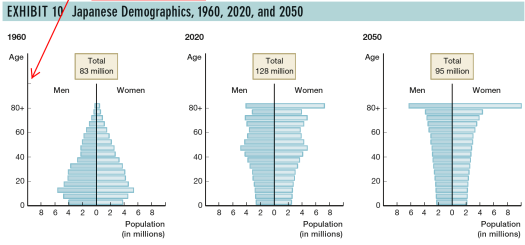
Consider the population distributions, by age for Japan in 1960, 2020 and 2050:

Screen Shot 2018-08-28 at 1.30.47 PMYou can see that during the 1950s, life in Japan was mostly young life.  During the 2050s, life in Japan will be mostly old life.  In my previous post I argued that I’d gladly accept a much lower income to have the health and energy I had at age 31, rather than my current 62.

Just to be clear, I’m not a nihilist arguing that Japan’s amazing economic progress since the 1950s has been of no value.  Living standards in material terms really are vastly higher.  Not only are the Japanese much richer, they also live much longer.  Nor am I arguing for a natalist policy to boost birthrates—I see no obvious market failure that calls for government interference.  On the other hand, I’m not denying that a natalist policy might be beneficial, just that I haven’t yet seen any convincing arguments for interfering with people’s personal decisions on having children.  So I don’t have any sort of agenda here, other than to make people think about what it means for life to be “better” than in the past.

Of course all this hinges on my preference for definition B of “life”.  Most people probably think in terms of definition A, and hence would not be at all bothered by these trends, as long as the average complete life is better than before.  My “flow approach” partly fits in with my denial of personal identity.  I think of life as a series of experiences, and I think of “me” as being a completely different person from the “me” at age 8.  Japan in the 1950s had a big flow of “young life”.

I’m so agnostic about all of this that I’m not even sure younger people really are happier. Happiness research doesn’t necessarily support this claim, even though we almost all instinctively feel that we’d like to be younger.  Think about the vast industry for beauty products to make people look younger.  Or “health clubs”.  But maybe our worship of youth is all just looking through rose-tinted glasses.

BTW, the Japanese population pyramid from 1960 is roughly how things looked throughout most of human history, almost everywhere in the world.  It’s the new distribution that is uncharted territory.  If youth really does equate with happiness, how do we compare life in Mali and Niger, with life in Japan?  Also, because poor countries typically have higher birth rates, and because birth rates fall as countries get richer, Japan’s birthrate cannot be increased by economic growth, no matter how many stories you read about modern East Asian families being unable to “afford” more than one child.  Singapore is twice as rich as Japan, and has an even lower birth rate.  Crazy rich Asians!

PS.  The little girl on the left didn’t have an iPhone.  I’m old enough to remember just how sad life was back then.  Young people today can’t even imagine.

GOP banking policy bleg

For millennials, the 2008 financial crisis was the defining economic shock of their lifetime.  I believe I know how the Democrats think about his issue.  But what about the GOP?  For some bizarre reason, I have no idea what policy stance the GOP favors as a way of avoiding a repeat of 2008.  If a student asked me to describe the GOP position, I’d wouldn’t know what to say.  That’s not true of any other major public policy issue.  I may not always agree, but at least I know where the GOP stands on abortion, tax cuts, coal burning, etc.  I know they are split on trade.  But I know nothing of their views on banking reform.

The Dems seem to favor something like Dodd-Frank.  I don’t like that approach, as it’s overly complex and avoids most of the key problems (subprime loans, FDIC, the GSEs etc.)  But what about the GOP?  It would be nice if they favored a more sensible approach, which might include higher capital requirements for banks (or convertible debt), abolishing the GSEs, reforming or abolishing FDIC, more expansionary monetary policy during periods such as the Great Recession.  Another option is to adopt the Canadian (big bank) system, which doesn’t have crises every few decades.  But I never see any evidence for GOP support of any of those options.  They favored tighter money during the Great Recession.  (Oddly many Republicans are now calling for easier money, even as inflation is much higher than in 2009.)  I see no evidence that the GOP has any interest in abolishing the GSEs or reforming FDIC.  They seem to favor small banks, which are the biggest flaw in our financial system.  The FT says the GOP is opposed to higher capital requirements, an option that seems greatly preferable to Dodd-Frank.

So what does the GOP actually favor?  The 2008 financial crisis happened during a Republican administration.  What lessons has the GOP learned?

I’m not being sarcastic, I’d actually like to know the GOP position on banking crises.

PS.  The Mexico trade deal is good news, despite being a very slight net negative.  There is a tiny bit more protection for industries, as well as tighter IP rules.  I see those as small negatives.  There will be freer trade in digital goods. The stock market hates protectionism and is rallying on the (good) news that Trump only cares about symbolic “wins”, not content (something I’ve been arguing for quite some time.)  Let’s hope there is a similar agreement with Canada and China.

As far as the “downtrodden workers” in the Rust Belt—this agreement says the administration doesn’t care about you.  The steel and aluminum tariffs will hurt manufacturing by more than the rules of origin changes will help.

PPS.  Hopefully the Dems will take the House and refuse to ratify the agreement.  But I suspect they’ll cave.