Taking Trump seriously and literally

Before becoming president, Trump said things that were so bizarre and so offensive that most people assumed he could not possibly be serious. They’d say things like, “Trump should be taken seriously, but not literally.” After all, if we took him literally, then he would have been a fascist.

Some examples. Prior to becoming president:

Trump said we should have stolen Iraq’s oil. Seriously, he said that.
Trump often lavished praise on Vladimir Putin. He said the previous Russian leader didn’t have a “firm enough hand”.
Trump said the Chinese showed strength in putting down the Tiananmen “riots” in 1989. Not brave peaceful protesters—rioters.

It seems incredible that a US president would actually favor fascist policies, so these comments were discounted as Trump just being Trump. It now appears that we should have taken Trump literally.

Today, Trump is brazenly trying to steal money from the Chinese, and is igniting a cold war with China.

Trump issued a pardon for soldiers viewed by our own military as war criminals and then uses one of them as a mascot for his campaign. People hate Nazi comparisons, but come on now—praising war criminals?

Trump encourages Xi Jinping to put Uighurs into concentration camps in Xinjiang province. People hate Nazi comparisons, but . . .

Here’s Bloomberg:

President Donald Trump repeatedly insisted on Monday that any sale of TikTok’s U.S. operations would have to include a substantial payment to the U.S. — but it wasn’t clear under what authority he can extract a payout.

It would be unprecedented, based on recent history, for the U.S. government to collect a cut of a transaction involving companies in which it doesn’t hold a stake. Trump said the money would come from China or an American buyer such as Microsoft Corp.

“The United States should get a very large percentage of that price, because we’re making it possible,” Trump told reporters at a news conference Monday evening. “Whatever the number is, it would come from the sale, which nobody else would be thinking out but me, but that’s the way I think. And I think it’s very fair.”

“Wasn’t clear under what authority”? Is Bloomberg that naive? Trump doesn’t need any authority to do anything. There’s no law that gives Trump the right to stop Americans from using TikTok, so why should the lack of legal authority stop Trump from engaging in what the Chinese correctly call “smash and grab“?

The US already controls almost all of the world’s biggest tech companies. But that’s not enough. When the Chinese finally come up with a competitor that American consumers like (recall how the anti-Chinese nationalists tell us they can’t invent anything) then it’s not enough that we ban it, we also want to steal it without paying fair compensation. The US government is like a mafia family. We won’t be satisfied until 90% of the world’s wealth is in NASDAQ.

Every day I pray for the moment when the Europeans and the Chinese finally have the nerve to stand up to Trump. Unfortunately, I don’t expect it to happen.

PS. Some commenters point me to tech experts like Ben Thompson and Jordon Schneider, who worry about potential manipulation of TikTok by the Chinese government. (And yes, these guys do know 1000 times more about tech than I do.) I agree that that is a risk, but why not wait and see if there is a problem, and then shut them down if a problem develops?

I notice that Russia (which has far more nukes than China), actually does invade other countries. We worry that China might invade other countries. I notice that Russia actually does interfere in US elections. We worry than China might interfere in US elections. And yet it’s China with which the foreign policy establishment is determined to start a cold war.

PS. The Taiwanese should be very, very worried about what Trump is doing. Unlike the US, they are weaker than China. This madness won’t end well.


Will Trump do for NIMBYism what he did for trade and immigration?

The GOP has traditionally been the party that is more skeptical of economic regulations, including zoning restrictions. Republican states like Texas have far more lenient zoning rules than Democratic states like California.

But just as Trump moved the GOP away from its traditional views on trade and immigration, he seems to be doing the same on zoning.
I say, “seems” because his tweets are so vague that it’s hard to be sure. But that’s certainly the perception out there, and there’s some evidence to support that claim.

For the sake of this post, there are three groups to consider. President Obama enacted a “progressive” policy to promote housing construction that was also highly complex and interventionist. Conservative intellectuals tended to oppose the Obama regulations, and support a streamlined approach that focused mostly on reducing zoning barriers to new construction. A new group of conservatives likes zoning rules, as they are seen as preserving suburbs full of single-family homes.

As of January, the anti-zoning conservatives seem to have had won, and Ben Carson’s proposed rule changes reflected their views. But this is an election year, and the final version of the rules rejected the anti-zoning conservative approach and went with the pro-zoning conservatives, who are motivated by some combination of favoring “local control” and genuine support for zoning. Trump began sending out his typical dog whistle tweets about protecting real Americans in their suburban utopias from those awful people who might move in if we don’t stop them.

Here’s Reason:

But by reversing course on its own proposed rule, the Trump administration has passed on an opportunity to impose a fair housing rule that would do a better job of fulfilling the purpose of the fair housing act, while also incentivizing freer markets in land use across the country.

It’s a symbolic defeat for those who had hoped that Trump’s deregulatory promises and the explicitly YIMBY-inflected rhetoric coming from administration officials would prevail over his toxic culture war politics.

With the preceding in mind, consider the following quote from New York magazine:

Alas, if Trump has an intuitive grasp of white suburbia’s id, he has no feel for its superego. Making it impossible for poor people to move to your town — and thus, lay a claim on your local tax dollars, or the time and attention of your kid’s public school teachers — clearly has some appeal to left-leaning suburbanites. But being confronted with the fact that this is what they are doing when they oppose new construction — let alone, that by doing so they are effectively entrenching racial segregation — has no appeal to this voting bloc. NIMBY liberals want racially exclusionary zoning policies wrapped up in rhetoric about historical preservation, not Trump’s garish branding.

In fact, by ripping off liberal NIMBYism’s Jane Jacobs mask — and revealing that it was actually Old Man Racism all along — Trump likely did more to advance the cause of neighborhood desegregation than that of his own reelection. A variety of euphemisms — and the fact that zoning laws are a form of government regulation — have helped liberal NIMBYs reconcile their political identities with their reactionary housing politics. Trump has now made that task more difficult. Meanwhile, among liberal homeowners who’d previously lacked strong views about local housing debates, Trump’s intervention could be a catalyst for pro-inclusive-zoning voting behavior and civic engagement. The president has already demonstrated a gift for mobilizing Democrats against regressive policies they’d previously abided (or even supported). There are large and important distinctions between the Obama and Trump administrations’ immigration policies. But there’s no question that the unabashed racism of the latter’s rhetoric on border security made white liberals less tolerant of mass deportation — and more supportive of Central American migrants’ asylum rights — than they had been under Trump’s predecessor. Similarly, by associating opposition to immigration and trade with xenophobic nationalism, Trump has brought the American public’s support for both those pillars of “globalism” to new heights.

Yes, New York magazine has a strong liberal bias. But notice that this piece is actually critical of the typical suburban Democratic voter in places like California. They are counting on Trump to (indirectly) make the Democrats see the light on zoning.

It’s certainly true that support among Democrats (in public opinion polls) for trade and immigration has soared under Trump. Whether that change of heart is sincere is another question. But it a minimum, Trump’s recent statements might make YIMBYism poll better, at least for a while.

Of course it’s policy that matters, and we won’t know the answer to that question (on trade, immigration and zoning) until the next time the Dems take power.

Back in the era of Ronald Reagan and Jack Kemp, conservatives would have been slightly ashamed to promote government regulations that help some upper middle class whites and hurt lower income minorities. That sense of shame is gone—now they promote these tribal views loudly and proudly.

Everything is political in a banana republic

Another example:

Two board members have since departed. David C. Williams, the vice chairman, left in April over concerns that the Postal Service was becoming increasingly politicized by the Trump administration, according to two people familiar with his thinking. Ronald Stroman, who oversaw mail-in voting and relations with election officials, resigned in May.

One of the remaining members, Robert M. Duncan, is a former Republican National Committee chairman who has been a campaign donor to Trump.

In accusing the administration of politicizing the Postal Service, the president’s critics point to a recent decision to send a mailer detailing guidelines to protect against the coronavirus. The mailer, which featured Trump’s name in a campaignlike style, was sent in March to 130 million American households at a reported cost of $28 million.

According to Postal Service emails obtained by The New York Times under the Freedom of Information Act, Trump was personally involved.

And then there’s this headline:

A day after Trump floated delaying the presidential election, which he cannot do, the White House condemned Hong Kong for delaying its election

But is this really a surprise? This is an administration where Trump encourages Xi Jinping to put Uighers into concentration camps while his aides pretend to criticize the policy.

Meanwhile, Trump continues to use the power of the presidency to boost the value of his family’s real estate holdings:

But shifting the FBI headquarters to the suburbs would clear the way for redeveloping its current site, a prime property ripe for shops, restaurants, high-end apartments — and a luxury hotel. That luxury hotel would compete with another one a block away on Pennsylvania Avenue: the Trump International, which, in 2018, provided the president’s company with a substantial chunk of its revenue.

What’s the nation’s hotelier in chief to do? Following his personal intervention, the government announced that rather than moving the FBI, it would raze the building and rebuild on the same insecure, too-small site, which would force thousands of FBI staffers to move permanently to facilities in Idaho, Alabama and West Virginia. As for the cost, including to relocate more than 5,000 FBI headquarters personnel for years while construction was underway — well, no one could provide an estimate of that.

When I used to argue that it’s not a good idea to have a mentally unstable person with his finger on the nuclear trigger, people reassured me that Trump was surrounded by sober military experts like General Mattis and General McMaster. Now Trump has gotten rid of those two and is surrounding himself with people as paranoid as Jack D. Ripper from Dr. Strangelove. You might argue that Congress would never approve the Tata appointment, and that’s true. But quaint formalities like Senate approval are so 20th-century. This is the age of authoritarian nationalism, so Trump’s going to appoint General Tata anyway, despite his being too bizarre for even the Republicans in the Senate.

Do you think this guy plans to preserve the military’s traditional non-partisan stance?

In several tweets from 2018, Tata said that Islam was the “most oppressive violent religion I know of” and claimed Obama was a “terrorist leader” who did more to harm the US “and help Islamic countries than any president in history.” Following the publication of this story, Tata deleted several of his tweets, screenshots of which were captured by CNN’s KFile.

Tata, in one radio appearance, speculated the Iran deal was born out of Obama’s “Islamic roots” in an attempt “to help Iranians and the greater Islamic state crush Israel.”

Tata also lashed out at prominent Democratic politicians and the media on Twitter, such as California Reps. Maxine Waters and Nancy Pelosi, who he said “have always been the same violent extremists.”

Not that it matters, but Obama is Christian, not Muslim.

Donald Trump surrounded by delusional paranoid military leaders in his second term. Hey, what could go wrong?

Another day, another example

It’s getting to the point where every single day you can find examples of the US becoming a banana republic, usually on Trump’s twitter account:

The appeal came a day after US president Donald Trump vowed to ban TikTok in the US, and said a sale to any party — including Microsoft — would not be an acceptable solution.

“As far as TikTok is concerned we’re banning them from the United States,” Mr Trump told reporters on Air Force One late on Friday, who said he could use executive powers to formalise the decision as early as Saturday. “We are not an M&A [mergers and acquisitions] country.”

The comments left some involved in the talks between Microsoft and ByteDance fearing that any hope of a deal had collapsed on Saturday.

However, others — including ByteDance executives — believe that Mr Trump’s intervention was a negotiating ploy intended to compel the Chinese group to sell the US business in full and at a lower price than it had been holding out for from Microsoft.

Yes, we can’t have a Chinese firm involved in US social media. And everyone knows that Microsoft is secretly owned by the CCP.

Recall all those crocodile tears in DC about the big tech “monopolies”?

Microsoft has a limited presence in social media and believes a deal would allow it to enter a category dominated by rivals such as Facebook, one person added.

In private, TikTok executives and investors have speculated that Facebook, which is preparing to unveil a rival product in America as soon as this week, has been lobbying the US government behind closed doors to ban the app.

Wouldn’t that be a surprise.

BTW, I did a post on December 10, 2019 over at Econlog. Here’s the title and first two sentences:

Is the “War on Tech” just around the corner?

The media says yes. I say no. 

And here’s Tyler Cowen today:

Furthermore, the tech companies have been rising in popularity.  I am going to “call” that the “war against Big Tech” essentially is over, and that the critics have failed.

In last year’s post I explained why the war on tech would fizzle:

Actually, I do understand, which is why I’m so skeptical of the idea that a war on big tech is just around the corner.  Big tech firms are the crown jewels of the US economy.  Their big profit margins are a boom to both US stock investors and the US Treasury.  Yes, we could break them up into tiny pieces, each highly competitive.  I’m sure the French government would love to see tech profit margins plunge so that French consumers would transfer much less money to the US.  But I’m not sure why the US would want to do that.

How do left wing politicians in Sacramento feel about breaking up big tech, which provides much of the funding for California’s lavish social programs?  How do left wing politicians in Massachusetts feel about drug price controls, which would impact the Bay State’s lucrative biotech industry?  How do left wing New York politicians feel about Wall Street profits?

President Trump is known to have a somewhat negative view of many firms in Hollywood and Silicon Valley.  So how does he represent their interests in trade negotiations?  Who said, “all politics is local”?

All we are left with is a war on Chinese tech.

Nowcast bleg

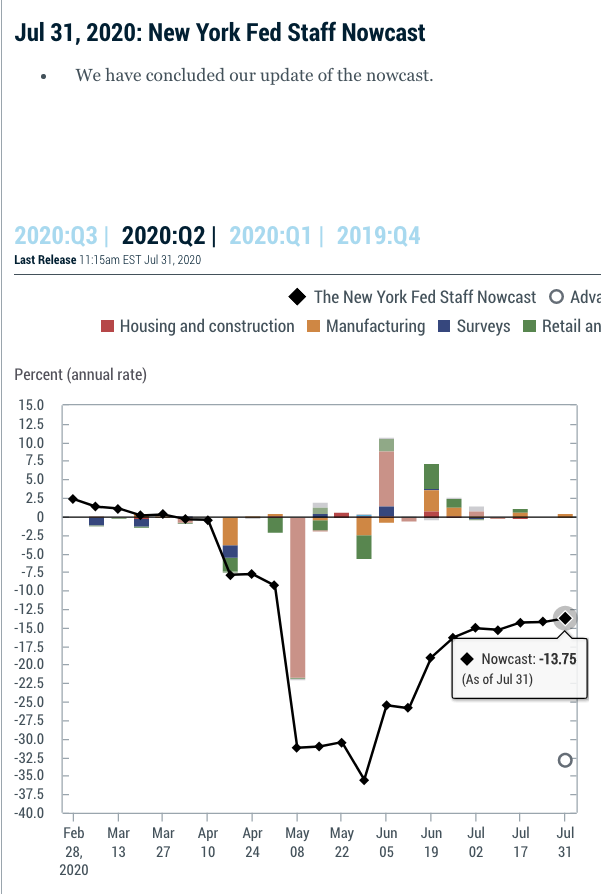
I just received in my email box the latest “Nowcast” from the New York Fed. Unfortunately, I cannot understand what they are trying to say. It seems like they are predicting (as of July 31, 2020) that Q2 growth will be minus 13.75%, at an annual rate. But one day earlier, growth was officially estimated to be minus 32.9%. So what is this Nowcast telling me? Is this an estimate of how the GDP number will eventually be revised?

After receiving suggestions, I may add some further comments below. But I don’t want to waste time if I’m misinterpreting the Nowcast: