Laugh, or cry?

1. The Chinese respond to the debate (from a ChinaTalk post with the subtitle “If we don’t laugh, we’ll cry”):

    From Guangdong:

    “Alzheimer’s disease vs. schizophrenia”

    From Beijing:

    “Trump’s debate today taught me a lesson: If 10% or even 5% of your words in a public speech are obviously lies, then sorry, the media will not stop picking on your lies. But if more than 90% of your words are lies, then the media will really give up, because they really don’t know which words to pick on.”

    I opt for laugh. My view on the election: “Vote for the less corrupt senile guy.”

    2. A very interesting thread on the decline and fall of the aboriginal inhabitants of Tasmania. Reminds me a bit of the decay of civilization on Pitcairn Island.

    3. It’s interesting that both the Russians and the Chinese view the other side as “Mongols“.

    China and Russia have a long history of cultural animosity. When the Russians consider the marauding Mongols who threatened them repeatedly across their history as a people, they equate those hoards to modern Chinese. When the Chinese conjure up images of the barbarians against whom they built successive Great Walls to defend themselves, today they think of the Russians who live on the great steppes of Asia. Since the seventeenth century when Russian settlers began to establish large communities in Siberia, there have been frequent skirmishes between the two peoples.

    Of course, Russia stole lots of land from China.

    4. The Supreme Court acted to shield Trump from jail time before the election. You’ll never guess how the 6-3 vote in favor of Trump lined up—undoubtedly based on “judicial philosophy”. Here’s Reason magazine:

    The Court’s decision nevertheless raises questions about whether a former president can be held criminally liable for outrageous abuses that arguably qualify as official acts. “The President of the United States is the most powerful person in the country, and possibly the world,” Justice Sonia Sotomayor writes in a dissent joined by Justices Elena Kagan and Ketanji Brown Jackson. “When he uses his official powers in any way, under the majority’s reasoning, he now will be insulated from criminal prosecution. Orders the Navy’s Seal Team 6 to assassinate a political rival? Immune. Organizes a military coup to hold onto power? Immune. Takes a bribe in exchange for a pardon? Immune. Immune, immune, immune.”

    5. Noah Smith’s (correct) opinion is indeed “unpopular”, which shows just how far America has regressed (in a moral sense) since the 1990s:

    6. This (from the National Review interview of Michael LaRosa) is excellent:

    The problem we face as a party is that we’ve spent several years shaming Republicans like Mitch McConnell and Lindsey Graham and others who we’ve accused of joining a cult of personality with Trump. Parties are not supposed to be cults of personality. They’re not families, they’re not siblings, they’re transactional by nature, because their only purpose is to win elections. That’s why they are transactional. It’s not meant to be sentimental. And frankly, the point some Democrats are making, not in public, is that we are now becoming very similar to Republicans, actually, because even though there is a real danger in Donald Trump becoming president, we are not going to step aside and leave our guy. That’s what they’re saying, that our guy, standing by our guy, is more important than winning, and we have now kind of conceded the case to Republicans. We’ve now given them quite an upper hand.

    7. And who better than Janan Ganesh:

    Even now, after the debate fiasco, Democrats are couching their misgivings about Biden in ambiguous language. Searching questions have to be asked about him, I read. Alternative candidates are within their rights to sound out donors, apparently. The passive voice is getting a strenuous workout. As ever, the priority is a sort of Edwardian drawing-room etiquette. On the one hand, Trump is an existential threat to democracy, and all legitimate means must be used to stop him. At the same time: don’t let’s be beastly to each other.

    Soon after the debate, Biden put in a solid showing at a campaign rally. Some Democrats talked this up as though it were a missing fragment from the Gettysburg Address. This is where liberal denialism ends up: the ignominious spectacle of Biden, a proud man, who served his nation and the world by defeating Trump, being commended for getting to the end of sentences. In its own way, it is a more poignant spectacle than the botched debate ever was.
    Good and bad news

    1. One state has avoided MAGA madness:

    A pair of moderate Utah Republicans won primary elections Tuesday for U.S. Senate and governor over far-right candidates who are loyalists to former President Donald Trump, the latest example of how Utah is a rare Republican stronghold that doesn’t fully embrace the MAGA-led GOP.

    U.S. Rep. John Curtis, who won the Utah GOP primary for Mitt Romney’s open U.S. Senate seat, and Gov. Spencer Cox still support Trump and many of his policies but have shown a willingness to stake out different positions on issues where they don’t agree.

    Curtis and Cox both defeated candidates who beat them at the state party convention earlier this year among delegates who lean far right. But in Tuesday’s primary, when Utah’s more muted GOP electorate gets its say, they easily scored victories.

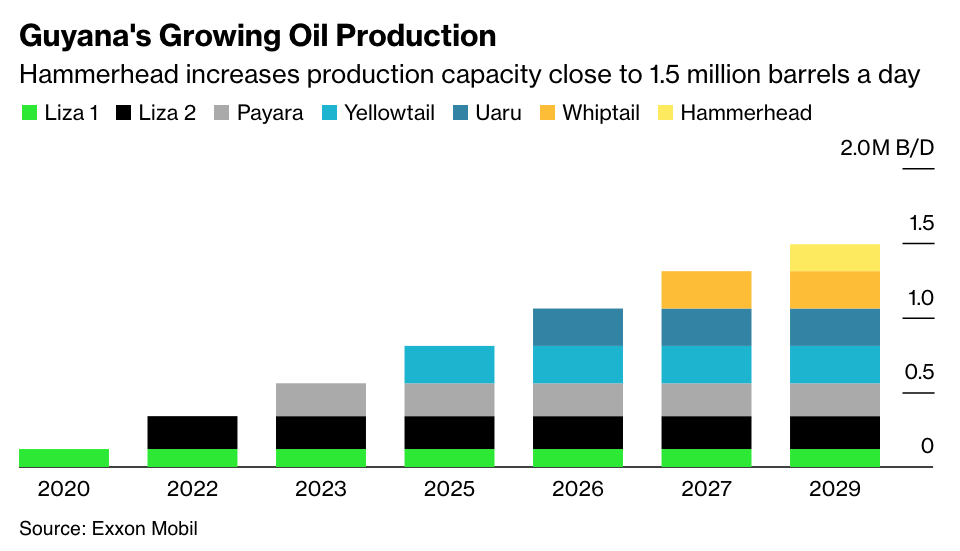
    2. Not too many people are paying attention, but Guyana is about to become very rich.

    More broadly, Western Hemisphere production is likely to keep oil prices low in the late 2020s (offshore Brazil, Canada tar sands, fracking in the US and Argentina, etc.)

    Venezuelan invasion? As Clint would say, “Go ahead punk, make my day.”

    3. It’s weird. I see lots of discussion of Taiwan, but very little comment on the Republic of China:

    My point isn’t that the PROC actions in the South China Sea are justified (they clearly are not.) Rather, that’s there is lots of history here that people seem unaware of. Both the ROC and the PROC claim these islands. The ROC occupies the largest one.

    4. I really like Taiwan, and hope they come to their senses:

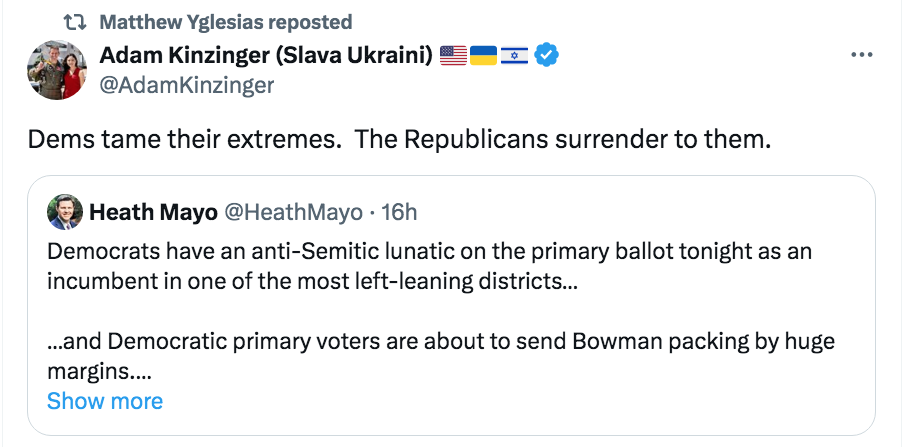
    5. The following tweet is referencing the lunatic that GOP voters in Colorado picked as their nominee:

    6. According to the FT, money printing in Japan may create supply side inflation:

    Next week, Japan will introduce three new banknotes for the first time in 20 years . . . But this is no straightforward or low-cost switch.

    It was never going to be in a country that has 3.9mn cash-ingesting vending and ticketing machines, acute labour shortages and government targets for pushing the country towards cashlessness. . . .

    With parts and labour costs rising, recalibrating even a small machine can cost anywhere from $1,000 to $3,000. Buying a new one can run at anything up to about $14,000 — enough to put real pressure on the economics of the type of small restaurants on which Japan depends.

    The only option, restaurant owners have now taken to telling Japanese media, is to raise the prices charged to customers.

    7. Biden supporters gave me a hard time when I suggested that Biden was a senile old man:

    8. The Brits would know how to handle this problem. But then Great Britain is not a banana republic, is it? The likely Biden loss in November is certainly “overdetermined”. The following (from the FT) is a pretty minor factor, but emblematic of what happens in banana republics:

    A case in point: back in 2020, when Trump’s White House distributed stimulus checks to offset the Covid slump, Trump insisted they carried his signature. These branded the handouts with his name in an easy-to-remember manner for voters. When Biden’s White House delivered its own largesse to consumers, he did not follow suit. Big mistake.

    Never underestimate the stupidity of voters. Many believe Biden ended Roe v. Wade. Lots believe crime rose under Biden (even though it fell sharply after soaring higher under Trump.) The Democrats don’t seem to understand how to do politics in a banana republic.

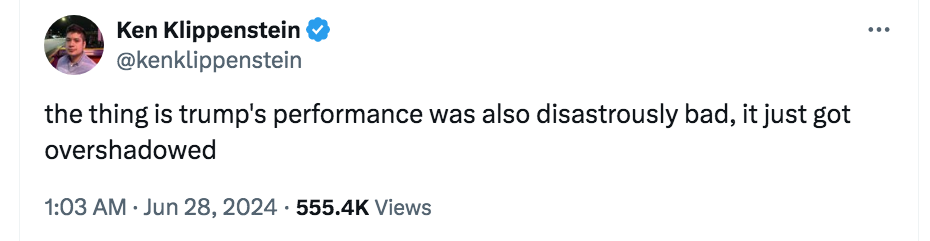
    9. Disastrously bad? Not by banana republic standards. Trump’s performance would be quite acceptable in Guatemala or the Philippines:

    10. Didn’t Newsweek used to be a respectable magazine? It seems like the internet has killed off much of the journalism that I grew up reading. They have a new article claiming that Taylor Swift is not a role model because she is single at age 34. Maybe that’s why you don’t hear much from The Onion any more. Almost all of US journalism is becoming a parody of itself.

    At 34, Swift remains unmarried and childless, a fact that some might argue is irrelevant to her status as a role model. But, I suggest, it’s crucial to consider what kind of example this sets for young girls. A role model, by definition, is someone worthy of imitation. While Swift’s musical talent and business acumen are certainly admirable, even laudable, we must ask if her personal life choices are ones we want our sisters and daughters to emulate. This might sound like pearl-clutching preaching, but it’s a concern rooted in sound reasoning.

    That seems like something written by a high school student.

    Have a nice 21st century!

    You can’t handle the truth

    1. In a previous post I showed that the recent NYT article on the lab leak hypothesis was based on an ignorance of Chinese geography.

    Philipp Markolin has a very long piece that is well worth reading. It does an excellent job of debunking the view that the Covid-2 virus looks “suspiciously engineered”. At one point he offers this interesting quote:

    “If you gave me a billion dollars to find the origins, I`d probably spent 90% of that outside of China in South East Asia” 

    — Bat immunologist Linfa Wang, Duke-NUS Singapore

    No, that doesn’t mean the pandemic began in SE Asia, it probably began in China. But the Covid-2 virus was likely created by a sort of natural gain of function research, as SARS virus recombined trillions of times in nature, before hitting on a format that was ideally suited to transmission in humans:

    A comprehensive body of scientific evidence has shown us that the immediate bat ancestor to SARS-CoV-2 came from one of the countless natural “gain-of-function labs” spanning the vast biodiverse Karst region from Yunnan in Southern China towards Myanmar, Laos, Thailand, Cambodia, Vietnam, and maybe even Malaysia in Southeast Asia. The lingering and promiscuous endemic viral elements in that enormous geographic region constantly mix and bring forth new chimeric combinations within their socially intricate reservoir hosts; while human activities and encroachment on bat territories stir the genetic cauldron ever faster.

    Once a particularly combustible set of genetic elements produced a potential pandemic pathogen with broad host tropism, the legal and illegal mammalian wildlife industry likely became the maturing vessels through which the virus we now know as SARS-CoV-2 reached its final explosive form. From there, it was dragged in front of hundreds of immune-naïve future hosts visiting the largest wet market of one particular Chinese megacity well connected with the entire world. . . .

    Maybe after four years of political myth-making and societal inaction, it is time to face scientific reality. I certainly believe we’d be better off fighting for solutions rather than for who is to blame.

    2. It seems that QAnon conspiracy theories have also caught on among older women in Japan:

    Triggered by the bitter U.S. presidential election and followers of former U.S. President Donald Trump, such conspiracy theories have spread via social media and videos, even in Japan. 

    There are widening gaps between people who believe in groundless information and their families and people close to them in Japan as well. 

    An expert warns that social anxiety caused by the COVID-19 pandemic has allowed such conspiracy theories to flourish.

    The Aichi woman’s mother is believed to have been influenced by videos on QAnon, which she watches for about eight hours in a day.

    Presumably this is all because these people lost coal mining jobs due to “neoliberalism”.

    3. Jordan was a very good defender, but not DPOY good:

    In the six games, the box scores indicated that Jordan’s total steal count was 28. After comparing our notes from the film study, we each counted 12 steals. An astounding difference of 16 excess steals. Almost every excess steal was being allocated to Jordan.

    Those were all home games, which seems to be the problem:

    Between them, Russell and Chamberlain registered 26 games with 40-plus rebounds. None of the 26 games were tabulated on the road, per Stathead.com tracking.

    4. Janan Ganesh says it’s not just greed that is pushing billionaires toward Trump:

    It doesn’t explain the pro-Brexit industrialists who had little obvious to gain outside the European single market. It doesn’t explain why I can’t attend a finance dinner without hearing the Kremlin script (“You know, Zelenskyy’s no saint”) from someone who neither profits from the Ukraine invasion nor loses from the retaliatory sanctions.

    There is such a thing as sincere wrongness. . . . First, business people struggle to understand fanaticism. In commercial life, all actors are negotiable, even if their price is high. You might pass decades in the private sector without encountering someone who has total commitment to an abstract doctrine (socialism), to an individual (Trump) or to a cause (Russian amour propre). This blind spot for zeal is why corporations were such sitting ducks for “woke”. And why oligarchs a generation ago thought Vladimir Putin was their pliable instrument.

    The twitter feed of Elon Musk shows that it’s possible to be a brilliant businessman and still be completely clueless about politics.

    5. Will we ever learn?

    A group that claims to have hacked CDK Global, the software provider to thousands of car dealerships in North America, has demanded tens of millions of dollars in ransom, according to a person familiar with the matter.

    CDK is planning to make the payment, said the person, who asked not to be identified because the information is private. The hacking group behind the attack is believed to be based in eastern Europe . . .

    A demand in the tens of millions of dollars comes after hackers sought $50 million from a lab services company at the center of an ongoing ransomware attack that’s caused outages in London hospitals. UnitedHealth Group Inc., the largest medical insurer in the US, acknowledged earlier this year it paid hackers a $22 million extortion fee.

    The solution is simple. Pass a law requiring long prison sentences for any US corporate official that pays ransomware. Then the bad guys will start going after foreign firms. This is a classic externality problem—why are we too stupid to see that?

    6. Why am I not surprised?

    7. On a lighter note, Herman Melville anticipated the concept of “the wisdom of the crowd” in his novel Mardi:

    But who has seen these things, Mohi?” said Babbalanja, “have you?”

    “Nay.”

    “Who then? —Media?—any one of you know?”

    “Nay: but the whole [Mardi] Archipelago has.”

    “Thus,” exclaimed Babbalanja, “does Mardi, blind it be in many things, collectively behold the marvels, which one pair of eyes sees not.”

    From the end of chapter 116. Note that “Mardi” is the name of an island chain.

    Are we the baddies?

    You’ve probably seen that amusing British comedy bit when one German officers asks another, “Are we the baddies?”

    I’m pretty sure that we (in the US) aren’t the Nazis, although some pro-lifers complain that legal abortion is kind of like the Holocaust. (Not my view!!)

    Nonetheless, as each day goes by I see more and more news stories that remind me of that meme. Here’s The Economist:

    The latest tariffs reject such mechanisms. The administration could have set out how Chinese EVs had gained from huge subsidies and then hit them with calibrated countervailing duties. It could have documented the security threat it claims they pose, rather than offering scary conjectures. Instead, it covered its protectionist aims with a fig-leaf: the new tariffs were put on top of Mr Trump’s, which were themselves originally justified by China’s theft of American technology. How farcical. The real fear about Chinese evs today is not that they are stealing from America, but that they have left American cars in the dust.

    America’s blatant disdain for the need to make a rigorous case has dangerous consequences. At home it invites more firms to seek protection. Republicans and Democrats are already vying to offer the steepest barriers: Mr Trump has warned that he will put tariffs of 200% on cars made by Chinese-owned plants in Mexico. 

    As if that’s not bad enough, now the US is bullying smaller nations into imposing tariffs of Chinese goods.

    Canada has faced domestic and international pressure to join U.S. policy after President Joe Biden announced last month that tariffs on Chinese EVs would be raised to 102.5%, nearly four times the current rate. Following the U.S.’s lead, the EU also revealed plans last week to impose up to 48% tariffs on certain Chinese EVs.

    Western countries, including the U.S., believe China’s overproduction threatens their industries by dominating the global supply chain.

    Yes, I know. There are plenty of far worse regimes out there. Even so, it’s discouraging to see how America’s moral authority has declined so sharply over the past 10 years. We no longer even pretend to care about the international agreements that we once helped to forge.

    I guess banana republics don’t need badges.

    Get happy!!

    1. I frequently argue that the money/happiness correlations are misleading, that it is happiness causing prosperity. An expert on happiness now suggests that there is abundant evidence for that proposition:

    Choosing to engage in practices like building strong social connections and finding a purpose that fuels you is what actually leads to happiness and fulfillment, not achieving a specific financial goal, Brooks emphasizes.

    But being happier in life can lead to financial increases and success, Muller says. “Happiness is the thing that’s actually causing us to succeed,” she notes.

    A 2005 systematic review of 225 papers found that being happy can lead to success in different areas of life including income and health.

    2. The FT says markets don’t believe that China will invade Taiwan:

    An invasion of Taiwan would severely disrupt global chip supply and also have an impact on China, which like the rest of the world relies heavily on TSMC for its supply of advanced chips. The country is TSMC’s third-largest revenue contributor by geography, accounting for nearly a tenth of TSMC’s sales.

    A good measure of foreign investor anxiety — the premium that TSMC’s US-listed American depositary receipts trade at compared with the stock listed in Taiwan — suggests investors are becoming increasingly sanguine about geopolitical risks. These trade at more than a 20 per cent premium to local shares for the current quarter, the widest gap in more than a decade.

    That sentiment is mirrored in Taiwan, where locally listed TSMC is the most bought stock by overseas investors. Nvidia has also added support by announcing plans to increase its investments in the island.

    I’m not so sure about that. All I know is that if China does invade it will do so knowing full well that this makes it likely that it will lose the AI race to America.

    3. During the late 20th century, airliners were much safer than cars. Nonetheless, you’d have a major accident every few years, often involving well over 100 deaths. In the 1990s, for example, well over a thousand people died in US air crashes. Ditto for the 1970s and 1980s. Since 9/11, the record of US airliners has become almost insanely good, with only 476 deaths over nearly 23 years. Most of those were in a December 2001 Airbus crash that killed 265, and almost all of the rest were in small commuter planes.

    The star for recent US flight safety is Boeing, which has seen only about 10 US deaths since 9/11, only one of which (AFAIK) was due to mechanical problems. If someone in late 2001 had predicted this sort of Boeing safety record for the next 22 1/2 years, they would have been laughed out of the room. Why have Boeing airplanes become so astoundingly safe? Some of you know more about this than I do; please provide explanations in the comment section.

    Bonus points to anyone who can explain why almost everyone disagrees with me, viewing Boeing airplanes as having a poor safety record. (Of course given my forecasting record, you can expect a Boeing crash any day now.)

    BTW, anyone who says, “Yeah, US Boeing flights are super safe, but flying a Boeing plane in Ethiopia remains dangerous” will be banned for life.

    4. In the future, everyone will be rich.

    Even today, we drive cars that are far better than the Cadillacs and Mercedes of yesteryear. Ditto for our TVs and phones. I can get Asian food in a strip mall that’s better than an elegant NYC steakhouse of the 1950s. But what about big ass diamonds?

    Have no fear. The price of really big diamonds is falling fast. For less than $1500, you can get a 3 carat diamond with pretty good cut, color and clarity, due to rapid progress in lab grown diamonds. (No, these are not cubic zirconia; they are real diamonds. Even experts cannot tell them from natural diamonds without a magnifying class.

    5. Biden finally does something good:

    To be eligible, the spouses must have lived in the United States for 10 years and been married to an American citizen as of June 17. They cannot have a criminal record. The benefits would also extend to the roughly 50,000 children of undocumented spouses who became stepchildren to American citizens.

    Imagine you are a child that has grown up in America, does well in school, and doesn’t even remember the country in which you were born. Then at age 18 you are forced to return to live in what Trump calls a “shithole country”. Biden’s action is great news.

    6. And the Senate just voted 88-2 to make it easier to build nuclear power plants.

    7. When will AIs be able to do scientific research? It’s already begun!

    8. Like Noam Chomsky (and Franco), Hong Kong is not dead yet.

    PS. Why two exclamation points in the post title? Nostalgia for when I was young: