
Archive for the Category Inflation


Reply to Thoma on NGDP targeting

Mark Thoma recently asked the following question:

So, for those of you who are advocates of nominal GDP targeting and have studied nominal GDP targeting in depth, (a) what important results concerning nominal GDP targeting have I left out or gotten wrong? (b) Why should I prefer one rule over the other? In particular, for proponents of nominal GDP targeting, what are the main arguments for this approach? Why is targeting nominal GDP better than a Taylor rule?

The entire post is rather long, and Thoma raises issues that I don’t feel qualified to discuss, such as learnability.  My intuition says that’s not a big problem, but no one should take my intuition seriously.  What people should take seriously is Bennett McCallum’s intuition (in my view the best in the business), and he also thinks it’s an overrated problem.  I think the main advantage of NGDP targeting over the Taylor rule is simplicity, which makes it more politically appealing.  I’m not sure Congress would go along with a complicated formula for monetary policy that looks like it was dreamed up by academics (i.e. the Taylor Rule.)  In practice, the two targets would be close, as Thoma suggested elsewhere in the post.

Instead I’d like to focus on a passage that Thoma links to, which was written by Bernanke and Mishkin in 1997:

Nominal GDP targeting is a reasonable alternative to inflation targeting, and one that is generally consistent with the overall strategy for monetary policy discussed in this article. However, we have three reasons for mildly preferring inflation targets to nominal GDP targets. First, information on prices is more timely and frequently received than data on nominal GDP (and could be made even more so), a practical consideration which offsets some of the theoretical appeal of the nominal GDP target. Although 20 collection of data on nominal GDP could also be improved, measurement of nominal GDP involves data on current quantities as well as current prices and thus is probably intrinsically more difficult to accomplish in a timely fashion. Second, given the various escape clauses and provisions for short-run flexibility built into the inflation-targeting approach, we doubt that there is much practical difference in the degree to which inflation targeting and nominal GDP targeting would allow accommodation of short-run stabilization objectives. Finally, and perhaps most important, it seems likely that the concept of inflation is better understood by the public than the concept of nominal GDP, which could easily be confused with real GDP. If this is so, the objectives of communication and transparency would be better served by the use of an inflation target. As a matter of revealed preference, all central banks which have thus far adopted this general framework have chosen to target inflation rather than nominal GDP.

1.  I believe the federal government could estimate monthly nominal GDP numbers that are accurate enough to be useful for policy purposes.  However, even if they could not I’d still favor NGDP targeting, because like Lars Svensson I believe the Fed should be targeting the forecast, that is, setting policy in such a way that the Fed’s forecast of future NGDP is equal to their policy target.  I also favor level targeting (recently recommended by Woodford), and I think this would reduce the overshooting problem associated with futures targeting.

2.  It seem to me their second point (which isn’t really a criticism at all) was actually disproved during the recent crisis.  Between mid-2008 and mid-2009 NGDP fell over 8% below trend (or about 3% in absolute terms.)  On the other hand core CPI inflation fell only slightly below trend.  Because the Fed is an (implicit) inflation targeter, the slight slowdown in CPI inflation did not present an unambiguous signal (in their view, not mine) for aggressive stimulus.  Hence they waited until November 2010 to undertake QE2.  If they had been targeting NGDP along a 5% growth trajectory, it would have been immediately obvious that NGDP was coming in well below target, and would remain below target for many years.  In my view the QE2 program would then have been adopted much sooner and in larger amounts, and I think it retrospect it is clear that additional stimulus would have been welcome in late 2008 and 2009.

3.  The third point is where I most strongly disagree with Bernanke and Mishkin.  In the current crisis we’ve seen just how difficult it is to communicate the need for higher inflation.  The public interprets that as the Fed trying to raise their cost of living.  I’m not surprised the plan is unpopular.  I’d guess that in 1997 Bernanke and Mishkin were thinking about the central bank communicating the need for lower inflation, not higher inflation.  In contrast, NGDP is essentially nominal income.  The Fed can tell the public they are trying to raise nominal growth to 5%, because a healthy economy requires the incomes of Americans to grow by about 5% per year.  That’s much less negative sounding that trying to raise the cost of living.  Of course the opposite could be argued on the upside, but the Fed has shown a much greater ability to hold inflation down that increase it, as the zero rate bound has left them spinning their wheels when inflation has fallen below target.  I think it would be easy to explain to the public that an excessively rapid growth in nominal incomes could be inflationary, and raise rates when needed.  Especially given that they were widely criticized for not raising rates enough during the housing bubble.

4.  Regarding revealed preference, NGDP targeting is more desirable the larger and more diversified the economy.  If an economy is dependent on just a few industries, then a major price shock in one export industry might force a dramatic contraction in other industries under NGDP targeting.  Price level targeting might provide for a better macroeconomic outcome in that case.  Thus I wouldn’t expect small countries to be the first to adopt NGDP targeting.  And would I be out of line in noting that the BOJ and ECB haven’t become famous for creativity and boldness?

Update:  I just noticed that Bill Woolsey has a long and very informative reply to my discussion of NGDP futures, and also a response to some of the points made by Brad DeLong.  Bill knows my plan better than I do, so I usually defer to his judgment.  He’s correct that I cut some corners in selling the idea to the National Review’s readers, and that the actual plan is more complicated than I suggested.  Indeed, I believe he was the first to use the phrase “index futures convertibility.”
Disinflation denial

During the past several years I’ve repeatedly insisted that the huge increase in the monetary base of 2008 would not produce high inflation.  I suppose I was naive in thinking that when it became clear that excessively low inflation was the real problem, the inflation hawks would admit they were wrong and re-evaluate their models.  I don’t see much evidence of that happening.

One recent theme has been the supposedly unreliability of the core inflation rate, which is now below 1%.  Critics (and cartoon bunnies) point to the fact that food and energy are an important part of the average American’s budget.  When it’s noted that even headline inflation is barely over 1%, the attention turns to other prices.  For instance, Congressman Ryan has recently argued that the Fed should focus on commodity prices.  My initial reaction is to say “Yes!  Let’s focus on commodity prices!  Commodity prices are the best way to tell if money is too easy or too tight.”  Think I’m being sarcastic?  Then you are in for a surprise.

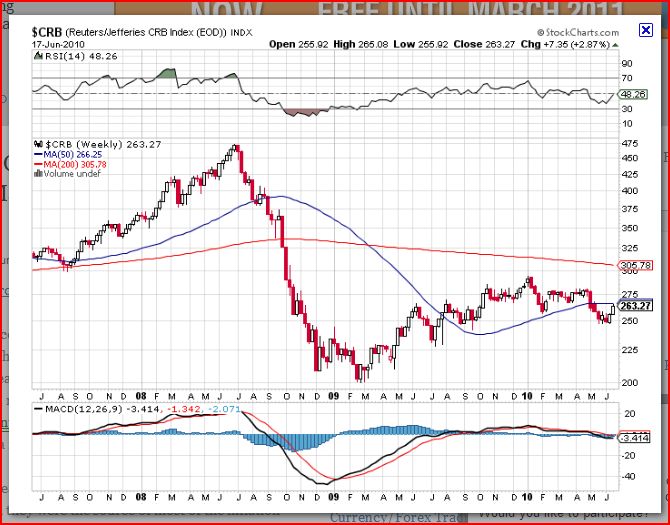
Before continuing, I’d like to remind readers that in late 2008 you could count on one hand the number of economists (in the entire world) claiming monetary policy was very tight.  So let’s take a look at the change in commodity prices in late 2008:

That’s right, commodity price indices fell by more than 50%.  That’s Great Depression-style deflation.  And where was Congressman Ryan when the Fed was engineering one of the greatest deflations in world history?  I don’t recall him or any of the other inflation hawks calling for easier money.  But maybe I missed something.  If so, I hope my readers will dig up all the stories of conservatives demanding easier money in the fall of 2008.  In any case, it’s good to know that whereas back in late 2008 I was almost all alone in viewing money as being extremely tight, I now have the vast right wing conspiracy on my side.  Money really was tight in late 2008.  And if commodity prices are now the preferred metric of the right, then I’m half way to convincing the economics establishment that I was right all along.  Now I just have to convince the left that money was way too tight in 2008.  About those near-zero interest rates . . .

BTW, I don’t mean to bash Congressman Ryan, who is from my home state and is  one of the best of a bad lot.  If all 435 Congressmen and women were like him we’d probably end up with a much more economically sensible tax and spending regime.   But I have to say that the conservative movement has recently been grasping for straws on monetary policy.  All their predictions are coming in false, and they aren’t drawing the appropriate conclusions.

Update 12/19/10:  This post wasn’t well written.  I have always felt that commodity prices were one of many useful indicators of whether money is too tight or too easy.  But I left the impression that I completely supported a monetary policy that single-mindedly focused on commodity prices.  In fact, I’d prefer the Fed look at a wide range of indicators when estimating market NGDP growth expectations, including stock prices, bond prices, TIPS spreads, forex rates, commodity prices, real estate prices, etc.  Many commenters correctly pointed out that commodity prices can be an unreliable indicator, and I entirely agree.  I got overly enthused trying to show that if it was the right indicator, then money was ultra-tight in late 2008.

Kling on NGDP targeting

Here’s Arnold Kling’s response to my recent advocacy of NGDP targeting:

Because of a cold, I will be missing an invitation-only event featuring Scott Sumner. In the spirit of sharing my ideas without my germs, let me offer some thoughts on nominal GDP targeting.

That’s no excuse, I also had a cold.   🙂

Kling continues:

1. For the Fed, a target represents a justification for taking action. Some people may be upset with what your action does to the exchange rate or the interest rate. Having a target allows you to justify your action.*

2. I would like to see the Fed use a target to justify its actions.

3. If the Fed were to use a target, then future nominal GDP would be an excellent choice.

4. In the current environment, a target for future nominal GDP could be used to justify expansionary actions.

5. There are plenty of expansionary actions available. The Fed could charge a penalty for holding excess reserves. The Fed could be buy foreign bonds (this might require a change in current law). There still are plenty of long-term Treasuries out there for the Fed to buy.

6. In the best case, the Fed would hit a target for future nominal GDP, unemployment would fall fairly quickly, and we would live happily ever after.

7. In the worst case, we would begin to shift to a regime of high and variable inflation. The Fed would have to undertake strong contractionary measures in order to keep nominal GDP on target, while unemployment remains high.

I believe we would all live happily ever after, and that inflation would not become high and volatile.  In order for inflation to be high (on average), RGDP growth would have to average much less than 3%. Let me repeat; much less, not slightly less.  A trend rate of 1% or 2% RGDP growth will not get you high inflation on average, unless you think inflation was still high after Volcker brought it down to low levels.

Much more importantly, I don’t think high or variable inflation is a problem as long as NGDP growth is on target.  All of the problems that are widely believed by economists to flow from high and variable inflation; actually result from high and variable NGDP growth:

1.  Excessive taxation of capital in a non-indexed tax system results from high nominal rates of return, associated with high NGDP growth.

2.  Unfair borrower/lender redistributions actually result from volatile NGDP, not volatile inflation.

3.  Distortions to the labor market (when nominal wages are sticky) are caused by NGDP shocks.

4.  Even the “shoe leather” cost of inflation may be better described by NGDP growth, assuming real interest rates and real GDP growth rates are strongly correlated.

George Selgin has much more to say about the advantages of using NGDP.

In the end Kling argues the NGDP targeting is worth a shot, and he also has some interesting things to say about the possible reasons why the Fed hasn’t yet taken this step:

(a) They do not want to be embarrassed if they are unable to hit a target
(b) This is what Tyler Cowen would call a Straussian situation, in which the insiders must never reveal their true agenda, or horrible demons will be let loose, leading to social breakdown and bloodshed.
(c) They fear that announcing a target would create “lock-in” and cost flexibility.
(d) A target would make many of the departmental functions and rituals (such as FOMC meetings) long cherished at the Fed seem pointless.
(e) The Fed is institutionally more concerned with the stability and profitability of the banking system than with macroeconomic variables.

I would add that most private macroeconomists also prefer inflation targeting to NGDP targeting.  Or they favor flexible inflation targets, but don’t plump for NGDP targeting because it seems too crude.  I believe that is because inflation and RGDP play an important role in their macro models.  Unfortunately, the ‘inflation’ in their models bears little resemblance to real-world inflation indices.

More evidence that the BOJ is not trying to create inflation

I frequently assert that no fiat-money central bank ever tried to inflate and failed.  Some people respond by pointing to the long period of mild deflation in Japan.  I won’t repeat all my arguments that the BOJ was intentionally pursuing a highly contractionary monetary policy.  Instead, I’d like to cite the findings of a new study by three Japanese economists, who use a New Keynesian DSGE model to estimate the Taylor rule.  The study by Koiti Yano, Yasuyuki Iida, and Hajime Wago, found that the BOJ seemed to shift from a roughly 2% inflation target in the 1980s and early 1990s, to a roughly negative 1% target after 1995.

Unfortunately, I went to grad school back in the stone age when we mostly taught economic intuition, not math and econometric skills.  So I’m hoping my very smart commenters will help me out with this paper.  I wasn’t quite able to figure out how they got the estimate of minus 1% inflation target.  Does their method seem reasonable?

Part 2:  Three from The Economist

I’ve been so busy that I haven’t had time to link to my last three essays for The Economist.

The ECB has made the European debt crisis much worse

There’s little risk of inflation

QE has helped raise commodity prices

I should have an article in the National Review very soon.  I’ll let you know.

Part 3:  No one should pay any attention to my political forecasts.

I said Obama was unlikely to get more fiscal stimulus, and he got a lot more.   I would have thought if he got a lot more, the Keynesians would have been ecstatic.  Instead they are outraged.  The announcement seemed to raise the expected rate of inflation by about 8 basis points per year over 5 years.  There’s two ways of looking at that.  On the plus side, it shows fiscal stimulus does have a positive multiplier.  On the minus side, it’s not much bang for the buck, as I was under the impression that the FICA tax cut was a surprise.  Real interest rates rose by 13 basis points, and nominal rates rose by 21 basis points.  (So much for Ricardian equivalence.)

But I also believe Obama missed an opportunity.  If you believe as I do that sticky wages explain part of the high unemployment, it would have made much more sense to cut the employer’s share of payroll taxes, not the employee share.  Still, if we need to do fiscal stimulus, I favor tax cuts both for small government reasons, and for stimulus reasons.  I agree with Christina Romer that tax cuts are much more stimulative than spending increases.

Part 4:  The endless, pointless, debate over the EMH

A few reactions to comments on my recent post on the EMH.  Some people get extremely angry when you defend the EMH.  The debate reminds me of arguments I have over free will.  I point out that either events have causes, or they are random.  In either case there is no room for free will.  My opponent responds that he is free to pick up either the salt or pepper shaker in front of him.  The debate never really gets joined, and is thus largely a waste of time.  I’ve decided I shouldn’t waste any more time arguing against free will, or defending the EMH.

I must have done at least 6 posts on the EMH and I always get the following responses, even if they have nothing to do with the specific arguments that I make in the post:

1.  It is noted that some people correctly predicted this or that bubble.  The way I look at it, you have roughly a fifty/fifty chance of being right if you predict prices will fall.  Given there are 7 billion people on planet Earth, I’m not blown away by the finding that some of them predicted this or that bubble would pop.  What does blow me away is that some people who have become world famous predicting bubbles, have done so despite also making important false predictions.

2.  Some commenters point to anomalies.  I point out the EMH predicts there will be millions of anomalies.  Some respond that a few anomalies have even done well in out-of-sample forecasts.  That’s great, but you’d expect that.  I recall reading about studies showing many anomalies failed to do well after they were published.  Was I misinformed?

3.  Some point to experimental economics.  I point out that studies have found experimental results do not always hold up in the real world.  Some commenters found the experimental evidence against the EMH to be irrefutable.  But this is also part of that evidence:

But people do learn. By the third time the same group goes through a 15-round market, the bubble usually disappears.

I’m guessing that real world traders are more savvy than college students playing a game for only the third time.

4.  Don’t get me wrong, I think there is evidence against the EMH (such as the 1987 stock crash), my real argument all along has been that the anti-EMH view is literally useless.  And that which has no practical value has no theoretical value.  In contrast, the EMH has been very useful in my research on the Great Depression.

5.  Several people mentioned market observers who denied bubbles, but no one provided me with a specific example of a bubble denier who became famous because his or her prediction was correct.  During bubbles, I find all the sophisticated people I talk to are pessimists, arguing it’s a bubble and it must burst at some point.  I rarely find people who say it’s going much higher.  So I think a successful bubble denial ought to earn some praise from the intellectual elites.  Given that pessimism is the only fashionable stance if one wants to be viewed as a SERIOUS THINKER, the bubble deniers ought to be viewed as being the ones going against the grain.

So I feel it’s hopeless, I get way more comments than I have time to answer, and only 10% or 20% actually address the specific arguments in my post.  So I’ll just give up, and stop doing bubble posts.  Of course as soon as I find another interesting way of denying the existence of bubbles, I’ll break my vow and post another EMH defense.  After all, it can be logically shown that I don’t have any free will.

PS.  I will be super busy until after New Year’s Day, not doing as much blogging.  (Although I’ll try to do some.)  Apologies to those who used to get Christmas cards from me.  Consider this:  “Merry Christmas,” to be my holiday greeting.

PPS:  I just noticed that Bryan Caplan and Arnold Kling commented on my post.  In response to Bryan Caplan, I think Fama became famous for inventing and defending the EMH, not making a specific correct forecast that a specific bubble would keep inflating.  I don’t know the other guy.  Arnold Kling’s definition of a bubble is one of many out there.  My problem is not that it is wrong, but rather that even if true, it is a useless concept.  I insist that unless a bubble call is an implied prediction, it is useless.

PPPS.  Thanks to Yasuyuki Iida for sending me the paper.  He indicated it was presented at this year’s Econometric Society World Congress (ESWC2010).

Worthwhile Canadian Initiative

As people in the humanities would say, this post’s title is an “homage” to Nick Rowe.  JimP sent me this interesting Bloomberg article:

Montreal undergraduates may help reshape the Bank of Canada’s monetary policy and give Federal Reserve Chairman Ben S. Bernanke and Bank of Japan Governor Masaaki Shirakawa clues about how to ward off deflation.

About 240 students so far have spent two hours in a 25th- floor computer lab near McGill University, earning an average of C$30 ($29.88) by viewing combinations of economic data, including unemployment and gross domestic product, and then predicting what would happen to inflation. Central bank researchers are taking part in the project to see whether people can make such forecasts more easily if policy makers target specific levels in the consumer price index instead of the inflation rate — which might help households and companies make better decisions about spending and investing.

The more accurate the test subjects are, the more they earn. One did so well, “we tried to track this person to see if we could hire her,” said Jean Boivin, 38, a Bank of Canada deputy governor who is helping with the research and has also co-written paperswith Bernanke.

The experiments will help Canada decide if it should switch from inflation targeting to price-level targeting in 2012 and may help the bank better communicate its policies to the public, Boivin said. The test results also might benefit Fed policy makers, who discussed price-level targets on Oct. 15 and voted Nov. 3 to inject another $600 billion of reserves into the banking system to avoid deflation — a widespread drop in prices that has plagued Japan for more than a decade.

Broader Agenda

“Central banks need to know more about how expectations are formed, and so we see that as part of a much broader agenda,” Boivin said in an interview at the Bank of Canada’s Ottawa headquarters in the room where he, Governor Mark Carney and four other policy makers decide on interest rates, including a decision tomorrow that’s scheduled for 9 a.m. New York time.

A few weeks back a Bentley student named David Norrish pointed to a flaw in my NGDP targeting idea.  Why [he asked] should we expect the largest economy in the world to experiment with a risky monetary regime that had never been tried out anywhere else?  I seem to recall that ideas like inflation targeting were pioneered by smaller economies such as New Zealand.  So I’m glad to see that the Canadians are considering serving as guinea pigs for price level targeting, before the policy is deployed in the much more important American economy.

BTW, the critieria for success should not be defined solely in terms of accurate inflation forecasts.  Short term forecasts may be relatively accurate under inflation targeting, even if the price level follows a random walk.  It’s more important to have accurate inflation expectations over the life of nominal contracts (wage and debt contracts.)  That’s where the advantages of level targeting are strongest.

PS.  Canadian readers:  I was just kidding—playing the ugly American for cheap laughs.