Archive for the Category Efficient markets hypothesis


Are stocks overvalued?

Well that should teach me never to go on vacation again.  I blogged pretty intensively for just over two years, from February 2009 through March 2011.  This frenzied activity was correlated with (or caused?) one of the great bull markets in American stock market history.  Then stocks started falling.  I had planned to return to blogging on July 5th, after a short vacation.  But with the market doing so poorly I felt duty bound to do something last week, and hence I came up with a few posts.  The effect on Wall Street was immediate and electrifying.

But (seriously) are stocks now overvalued?  Because I’m an efficient markets-type, the only answer I can give is no.   So why does Robert Shiller say yes?  Apparently because the P/E ratio is relatively high by historical standards.  And he showed that for much of American history investors did better buying stocks when P/Es were low than when P/E ratios were high.  Of course hindsight is 20-20.

I’d rather not get into the minutia of all the various ways of calculating P/E ratios.  And I have no idea where stocks are going from here.  Instead I’d like to focus on three arguments for relatively high P/E ratios in the 21st century American economy (however you’d like to measure them):

1.  Stocks have done very well since the 1920s, which suggests that 20th century P/E ratios were usually too low.

2.  American companies are making lots of money in the worst recession since the Great Depression.  This is partly because US multinationals are making huge profits in the developing world.  And this suggests that traditional market indicators based on the ratio of US corporate profits to US GDP may be outdated.  US GDP is no longer the relevant denominator.  So “E” may be relatively high for the foreseeable future.

3.  My most important argument is that low real interest rates might be the “new normal.”  The most striking characteristic of the US economy over the past decade is the unusually low level of both nominal and real interest rates.  And it’s not just because of the current “unpleasantness;” rates also fell to very low levels in the early 2000s.  Why have people missed this story?  I believe it’s because they’ve assumed the low rates are some sort of Fed policy, not a free market outcome.  But if the low rates since 2001 were an easy money policy, then why didn’t we see high rates of inflation and NGDP growth?  So money hasn’t been easy, which we should have obvious all along, given that INTEREST RATES ARE NOT THE PRICE OF MONEY, THEY ARE THE PRICE OF CREDIT.  And these low real interest rates should support a higher P/E ratio.

Why has credit been so cheap?  Perhaps it’s been special factors, but rates have been ultra-low in Japan since the early 1990s, and I don’t see any reason to assume that it can’t happen here as well.  (Of course Paul Krugman came up with this argument long before I did.)  All it would take is a combination of low demand for credit and high supply of credit.  For low demand, we have slowing population growth in the developed world, and fewer good investment opportunities (what Tyler Cowen calls fewer low hanging fruit.)  On the supply side, we have Asian countries that already have high saving rates at relatively low incomes, and which are rapidly becoming a larger share of world GDP.  Then think about the fact that the 1.3 billion people of China will soon live in a country with a falling population (i.e. similar demographics to Japan, but in a country 10 times larger.)

BTW, some people try to deny the “savings glut” argument by citing the relatively stable world savings ratio.  But if we are seeing both more global saving and less global investment, then you’d expect little change in the global savings/investment ratio.   (And yes, S does equal I at the global level.)

Once again, I’m not trying to predict stock prices, just suggesting why Shiller might be wrong.  Fans of Shiller might want to think about this.  He failed to give a strong buy call in March 2009, when stocks were at barely half current levels.  If he has the right model, why didn’t he scream out BUY in March 2009?

Yes, you can go back into history and find lots of other times when pundits like me claimed that high stock prices were the “new normal.”  But how many of those stock bubbles occurred in the midst of a severely depressed US economy, with very high unemployment?

How does it feel to be back blogging again?  Remember the look on Humphrey Bogart’s face as he was about to go back into the leech-infested waters for the second time?  I really wish the Fed would aim for a bit higher liquidity levels, so that we can float free from these reeds, er, I mean a bit faster growth in AD, so I can have my life back.

I’ll do a couple more posts this evening, and then go full blast starting tomorrow.

Update:  I guess I’m still rusty.  Commenter Steven pointed out that more aggregate earnings (point #2) doesn’t raise the P/E ratio.  When I wrote the post I was actually trying to explain the high ratio of stock values to GDP, but ended up using the P/E ratio terminology.  However Shiller uses a 10 year moving average P/E ratio, so his method arguably overlooks the importance of the recent growth in the foreign earnings of US multinationals.

Crises can’t be forecast

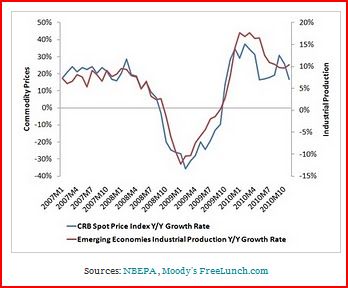
Here’s a graph from a recent David Beckworth post:

–

–

–

–

–

–

–

–

–

–

Spot commodity prices can’t be forecast (EMH.)  Spot commodity prices are highly correlated with the business cycle.  Ergo, the business cycle cannot be forecast.  This is in response to a recent Tyler Cowen post:

Raghu Rajan nails it:

“I would argue that three factors largely explain our collective failure: specialization, the difficulty of forecasting, and the disengagement of much of the profession from the real world.”

Rajan’s second point is exactly right.  The other two are completely irrelevant.  Someone please tell the Queen.

Another nail in the anti-EMH coffin

I generally don’t argue that the efficient markets hypothesis is true, rather I argue it is useful, and that anti-EMH theories are not useful.  I should say that I just focus on those anti-EMH theories that assert one can spot bubbles in real time, which imply one can predict markets (to some extent) over a longer period of time.  (Researchers like Rajiv Sethi analyze market inefficiency that doesn’t imply prediction.)

One famous argument against the “markets are predictable” anti-EMH view is that mutual funds that do well one year tend to do about average the next, indicating that it was more a question of luck then skill.  A popular retort is that the smart money isn’t managing mutual funds, which are an investment for suckers.  I don’t agree with this view, as successful stock picker Peter Lynch was highly beneficial to Fidelity Investments.  Mutual funds have an incentive to forecast well.   But let’s say I’m wrong.

A recent Boston Globe article sent to me by Miguel Barredo suggests that bubble forecasting success by economists is also pure luck:

That economist was New York University’s Nouriel Roubini. And since he called the Great Recession, he has become about as close to a household name as an economist can be without writing “Freakonomics” or being Paul Krugman. He’s been called a seer, been brought in to counsel heads of state and titans of industry “” the one guy who connected the dots while the rest of us were blithely taking out third mortgages and buying investment properties in Phoenix. He’s a sought-after source for journalists, a guest on talk shows, and has even acquired a nickname, Dr. Doom. With the effects of the Great Recession still being keenly felt, Roubini is everywhere.

But here’s another thing about him: For a prophet, he’s wrong an awful lot of the time. In October 2008, he predicted that hundreds of hedge funds were on the verge of failure and that the government would have to close the markets for a week or two in the coming days to cope with the shock. That didn’t happen. In January 2009, he predicted that oil prices would stay below $40 for all of 2009, arguing that car companies should rev up production of gas-guzzling SUVs. By the end of the year, oil was a hair under $80, Hummer was on its way out, and automakers were tripping over themselves to develop electric cars. In March 2009, he predicted the S&P 500 would fall below 600 that year. It closed at over 1,115, up 23.5 percent year over year, the biggest single year gain since 2003.  . . .

But are such people really better at predicting the future than anyone else? In October of last year, Oxford economist Jerker Denrell cut directly to the heart of this question. Working with Christina Fang of New York University, Denrell dug through the data from The Wall Street Journal’s Survey of Economic Forecasts, an effort conducted every six months, in which roughly 50 economists are asked to make macroeconomic predictions about gross national product, unemployment, inflation, and so on. They wanted to see if the economists who successfully called the most unexpected events, like our Dr. Doom, had better records over the long term than those who didn’t.

To find the answer, Denrell and Fang took predictions from July 2002 to July 2005, and calculated which economists had the best record of correctly predicting “extreme” outcomes, defined for the study as either 20 percent higher or 20 percent lower than the average prediction. They compared those to figures on the economists’ overall accuracy. What they found was striking. Economists who had a better record at calling extreme events had a worse record in general. “The analyst with the largest number as well as the highest proportion of accurate and extreme forecasts,” they wrote, “had, by far, the worst forecasting record.” . . .

Their work is the latest in a long line of research dismantling the notion that predictions are really worth anything. The most notable work in the field is “Expert Political Judgment” by Philip Tetlock of the University of Pennsylvania. Tetlock analyzed more than 80,000 political predictions ventured by supposed experts over two decades to see how well they fared as a group. The answer: badly. The experts did about as well as chance. And the more in-demand the expert, the bolder, and thus the less accurate, the predictions. Research by a handful of others, Denrell included, suggests the same goes for economic forecasters. An accurate prediction “” of an extreme event or even a series of nonextreme ones “” can beget overconfidence, which can lead to making bolder and bolder bets, and thus, more and more errors.

So it has gone with Roubini. That one big call about the Great Recession gave him an unrivaled platform from which to issue ever more predictions, and a grand job title to match his prominence, but his subsequent predictions suggest that his foresight may be no better than your average man on the street. The curious nature of his fame calls to mind two of economist Edgar Fiedler’s wry rules for economic forecasters: “If you must forecast, forecast often,” he wrote. And: “If you’re ever right, never let ’em forget it.”

There’s no great, complex explanation for why people who get one big thing right get most everything else wrong, argues Denrell. It’s simple: Those who correctly predict extreme events tend to have a greater tendency to make extreme predictions; and those who make extreme predictions tend to spend most of the time being wrong “” on account of most of their predictions being, well, pretty extreme. There are few occurrences so out of the ordinary that someone, somewhere won’t have seen them coming, even if that person has seldom been right about anything else.

But that leads to a more disconcerting question: If this is true, why do we put so much stock in expert forecasters? In a saner world than ours, those who listen to forecasters would take into account all their incorrect predictions before making a judgment. But real life doesn’t work that way. The reason is known in lab parlance as “base rate neglect.” And what it means, essentially, is that when we try to predict what’s next, or determine whether to believe a prediction, we often rely too heavily on information close at hand (a recent correct prediction, a new piece of data, a hunch) and ignore the “base rate” (the overall percentage of blown calls and failures).

And success, as Denrell revealed in an earlier study, is an especially bad teacher. In 2003 he published a paper arguing that when people study success stories exclusively “” as many avid devourers of business self-help books do “” they come away with a vastly oversimplified idea of what it takes to succeed. This is because success is what economists refer to as a “noisy signal.” It’s chancy, fickle, and composed of so many moving parts that any one is basically meaningless in the context of the real world. By studying what successful ventures have in common (persistence, for instance), people miss the invaluable lessons contained in the far more common experience of failure. They ignore the high likelihood that a company will flop “” the base rate “” and wind up wildly overestimating the chances of success.

To look at Denrell’s work is to realize the extent to which our judgment can be warped by our bias toward success, even when failure is statistically the default setting for human endeavor. We want to believe success is more probable than it is, that it’s the result of a process we can wrap our heads around. That’s why we’re drawn to prophets, especially the ones who get one big thing right. We want to believe that someone, somewhere can foresee surprising and disruptive change. It means that there is a method to the madness of not just business, but human existence, and that it’s perceptible if you look at it from the right angle. It’s why we take lucky rabbits’ feet into casinos instead of putting our money in a CD, why we quit steady jobs to start risky small businesses. On paper, these too may indeed resemble sucker bets placed by people with bad judgment. But cast in a certain light, they begin to look a lot like hope.

Yep.

Invisible Martians and Occam’s Razor

Say I’ve got a crazy uncle.  He tells me that there are Martians in his closet.  When I go to look I don’t see any.  “There invisible,” he replies.  I suppose that’s possible.  Or the closet might be empty.  Which alternative seems more plausible?  Occam’s Razor says you should go for the simplest explanation.

My recent post on finance produced some strong reactions.  Many were very good; indeed the comments by Ashwin were extremely good—better than my post.  But I still think Occam’s Razor’s on my side, and I’d like to explain why.  Having said that, I don’t mean to suggest my opponents are seeing invisible Martians.  Ashwin might well be correct.  I’ll let you decide.

The basic idea was that the structure of the economy had changed in such a way as to make financial skills far more valuable than in the 1960s.  I define “finance” as the business of allocating capital, which is a bit different from how it shows up in the national accounts.  For instance, I believe the CEOs of major non-financial companies are being paid (in part) for the decisions they make in allocating capital.  I argued that two changes in the economy had made skill at allocating capital much more important; high tech, and globalization.  But the way, I think these are also the two forces that did in communism.  Remember that the 1960s were the golden age of the Soviet economy.  If all you have to do is churn out iron and steel and washing machines and apartment buildings, it can be done passably well with central planning.  Of course even then the American economy was superior to the Soviet economy, but less superior than later on, when the decisions were about whether to allocate capital to Google or Genzyme, or whether to build that auto parts plant in Detroit or Mexico or China.  It’s no longer about simply mobilizing capital to mass produce clearly defined output of stuff we all know consumers will want.

I argued that those with great skill in spotting good investments would be expected to earn much higher incomes in the modern economy than in the economy of the 1960s.  And that you’d expect income to become more unequal, with some particularly big incomes going to the top.  The strongest arguments against me (and you should look at the comment section, because I won’t be able to do them justice) revolved around the fact that finance is distorted by all sorts of government intervention, which allow the big investment banks to earn enormous profits.  I’ll call this the subsidy argument; although later I’ll address more sophisticated versions that involve market power.

As an analogy, it would be like me claiming that the fast rising salaries of athletes (since the 60s) is due to growing TV money, and my opponents claiming that it’s due to public funding of stadiums.  I used the analogy of farming, which receives lots of government subsidies, but still sees rather modest average incomes, due to competition.  My opponents accepted the fact that this analogy applied to the smaller banks, but not to the big banks, hedge funds, and billionaire investors.  They argue that there are barriers to entry; that certain types of trading are effectively controlled by oligopolies, and that insiders have other related advantages.  I don’t completely dismiss their arguments, but for the following reasons I’m not convinced either:

1.  I’ve always believed that oligopolies are more competitive than they look.  It’s still a dog eat dog world out there, a real struggle to survive.  Lehman and Bear Stearns recently went bankrupt (or almost bankrupt, in the case of Bear Stearns.)  Yes the creditors of BS were bailed out, but the shareholders lost a lot of money.  The most oligopolistic industry in the world might be big jets, where two firms split the market.  And yet Airbus and Boeing seem to compete fiercely for sales.  In contrast, there are dozens of big banks competing in a globalized market.  I must defer to my opponents on the specifics of big banking, as I am not an expert, but are the areas where only a few banks dominate, such as trading certain types of securities, really enough to explain the extraordinary fortunes being earned by the wealthiest financiers?  I’d like to see some data on earnings from market making as a share of GDP.

2.  Hedge funds are much less regulated than big banks, and yet some of the most spectacular earnings go to the managers of top hedge funds.  So that would seem to undercut their argument that it’s all about barriers to competition.  It’s been argued that some of the profits that hedge funds earned came from activities involving the big banks, which are effectively subsidized by the Treasury (as Too Big to Fail means they can borrow at very low rates.)  Here’s Ashwin:

Let me try a simpler explanation – big banks are implicitly protected in scenarios of significant systemic risk. This incentivises them to seek out bets which explode in such scenarios but provide them with small premiums in more normal times (negatively skewed tail bets). Hedge funds such as Paulson, Magnetar etc take the other side of this bet which is a positive NPV trade. Again, at least in the cases of UBS and Magnetar this is not conjecture but based on publicly available information.

Yes, but that doesn’t really undercut my competition argument.  Why don’t others try to get those investments in subsidized markets?  Competition should still drive down the rates of return earned by hedge funds.  The only counterargument I can see here is that only a few hedge fund managers know how to find these easy pickings created by government subsidies.

But now we are veering dangerously close to the world of invisible Martians.  I claimed that the big earnings of rich financiers reflect their skill at allocating capital.  Others say they are benefiting from government favoritism.  I point out that competition should eliminate those gains in industries like hedge funds.  They say the hedge funds are dabbling in subsidized areas.  I ask why others don’t get rich doing this.  Perhaps only a select few have the skill to do these types of investments.  But for me to be wrong it also has to be true that those managers mostly lack the skill to spot socially beneficial investments, they concentrate on socially harmful ones.  Isn’t that one assumption too many?  To be clear, I never said that financiers never benefit from government subsidies, indeed my whole post had a completely different focus.  I argued that one would expect the recent structural changes in the economy to greatly enrich finance.  Either the gains to hedge fund managers come from talent, or they don’t.  And if the returns come from investment talent, then why wouldn’t one expect them to be able to make large amounts of money allocating capital in our dynamic modern economy.  And if they don’t have any special talent, why aren’t we all so rich?

Here’s what I think is the simplest explanation:

The return to hedge fund managers, CEOs, billionaire investors, and Goldman Sachs employees has soared in recent decades because their skills are far more socially valuable than the 1960s, when the biggest decision was whether GM should put tail fins on Cadillacs.  This dynamic, fast changing environment is like a big playpen for the shrewd and savvy investor.  We all know how the founders Microsoft and Google and Facebook got really rich because their “product’ can be produced at ultra-low marginal cost.  Or how great cost savings can be achieved by moving capital overseas.  In that sort of world it’s no surprise that investors who allocate capital to profitable ventures also get much richer than in the world where big corporations raised capital to make predictable products using American labor.

It seems to me that this should be the standard explanation, and any alternative explanation should have the burden of proof.  Instead it usually seems like the opposite is true.  I constantly read opinion pieces that seem to simply assume that the big earnings in finance are unwarranted.  Partly this is a backlash against the behavior of banks in the recent crisis.  I’m just as outraged by our financial system as the next guy.  But those are completely separate issues; one issue is secular trends in financial income, the other is bad regulation in banking.

Some commenters accused me of defending the financial system, which is absurd given that I have been a strong critic of the entire system.  The big bankers would be horrified if I was given dictatorial power over regulation.  I’d get rid of all the moral hazard.  But the investment banks and the hedge funds would still make boatloads of money in a completely free markets.  Perhaps a tad less, but the profits still would have soared in recent decades.

Others pointed out that my description didn’t match the Wall Street they knew.  Yes, lots of managed mutual funds rip off investors, and add little social value.  But that’s always been true, and with the rise of indexed funds is actually becoming less true over time.  Commissions don’t explain the huge growth in income to Buffett or Soros or the big hedge funds.  I doubt it even explains Goldman’s success.

Others argue my hypothesis is inconsistent with my belief in the EMH.  But I’ve never argued the EMH is true for everyone.  I’ve argued it’s a useful theory for regular investors like me, for regulators, and for academics.  But someone has to be doing the work of figuring out where capital should be allocated, and I presume they are rewarded for their efforts.

Some pointed out that my argument seemed to fit venture capital best, but their earnings are modest.  No, the reason the VC earnings are modest is because VC is only a tiny part of capital allocation.  And many investors in VC are not particularly sophisticated.  Others argue that trading shares in secondary markets doesn’t fit the description of allocating capital.  But I say it does, indeed even short selling plays a role in allocating capital.

Some accuse me of defending the wealth of financiers.  But I’m not making a moral argument here.  Because I’m a utilitarian I don’t pay any attention to the concept of “deserving” the money you make.  Our tax policy should redistribute money in the way that best maximizes aggregate utility, and pay no attention to whether it looks like various people’s incomes are “earned.”  Unfortunately I used the term ‘deserve’ in my post title, so I “deserved” that criticism.  🙂

Because of lack of time I will fall behind in my comments.  I’ll catch up eventually.

PS.  Some people talk about the big profits trading currencies, T-bonds, etc.  This is probably a naive question, but precisely who are these profits being extracted from?  If it’s companies that trade, why don’t the companies lean on their own bank for a better deal than GS can provide?  What am I missing?  It’s a learning process for me as well.

Avoid asymmetries

In a recent post I pointed to a weird asymmetry.  Even though bubble theory proponents think that prices are more likely to fall after a large run-up, those who correctly predict that prices will go even higher seem less famous (at least in America) than those who correctly predict the bubble will burst (which is allegedly the easier market call.)  I suggested this is just a part of the general problem of cognitive bias, which leads people to see patterns where there is actually nothing more than randomness.

In the comment section of a recent Tyler Cowen post, Rajiv Sethi made the following observation:

Let me repeat that I admire Scott Sumner, the coherence of his vision, and his general approach to blogging (as laid out in his amazing birthday post). But I think that his faith in market efficiency is misplaced and his glib dismissal of those who take bubbles and crashes seriously (we suffer cognitive illusions) baffling.

On a certain level I agree with Sethi (who is a very smart guy.)  There’s nothing people like less than for someone to respond to their argument by calling them irrational, or suggesting they have bad motives.  But this also raises an interesting problem for the bubble theorists.  Unless I’m mistaken, most anti-bubble theories assume some sort of irrationality among market traders, or dare I say, cognitive illusions.  (Which is supposedly “proven” by economic experiments which in fact do nothing of the sort.)  I’m not sure Sethi was actually complaining about my cognitive illusions comment, although I got that impression.  But if so, is it really any different from what the bubble theorists assume about asset market participants?

I need to constantly repeat a very important point; I’m not arguing the EMH is true.  I’m arguing the EMH is useful and that anti-EMH models are not useful.  The reason I don’t think the EMH is true is because I believe market participants do have cognitive illusions.  And the reason I don’t think the anti-EMH theory is useful is because I think academics and policymakers are equally susceptible to cognitive illusions.

Paul Einzig made the same basic argument back in 1937:

“On June 9, 1937, this veteran monetary expert [Cassel] published a blood-curdling article in the Daily Mail painting in the darkest colours the situation caused by the superabundance of gold and suggesting a cut in the price of gold to half-way between its present price and its old price as the only possible remedy.  He took President Roosevelt sharply to task for having failed to foresee in January 1934 that the devaluation of the dollar by 41 per cent would lead to such a superabundance of gold.  If, however, we look at Professor Cassel’s earlier writings, we find that he himself failed to foresee such developments, even at much later dates.  We read in the July 1936 issue of the Quarterly Review of the Skandinaviska Kreditaktiebolaget the following remarks by Professor Cassel:  ‘There seems to be a general idea that the recent rise in the output of gold has been on such a scale that we are now on the way towards a period of immense abundance of gold. This view can scarcely be correct.’ . . . Thus the learned Professor expected a mere politician to foresee something in January 1934 which he himself was incapable of foreseeing two and a half years later.  In fact, it is doubtful whether he would have been capable of foreseeing it at all but for the advent of the gold scare, which, rightly or wrongly, made him see things he had not seen before.  It was not the discovery of any new facts, nor even the weight of new scientific argument that converted him and his fellow-economists.  It was the subconscious influence of the panic among gold hoarders, speculators, and other sub-men that suddenly opened the eyes of these supermen. This fact must have contributed in no slight degree towards lowering the prestige of economists and of economic science in the eyes of the lay public.” (1937, pp. 26-27.)

Sub-men and supermen.  Hmmm . . . I wonder into which group Paul Krugman would place himself?

Now let’s see if we can draw a broader set of conclusions from this pattern, these asymmetries.  We’ve seen bubble predictors are treated differently from bubble deniers, and in the previous post we saw that conservatives were gung ho about focusing on commodity prices, except when commodity prices showed a desperate need for much easier money.  Can we find a third example?

How often have you heard people remark that high gasoline prices are caused by the machinations of oil market speculators?  But we know that the net demand for oil by speculators averages out to roughly zero in the long run.  This means that for every period where speculators are raising prices, there is another period where they are reducing prices.  But how often in general conversation do you hear people say:

Hmmm, gas is really cheap right now, I wonder if speculators are depressing the price?

Because I’m a mind reader, I can answer the question for you.  Zero times.  And it’s not just because people prefer to talk about bad news, they don’t even think speculators depress oil prices.

The world is full of this sort of asymmetrical thinking.  And it’s almost always a sign of sloppy thinking, of cognitive illusions.  And it often leads to bad public policy.

PS.  This isn’t an exact analogy, but notice that narcotics and sex transactions are usually considered bad if money is involved.  But in most societies the selling of sex and drugs is considered far worse than the buying of sex and drugs, even though each participant has an equal role in the transaction.  A sign of bad public policy?

PPS:  Five minutes after posting this I came across another example. We think that people who make lots of money are evil villians, whereas people who lose lots of money are innocent victims.  Consider the following:

Earlier that year, Picard claimed in court filings that Picower was a key beneficiary of Madoff’s scheme. The trustee said Picower had withdrawn $7.8 billion from Madoff’s firm since the 1970s, even though he only deposited $619 million. Picower “knew or should have known that [he] was profiting from fraud, because of the highly implausible high rates of return” on his accounts, the trustee said.

Right after the Madoff scandal broke all the brain-dead critics of laissez-faire said “see, this shows that unregulated capitalism doesn’t work.”  Eventually people pointed out that we don’t have unregulated capitalism, the SEC is supposed to prevent these sorts of abuses.  Even worse, someone told the SEC about the Madoff fraud, and even pointed to absurdly high and persistent rates of return that anyone with half a brain knew were impossible.  Or anyone who believes in the EMH knew were impossible.  But apparently the SEC is one of those groups that doesn’t find the EMH to be “useful.”  So they ignored the whistle-blower.  Now when we find someone who actually made off with lots of money from Madoff (pun intended) we react in horror.  Surely that rich bastard knew he couldn’t be earning that money legitimately!

That’s right, the supposedly expert SEC is given a pass in not responding to these high returns, as people keep insisting this shows we need still more regulation.  But the person that benefited, who like all humans would just love to think his success was well earned, that it resulted from his investment acumen, is somehow obviously guilty.

I give up.