Back in 2010, I predicted that India would have the world’s largest economy (in PPP terms) within 100 years. A few months later, I moved up the predicted date to 2081. Based on this graph, I’d now say some time in the 2060s:
Today, India and China both have a bit over 1.4 billion people. But look at the disparity in births! India has 23.2 million births, whereas no other country has even 9 million. By the 2060s, those Indian babies will be 40 years old, right in the prime age for working. As long as India can get its productivity up to half of China’s level (which seems doable in the long run) then it should surpass China in GDP (PPP). Of course, long before that the US will have fallen to third place. (We’ll still be number one in per capita terms, which matters for living standards.)
I used to find these sort of predictions to be sort of intriguing. More recently, they’ve started to seem kind of pointless. That’s partly because I won’t live to see how all this pans out, and partly because AI is eventually likely to transform the world in such a radical fashion that all predictions about the 22nd century become about as meaningful as those a 13th century peasant might have made about the world of 2024.
It isn’t just that India has more births than China, even pre-breakup Pakistan has more births. That’s crazy. (When I was young, Bangladesh was part of Pakistan.)
PS. This is one reason I’m not part of the natalism panic. Even with low birth rates, the world’s population will reach about 10 billion in 2100. And after that it’s totally impossible to predict anything. I’m not saying the birth rate worriers are necessarily wrong, just that no one knows what the 2100s will look like.
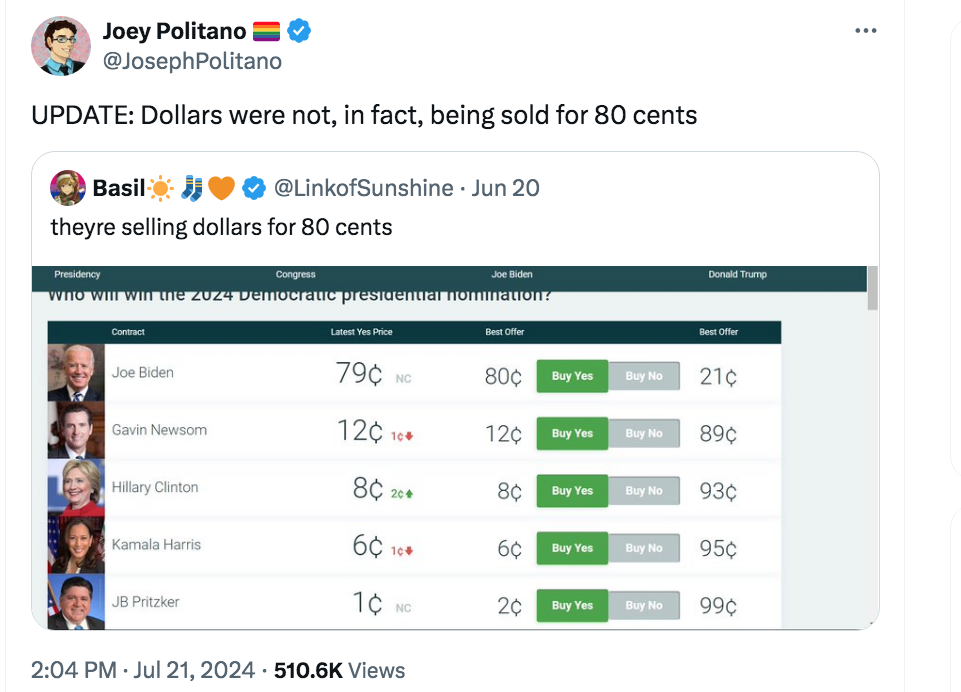
If Biden had been nominated, I guarantee that this example would have been cited by anti-EMH types. “Markets were giving a 20% chance that someone else would be nominated, when it was obvious that Biden had things wrapped up.”
The market is smarter than you think.
PS. A few comments on Harris:
I often see right wingers making two points:
1. DEI programs that promote the unqualified are bad.
2. Problem X occurred in a system that had hired women and blacks, and hence DEI is to blame for problem X.
The first claim is true, while the second is usually sexist/racist.
The Harris case is particularly interesting. She was certainly “hired” because she is a black woman. And yet she’s far more qualified to be president than either Biden or Trump. Smarter, more articulate, more energetic, etc. (Of course I don’t agree with her politics, but that’s neither here nor there.)
On the other hand, she’s not the most electable Democrat, mostly because she is a black woman. That’s presumably why Obama has held back in endorsing her; he understands that someone like Beshear is more electable. Life is unfair.
No one looks good here. Not the DEI obsessed Democrats. Not the low news engagement swing voters that don’t like forceful black female personalities. Not the Republicans who whisper that Harris is a DEI hire. Very sad all around.
PPS. Can we please stop electing senile 80-year old presidents, especially ones who have committed dozens of felonies? Is that too much to ask? The same Republicans who (correctly) insisted Biden was senile see no problem with a very old man who rambles on interminably and incoherently in a major convention speech, in the way that you associate with leaders of countries like Cuba and Venezuela. Really?
PPPS. If we had to have a “thinker” as VP, couldn’t we choose one who is less shallow than Vance. (He’s not even able to hide his disgusting bigotry.) I recently met Rob Henderson at a book signing. His life story has some similarities to Vance’s but Henderson is a vastly more thoughtful intellectual.
PPPPS. When I say “markets are smarter than you think” I’m excluding Matt Yglesias, who doesn’t like headlines telling him that he doesn’t understand something.
1. Radical egalitarianism. Public shaming and forced apologies when people fail to spout obvious nonsense like, “All differences in pay between ethnic groups reflect racism.” (I guess there’s lots of racism against white Christian Americans, as they make less than Jews from Eastern Europe or Hindus from India.)
2. Resentment against the intellectual elite. Shut down the universities and send the intellectuals to the countryside.
Over the next four years, I expect to be eagerly munching on my popcorn as these two types of Maoists go after each other. Consider the following tweets:
Why not remove the tax exemption from all universities? Why would they go after only NGOs with more than $5 billion in assets? The answer is obvious. They are not upset by places like (relatively apolitical) Bentley College, where I used to teach. The right wing Maoists hate those pointy headed intellectuals at Harvard and Yale, as those are the people with real influence over our political system.
The ironies are rich. Our intellectual elite has an radical anti-elite ideology. Those who hate our intellectual elite, hate their anti-elite ideology. Thus they believe the elites must be punished.
Got that?
PS. Just to be clear. I’m not saying that going after tax breaks for universities is Maoist. (It may be good policy.) I’m saying that going after tax breaks for elite universities is Maoist.
[I’ve received complaints that I don’t do enough posts on monetary policy. I have a long one over at Econlog with zero comments, while my moronic Trump posts get dozens of comments.]
Because, in Britain, someone who is nationalist in general will be anti-EU in particular, the Anglo-American intelligentsia tends to assume the same of Europeans. In fact, millions are able to decouple the two things.
Brexit helped. If Nato owes its second life to Russia, the EU is forever in Britain’s debt. Its great adventure of 2016 has gone badly enough to discourage the rest of Europe from even entertaining the same idea. Apart from its co-authorship of the single market in the 1980s, Brexit stands out as the UK’s kindest service to the European project. (Both happened under the Tories, which will gall that party to a degree that no landslide election defeat ever could.) What a parting gift. And how true, on such different levels, when Brussels says: “You shouldn’t have.”
I wrote about this in the context of Biden’s “save democracy, vote Democrat” rhetoric before the 2022 midterms, but clearly the point merits new elaboration. Time and again, from 2016 to the present, the Democratic Party has treated Trumpism not as a “civic emergency” but as a political opportunity, a golden chance to win over moderate and right-leaning voters with the language of anti-authoritarianism while avoiding substantive concessions to these voters and actually moving farther to the left.
By March 2008 America had entered recession and its financial crisis was under way. The country’s stocks accounted for less than 40% of the world’s total stockmarket capitalisation.
Fast-forward to today and things look rather different. America’s share of the world’s stockmarket capitalisation has climbed pretty consistently over the past decade and a half, and sharply this year. It now stands at 61%. That is astonishing dominance for a country which accounts for just over a quarter of global GDP.
4. Many people seem to think Trump is the same guy as in 2020, or 2016. I think this is related to the famous example of the frog in the pot, not realizing that the water is getting hotter and hotter. The Economist points out that there was a time when even Republicans like Trump condemned the Jan. 6 insurrectionists. Now, Trump is campaigning on the theme that they were actually heroes. He calls them warriors:
To call them warriors is not simply to insist their cause was just and that they were somehow tricked into entering the Capitol with the guns, bats, knives and other weapons that Mr Trump once maintained they did not have; it is not just to ignore or minimise the violence that day, which resulted in five deaths; it is not even to shift the blame for that violence to others, whether police officers (some 140 of whom were assaulted), or Ms Pelosi (whom the rioters were hunting, and who can be seen on video from that day urging Mr Trump’s acting secretary of defence to dispatch troops to the Capitol). It is instead to praise the people who attacked the Capitol precisely—definitionally—for their capacity to wage war. That is to move the understanding of what happened on January 6th, at least for Mr Trump’s supporters, onto new and even darker ground.
There was a moment, back in the mists of 2021, when just about everyone in the mainstream of American politics recoiled in shock from the mayhem of January 6th. They agreed that attacking the Capitol was wrong, and that Mr Trump, to some degree, was responsible. Even Mr Trump said so,
The Trump of 2020 was considerably more authoritarian than the Trump of 2016. And the Trump of 2024 is considerably more authoritarian than the Trump of 2020. Deep down, Trump hasn’t changed. Instead, he’s realized that America has changed. In 2024, it’s OK to run for president celebrating violent insurrectionists who tried to overturn an election.
5. If you haven’t been keeping up with developments in solar power, you might wish to check out a new essay in The Economist. It seems that solar energy prices are plunging so low that entirely new possibilities are opening up:
It is possible that batteries might move electricity in space as well as time. Lawrence Berkeley National Laboratory estimates that there are 2.6tw of generation and storage capacity queuing up for grid connections in America—enough to double the country’s installed generating capacity. This queue contains a full terawatt of solar power. SunTrain, in which Dr Carlson’s firm, Planetary Technologies, is an investor, sees this as a market for batteries with wheels.
The company plans to use solar farms in places that have little to recommend them other than a railway line nearby as filling stations at which to charge heavy but cheap batteries built into goods wagons. A 100-car train similar to the ones that currently carry coal east from Wisconsin could deliver 3 gigawatt-hours to users. Dr Carlson describes a utility-boss’s jaw hitting the floor when he proposed that, instead of a multi-decade planning battle to build a high-voltage transmission line, SunTrain could meet the utility’s power-import needs with a couple of trains a day.
6. It’s a mistake too focus too heavily on US politics, as you may miss the bigger picture:
When the Alternative for Germany (AfD, from its German initials) was launched in 2013, it was a pro-business, classically liberal party created by German intellectuals opposed to the single European currency. Hans-Olaf Henkel, a free-market enthusiast and former boss of the bdi, the main German industry association, was a founding member.
Then, in the space of a few years, the afd turned into an anti-immigrant, populist party toying with Dexit—Germany’s exit from the EU. Mr Henkel quit in 2015. German bosses turned their backs. Despite being generally reluctant to voice political opinions, many came out strongly against the afd ahead of the election to the European Parliament on June 9th.
Remember when Tea Party was sort of libertarian?
7. More evidence that the War on Drugs was a catastrophic mistake:
Some fear that super-strength commercial pot is fuelling mental-health breakdowns. But the evidence for this is thin. An extensive study published last year in the journal Psychological Medicine found that people who live in states where weed is legal consume more than their identical-twin siblings in states where it is not. But they are no more likely to suffer mental, physical, relationship or financial problems. Another study looked at health-insurance data to see whether states with legal cannabis saw more claims for psychosis. The authors found no relationship.
BTW, Brian Albrecht has an interest post on the opioid epidemic.
8. Worried about abuse of power? Consider the following:
Nowadays the deployment of troops and suspension of liberties on American soil by the federal government is hard to imagine. Yet if a tyrannical president wished to do so, he would have the power to send in the troops under the Insurrection Act. This law, dating from 1807, gives the president the authority to deploy the army or the navy in the case of a domestic uprising or where federal law is being ignored. The act states that this can be done when lawful, without defining when that means. “It’s a loaded gun for any president. There are practically no constraints,” says Jack Goldsmith, a former attorney-general and current scholar of presidential power who is part of an effort to reform the act.
But have no fear, the Supreme Court will certainly not allow any president to be above the law.
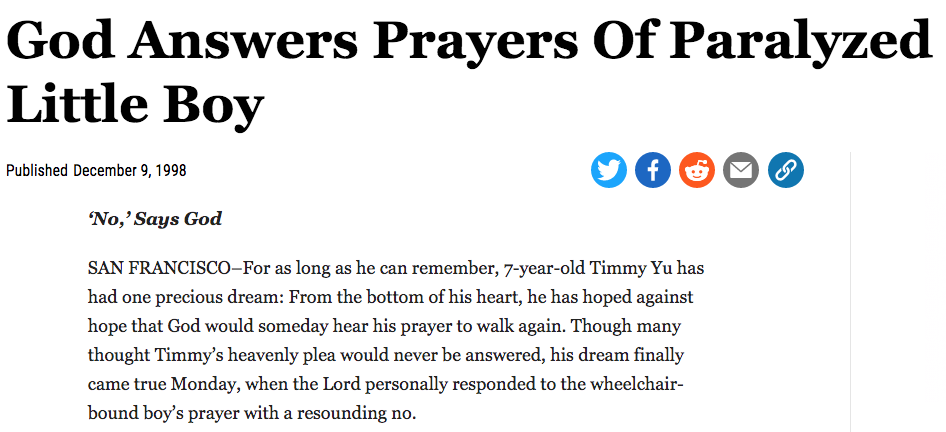
9. Some are claiming that after previously deciding not to deflect bullets away from JFK and Bobby Kennedy, God did decide to deflect a bullet away from Trump’s head. Because I am not religious, I’ll refrain from offering an opinion on this hypothesis. But I will say that it reminds me a bit of an old Onion headline:
Remember the “Nixon to China” meme? The basic idea is that under our system of governance, major shifts in policy require buy-in from the faction that is traditionally hostile to the idea. There are too many checks and balances to ram through a momentous change without support from the opposition party.
If you compare the American fiscal regime with the fiscal policies of most European countries, you’ll notice many similarities, but also a few key differences:
1. Both feature big government, but government in Europe is usually at least 10% of GDP larger than in the US. (Except Switzerland.)
2. Both raise a lot of revenue through progressive income and corporate income taxes. The top income tax rates are not all that different. Both have extensive payroll taxes.
3. European countries have VAT systems with tax rates of roughly 20% (and much high gasoline taxes than the US.) These higher taxes on consumption are (perhaps unfairly) considered regressive, and largely explain why European countries raise substantially larger amounts of revenue than does the US government.
The progressive left will never be able to achieve their dream of a Euro-style welfare state by taxing the rich. If you read the smarter progressives, they all know this. They understand that the US would have to add a large tax on consumption in order to get government spending up to 45% of GDP. Until now, that idea has been a complete non-starter, because of intense opposition from the GOP.
But now, Trump is proposing a big new tax on consumption, indeed a tax that is even more regressive than a VAT. He’s advocating a 10% tariff on all imports (and 60% on China.) Yes, that falls far short of a 20% VAT on goods and services. But it’s the foot in the door. The next step is when the Dems reclaim power and complain that tariffs hurt the poor because the consumption basket of the rich is skewed toward services. “Why should services be exempt?” They switch us from a 10% tariff to a 10% VAT. Then, when more money is needed, it becomes a 12% VAT. Rinse and repeat . . . we are on the way to becoming a Euro-style welfare state.
Trump is doing the Dems a huge favor, making the idea of massive regressive consumption tax seem less toxic. It’s the fiscal equivalent of Nixon going to China.
PS. Yes, tariffs only apply to imported goods. Next time you’re at Walmart, check the labels to see how many goods are made in the USA. And yes, I realize that Trump may not actually implement the 10% tariff. Consider this post a “what if”, not a prediction.
PPS. Some will say that consumers don’t pay the tariff, the money is paid by producers. In a technical sense, that’s also true of VATs and gasoline excise taxes. Does anyone think that producers aren’t passing those taxes along to consumers?
PPPS. Today’s Weekend at Bernie’s moment, Biden wants to cap rent increases at . . . er . . . $55!!
Welcome to a new blog on the endlessly perplexing problem of monetary policy. You’ll quickly notice that I am not a natural blogger, yet I feel compelled by recent events to give it a shot. Read more...
My name is Scott Sumner and I have taught economics at Bentley University for the past 27 years. I earned a BA in economics at Wisconsin and a PhD at Chicago. My research has been in the field of monetary economics, particularly the role of the gold standard in the Great Depression. I had just begun research on the relationship between cultural values and neoliberal reforms, when I got pulled back into monetary economics by the current crisis.
"This man is the devil. Look at his eyes. Same as Soros. All baggy and nasty. Good people dont age like that. Its the sign of a madman. A negativity..."
"I watched Satantango on video over 3 days. I found it absolutely gripping, but one must surrender for a time one's idea of what a movie should be. Instead, you..."