Vincent Reinhart, who worked at the US central bank for more than 20 years, expects the Fed to proceed “gradually” this year in light of geopolitical uncertainties and the dovish composition of the its monetary policy setting committee. He also worries that will amount to a policy error.
“They’re not going to be able to tighten enough in 2022,” he predicted. “They’ll have to go a bit more in 2023 and inflation is going to be well above their goal this year and next.”
I think that’s right, but I’d like to make one small change, using my strikethrough function:
“They’re not going to be able to tighten enough in 2022,” he predicted. “They’ll have to go a bit more in 2023 and inflation is going to be well above their goal this year and next.”
So where do Reinhart and I differ? I cannot be sure, but I suspect Reinhart has in mind something like the following:
Given the Fed’s commitment to interest rate targeting, as well as their commitment to avoiding the sort of dramatic adjustments in the target interest rate that might spook the markets, they will not “be able to” tighten enough in 2022.
If that’s what Reinhart had in mind, then I agree. The real problem is the policy regime. The Fed needs to take seriously its commitment to average inflation targeting, and do whatever it takes to achieve that commitment. They need to “be able to” do the right thing.
I’m doing this post partly because I think people are underestimating the importance of recent research on the origin of SARS-CoV-2, which points more and more strongly to a zoonotic origin. Matt Yglesias has a very sharp analytical mind, but I’m not sure that even he is quite seeing the picture.
There’s essentially only one important remaining piece of evidence pointing to a lab leak, the fact that Covid first appeared in Wuhan, which contains a virus research lab. That’s consistent with both a lab leak from a natural sample or a lab leak from gain-of-function research. All of the other so-called evidence pointing to a lab leak has been thoroughly discredited. To his credit, Yglesias doesn’t rely on the discredited evidence, just the coincidence of the virus popping up in Wuhan.
I’d like to make two points here. First, the virus emerging in Wuhan is nowhere near as a much of a weird coincidence as one might think. Second, evidence pointing to a zoonotic origin is a bit stronger than Yglesias assumes.
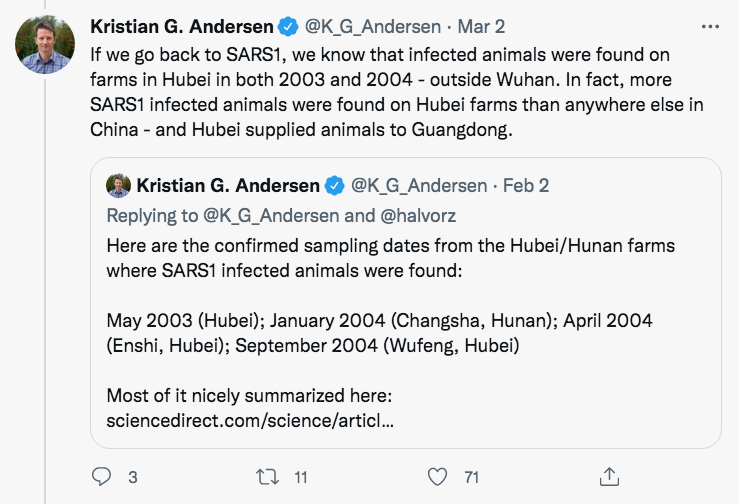
Let’s start with SARS1, which everyone agrees is of natural origin. It first appeared in 2002 in Foshon, which is part of the huge Guangzhou metro area in the even more massive Pearl River delta metroplex. That city is nearly as far from the bat caves of Yunnan as is Wuhan. It also appeared in November, just as did the outbreak in Wuhan. The first known cases were associated with an animal market, just as in Wuhan. Furthermore, Wuhan is in Hubei province, which is full of the sort of mammals that provide a plausible transmission to humans:
BTW, Andersen’s source is a 2008 paper, for all you conspiracy theorists.
Here’s what you need to know about virus outbreaks:
1. Southern China is different from northern China; they eat lots of unusual animals.
2. The animals are brought to large markets in big cities, where disease outbreaks tend to occur.
3. This has been going on for a long time—remember the Hong Kong flu? (Which didn’t necessarily begin in HK, but was first noticed in the Pearl River delta area.) China has been a leading source for global pandemics throughout history.
The biggest metro areas in south China are the Pearl River Delta metroplex, Wuhan, Chongqing and Chengdu. These are the cities where you’d expect a new global pandemic to begin. And more specifically, you’d expect the pandemic to begin in an animal market in one of those big cities. So please don’t anyone tell me that it’s a one in a thousand chance that Covid would begin in a Wuhan animal market, that’s nonsense.
The new research shows that the Covid-19 outbreak did first show up near a Wuhan animal market, something Yglesias acknowledges. But he also suggests that it might have begun there due to a superspreading event when a lab worker visited the market (or a nearby location) and infected lots of other people. But there are all sorts of problems with this hypothesis.
First the obvious. Wuhan is a crowded city of 11 million people. It has thousands of crowded sites where a superspreading event could have occurred. Why the animal market? Many people wrongly view it as an amazing coincidence that the outbreak occurred in Wuhan of all places, but it really would be an amazing coincidence of a lab worker brought the virus to the animal market of all places for which a superspreading event could have occurred. The “I don’t believe in coincidences” argument points strongly to a zoonotic origin.
One response is that the market is near the center of Wuhan. But it’s not just that the early cases were in the central Wuhan area; a disproportionate number were clearly associated with the market itself. Why?
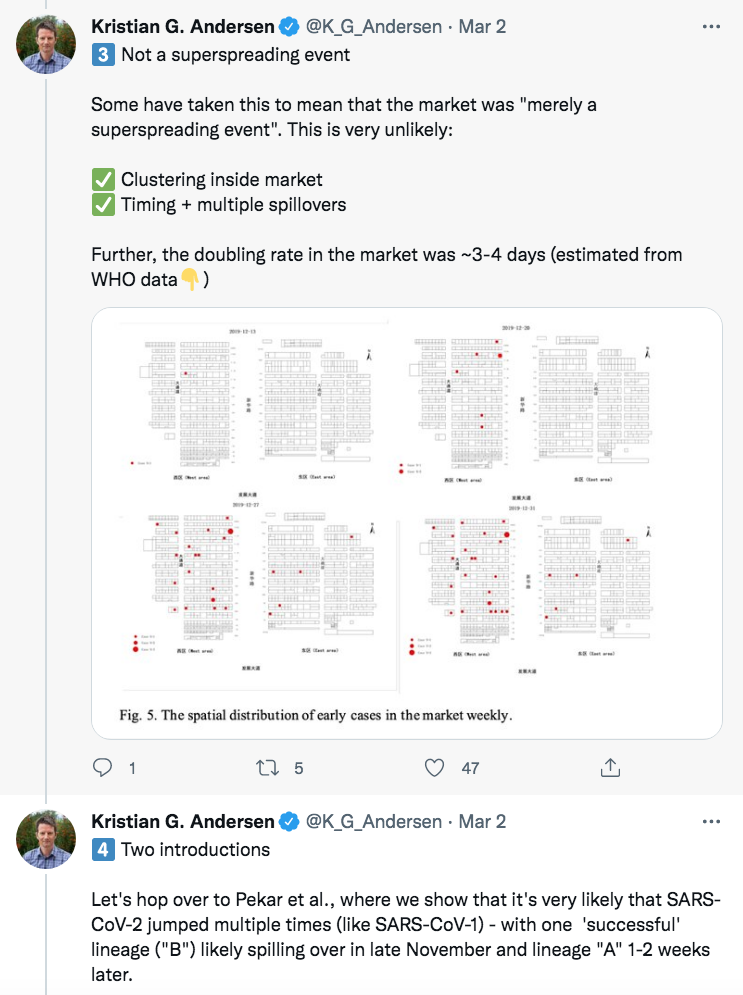
Second, there doesn’t even seem to have been a superspreading event at the animal market:
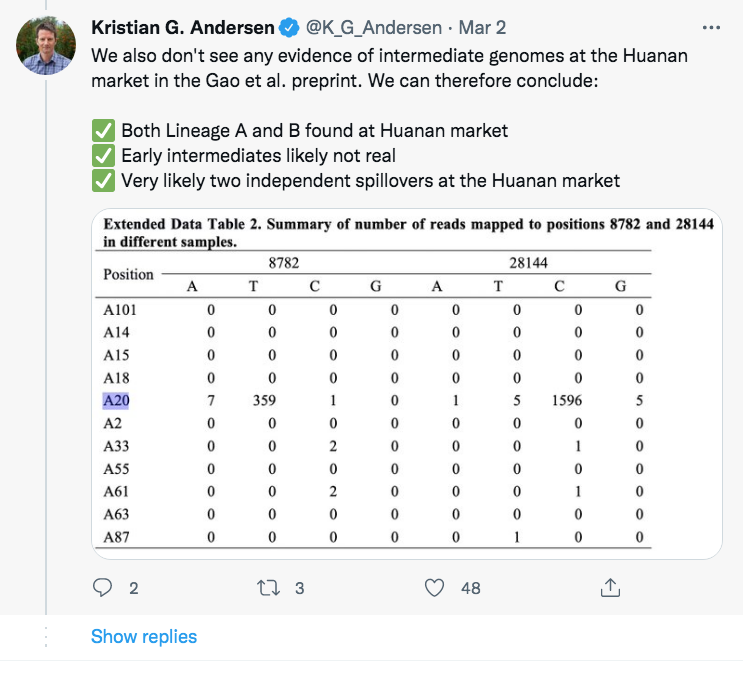
And this:
Thus the spillover occurred over days and weeks, and involved two variants, A and B. Models suggest there’s only a 3.6% chance B mutated to A in humans, and what are the odds of two lab leaks?
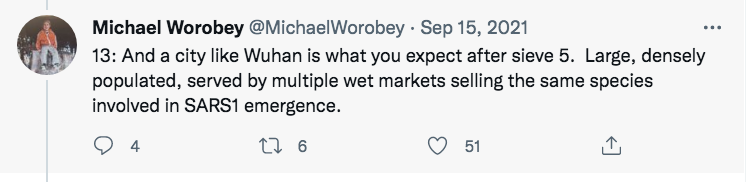
Michael Worobey also has a good tweet thread. Here’s one point:
3. Also note that environmental samples from the animal market showed SARS-CoV-2. They could have come from humans (the animals were unfortunately destroyed), but the fact that they were more concentrated in areas of the market containing wildlife animals is at least a suggestive piece of evidence.
Does the destruction of the wildlife at the market suggests a Chinese cover-up? Absolutely. China had been heavily criticized for these markets, and China claims that the Wuhan market did not contain wildlife. We now have conclusive evidence that that was a lie. China is covering up the fact that Covid likely began in a animal market in Wuhan. There is no doubt about the cover-up; the only question is whether they are covering up something that actually happened. Indeed the Chinese are now rejecting these new studies pointing to the animal market:
In the new preprint, Gao and colleagues analyzed 1380 samples from 188 animals in the market and the environment, including sewer wells, the ground, feather removing machines, and “containers.” They found SARS-CoV-2 in 73 samples. But because all were from the environment, not the animals themselves, they assert that humans introduced the virus to the market. The authors call the market an “amplifier,” not the source, of SARS-CoV-2.
Hewing closely to government assertions on COVID-19’s origin, the preprint by Gao and colleagues notes studies that have reported evidence of SARS-CoV-2 in other countries before it surfaced in Wuhan, making no mention of critiques that attribute that evidence to contamination. It also floats a widely disputed theory that frozen food imported to China might have been the original source. (Authors of the paper, including Gao, did not respond to requests to discuss the work.)
BTW, for you who like coincidences, chew on this one. Only once in my life did I ever see wildlife (about to be eaten) being kept in cages right on a table of the dining area of a restaurant. It was back in 1994, as I was eating one night at an outdoor restaurant and noticed out of the corner of my eye that a bag was moving slightly, just one table over to my left. On closer inspection, it was a mesh bag full of dozens of frogs, attempting to hop around. It gave me a really queasy feeling. And guess what:
The restaurant was in China.
The restaurant was in Wuhan, China.
The restaurant was in the old colonial section of Wuhan, 2 miles southeast the animal market where Sars-Cov-2 first emerged.
Coincidence? Queue the Twilight Zone music.
For many people Wuhan is just a word. For me, it’s a massive urban area full of dense crowds of people and weird animal consumption patterns. I’m not in the least surprised that Wuhan is the origin of the Covid pandemic.
On one point I agree with Yglesias. Regardless of the origin of Covid-19, virus research has the potential of being extremely dangerous and should be regulated in such a way as to reduce tail risk of an artificially engineered pandemic. That’s what we should be focusing on.
PS. If you are not aware of how the other lab leak evidence has been discredited, read this.
The studies were posted as preprints and are not peer reviewed, but scientists, biosecurity experts, journalists, and others are already intensely examining their details. “I have been brought closer to the zoonosis side with these preprints,” says Flo Débarre, an evolutionary biologist at the French national research agency, CNRS, who has followed the origin debate closely and not thrown her lot with either the natural-origin or the lab-leak camp. Evolutionary biologist William Hanage of Harvard University agrees these studies “will be taken as a blow” to the lab-leak hypothesis. “They substantially move the needle on the origins in the direction of the market,” Hanage says.
I was sent a long video from 2015 of John Mearsheimer discussing the roots of the Ukraine crisis. At a superficial level his talk seems impressive. He’s very knowledgeable. Dig deeper, however, and it all falls apart.
One thing I noticed almost right away is that Mearsheimer is quite biased, and presents information is a misleading fashion. At times he seemed to be echoing RT talking points.
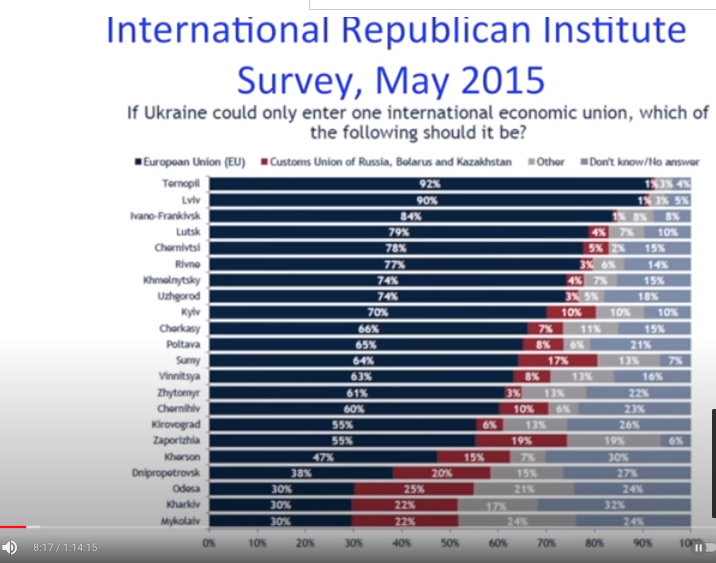
Here’s a minor but telling example. He presents a graph showing the poll results when Ukrainians were asked if they wished to join the EU or a Russian trade pact. In every single city in Ukraine, a plurality of those who responded to the question favored the EU over the Russian option. The graph goes by quickly and is rather complicated, however, and thus most listeners may not notice this fact. They might believe that Mearsheimer is telling the truth when he says the poll showed that Eastern Ukrainians have “little interest” in joining the EU. That interpretation is simply false. Among those who responded to the survey, a plurality favored EU membership in every single Ukrainian city, no matter how high the proportion of ethnic Russians. In other words, while no option got a majority in a few eastern cities, EU membership was the most popular option in all cities.
He makes a big deal of the 2014 Ukrainian revolution, which he misleadingly calls a “coup”. This was triggered by the Ukrainian government’s decision not to move forward on joining the EU. Mearsheimer says that joining the EU would be a terrible mistake because Ukraine needs to stay neutral. But neutrality in no way precludes a country from joining the EU. Sweden, Finland, Ireland and Austria are all EU members. Ukraine is a sovereign European country and thus has every right to join the EU. Doing so poses no threat to Russia, indeed I hope that someday Russia joins the EU.
His other big obsession is NATO. Mearsheimer seems to agree with Putin that NATO is a threat to Russia. If so, then why didn’t Putin complain when the Baltic States joined NATO? They are right on Russia’s border. He presents a dark image of NATO as an aggressive force, bent on overthrowing governments that it does not like. But his real target seems to be the US, particularly when he cites US foreign policy in places like Iraq.
Mearsheimer has some truly far-fetched analogies involving the Monroe Doctrine. He claims that the US would never allow foreign powers to get involved in our back yard. But Cuba’s been a Soviet/Russian ally for decades. Yes, we did support the foolish Bay of Pigs, but that was certainly not an all out invasion of Cuba with US troops. In any case, I’ve never liked Cold War moral equivalence arguments. What the Soviets did in the Warsaw Pact was outright colonialism, far different than NATO.
I suppose the best argument along those lines is that we did not tolerate Soviet missiles in Cuba. But if the Russians were merely arguing against US nuclear warheads in Ukraine then I’d agree with them. Indeed we pulled our nukes out of Turkey as part of the Cuba deal.
[To be clear, I am not arguing that we should now admit Ukraine to NATO, I’ve opposed that for quite some time. But I’m also opposed to a statement that Ukraine can never join NATO. I hope that at some point in the future all the world’s nations belong to NATO, and then if one country attacks another, the entire world goes to war with the aggressor. Obviously, that’s a dream for the 22nd century, if we are still around.]
Mearsheimer’s most notable mistake was his repeated claim that Putin was far too smart to invade Ukraine, and that this would be a disaster for Russia. Perhaps it will be a disaster (it’s too soon to say), but obviously he was wrong about Putin. He said that comparisons between Putin and Hitler were ridiculous. If by “comparison” you mean, “they are identical”, then Mearsheimer is correct. But if by comparison you mean, “just as Hitler used force in an attempt to create a Greater Germany, Putin will use force to create a Greater Russia”, then comparisons are appropriate.
This talk occurred in 2015. Since that time, the entire world has become far more nationalistic. Not just Russia, but also China, India, Turkey, Hungary and to a lesser extent even places like the US the UK, and Israel. Mearsheimer may not have anticipated this trend, which is why he thought Putin would never invade Ukraine.
When bad guys behave badly, beware of claims that the “root cause” is some minor policy mistake by the good guys. Bad guys are bad.
Former Trump administration national-security adviser John Bolton dismissed the notion that President Trump deterred Russian president Vladimir Putin from behaving aggressively toward Ukraine while he was in office, arguing that the Trump administration was tough on Russia in spite of the president, not because of him. . . .
“But in almost every case, the sanctions were imposed with Trump complaining about it and saying we were being too hard. The fact is he barely knew where Ukraine was. He once asked John Kelly, his second chief of staff, if Finland were a part of Russia. It’s just not accurate to say that Trump’s behavior somehow deterred the Russians,” he added.
Finland part of Russia? And to think that my Republican commenters think Biden is senile!
Welcome to a new blog on the endlessly perplexing problem of monetary policy. You’ll quickly notice that I am not a natural blogger, yet I feel compelled by recent events to give it a shot. Read more...
My name is Scott Sumner and I have taught economics at Bentley University for the past 27 years. I earned a BA in economics at Wisconsin and a PhD at Chicago. My research has been in the field of monetary economics, particularly the role of the gold standard in the Great Depression. I had just begun research on the relationship between cultural values and neoliberal reforms, when I got pulled back into monetary economics by the current crisis.
"This man is the devil. Look at his eyes. Same as Soros. All baggy and nasty. Good people dont age like that. Its the sign of a madman. A negativity..."
"I watched Satantango on video over 3 days. I found it absolutely gripping, but one must surrender for a time one's idea of what a movie should be. Instead, you..."