Archive for October 2013


Maybe next year

Each year I do a post about the Chinese crash that did not occur.  Early 2012:

Apocalypse later?

Each year there is a loud chorus of pundits predicting that China’s boom will turn to bust.  And each year they are wrong.  .  .  .

And then early this year:

Apocalypse delayed, once again.

Time for my annual post pointing out that the China bears were wrong once again.

And here’s Matt Yglesias this morning:

The Chinapocalypse Keeps Not Happening

By 

I’ve lost track of how many years we’re into the story of “debt-burdened China and its unsustainable investment-fueled growth are about to crash and burn” but this morning came the news of a rebound in economic growth despite a fall in exports after a couple of down quarters. Naturally the news article is nonetheless filled with gloom and doom about bad debts and overinvestment and blah blah blah.

And to be clear, I think that two things are true. One is that as China gets richer and richer its growth rate is going to be on a downward trajectory. The other is that if you predict a Chinese financial crisis every month for enough straight months, eventually the Chinese financial crisis will occur.

But it’s very hard for me to think of another story where the ratio of pessimistic commentary to actual bad news has been so high. You particularly see this in the odd obsession with overinvestment.  .  .  . But the question must be asked: Compared to what? A dollar invested in a very bad project is still going to have more long-term wealth-building impact than a dollar spent on Chicken McNuggets. And by the same token, resources employed in a white elephant infrastructure project are generating drastically more social value than resources employed in Southern Europe’s booming unemployment sector.

PS.  I see that Tyler Cowen has a Time magazine article on a topic of interest to both Matt and me, Texas.

Billionaires have a moral obligation to become tax exiles

I’ve always had a relatively high opinion of Richard Branson.  What’s not to like? But I was a bit disturbed by this:

U.K. billionaire Richard Branson has mounted a swift online defence of his decision to live to his private Caribbean island retreat, claiming he was not quitting the U.K. for tax but for lifestyle reasons.

Over the weekend, a report in the U.K.’s Sunday Times highlighted the tax benefits for the 63-year-old billionaire in setting up home on Necker Island in the British Virgin Islands.

The U.K. has an income tax rate of 50 percent for the highest earners, while Necker has a zero rate of income tax. Moving to Necker will mean that he is no longer a British resident and, as such, no longer subject to income or capital gains tax. Branson can still spend up to 183 days in the U.K., however.

(Read more: Jump! Richard Branson Wants to Skydive From Space )

“After 40 years building companies & creating jobs in the UK, I now live on Necker working on building not-for-profits…I have not left Britain for tax reasons but for my love of the beautiful British Virgin Islands and in particular Necker Island , which I bought when I was 29 years old,” Branson wrote on his Virgin blog page on Sunday.

Of course I’m glad he moved, but disappointed by the motive.  Branson had a moral obligation to leave the UK, even if he preferred London to BVI.  To see why, let’s view the following facts from a utilitarian perspective:

1.  Billionaires have way more money than they “need.”  Of course so do average Americans, so let’s be more precise. Billionaires receive very little marginal utility from lifetime consumption levels above $100 million. Therefore, they should give at least 90% of their wealth to charity.

2. In countries like Britain and the United States, government spending (at the margin) tends to be very wasteful from a utilitarian perspective. Upwards of 90% of government spending goes towards special interest groups or towards programs of dubious value. Even programs that represent the core function of government, such as national defense, tend to have zero or even negative value at the margin. Only a small fraction of spending goes towards programs such as poverty reduction and medical research, where it is at least possible that government spending is as valuable as the spending of a well-run charity.

I do understand that there are legal roadblocks that make it difficult for people like Bill Gates to become tax exiles. However the basic principle is clear; if billionaires are able to successfully shield their wealth from the tax authorities, they should do so.  Starving kids in Africa need the money much more that older Americans need a COLA in their Social Security benefits, and more than the military needs another $300 billion in fighter jets.

I presume this post will horrify big government liberals. And also those libertarians who are repulsed by utilitarian arguments that the rich have a moral obligation to give much of their wealth to the less fortunate. But I’m not in this business to please people.

PS.   Recall that there is a big difference between “expenditure” and “consumption.” At the low interest rates that we see today the flow of consumption services over 25 years from a $50 million mansion is much less than $50 million. It’s actually pretty hard to consume $100 million.  Think of all those fashionable townhouses in the West End of London that remain empty 95% of the time. Is that really a good use of our resources?

PPS.  Now that government is back in business it’s time to reform immigration.  Let the huddled masses in and encourage billionaires to get the hell out, and take their money with them.

PPPS.  It’s wrong to claim the GOP got nothing out of the shutdown, they did get more government spending on boondoggles:

It also includes an increase in authorization for spending on construction on the lower Ohio River in Illinois and Kentucky. The bill increases it to $2.918 billion.

The Senate Conservatives Fund quickly called that language the “Kentucky Kickback,” and said Senate Minority Leader Mitch McConnell (R-Ky.) secured that as the price of his support for the bill. Taxpayers for Common Sense says the bill would increase total authorized spending by $1.2 billion.

Bastiat talked about “negative railroads.”  I consider Senators to be “negative billionaires.”

About that Bitcoin “bubble”

People have been talking about the Bitcoin “bubble” from the beginning, when the price was just a few dollars per coin.  Each time the price falls sharply they say; “I told you so.”  But when the price then rises again, they don’t say “I was wrong.”

Some claim that a lot of Bitcoins are used in the underground economy.  So if the US government cracked down on that use of Bitcoins then surely the bubble would have to burst, wouldn’t it?  Apparently not this bubble, which seems made out of titanium, not soap:

The value of Bitcoins is on the rise this week, climbing as much as 16%, as a major new vendor, a unit of Chinese Internet giant Baidu (BIDU), began accepting the virtual currency for payments.

Baidu’s Jiasule unit, which provides online security and firewall services, said in a Chinese language post on Oct. 14 that it had started taking Bitcoins.

The price of a Bitcoin traded at the popular Mt.Gox Exchange in Tokyo reached a high of $163 today, up from $140 five days ago. The Bitcoin System has fallen victim and can have completely erased the 20% drop suffered earlier this month after U.S. law enforcement authorities shut down the drug-dealing website Silk Road.

Look for more “I told you so” comments the next time there is a sharp decline in the price of this highly volatile asset with difficult to measure fundamentals.

PS.  Speaking of the EMH, Matt Yglesias recently made this observation:

But in many ways. the linkage ought to go the other way around. John Cochrane, celebrating Fama’s Nobel Prize, remarks:

Unhappy investors who lost a lot of money to hedge funds, dot-coms, bank stocks, or mortgage-backed securities can console themselves that they should have listened to Gene Fama, who all along championed the empirical evidence – not the “theory” – that markets are remarkably efficient, so they might as well have held a diversified index.

And indeed this is what people should have done. What’s a bit strange to me is that Cochrane doesn’t see the clear implication here that there are dramatic and remarkably persistent market failures in the financial services industry and that there’s an extremely strong case for paternalistic regulation in this sphere.

Matt’s right that there is a sense in which markets are “inefficient,” but he’s not right about the need for paternalistic regulation.  We really don’t know whether society spends too much money on market research or too little.  People tend to free ride on useful market research that becomes public. There are market failures, but in both directions.  And it’s almost impossible to know how large they are.

Update:  I should have made it clear that Yglesias was talking about the excessive use of costly non-indexed mutual funds, which have a poor performance record.

Mark Sadowski drives another stake through Keynesian economics

Paul Krugman claims that he only reads other liberals, because conservatives have nothing to offer.  I’m sure that makes life less aggravating, but unfortunately living in a bubble can lead to a false sense of security that you are “always right” about everything.  One area where Krugman has been consistently wrong is fiscal policy, where he keeps citing studies that don’t show what he thinks they show.  They fail to account for monetary offset.  For instance they might look at differing fiscal policies among American states.

I’ve talked about this problem many times, but Mark Sadowski left a comment in an earlier post that puts meat on the bone, with a regression showing no significant fiscal multiplier, even using Krugman’s preferred data set (but also accounting for monetary offset.)  Here is Mark’s comment:

Scott,
Krugman’s latest:

http://krugman.blogs.nytimes.com/2013/10/15/five-on-the-floor/

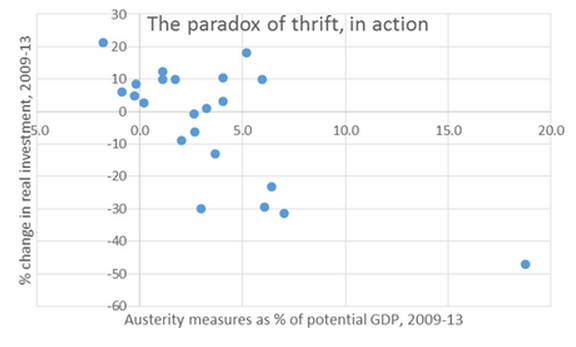
“…What’s more, the turn to austerity that began in 2010 gives us an opportunity to observe the paradox in action. Take the estimates of fiscal contraction 2009-13 from the IMF Fiscal Monitor in fall 2012 (Figure 13), and compare this with changes in real fixed investment over the same period (from Eurostat). It looks like this:

Screen Shot 2013-10-16 at 3.44.33 PM

That’s Greece in the lower right corner, of course “” but even without Greece there’s a clear negative correlation between government austerity and investment. Yes, you can try to explain away the results with endogeneity, but it’s a strain.This is prima facie evidence of crowding-out in reverse, aka the paradox of thrift…”

Krugman defines the degree of fiscal contraction as the change in the general government cyclically adjusted primary balance as a percent of potential GDP between 2009 and 2013. He graphs this for 22 nations. These consist of all of the eurozone members except Cyprus, Estonia, Luxembourg and Malta, plus Denmark, the Czech Republic, Sweden, the UK, Norway, Switzerland, Iceland, Japan and the US. (Krugman doesn’t explicitly say which nations, but it is clear if you read between the lines.)

Right away you should see the problem. Thirteen of these countries are eurozone members, and another (Denmark) is pegged to the euro. Thus two thirds of the sample have the same exact monetary policy. It would be very surprising if there were no correlation between the degree of fiscal austerity and the change in real gross fixed investment.

I’ve run regressions using the exact same investment data and the change in the cyclically adjusted primary balance between 2009 and 2013 from the October 2013 IMF Fiscal Monitor. The correlation is statistically significant with the R-squared value equal to 52%. When you run the same regression on just the 13 eurozone members and Denmark the R-squared value rises to 71%. But when you run it on the other eight nations plus the eurozone as a whole, the result is not statistically significant and the R-squared value drops to only 8%.

In particular, four nations out of the original 22 nation sample had above average fiscal austerity and investment growth, namely Iceland, Slovakia, the UK and he US. I have no idea what’s going on in Slovakia, but the UK and the US have both done significant amounts of QE, and Iceland is Krugman’s poster child for the benefits of currency devaluation in his never ending feud with the Council on Foreign Relations.

PS.  Some have noticed a recent increase in typos.  I recently began using Dragon Dictate (as I got sick of typing 6000 pages using two fingers), and it doesn’t always print out what I am trying to say.  For instance, Dragon believes “been burning key” is the current Fed chair.  Look for “Janet’s yelling” in future posts. However I am a rather poor speller, so there is poetic justice in this.  Spell check had been making me seem slightly less inept than I really am.  IT giveth, and IT taketh away.  Just read my posts phonetically.

Update:  Krugman is certainly right about this:

I’m coming to this a bit late, but I see that there’s now extensive evidencethat facts not only don’t win arguments, they make people on the wrong side dig in even deeper: “When your deepest convictions are challenged by contradictory evidence, your beliefs get stronger.”

The stock market cares a lot about the budget fiasco

In this post, I’ll talk about two examples of how people tend to misinterpret market reaction to macro news.

You see lots of commentary to the effect that the stock market doesn’t care very much about the budget fiasco and/or that these budget fights only have a temporary impact on stock prices. If so, why wouldn’t investors buy stocks during a budget fight and sell them once the dispute is resolved?

At first glance, it seems like this strategy would work.  And it often would work. But Eugene Fama and the EMH tell us that it’s too good to be true. Let’s take the 2% stock market rally last Friday on growing optimism of the budget deal. What does that stock market rally tell us? We can’t be sure, but the most likely explanation would go long following lines:

1. As of last Thursday investors saw a nontrivial risk of budget Armageddon. Let’s assume that budget Armageddon was expected to reduce stock values by 20%. That’s obviously huge, so in that case it would be wrong to say the stock market doesn’t care about the budget fight.

2. Let’s assume that last Thursday investors saw a 15% chance a budget Armageddon. That’s small, but obviously still significant. By Friday evening the perceived risk of default may have fallen to 5%.   With 10% less chance of budget Armageddon that would reduce stock prices by 20%, stocks rallied by 2%.  Of course these numbers are merely illustrative.

3. Changes in current stock prices are generally mirrored in changes in future expected stock prices. Thus if budget Armageddon had occurred and stocks had fallen 20%, then future expected stock values would also fall by roughly 20%. The effects are not temporary.  That’s why even a 2% stock market rally is significant.

I am very sympathetic to the view that market setbacks in response to short-term crises are temporary. It certainly looks that way. However it’s a dangerously misleading way of looking at markets.  Consider the sharp market “correction” of mid-2011. Stocks fell by nearly 20% during the euro zone crisis. When we look back on this period it merely looks like a blip in a powerful four-year bull market. But of course that’s not how it looked at the time.

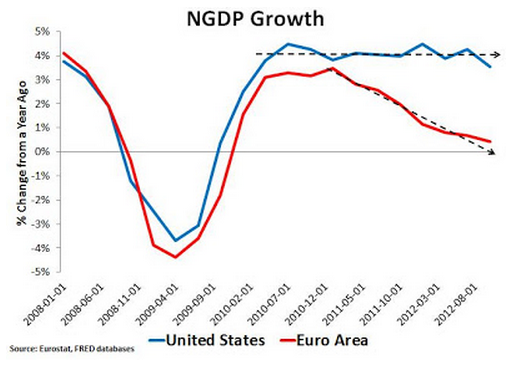
David Beckworth has a post comparing US and euro zone and GDP growth over the last decade:

Screen Shot 2013-10-16 at 9.49.11 AM

What is puzzling to me is how anyone could look at the outcome of this experiment and claim the Fed’s large scale asset programs (LSAPs) are not helpful.

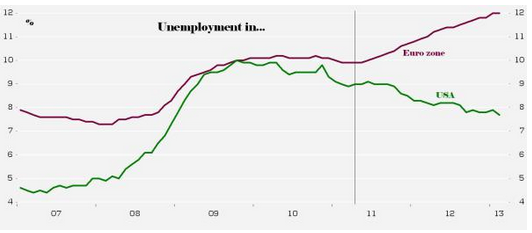
Note that although the euro zone and the United States have done roughly equal amounts of “austerity,” aggregate demand in the US has grown much faster than in the euro zone since 2011. And this difference largely explains the huge unemployment gap that has opened up between the two regions.  Here’s Lars Christensen:

while the US is slowly getting out of the crisis things have in fact gotten worse and not better since ECB’s first rate hike in April 2011.

Screen Shot 2013-10-16 at 10.18.11 AM

So the US and the euro zone have done roughly equal amounts of austerity, but very different monetary policies. As a result a nearly 5% gap has opened up between eurozone and American unemployment rates. And yet how often do you hear people say that QE is helping Wall Street but not Main Street? And they say this even though there is no plausible economic model where monetary policy could boost stock prices but not aggregate demand.

People get fooled by the fact that stock prices have recovered after each dip during the powerful four year rally. Thus it’s hard to see what the stock market was worried about during 2011. But if we look at Europe as a counterfactual, then the 20% dip in stock prices makes much more sense. The market might’ve been fearful that the US would also suffer a double dip recession. When it became clear that was not going to happen, stocks rallied. The double-dip recession that never happened in the US is sort of like the dog that didn’t bark in the Sherlock Holmes story, easy to overlook.

PS.  Just back from Switzerland, I’ll catch up on the old comments.