
Archive for May 2013


How the Keynesians miss the bigger picture

Another day, another data point suggesting a zero fiscal multiplier:

The number of Americans filing new claims for unemployment benefits dropped to its lowest level in nearly 5-1/2 years last week, signaling labor market resilience in the face of fiscal austerity.

On the other hand, Matt Yglesias points out that most pragmatic economists are at least partly Keynesian:

A meta-point that is a little underappreciated here is that private sector macroeconomists all use models that embed broadly “Keynesian” assumptions about the behavior of the economy. Government economists at the OMB and CBO do it too, but they’re really just following the lead of what you would find at any bank or consultancy. Obviously that doesn’t prove that these models are correct””in fact that record of forecasting accuracy isn’t stellar””but I don’t hear much from anti-Keynesian types about why their preferred models have failed the market test.

If I were going to treat Yglesias the way he recently treated Alex Tabarrok, I’d say he’s attacking a strawman.  But Yglesias (and Tabarrok) obviously understand the opposing argument.  Nonetheless I find many people do misunderstand what “monetary offset” is all about.

It’s quite possible to write down a model where, ceteris paribus, fiscal austerity reduces output, and monetary stimulus (such as the recent actions of the Fed) raise output.  You can call that model “Keynesian,” and attach a positive multiplier to fiscal policy if it makes you feel good.  But what matters are counterfactuals.  And if more fiscal stimulus leads to less monetary stimulus (as the Fed claims!), then the fiscal multiplier estimates will be nearly worthless.  This is a subtle game theory problem, which as far as I can tell hasn’t even been considered by many Keynesian economists.

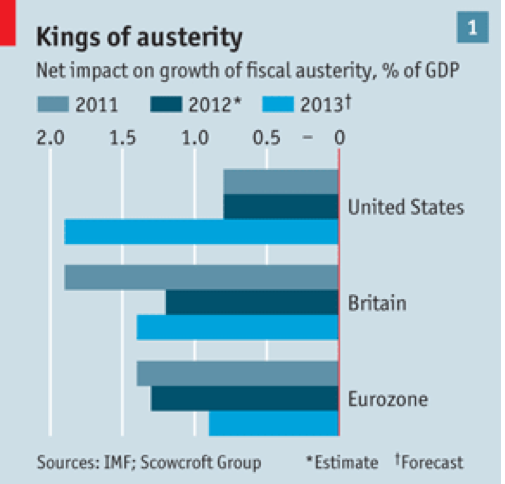
One can talk all one wants about Keynesian forecasters predicting that fiscal austerity would have a sharp contractionary impact in 2013.  But the fact of the matter is that the consensus forecast for 2013 from all these supposedly Keynesian economists was about the same as for 2012, despite a much higher level of fiscal austerity in 2013.

By the way, the real “market test” isn’t what forecasters think, it’s what markets think.  And as I’ve pointed out numerous times, the markets are market monetarist.

PS.  Here’s the sort of slowdown expected by The Economist:
Screen Shot 2013-03-13 at 8.52.49 PM

Yes, this could still happen.  Market monetarism says fiscal stimulus estimates are nothing more than estimates of central bank incompetence.  And central banks are far from perfect.  But I continue to believe that 2% RGDP growth should be the baseline forecast for 2013.  Now we’ll just have to wait and see just how incompetent the Fed actually is.

Bloomberg in Boston

Bloomberg has a new radio station in Boston (1200AM)

Here’s an interview I did this morning (May 8) with Tom Keene and Michael McKee.

And from last week an interview with my colleague Aaron Jackson, and also Marvin Goodfriend of Carnegie Mellon.


Megan Greene on negative IOR

Tyler Cowen linked to a new Megan Greene piece in the FT:

In its efforts to get banks lending again, the ECB is looking at excess reserves — some 120 billion euros ($157 billion) the banks have been holding on deposit at the central bank for safekeeping. If the ECB were to introduce a negative interest rate on deposits, effectively charging a fee, the banks might choose to lend the money out rather than watch it lose value.

This logic is far from ironclad. Instead of lending the money to businesses and individuals, the banks could simply park it elsewhere — for example, in the sovereign bonds of Germany and other countries perceived to be financially healthy. This might benefit Germany by further pushing down its borrowing costs, but would do little to unblock credit to businesses.

This is actually an argument in favor of negative interest on reserves.  One common fear expressed by monetary stimulus opponents is that the major central banks will artificially inflate another credit bubble.  Thus an ideal monetary stimulus would be neutral—boosting NGDP without favoring the lending channel.  I think Greene is right that the initial effect of negative IOR would be for banks to buy government bonds.  This means that banks would essentially be doing “QE.”  Why is that better than the ECB doing QE?  It’s not clear it is, although some people worry about the bloated balance sheets of the major central banks, and negative IOR would greatly reduce that “problem.”

Of course all this is a sideshow, as what’s really needed is NGDP targeting.  Here’s Greene:

Even if the ECB could encourage banks to lend, though, that doesn’t mean businesses will borrow. The primary issue in the euro area isn’t the cost of funding. The main problem is that few businesses want to borrow at any cost. According to a recent ECB study on access to financing in the euro area, “finding customers” is the No. 1 concern for businesses in the region. If businesses are worried about demand, they will not seek loans to grow.

Exactly.  BTW, several commenters asked me about the Danish program of negative IOR.  That was not aimed at monetary stimulus (their currency is pegged to the euro, making stimulus almost impossible), but rather at arresting an inflow of hot money.  The Swiss have enacted similar policies on occasion.

If the Danes want to stimulate their economy they need to copy the Swiss, and devalue.

PS.  Some have tried to make a contrarian argument that pushing IOR below zero is somehow contractionary.   I’m not buying (after all, it reduces demand for the MOA), and neither are the markets:

The euro immediately slumped against the U.S. dollar after Draghi’s statement.

Nunes on Krugman

Marcus Nunes discusses Clive Crook’s analysis of Paul Krugman, and then adds the following:

All this comes out clearly in Krugman´s May 6 column for the NYT, but I want to be specific in my comment, so I´ll concentrate on one of his favorite arguments, and show it´s misleadingly wrong. Krugman writes:

F.D.R. cut back sharply in 1937, plunging America into recession; the Recovery Act had its peak effect in 2010, and has since faded away, a fade that has been a major reason for a slow recovery.

Wow! In 1937 real government purchases recoiled 4.2% and the economy tanked. In 2012 real government purchases were 4.8% below the 2010 level and the recovery is slow!

Surely something is going on that´s making comparable ‘fiscal austerity’ so much less damning in 2012 than in 1937.

And that ‘something’ is monetary policy.

Bartlett on Keynes

Bruce Bartlett has a characteristically thoughtful piece on Keynes:

Brad DeLong, an economist at the University of California, Berkeley, has posted a long list of conservative attacks on Keynes that have used his homosexuality as a reason to reject his economic theories. But even economists who had no interest in this aspect of Keynes’s life, like the economist James Buchanan, have criticized Keynesian economics for its excessively short-term focus and negative long-run consequences.

Unfortunately, Keynes himself was to a large extent responsible for giving this criticism of his work currency. That is because he titled his most important work “The General Theory of Employment, Interest and Money.” The term “general theory” obviously implies that it is applicable at all times, in all economic situations.

This was an unfortunate error, because the core insight of Keynesian economics is that there are very special economic circumstances in which the general rules of economics don’t apply and are, in fact, counterproductive.

This happens when interest rates and inflation are so low that there is no essential difference between money and bonds; money, after all, is simply a bond that pays no interest. When this happens, monetary policy becomes impotent; an increase in the money supply has no stimulative effect because it does not lead to additional spending by consumers or businesses.

This is interesting.  Both John Hicks and Milton Friedman also thought the liquidity trap was the core insight of the General Theory.  In Friedman’s case, perhaps I should say the core “idea,” as he didn’t think much of the concept.  But Keynes himself actually thought his theory was much more general, and so do many of his followers (who like to quote Keynes’s statement that it is unlikely that there has ever been a case of absolute liquidity preference.)

I think Hicks and Friedman were right and Keynes was wrong.  Keynes certainly saw the impact of FDR’s dollar depreciation policy of 1933.  When FDR finally gave in to pressure from people like Keynes, and stopped devaluing the dollar, Keynes congratulated him for ignoring the advice of the “extreme inflationists.”  Keynes once said that the only monetary regime that was worse than a pure gold standard was a pure fiat money regime.  That’s the real reason Keynes worried about monetary policy ineffectiveness at the zero bound; he opposed what Lars Svensson calls the one foolproof escape technique—devaluing as much as it takes to generate higher inflation rates.

Bartlett continues:

Keynes called this situation a “liquidity trap.” Under such circumstances, government spending can be highly stimulative because it causes money that is sitting idle in bank reserves or savings accounts to circulate and become mobilized through consumption or investment. Thus monetary policy becomes effective once again.

This is an extremely important insight that policy makers have yet to grasp, even though interest rates on Treasury bills are just a couple of basis points above zero and inflation is virtually nonexistent.

Here I think that Bartlett has things exactly backward.  I believe most policymakers do agree with Keynes and Bartlett, i.e. they wrongly believe that monetary policy is ineffective at the zero bound.  That’s why it took the Japanese 20 years to even attempt a policy of inflation.  That’s why New York Fed President Dudley now says that Fed policy was too tight in 2009, but wasn’t saying that in 2009.  That’s why the non-German European governments haven’t been pressuring the ECB to boost NGDP.  That’s why Ed Balls opposes a higher inflation target for the BoE.

In the 1930s FDR knew how to debase a currency.  Modern policymakers seem to have forgotten how, and thus embarked on a long and fruitless detour into the morass of fiscal stimulus.

HT:  Caroline Baum

PS.  I may be on Bloomberg radio (Boston) tomorrow morning around 9am.