Archive for February 2011


Monetarism is dead; long live (quasi) monetarism

In this post Brad Delong treats me like a monetarist.  That ideology that died in 2006, when Milton Friedman passed away.  Friedman believed that the stance of monetary policy could be characterized by the growth rate of M2.  That the Fed should stabilize M2 growth, and that current monetary policy affects future aggregate demand.  That monetarism is dead.

Quasi-monetarists like me look at the world very differently.  Monetary aggregates are neither good indicators of the stance of monetary policy, nor good policy targets.  Rather than assume current changes in M affect future AD with long and variable lags, I assume current changes in the expected future path of M affect current AD, with almost no lag at all.  That is, I’m a Woodfordian on the role of policy expectations, and a Friedmanite in that I believe that changes in nominal aggregates are ultimately caused by changes in the supply and demand for the medium of account.  (Other quasi-monetarists like Nick Rowe would use the medium of exchange.)

Brad DeLong worries about what happens if an increase in the supply of money leads to lower interest rates, which produces an offsetting fall in the velocity of circulation.  He cites John Hicks as an inspiration.  But Hicks lived in a world where currencies were pegged to gold, or were expected to be pegged in the future.  I used to think the main problem with the gold standard was that it constrained the central bank from printing more dollars than they could back with gold.  In that sort of policy environment the danger Brad mentions is quite serious.  Now I think the bigger problem was the fact that the gold peg anchored the future expected price level.  To see why this is so important, we need to understand that modern policy is not really about either interest rates or (current changes in) the money supply.  It is about changes in the expected future path of prices and NGDP, which can be signaled by changes in interest rate targets or the money supply (as with QE.)

Yes, a doubling of the monetary base might have no impact on the price level.  Paul Krugman showed that in 1998 and I showed that in 1993.  But the reason it would fail (we both agree) is not because rates are stuck at zero, but rather because the money supply increase is expected to be temporary.  A money supply increase that is expected to be permanent will raise future expected NGDP, and Woodford showed that future expected AD is the most powerful determinant of current AD.  And this is true regardless of whether rates are zero or positive when the monetary injection first occurs.  A doubling of the money supply expected to be withdrawn 2 months later will have almost no effect, regardless of short term rates, and a permanent doubling of the money supply will have a huge effect, regardless of the level of short term rates.

We need to stop thinking of current changes in short term rates and/or the monetary base as causal factors, and start thinking of them as signaling devices.  Thus the question is not; (as DeLong often implies) “Just how much base money would it take to boost AD?”  The question is; “If the central bank promises to target 6% NGDP growth, how much base money do people want to hold?”

Because most economists wrongly assume that low rates and a bloated base mean easy money, they despair at how much easier money must be for significant stimulus to occur.  But this is looking at things backward.  Money has been extremely tight in the only metric that matters—relative to what is needed to produce on-target NGDP growth expectations.   That’s why rates are low and the base is bloated.  If the Fed promised to target a much higher future NGDP trajectory, and do level targeting (making up for undershoots), then the demand for base money would probably be far lower than today, and nominal rates might be higher.  As Friedman said about Japan, ultra-low rates aren’t a sign of easy money; they are a sign that money has been too tight.

A promise to raise the expected future growth of NGDP is equivalent to a promise to raise the expected future money supply. But it is not a promise to raise the current money supply, nor is it a promise to lower current rates, nor even (as Woodford asserts) to keep short term rates at the zero bound for a period longer than markets currently expect.  All those variables respond endogenously.

Friedmanite monetarism died because it wasn’t consistent with good right-wing economics.  The long and variable lags could not explain why markets often failed to respond to policy shocks that Friedman and Schwartz thought were important.  An X% money supply rule is clumsy central planning, clearly inferior to a policy of having markets determine the monetary base setting most likely to produce on-target inflation.  Don’t believe me?  Well then explain why late in his life Friedman endorsed Robert Hetzel’s 1989 proposal to have the Fed stabilize the TIPS spread.  I’m simply doing the sort of monetary economics Friedman would have done had he been born in 1955, and if his IQ had been 30 points lower, and if he had been able to stand on the shoulders of giants like Irving Fisher and . . . well, Milton Friedman.

Part 2.  Only Krugman understands the zero rate bound, and even he doesn’t really understand it.

Paul Krugman once had a post claiming he was the only person who understood liquidity traps.  I know the feeling of exasperation.  I often feel the same way. (Of course this isn’t actually true.  I’m only joking.)

If I am right that the zero bound is not a problem, why do central banks seem to flounder in that situation?  I’m not quite sure.  I’ve gradually become convinced that the BOJ actually likes zero to -1% inflation—they sure act that way.  Krugman doesn’t agree.  I still believe the US will eventually exit the liquidity trap, and not end up like Japan.  But I can’t be certain.  Nick Rowe has as good an explanation as any for the seeming paralysis of US policy at the zero bound.  He argues that nominal rates were the Fed’s way of signaling future policy intentions to the public.  It’s not that the fed funds rate actually matters all that much for long term investments.   And we know that when the Fed eases aggressively then long term rates often go in the opposite direction from short rates (January 2001, September 2007.)  No, the Fed is saying “by cutting our fed funds target, we signal that we will provide enough base money over time to raise the long run NGDP growth rate.”  That is, if they cut rates in order to change policy expectations.  Roughly 80% of rate adjustments are merely reflecting ongoing changes in the Walrasian equilibrium rate, and aren’t intended to move expectations.

Nick says that when the nominal rate hits zero, the Fed is (temporarily) mute.  They don’t know how to communicate policy intentions to the markets.  Eventually if things get bad enough they develop other languages; quantitative easing, inflation targeting, level targeting, exchange rate depreciation, lower IOR, etc.  As I pointed out earlier (and as Jim Hamilton also argued) QE2 did not do anything significant in a mechanical sense.  But it did convey to markets a renewed Fed determination to speed up NGDP growth.  And it worked; NGDP growth expectations rose significantly following each important Fed speech during September/October 2010, speeches hinting at QE2.

Once you start to look at things this way, everything makes much more sense.  Many of my commenters insist that monetizing deficits is the one surefire stimulus option.  Not so, as the Japanese have discovered over the past 17 years.  If the money supply increase is temporary, the future expected price level will not rise.  In that case all the deficit spending in the world won’t create inflation.   Yes, most examples throughout history of monetizing the debt have produced inflation, but that’s because no other central bank has been as obsessively masochistic as the BOJ.  They reduced the monetary base by 20% in 2006, even though the the price level had not increased in the previous 12 years!

This is not to say that monetizing deficits won’t “work” on most occasions.  I’m pretty sure if the Fed began dropping money out of helicopters most people would be able to quickly infer what they were trying to “communicate” about future policy.  But why bother, when all they need to do is say they want higher NGDP, or a higher price level?  So far the Fed refuses to set any sort of aggressive nominal target, thus it’s not surprising that we’ve been limping along.

The “new monetarism” of the 21st century can’t be found by reading the blogs of people who don’t think nominal shocks are important.  Rather, it will be based on a more sophisticated understanding of the role of expectations.  Eventually macro and finance will merge.  “Easy money” won’t be low interest rates, and it won’t be increases in the current money supply.  Easy money will be above-target NGDP futures prices, and tight money will be below target NGDP futures prices.  Then and only then will we be able to tear down the confusing Tower of Babel called 20th century macroeconomics, and all start speaking the same language.  Then and only then will we be able to focus on the real problems, which are the . . . “real” problems.

PS.  A commenter asked me to comment on this post by Mark Thoma, which he thought was directed at my views on QE2.  I’m not sure it was, as Mark never mentions my name.  But he does link to one of my posts.  All I can say is that his argument has no bearing on my claim that QE2 is working, because my argument was not based on how QE2 affected the economy, but rather how it affected market expectations.  Because expectations respond immediately to rumors of QE2, there is no policy lag to worry about, and no identification problem.  I did also discuss movements in the actual economy, but made it very clear that those changes would be of interest to others, not to me.  I had all the information I needed by November 3rd, 2010.

PPS.  I now realize that I never really answer Brad’s questions.  Financial assets play no role in my model.  In my view an increase in the expected future money supply (relative to demand) raises expected future NGDP.  That raises the current price of real assets and flexible price goods.  It also raises nominal spending, by boosting velocity.  With sticky wages, this raises current output.  Add interest rates if you wish, it adds nothing to the transmission mechanism in my view.  Interest rates aren’t causal factors; they reflect what’s going on with the economy.  Disinflation and low output produce low rates, and vice versa.

Yes, fiscal stimulus can “work” if the Fed wants it to work, by boosting V.  But if the Fed wants it to work, why not just do the job with monetary policy?

The wheel of politics

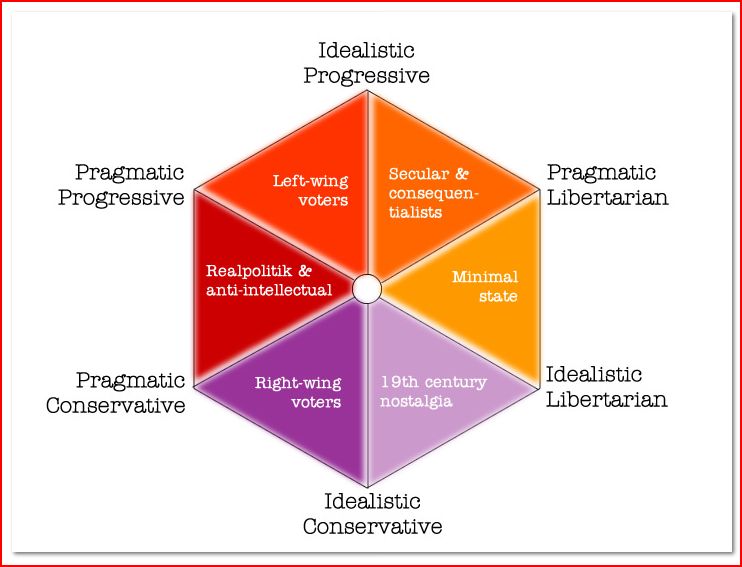
You’ve all seen the 4-quadrant diagram used by libertarians; here’s  a six-sided diagram that I think might be more useful:

                                    Idealistic Progressives

Corrupt Democrats                                              Pragmatic Libertarians

Corrupt Republicans                                            Dogmatic libertarians

                                    Idealistic conservatives

Update#2:  Vlad Tarko sent me a couple much prettier version.  His preferred labeling is at the bottom, below is a version closer to my terminology:

My goal here is to set things up in such a way that each group has a values affinity to those on one side, and an ideological affinity to those on the other side.  So you could circle any two adjoining groups, and describe a common feature:

1.  Progressives/Pragmatic libertarians:  Both tend to be secular utilitarians, or at least consequentialists

2.  Pragmatic and dogmatic libertarians;  Both favor very small government

3.  Dogmatic libertarians and idealistic conservatives:  Both are nostalgic for the past, and revere the (original intent of) the Constitution.

4.  Idealistic conservatives and corrupt Republicans:  Both are Republicans.

5.  Corrupt Republicans and corrupt Dems:  Both believe in realpolitik, are disdainful of fuzzy-headed, idealistic intellectuals.

6.  Corrupt Democrats and idealistic progressives:  Both are Democrats:

Thus on values the there are three pairings:  utilitarian, natural rights, and selfish.  On ideology there are three different pairings:  Democrat, Republican and libertarian.  Let’s apply this political scheme to public policy issues.  I would like to argue that most of the really important public policy issues are not even part of the ongoing debate in the press.  Here are some examples:

1.  The huge rise in occupational licensing.

2.  The huge rise in people incarcerated in the war on drugs, and also the scandalous reluctance of doctors to prescribe adequate pain medication (also due to the war on drugs.)

3.  The need for more legal immigration.

4.  The need to replace taxes on capital with progressive consumption taxes.

5.  Local zoning rules that prevent dense development.

6.   Tax exemptions for mortgage interest and health insurance.

These 6 policy failures impose enormous damage on the country, far more than the issues typically discussed on the evening news.  Why aren’t they discussed?  I would argue that it is partly because the disagreements tend to break down on values, not ideology.  Most idealistic intellectuals agree with me on all of these issues.  They are not issues that divide the left and the right.  It’s also true that most real world politicians agree on these issues.  However their views are exactly the opposite of the views of intellectuals.  Hence there is no “policy debate” in either the political or intellectual arenas, and hence no “fight” for the media to report.  They become invisible issues.

The media likes drama and conflict.  They will report on those issues where corrupt Democrats and corrupt Republicans disagree, and not where they agree.

BTW, perhaps I should explain what I mean by “corrupt.”  I don’t mean politicians taking bribes that violate existing laws.  I mean Republicans who support various special interest groups like doctors and seniors (Medicare), farmers, energy producers, car dealers, bankers, and the rich, even if it goes against their supposed “small government” ideology.  And the same would be true about Democrats who support various special interest groups like teachers unions, trial lawyers, government workers, etc, for non-utilitarian/non-egalitarian reasons.

I should add that most people I know do not fit neatly into any of the six categories I listed, but rather are a composite of two or more categories.  Also, the reason there are four right wing and only two left wing categories is because US politics is dominated by the right.  The missing categories are non-utilitarian leftists, such as Maoists who hate the rich, or radical environmentalists who care more about “The Earth” than human welfare.

PS.  I am a pragmatic libertarian.  Is it self-indulgent to devote two of six categories to libertarians, given that they receive less then one percent of the vote in presidential elections?  I suppose, but recall that the Libertarian Party is strictly a dogmatic libertarian organization.  Pragmatic libertarians probably constitute at least 1/6th of the intellectual elite in public policy.

Here’s the original version Vlad sent me:

Don’t mind the gap

In philosophy the “god of the gaps” hypothesis suggests that while science can explain most phenomena, certain seemingly inexplicable events (the origin of life, the universe, the laws of nature, Morgan’s comments, etc) must be attributed to a deity.  In this recent post, I argued Keynesians were using a similar argument for fiscal stimulus.

By the 1990s, most macroeconomists attributed changes in the expected level of nominal spending to monetary policy, and this made fiscal stabilization policy redundant, a sort of 5th wheel.  During the recent crisis, some Keynesians have attempted to revive the arguments for fiscal stimulus, arguing that monetary policy was ineffective at the zero rate bound.  When a group of quasi-monetarists reminded them that there are all sorts of unconventional monetary policy tools, the Keynesians argued that these tools would only be effective if credible, and it was unlikely that markets would believe central bank promises to inflate.  Then the quasi-monetarists showed that markets did react to rumors of QE2 in a way that implied the policy was credible.  Once again, Keynesian fiscal stimulus would seem to have no role to play.

Keynesian were not going to give up easily.  The next argument was that while monetary stimulus can be effective, central banks were afraid to aggressively pursue this sort of policy.  In that case a “gap” would open up between the central bank’s forecast of NGDP, and their implicit target.  Fiscal policy can fill that gap.  In essence, they argue that fiscal policy is useful in direct proportion to the degree to which monetary policy is incompetent (in the Svenssonian sense of failing to equate the policy forecast and policy goal.)  And to give credit where credit it is due, monetary policy has been strikingly incompetent over the past 30 months.

[As an aside, this explains why back in 2009 both the right and left thought the other side was returning to the dark ages.  The right recalled that Keynesian fiscal stimulus had been expunged from graduate education for nearly 30 years, as the fiscal multiplier is zero under an inflation targeting regime.  The left couldn’t understand why the right denied that fiscal stimulus could be effective in a world where the central banks had obviously allowed inflation to fall below target.]

Before addressing some questions by Ryan Avent, I’d like to tell a brief story that might help explain why I think Keynesians are putting too much weight on the “gaps” argument.  Not that the argument is wrong, but rather that it is much less right than it seems at first glance.

Years ago I used to get into arguments with our dean, who insisted that the marginal cost of admitting an extra student to Bentley was essentially zero.  He relied on the common sense notion that most classes had at least a few empty seats, and hence one extra student could be squeezed in at virtually no additional cost.  Here’s why I think that argument is wrong.  Bentley caps classes at 35.  For simplicity, assume it costs $35,000 in salary and benefits for each professor-taught course.  (I.e. profs earn $140,000 in total comp., and teach 4 sections.)  For each student added by Bentley, there is a 1/35 chance that the admission will trigger the need for an extra section.  In that sense the dean was right.  It’s quite likely that the marginal cost would be zero.  On the other hand, if an extra class was needed the cost would be $35,000.  Since we have no idea when and where students will trigger an extra section being offered, the expected cost of an extra student is (1/35)*$35,000, which equals $1000.  And that’s also the average cost.  There’s no “expected gap” to be filled, even if there are occasionally some actual gaps that can be filled at no cost.

The Keynesian gap argument is not as weak, because we may be able to observes gaps in the aggregate economy more easily than in class size.  But I still think they are making an analogous mistake.  For instance, let’s go back to the argument (which I agree with) that the Fed has recently allowed the forecast NGDP growth rate to fall below their policy goal.  For simplicity, assume the Fed’s goal is 6% NGDP growth during the recovery, and the forecast is 4.5%.  So there is a 1.5% gap that might be filled by fiscal stimulus.  And furthermore (so the Keynesians argue) if fiscal stimulus does try to fill this gap, the Fed won’t take affirmative steps to neutralize the stimulus.

Now let’s ask why the Fed allows this 1.5% growth gap.  Perhaps it is fear that unconventional stimulus is a dangerous weapon, and that we might overshoot to high inflation.  (Recall the monetary base has more than doubled.)  The next question is; how should we interpret that caution?  Does that mean the Fed has a de facto 4.5% NGDP target?  When I talk to Keynesians, I get the feeling that they differentiate between situations where the Fed is “doing nothing” and where the Fed is “doing something.”  Thus the Fed would not do unconventional stimulus to push NGDP growth above 4.5%, but if fiscal stimulus pushes it above 4.5% (but below 6%) the Fed would not pull back to slow the economy.  They will allow faster growth, but they won’t try to cause faster growth.

This is where I begin to part company with the Keynesians.  I believe it’s better to think in terms of the Fed always “doing something.”  This is probably easier to explain with an example.  During the spring of 2010 NGDP growth slowed, perhaps due to dollar hoarding following the Greek/euro crisis.  Keynesians argued for more fiscal stimulus, and made the quite plausible assumption that the Fed would not try to offset the effects of fiscal stimulus.  One particularly sophisticated argument was that Bernanke didn’t have enough support (at that time) to push for more stimulus, but that the inflation hawks also lacked enough power to tighten policy after a fiscal boost.  Monetary policy was adrift in the gap.

How do things look today?  If the Keynesians had gotten their way in the spring and early summer of 2010, then Congress would have debated a new fiscal stimulus for a few months, and passed it during the second half of 2010.  Would this have boosted NGDP growth in 2011?  I’m skeptical, as it turns out that the monetary policy “gap” wasn’t that big.  The Fed did move aggressively in November, and indeed moved in September, if you recall that expectations of monetary stimulus are the same thing as actual monetary stimulus, even in the new Keynesian model.  If Congress had done another $400 billion stimulus, it seems unlikely that the Fed would have moved until they had a chance to see whether the fiscal boost would do the trick.  In that case the argument for a positive fiscal multiplier is essentially that fiscal stimulus is more powerful than monetary stimulus.  But in the famous cases where fiscal and monetary stimulus worked in opposite directions (1968-69 and 1981-82), monetary stimulus seemed much stronger.

Here’s my point.  In the spring of 2010 even I had trouble coming up with persuasive arguments against the Keynesian proposals for fiscal stimulus.  Even I had to admit that it was unlikely that the Fed would try to sabotage fiscal stimulus when the recovery was so weak.  But as things played out in reality, it seems unlikely that a fiscal boost would have helped all that much, not because it would have been intentionally sabotaged, but because it would have taken the Fed off the hook, allowing them to do nothing in the fall of 2010.

It’s a mistake to think the Fed is ever really in a situation of “doing nothing.”  We’ve seen them do several mid-course corrections (March 2009 and November 2010) when the recovery was unacceptably weak.  During early 2010 policy was de facto contractionary, as lots of Fed officials talked about “exit strategies.”  If, as seems plausible, these back and forth swings of monetary policy are reactions to expected NGDP growth, then it would be more accurate to say that there is no significant policy gap, but rather the Fed is (for whatever reason) targeting NGDP at a lower level than they would if they could rely on their tried and tested fed funds targeting approach.  They are like that 85 year old lady driving her Camry very slowing, with one foot on the brake, because she read scary news reports of “sudden acceleration” problems in Toyotas.  If Morgan Warstler gets right on her tail with his big SUV, and starts honking, she’ll get even more nervous and drive even slower.  (Sorry Morgan, I’m using you as a symbol of fiscal stimulus.)

In this comment section, Andy Harless presented one of the best arguments for fiscal stimulus:

I still believe the “god of the gaps” argument. (In fact, I may be the only one who has made the argument explicitly. Krugman and others kind of dance around it but don’t quite come out and say it.) Moreover, I believe that we are seeing it in action, although it will never be possible to prove counterfactuals about what Fed would have done. But we saw the tax compromise last year, and we saw that forecasters revised their forecasts as a result and that subsequent economic reports were consistent with that increased optimism, and a lot of people thought that the Fed would cut QE2 short because of the improvement. But subsequent Fedspeak makes it clear that such a cutting short is highly unlikely. I’d say that we are in a gap and that Almighty Fiscal Policy is filling part of it.

I’m not going to argue Andy is wrong, rather I’ll argue he is less right than he thinks.  First, Tyler Cowen often notes that the Fed is normally the “last mover” in the stabilization game.  Congress acts infrequently, whereas the Fed meets every 6 weeks.  In the case Andy discusses, Congress became the last mover for a variety of unusual reasons:

1.  QE2 occurred around election day.  This was partly because the recovery had stalled, and partly because Bernanke was waiting for more support (from the new Obama appointees) on the Board of Governors.

2.  The GOP made huge gains, necessitating a compromise to prevent a huge tax increase in 2011.  Obama was forced to give in on tax cuts for the rich, and in exchange was able to secure more fiscal stimulus via a payroll tax cut.

3.  Because the fiscal stimulus happened to occur right after QE2, and because the Fed likes to “wait and see” after a dramatic policy shift, we can be reasonably sure the Fed won’t immediately negate the tax cuts.

I would also agree that the fiscal stimulus has been somewhat effective.  But the reasons I’d give are a bit different from those of the Keynesians.  I believe cuts in MTRs boost the supply-side of the economy, which slightly raises the Walrasian equilibrium real interest rate.  This effectively makes monetary policy (even at the zero bound) slightly more expansionary.  I don’t believe spending increases have any supply-side boost, and I think their effect on the Walrasian real rate is smaller.  Hence part of the higher expected growth is a direct supply-side effect, part is the indirect effect on monetary policy, and perhaps another part is that if we exit the liquidity trap more quickly, the Fed will be more comfortable with slightly higher NGDP growth, as they can then use conventional tools.  No more 85 year-old lady driving the economy.

And if Keynesians insist on defining “monetary policy” as changes in interest rates, then the tax cuts probably did lead to tighter money.  Woodford argued the Fed should promise to hold rates at zero for an extended period.  But the fiscal boost seems to have moved the expected date of Fed rate increases closer to the present.  Unlike Woodford, I don’t necessarily see that as bad news, as it also indicates that markets think the economy will recover more quickly.  So I’m not going to argue against this particular fiscal stimulus.  All I’ll say is that there was a bit of luck (avoiding the usual last mover problem) and that it was effective partly for supply-side reasons.  (I won’t even attempt to defend that argument here, as it’s already an over-long post.)

This post was motivated by a Ryan Avent post, which asked me to respond to three arguments for fiscal stimulus.  I’ve responded to his second argument.  Here’s his third:

Finally, American government debt is extremely cheap during some severe recessions (like this one), and useful as a monetary tool. Resources and labour are also quite cheap during a downturn and slow recovery. If we’re anxious to minimise the cost of public investments, there seems to me to be a strong case for building a public investment project pipeline that can be accelerated during periods of economic weakness. Save the taxpayers money by borrowing and hiring when the demand for loans and labour is low.

I agree with this argument.  Projects such as infrastructure should meet a cost/benefit test.  Because real rates are lower during recessions, more infrastructure will pass that test during recessions.  But this isn’t how American states behave.  California spends money like a drunken sailor when the capital gains revenues pour in from Silicon Valley, and everything gets put on hold when the bubble collapses.  (BTW, for all you leftists who think the housing bubble shows capitalism doesn’t work, note that our governments are just as irrationally exuberant.)  Yes, I’d love to see our fiscal regime become more like Singapore, but it would be far easier to reform our monetary regime to make fiscal stimulus superfluous, then it would be to reform our dysfunctional fiscal regime.  I agree with Ryan’s logic; I just don’t see it happening.

If the states don’t save money in the good years, they have nothing to spend in the bad years.  At this point fiscal advocates call on the deus ex machina of federal spending.  But the federal government’s not good at quickly implementing shovel-ready projects; in our system that’s mostly done at the state level.  Plausible federal projects, like high speed rail, are far from being shovel-ready.  (There was a proposal to build high speed rail from Madison to Milwaukee, now cancelled.  Having grown up in Madison I can assure you no one would have used that high speed rail service.  Normal people do the very easy 75 minute trip by car, and poor people take Badger Bus, much cheaper than high speed rail.)

Ryan Avent also argued:

Mr Sumner suggests that the Fed controls the glide path, such that any fiscal boost will be offset by monetary policy and will therefore have a multiplier of zero. I don’t quite agree, for a few reasons. First, sometimes the Fed messes up, as it did in 2008. If Congress had passed a massive, immediate stimulus measure to go along with TARP, I believe Mr Sumner would agree that it would have done some good. He would prefer the Fed not to mess up, but given that the Fed will sometimes mess up, strong automatic stabilisers strike me as a very nice thing to have.

The honest answer is I don’t know, but here’s a few reasons I am skeptical:

1.  Fiscal stimulus is slow.  It wouldn’t prevent the initial slump, and the actual date of passage (early 2009) is about as fast as thing happen in the US.  But by that time it was obvious monetary policy had also failed.  The Fed knew it was behind the curve.  So Avent’s argument is that fiscal authorities were willing to act more aggressively than monetary authorities in early 2009.  The argument is (presumably), that a bigger fiscal stimulus bill would not have led the Fed to forgo QE1 in March 2009.  Maybe.  The argument is that no stimulus bill would not have forced Bernanke to pull out the nuclear option, level targeting, which is likely to be highly effective.  Maybe.  The argument is that the actual fiscal stimulus produced benefits in the form of faster recovery, which outweighed its costs (a big future deadweight burden on the economy, through higher taxes.)  Maybe.

2.  Given all this uncertainty, I can’t argue Avent is definitely wrong.  If I had my way the fiscal stimulus would have involved the elimination of the employer share of payroll taxes in 2009.  That’s effectively a 7.65% wage cut that doesn’t affect worker-take-home pay at all.  It essentially neutralizes the negative impact of falling NGDP combined with sticky wages.  Then I’d tell the Fed to get its act together and make sure it had enough monetary expansion in place to take over in 2010, once the taxes went back to normal.  I seem to recall that Singapore and also a few European countries do this sort of thing.

3.  I hope people reading this post will understand why even if I am wrong, we’ve got to stop building models of fiscal stimulus that rely on ever more epicycle-type arguments, and just get on with implementing a simple monetary regime of targeting the &%$@#%$ nominal GDP forecast, level targeting.

PS.  Readers who skip my comment sections can sample Morgan here at 2/10, 7:07am and 2/10, 13:23pm.  If only I could combine Morgan’s Hunter S. Thompson-like gonzo style with my knowledge of macro, I could be the Krugman of right-wing blogging.

More good news

In addition to the recent spate of positive economic reports, we have some good news on the policy front:

WASHINGTON “” Kevin M. Warsh, who was the Fed’s chief liaison to Wall Street, will resign from the central bank’s board at the end of March, giving President Obama yet another chance to leave his stamp on the Fed.

In an unusual move, Mr. Warsh, 40, had publicly expressed skepticism about the Fed’s $600 billion plan, begun in November, to buy bonds to lower long-term interest rates and stimulate bank lending.

This will strengthen Bernanke’s hand, making it less likely that he will be forced into a premature exit strategy.

My suggestion to President Obama is that he appoint a conservative QE2 supporter to the Fed.  Take a look at the impeccable credentials of this AEI economist.  A distinguished record of service, expertise in monetary economics, and he even looks conservative.  He’d clear the Senate more quickly than Nobel-prize winner Peter Diamond.

Speaking of Fed appointees, the left is waking up to the importance of the Fed:

Obama is a smart guy. His people are smart people. No doubt they are well aware of the benefits of stocking the courts with left-leaning judges and ditto for the Fed.

Yes, Obama’s a smart guy—he knows enough to rely on expert opinion on topics like monetary policy.  Unfortunately, those experts (also smart guys) were telling him in early 2009 that monetary policy wasn’t important.

Six months ago Brendan Nyhan made the following observation:

It’s shocking to me how little attention is being given to the Federal Reserve by the Obama administration and its supporters.

Matt Yglesias was on this issue well before most progressives; here’s his take:

On the Fed, my best understanding is that they just didn’t think the Board of Governors nominations would matter. In retrospect, I think that was a huge (and still underrated) mistake but they made it at the time for the pretty good reason that for the past two or three decades nobody saw instances of BOG nominations mattering to monetary policy.

That’s right, but it doesn’t go quite far enough.  The reason why BOG nominations didn’t matter is that monetary policy did a pretty good job during the Great Moderation.  But by early 2009 it was obvious that the economy needed a lot more stimulus.  So why didn’t Obama move more quickly? 

The answer is simple; in early 2009 it was hard to find a single respected liberal macroeconomist who was forcefully arguing that monetary policy was far too tight for the needs of the economy.  (There weren’t many conservatives forcefully pushing the issue either.  But that’s a moot point as Obama probably shares Krugman view that conservatives are a bunch of Neanderthals, and thus wouldn’t have paid attention.)

In retrospect, Obama might have been better off following the advice of this right-of-center blogger.

PS.  Now that I’ve finally have gotten some positive links from Krugman, I guess it’s time to stop teasing him.  Fortunately there is no need to, as even progressives are now providing a few (very gentle) jabs at blogging’s most famous liberal. 

PPS.  Haven’t had much time recently—I hope to respond to Ryan Avent’s questions this weekend.  This piece of fluff shows I’m still alive and kicking.

Any fiscal stimulus advocates left?

Throughout this crisis there have been a few paleo-Keynesians arguing that monetary policy is out of ammunition at the zero bound, and hence we must rely on fiscal stimulus.  Then there is a more enlightened group of Keynesians (Krugman, DeLong, Duy, Yglesias) that favor monetary stimulus, but also think fiscal stimulus can help.  They use what in philosophy is called a “God of the gaps” argument.  If the Fed wants 5% NGDP growth, and the Fed currently expects only 3% NGDP growth, then fiscal stimulus may be able to boost growth by 2%, before being neutralized by offsetting Fed tightening.

I have mixed feeling about this argument (mostly skeptical), but whatever relevance it might or might not have had for 2009-10, it certainly doesn’t seem to fit the current policy environment.  Here’s Ryan Avent:

But to move toward the point, the latest employment report has some economists wondering whether the Fed will keep to its planned QE2 purchases. The message of that report was far from clear, but the changes in the household survey, including the near 600,000 job rise in employment and the drop in the unemployment rate to 9.0%, seem meaningful. This has Macroeconomic Advisers increasing its inflation forecasts and reiterating its warning that Fed tightening may come sooner rather than later. And Tim Duy has the Fed shifting its bias from more easing to tightening. Are they right?

I wish they weren’t, but I suspect that they are. If we go back to January of last year, when economic figures were improving, and the Fed was mostly talking about its exit strategy preparations, we see a Fed forecast for 2011 unemployment of between 8.2% and 8.5%””almost identical to the forecast in November of 2009. I think we have to conclude that the Fed was basically happy with the trajectory of falling unemployment that it saw at that time. I think it was wrong of the Fed to be happy with this level of unemployment, but that’s beside the point.

It’s my feeling that the Fed will quickly grow concerned about inflation if the unemployment rate drops to 8.5% during the first half of the year. Ben Bernanke isn’t going to draw any conclusions about policy from the mixed January report, but I agree with Mr Duy that his biases may have shifted, and February and March data will quickly indicate whether the January trend is real. Again, I think the Fed should still be biased toward expansion, and that it should tolerate a period of catch-up inflation, but that’s beside the point.

That doesn’t sound much like the paleo-Keynesian vision of the Fed, a group taking a nap on the beach until the “liquidity trap” is over, planning on waking up when rates rise above zero and they can “start doing monetary policy” again.  And it doesn’t even seem much like the enlightened Keynesian vision; a Fed active, but for whatever reason not willing or able to produce desired nominal growth.  Here’s Richmond Fed President Jeffrey Lacker:

The Federal Reserve should seriously reconsider its bond purchases now that the U.S. economy looks stronger, a top Fed official said Tuesday.

Richmond Federal Reserve President Jeffrey Lacker said he expects the economy to expand close to 4.0% this year, lifted by robust consumer spending.

Can we please stop talking about fiscal stimulus?  Does anyone seriously believe that a fiscal initiative aimed at boosting NGDP growth would not be offset by a quicker exit strategy at the Fed?

BTW, The same Ryan Avent post contains a Paul Krugman quotation that discusses the ‘God of the gaps’ approach much more eloquently than I can:

…if you want a simple model for predicting the unemployment rate in the United States over the next few years, here it is: It will be what Greenspan wants it to be, plus or minus a random error reflecting the fact that he is not quite God.

HT:  Marcus Nunes

PS.  BTW, last year Marcus Nunes was just a commenter at blogs like this one.  Now he’s in the big time, getting quoted by Fortune magazine.  David Beckworth is also quoted.